A gap in treatment, in a personal injury claim, is a period during which the injured person received no medical care for the injury she is claiming for, typically weeks or months between one visit and the next. Insurers look at gaps because a gap can be evidence that the injury had resolved, or that later complaints have another cause; claimants and their lawyers point out that a gap can just as well reflect cost, work, childcare or a provider's discharge. Neither reading is automatic. The pages on either side of the gap usually show which one fits: what the last note before it says, and what the first note after it says. Bodily Injury Demand Package Review, Botminds' solution for evaluating injury demands, shades every gap at or above the carrier's threshold on the treatment timeline and opens those two pages side by side, so the person deciding what the gap means has read them.
One gap, as the sample package shows it
47days
with no treatment, 8 May to 24 June
2/10
pain at the discharge note before the gap (p. 409)
7/10
pain at the first visit after it; symptoms “worsened after moving furniture” (p. 592)
$16,890
billed from 24 June on, all after the gap
What is a gap in treatment in a personal injury claim?
It is the interval between two visits for the claimed injury that is long enough to raise a question. There is no legal definition of how long that is; carriers set their own thresholds, and claimants' lawyers know them. What makes a gap matter is not its length alone but what bounds it. A gap that starts with a discharge note recording improvement and ends with a new event in the history is a different thing from a gap that starts with "return in two weeks" and ends with the same complaint at the same level.
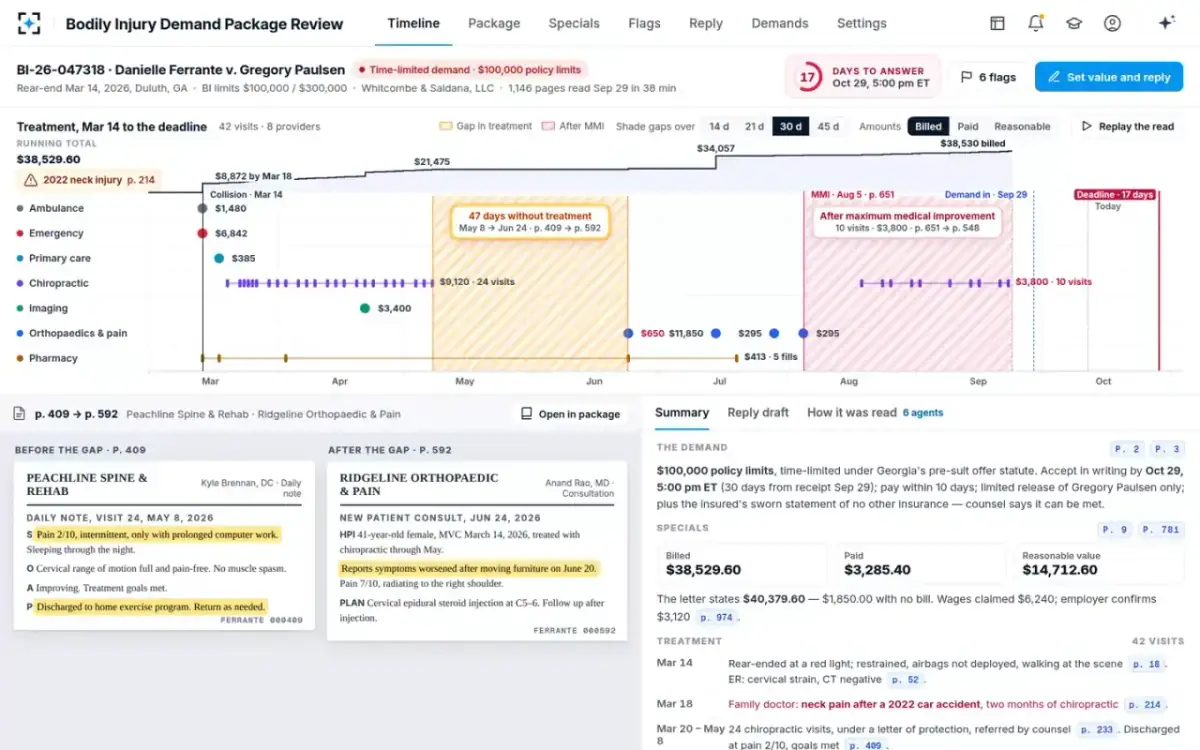
In the sample, Danielle Ferrante was rear-ended at a red light in Duluth, Georgia, on 14 March 2026 and treated with a chiropractor from 20 March. On 8 May the chiropractor's daily note records pain at 2/10, intermittent, only with prolonged computer work, and ends: "Discharged to home exercise program. Return as needed." Her next visit for her neck was on 24 June, with a new orthopaedic and pain clinic, at 7/10. The consult note records that her symptoms "worsened after moving furniture on June 20."
Six months of treatment, with the gap and the care after MMI marked
- ER, family doctor, 24 chiropractic visits, MRI55 d
- No treatment: 8 May to 24 June47 d
- Orthopaedic consult, injection, to MMI on 5 Aug42 d
- After MMI: 10 chiropractic visits from 19 Aug49 d
What a gap proves, and what it does not
A gap proves only that no care was recorded; what it means depends on the evidence around it. On its own it is weak evidence of recovery. Neck injuries in particular often persist without continuous treatment: a best-evidence review by the Bone and Joint Decade Task Force on Neck Pain concluded that "approximately 50% of those with WAD will report neck pain symptoms 1 year after their injuries", WAD being whiplash-associated disorders. And people go without care for reasons that have nothing to do with how they feel: in 2025, 6.0% of US adults failed to obtain needed medical care due to cost, according to the National Center for Health Statistics.
A gap becomes strong evidence when the pages around it say something. A discharge with goals met and pain at 2/10 is the treating provider's own record of improvement. A new event, such as moving furniture four days before the next visit, is a possible new cause recorded in the claimant's own history. Neither settles causation. Both are things the claim file should show the adjuster read before she valued the care that followed.
When a gap means something, and when it may not
The gap may mean little: Plan: return in two weeks; or no plan recorded.
The gap needs an answer: Discharged, goals met, low pain, return as needed.
The gap may mean little: Same complaint, same level, no new event.
The gap needs an answer: A new event in the history, or a sharp change in level or site.
The gap may mean little: Cost, work, travel, insurance, a provider closure, recorded somewhere.
The gap needs an answer: No reason recorded anywhere in the package.
The gap may mean little: One that commonly persists without continuous care.
The gap needs an answer: One the records already show as resolving.
The gap may mean little: Note it; value the care on the record.
The gap needs an answer: Ask for the records of the gap and the treating doctor’s opinion; consider nurse review.
How long of a gap in treatment is too long?
There is no legal rule for liability claims; the threshold is a carrier's claim-handling choice, and it should be a stated, consistent one. The sample carrier shades gaps of 30 days or more and lets the adjuster drop the threshold to 14, 21 or 45. At 30 days, the sample shows one gap, the 47 days. At 14, two shorter intervals shade in as well, of 21 and 14 days, in June and July, between the orthopaedic consult, the injection and a follow-up.
What shades in on the sample timeline at each threshold
Statute does set gap-like clocks in other kinds of coverage, which is a reminder of how specific they are. Florida's personal injury protection law pays medical benefits only if the injured person gets initial services and care no more than two weeks after the crash. That is a condition of a first-party no-fault benefit, not a rule for valuing a liability claim, and it measures the time to first care, not gaps within it. For a liability demand, the useful threshold is the one that surfaces the gaps worth reading, and every one it surfaces still needs its two pages read.
The 47 days, page by page
In the sample, the gap and causation checker found no visit between 8 May and 24 June and shaded the interval, citing the last page before it, 409, and the first page after it, 592. The adjuster opened both side by side. Everything billed from 24 June on, $16,890 of the $38,529.60 in the bills, followed the furniture event: the orthopaedic consult, the injection at the surgery centre and the later visits.
The 47-day gap shaded in Bodily Injury Demand Package Review, with the two pages that bound it
What the adjuster did with it is the point of this page. She did not exclude the post-gap care. She asked, in her reply to the claimant's lawyer, for "any records of treatment or symptoms between May 8 and June 24, 2026, and Dr. Rao's opinion on whether the care from June 24 relates to the collision rather than the June 20 event". If such records exist, the gap may close; if the treating doctor relates the June care to the collision, that opinion is evidence too. A gap is a question to put, with its pages, not a deduction to take.
Any records of treatment or symptoms between May 8 and June 24, 2026, and Dr. Rao's opinion on whether the care from June 24 relates to the collision rather than the June 20 event.
From the sample reply, as drafted from the adjuster's decisions
What happens after maximum medical improvement?
After maximum medical improvement, further treatment is expected to maintain rather than improve, and care billed after it needs its own support. The term comes from workers' compensation, where Texas, for example, defines it as "the earliest date after which, based on reasonable medical probability, further material recovery from or lasting improvement to an injury can no longer reasonably be anticipated"; in liability claims the phrase is used the same way in treating doctors' notes. Payers draw a similar line for chiropractic care. Under Medicare, "Chiropractic maintenance therapy is not considered to be medically reasonable or necessary, and is therefore not payable"; that is a Medicare coverage rule, not liability law, but it shows how widely the distinction between corrective and supportive care is drawn.
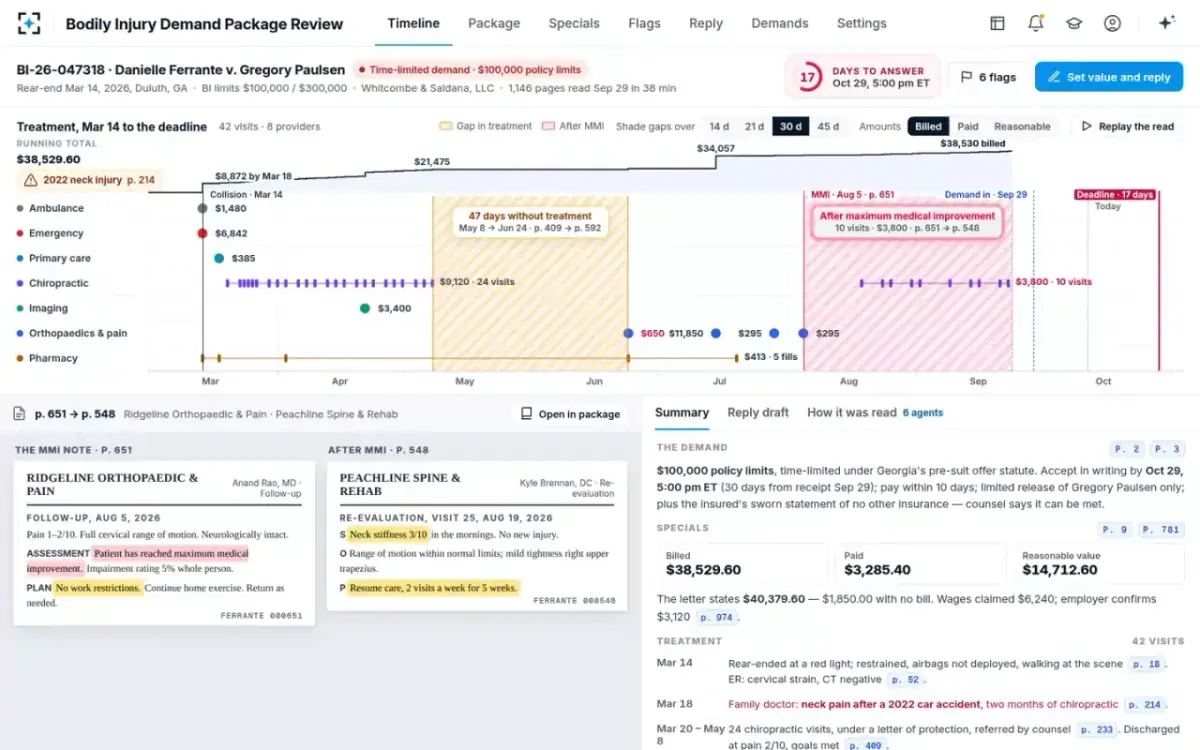
In the sample, Dr. Rao recorded on 5 August that the patient had reached maximum medical improvement, with a 5% impairment rating, no work restrictions and a home exercise program. Two weeks later the chiropractor resumed care, two visits a week for five weeks: ten visits, $3,800 billed, $1,600 at reasonable value. The solution shaded them, the adjuster sent the question to nurse review, as the carrier's rule provides for post-MMI care over $1,000, and the nurse answered on 9 October: not medically necessary on this record, citing the MMI note and the re-evaluation, which recorded stiffness at 3/10 and no new findings.
Ten visits after MMI in Bodily Injury Demand Package Review, beside the note that recorded it
Earlier injuries: pre-existing conditions and the same body part
An earlier injury to the same body part does not defeat a claim; it changes the question to how much of the present condition the collision caused or made worse. That makes the earlier records the most useful pages a reviewer can ask for. In the sample, the family doctor's note on 18 March, four days after the collision, records neck pain after a 2022 car accident, treated with about two months of chiropractic. The carrier's prior claims index showed a 2022 cervical-strain claim settled with another carrier, and the MRI described mild degenerative changes from C4 to C7.
None of that appeared in the lawyer's letter, and none of it decides anything on its own. Degenerative changes on an MRI are a finding whose significance is a medical question; a resolved strain four years earlier may be irrelevant. The checker's job is to put the three pages in front of the adjuster; the adjuster's was to ask for the 2022 chiropractic records "to compare her neck before and after March 14", which is what she did. How the same pages feed the chronology is described in what to look for in medical chronology software.
Does a gap in treatment hurt an injury claim?
An unexplained gap usually weighs on value; an explained one may not. From the insurer's side, the risk runs both ways. Discounting a claim for a gap without reading what bounds it is the kind of shortcut unfair claims rules target: the NAIC model act counts refusing payment before a reasonable investigation among unfair claims practices, when it is flagrant or a general business practice. Ignoring a gap that the records explain against the claim overpays it. The fair answer is in the pages, and the reply is where the insurer shows it read them.
From the claimant's side, the practical lesson is the same: the reason for a gap is evidence, and it belongs in the records or the letter. A note that she could not afford care, could not get time off or was told to return as needed is the answer to the question an adjuster will ask. This page does not advise either side on a particular claim; it describes how gaps are read. Where the bills behind the post-gap care are traced, see what medical specials mean.
Reading gaps fairly: a checklist
Seven checks before a gap in treatment changes a valuation
- Read the last page before and the first page after
Discharge or follow-up plan; same complaint or a new event; the pain level at each.
- Look for the reason
Cost, work, travel, insurance, a provider closing: anywhere in the records, the letter or the claim notes.
- Check for care elsewhere
Pharmacy fills, urgent care, a different provider; a gap in one lane may not be a gap in care.
- Compare with the injury’s usual course
Some injuries commonly persist without continuous treatment; that is a medical question for the nurse.
- Separate gaps from care after MMI
A gap is an absence of care; post-MMI care is care that needs its own basis. Different questions.
- Ask before you deduct
Request the records of the gap and the treating doctor’s opinion in the reply, with a date.
- Write down why
Whatever you decide, the file should show the pages you read and the reason, so the decision can be reconstructed.
Questions people ask
What does gap in treatment mean?
It means a period with no medical care for the injury being claimed. In injury claims it usually refers to weeks or months between visits; whether it matters depends on the records on either side. In the sample, the gap ran 47 days, from a chiropractic discharge on 8 May to an orthopaedic consult on 24 June.
How long of a gap in treatment is too long?
No statute sets a number for liability claims. Carriers choose their own threshold for review; the sample carrier uses 30 days and lets the adjuster choose 14, 21 or 45. The length matters less than what the last note before and the first note after the gap say.
What is a gap in care?
In health care quality programs, a "gap in care" usually means a recommended service a patient has not received, such as a missed screening. In an injury claim, the similar phrase "gap in treatment" means a period without care for the claimed injury. The two are related ideas used for different purposes.
What is maximum medical improvement?
It is the point after which further recovery is not reasonably expected, as recorded by a treating or examining doctor. Texas's workers' compensation law defines it as the earliest date after which "further material recovery from or lasting improvement to an injury can no longer reasonably be anticipated." Care after it may still be reasonable, but it needs its own medical basis.
Does a pre-existing condition stop a personal injury claim?
Not by itself. The question becomes how much of the present condition the accident caused or worsened, which is why earlier records of the same body part are worth asking for. In the sample, the adjuster asked for the 2022 chiropractic records rather than deducting anything for the earlier injury.