A letter of protection is an arrangement under which a health care provider treats an injured person now and agrees to be paid later, from any judgment or settlement of her injury claim. Florida's statute on the subject, section 768.0427 of the Florida Statutes, created by HB 837 in March 2023, defines the arrangement broadly and makes disclosure a condition: in a personal injury or wrongful death action, a claimant who treated under a letter of protection must produce the letter, the coded itemised bills, details of any sale of the bills to a factoring company, her health coverage and the identity of whoever referred her, before she may claim those medical expenses. For an insurer answering an injury demand, those are also the items to look for in the package. Bodily Injury Demand Package Review, Botminds' solution for the insurer's side of injury demands, marks every bill line treated under a letter of protection and applies Florida's medical damages rule to Florida claims.
“Letter of protection” means any arrangement by which a health care provider renders treatment in exchange for a promise of payment for the claimant’s medical expenses from any judgment or settlement of a personal injury or wrongful death action.
Fla. Stat. § 768.0427(1)(d)
What is a letter of protection?
It is a promise of payment from the outcome of the claim, in place of payment now. The Florida House's staff analysis of HB 837 describes it as an agreement under which the provider "agrees to defer collection on the medical bill until the plaintiff recovers in a lawsuit", and is then paid from the proceeds. Two consequences follow, and the analysis names both: the provider gains a financial interest in the outcome of the litigation, and if there is no favourable recovery, the client may remain liable to pay the medical bills.
The statute's definition adds a third point that matters in practice. It covers "any such arrangement, regardless of whether referred to as a letter of protection." A provider's lien agreement or an attorney's undertaking to pay a provider from the settlement can be letters of protection under Florida law if they fit the definition. The label on the document does not decide it; the arrangement does.
What Florida statute 768.0427 requires a claimant to disclose
Subsection (3) lists five disclosures that are a condition precedent to asserting any claim for medical expenses for treatment rendered under a letter of protection. The coding requirement is detailed: the statute specifies which code sets apply to professional, outpatient facility and inpatient facility bills.
The five disclosures in section 768.0427(3), and what to look for in a demand package
| Disclosure | What the statute requires | What to check in the package |
|---|---|---|
| (a) The letter | A copy of the letter of protection. | Every provider whose bills show no payer and no payment; a letter for each. |
| (b) Coded, itemised bills | All billings, itemised and coded: CPT or HCPCS for provider-level bills; ICD and, if applicable, CPT for outpatient facility bills; ICD diagnosis and procedure codes for inpatient bills. | Bills that give a total without lines or codes; the codes in force on the date of service. |
| (c) Sale of the bills | If the provider sold the receivables to a factoring company or other third party, its name and the price paid, including any discount. | Assignment notices, a change of payee, a different name on the statement. |
| (d) Health coverage | Whether the claimant had health care coverage when treated and, if so, its identity. | An insurance card, earlier bills paid by a health plan, an explanation of benefits. |
| (e) Referral | Whether she was referred for treatment under a letter of protection and, if so, by whom. | A new-patient intake that names the referring attorney or firm. |
Two of the five, the health coverage and the sale of the bills, exist because they change what the bills are worth in evidence, which is the subject of the next section but one. The referral disclosure exists because of a 2017 decision of the Florida Supreme Court.
Why HB 837 changed letters of protection
The Legislature's own analysis states the concern directly. Letters of protection, it says, "have sometimes been criticized as reflecting inflated, inaccurate amounts for medical damages", and because the provider has agreed not to collect until the litigation ends, there may be no paid amount to show a jury. In the analysis's words, a letter of protection "may essentially conceal the amount the provider would generally accept as satisfaction for services rendered, potentially inflating the total damages awarded."
The referral rule answers Worley v. Central Florida YMCA (2017). There the Florida Supreme Court, by four votes to three, held that "the question of whether a plaintiff's attorney referred him or her to a doctor for treatment is protected by the attorney-client privilege," as the House analysis quotes it. Section 768.0427(3)(e) reverses that for letters of protection: an attorney's referral may be disclosed and admitted notwithstanding the privilege, and "the financial relationship between a law firm and a medical provider, including the number of referrals, frequency, and financial benefit obtained, is relevant to the issue of the bias of a testifying medical provider."
From Worley to section 768.0427: six years, one statute
- Worley: referral protected by privilege2017–2023
- HB 837 becomes law; § 768.0427 in force 24 Mar 2023
- Applies to causes of action filed after 24 Mar 20232023 →
Is a letter of protection legally binding?
It binds the people who signed it, on its terms; it does not bind the defendant or the insurer to pay the amount on the bill. Between patient, provider and, often, the patient's lawyer, a letter of protection is an agreement about when and from what the provider is paid, and the House analysis notes that if there is no recovery the patient may still owe the bill. As against the defendant, Florida's statute decides what the bills are worth as evidence and caps what can be recovered, whatever the letter says.
That is why the disclosure list matters to an adjuster even before suit. A demand package from a Florida claimant whose care ran under letters of protection is a preview of what will be admissible if the claim is litigated. If the letters, the coded bills or the coverage details are missing, the reply can ask for them, and the evaluation can say which of the claimed expenses would rest on evidence the statute treats as incomplete.
What can a jury hear about medical bills under a letter of protection?
More than the bill. For unpaid charges, section 768.0427(2)(b) says the evidence "shall include, but is not limited to" a set of measures that depend on the claimant's situation, alongside evidence of reasonable amounts billed for medically necessary care. The measure most specific to letters of protection is the second: if the claimant had health coverage but treated under a letter of protection instead, the evidence includes "the amount the claimant’s health care coverage would pay the health care provider to satisfy the past unpaid medical charges" under her coverage, plus her own share, had she used it.
Evidence of unpaid medical charges under section 768.0427(2)(b), by the claimant's situation
| Claimant’s situation | Evidence the statute says shall be included |
|---|---|
| Has health coverage (not Medicare or Medicaid) and used it | What the coverage is obligated to pay the provider, plus the claimant’s share. |
| Has health coverage but treated under a letter of protection | What the coverage would have paid, plus her share, had she used it. |
| No coverage, or Medicare or Medicaid | 120% of the Medicare rate on the date of service or, with no Medicare rate, 170% of the state Medicaid rate. |
| Treated under a letter of protection and the provider sold the bill | What the third party paid or agreed to pay the provider for the right to collect. |
| In every case | Any evidence of reasonable amounts billed for medically necessary treatment or services. |
The factoring rule is easy to miss, because nothing on a bill says the account was sold. When a provider sells its letter-of-protection receivables at a discount, the price the buyer paid becomes admissible evidence of what the bills are worth. A package that shows a change of payee, a collection company's statement or a different name on the bills is worth a second look. How Florida's rule compares with Texas, California, Georgia and Missouri is set out in paid vs billed states.
Letter of protection vs medical lien
The practical difference is where the claim on the recovery comes from. A letter of protection is an agreement: the provider agrees to wait and the patient, or her lawyer, agrees to pay from the recovery. A medical lien is a legal claim on the recovery itself, created by statute, ordinance or contract depending on the provider and the place. In Florida, the distinction matters less than it sounds for section 768.0427, because the statute's definition reaches any arrangement for treatment in exchange for a promise of payment from a judgment or settlement, whatever it is called.
Letter of protection and medical lien, as an adjuster meets them
Letter of protection: An agreement to treat now and be paid from any judgment or settlement.
Medical lien: A legal claim against the recovery, by statute, ordinance or contract.
Letter of protection: The patient and the provider, often with the patient’s lawyer.
Medical lien: Depends on its source; some arise without the patient’s signature.
Letter of protection: Usually nothing was paid; the charge may be the provider’s list price.
Medical lien: The lien amount, which may differ from what the provider would accept.
Letter of protection: Defined term; five disclosures before claiming the expenses.
Medical lien: Within the definition if it is treatment for a promise of payment from the recovery.
Letter of protection: Mark every bill line it covers; look for coverage and referral.
Medical lien: Record the lienholder and amount; settle it with counsel at payment.
Which claims the statute applies to
Section 768.0427 governs evidence and damages in a personal injury or wrongful death action, and HB 837 applies to actions filed after it took effect. Section 30 of the act provides that, except as otherwise expressly provided, "this act shall apply to causes of action filed after the effective date of this act", and the act took effect on becoming law on 24 March 2023. On the act's own terms, what counts is when the suit is filed, not when the accident happened, unless another section of the act provides otherwise.
A pre-suit demand is not an action, so the disclosure duty does not attach to the demand itself. But an adjuster values a demand by asking what the claim is worth if it is not settled, and in Florida that question is now answered under section 768.0427. That is why the solution's Florida setting applies the statute's medical damages measures to Florida claims from the first read, rather than waiting for suit.
The Florida rule as a setting in Bodily Injury Demand Package Review
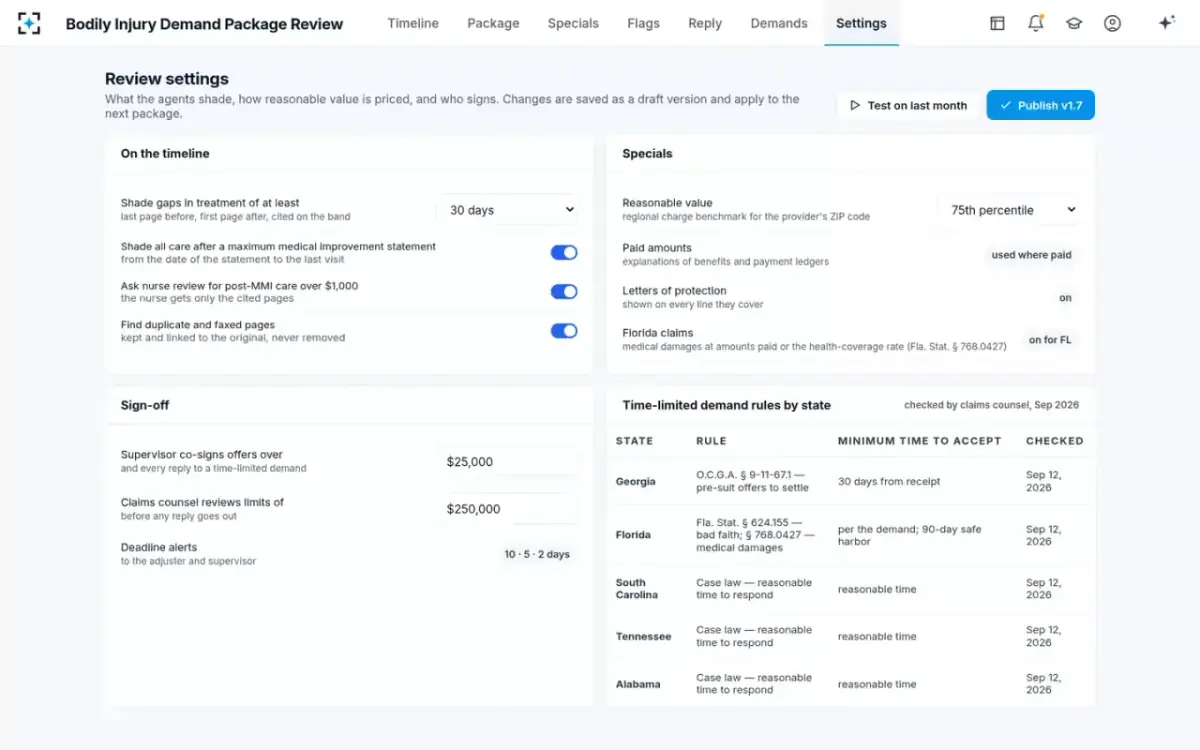
Reading a demand package for letters of protection, with Bodily Injury Demand Package Review
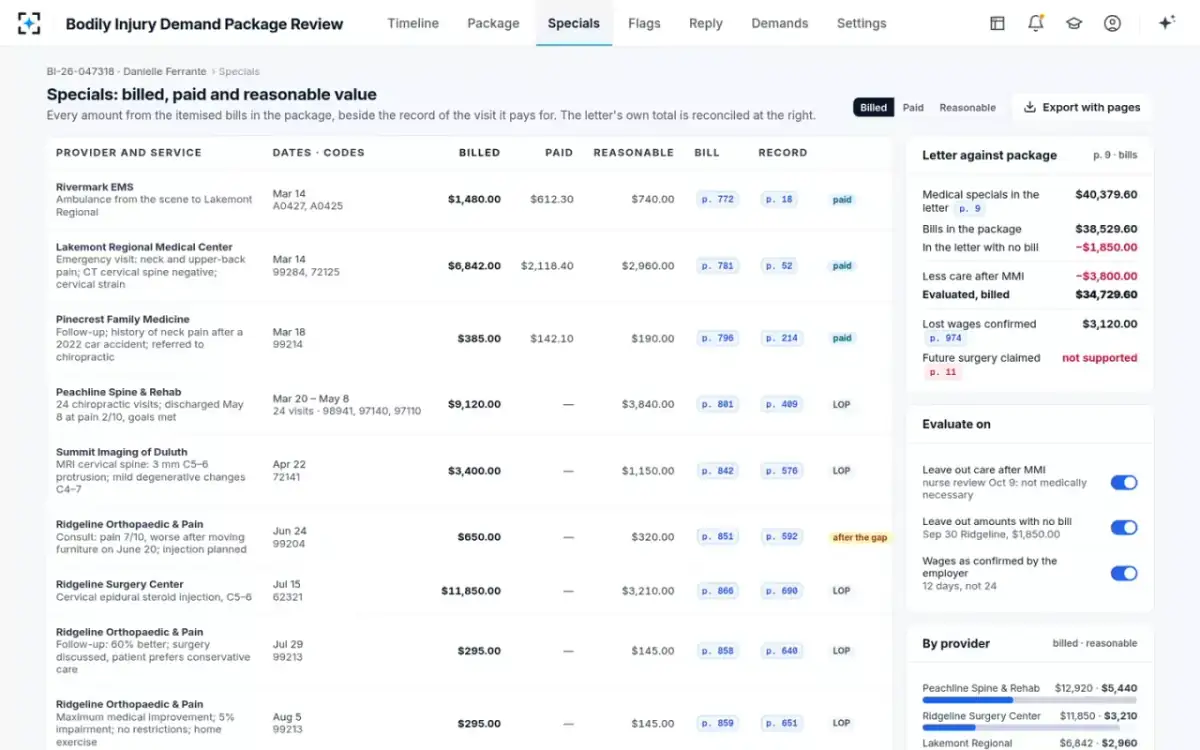
Letters of protection rarely announce themselves on the bill. They show up as bills with no payer and no payment, a document filed with the liens, or a sentence in a new-patient intake. In the fictional sample package used across these guides, a Georgia claim, the chiropractor's intake on page 233 records that the claimant was treating under a letter of protection, referred by counsel, and the chiropractic, imaging and injection bills all carry an LOP mark. Georgia's rules apply to that claim, not Florida's; it is shown here for what a reviewer would look for.
Bill lines marked LOP: no payment, and the reasonable value beside the charge
Six checks for letters of protection in a Florida demand
- Find every provider with charges and no payments
Each is a candidate letter of protection; ask for the letter if it is not in the package.
- Check the bills are itemised and coded
CPT or HCPCS for professional bills; ICD (and CPT where applicable) for outpatient facilities; ICD diagnosis and procedure codes for inpatient stays.
- Look for a sale of the bills
A factoring company or other buyer, and the price it paid, is admissible evidence of value.
- Establish health coverage at the time of treatment
If she had coverage and did not use it, what it would have paid is admissible.
- Read the intake for the referral
Who sent her to the provider; an attorney referral is disclosable and relevant to a treating provider’s bias.
- Note the filing date if suit follows
The statute governs causes of action filed after 24 March 2023.
In the solution, the bill reader marks each line covered by a letter of protection, the summarizer records the referral and coverage statements it finds in the records, and the Florida setting applies the statute's measures to Florida claims. None of it decides whether a disclosure is complete or whether a bill is reasonable; those are for the adjuster and claims counsel. How the bills themselves are traced from letter to line is covered in what medical specials mean, and the anatomy of the whole package in what is a demand package.
Questions people ask
What does Florida statute 768.0427 do?
It sets the evidence a jury may hear about past and future medical expenses in personal injury and wrongful death actions, caps the medical damages that can be recovered, and requires five disclosures when treatment was under a letter of protection. It was created by HB 837, chapter 2023-15, effective 24 March 2023.
How did HB 837 change letters of protection?
Before it, the Florida Supreme Court had held in Worley (2017) that an attorney's referral to a doctor was privileged. HB 837 requires the letter, coded bills, any sale of the bills, health coverage and the referral to be disclosed, and makes an attorney's referral admissible and relevant to the treating provider's bias.
Do letters of protection have to be disclosed in Florida?
Yes, in a personal injury or wrongful death action, as a condition precedent to claiming the medical expenses for treatment under the letter. The duty attaches to the lawsuit; a pre-suit demand is not an action, but an insurer can reasonably ask for the same documents in its reply.
Can a jury see what health insurance would have paid?
In Florida, yes, for unpaid charges where the claimant had health coverage but treated under a letter of protection or did not submit the charges: the evidence includes what her coverage would have paid, plus her share. For charges that have been paid, the evidence is limited to the amount actually paid.
What happens to a letter of protection if the case does not settle?
The provider's right to payment depends on the agreement. The Florida House analysis of HB 837 notes that if there is no favourable recovery, the client may remain liable to pay the medical bills. The letter defers payment; it does not cancel it.