An AI medical record summary is a summary or chronology of a person's medical records written by software rather than by a person, usually with a model that reads scanned pages, pulls out each visit and writes a line for it. For an insurer evaluating a bodily-injury demand, the summary is only as good as what the carrier brings to it: the demand packages exactly as received, the bill formats, the state rules for time-limited demands, the basis for reasonable value, the authority matrix for who signs what, a nurse to route medical questions to, and access controls for the health information. Bodily Injury Demand Package Review is Botminds' solution for this work, built around six agents that sort, summarise, total and check every page while the adjuster sets the value and signs; this guide lists what it needs from a carrier, and why each item matters for any AI tool.
Can AI summarize medical records for an injury claim?
Yes, and well enough that the question has moved from whether to how it is checked. The strongest published comparison we found is a 2024 study in Nature Medicine that adapted eight large language models to four clinical summarisation tasks and asked ten physicians to compare the results with summaries written by medical experts. In most cases the best-adapted models' summaries were judged "either equivalent (45%) or superior (36%)" to the experts'. The same study catalogued the fabricated information both the models and the experts produced, which is the part an insurer should dwell on.
AI summaries against medical experts' summaries, as ten physicians judged them
Best-adapted models vs experts
- Superior · 36%
- Equivalent · 45%
- Not as good · 19%
Clinical summarisation is not claims review, and an injury package is longer and messier than any of the study's tasks. What transfers is the shape of the answer: good enough to do the reading, not good enough to go unchecked. For a claim file, that means every line must cite its page, the summary must stay out of diagnosis and causation, and the carrier must be able to test it on its own files before relying on it. The rest of this page is what that takes.
What you need to start: eight things to bring
Most of the work of starting is gathering things a casualty unit already has but rarely keeps in one place. The list below is what Bodily Injury Demand Package Review asks a carrier for, and it is a fair checklist for any AI medical record summary used on claims.
Eight things Bodily Injury Demand Package Review asks a carrier to bring before going live
- A set of past demand packages, as received
Twenty or so closed files with the adjuster’s own chronology, specials and reply, so the output can be compared with work you already trust.
- Your intake channels
Where packages arrive (mail, email, portal) and how the date of receipt is captured, because statutory clocks run from it.
- Bill formats and lien documents
UB-04 and CMS-1500 bills, providers’ own statements, letters of protection and lien notices as your packages actually contain them.
- Your state rules for time-limited demands
The statutes and case law your counsel applies in each state you write, with who checked them and when.
- A basis for reasonable value
Which benchmark and percentile, when paid amounts override it, and any state rule (Florida’s, for example) that changes the evidence.
- Your authority matrix
Who may offer what, who co-signs, and which files go to claims counsel before any reply.
- A medical review route
Which nurse or physician answers relatedness, necessity and MMI questions, and the threshold for sending them.
- Access and privacy rules for health information
Who on the claim team may see which documents, how the nurse sees only the cited pages, and where it is all logged.
The packages, as received
The first rule is that the pages are kept exactly as they arrived, under their original numbers, with duplicates linked rather than removed. The NAIC's model claims regulation expects each relevant document in a claim file to be dated on receipt, processing or mailing. A package that has been cleaned up before the AI reads it has lost the page numbers the claimant's lawyer, a court and an examiner will use, and possibly the date that started a statutory clock.
In the fictional sample used across these guides, a time-limited demand for a $100,000 limit arrived by certified mail on 29 September 2026: 1,146 pages, of which 142 were faxed duplicates. The package sorter split it into 15 documents by provider, date and type and linked each duplicate to its original; two hard-to-read pages were re-read. Nothing was discarded, and every page kept its number. The anatomy of such a package, document by document, is in what is a demand package.
The rules Bodily Injury Demand Package Review applies, and who owns each one
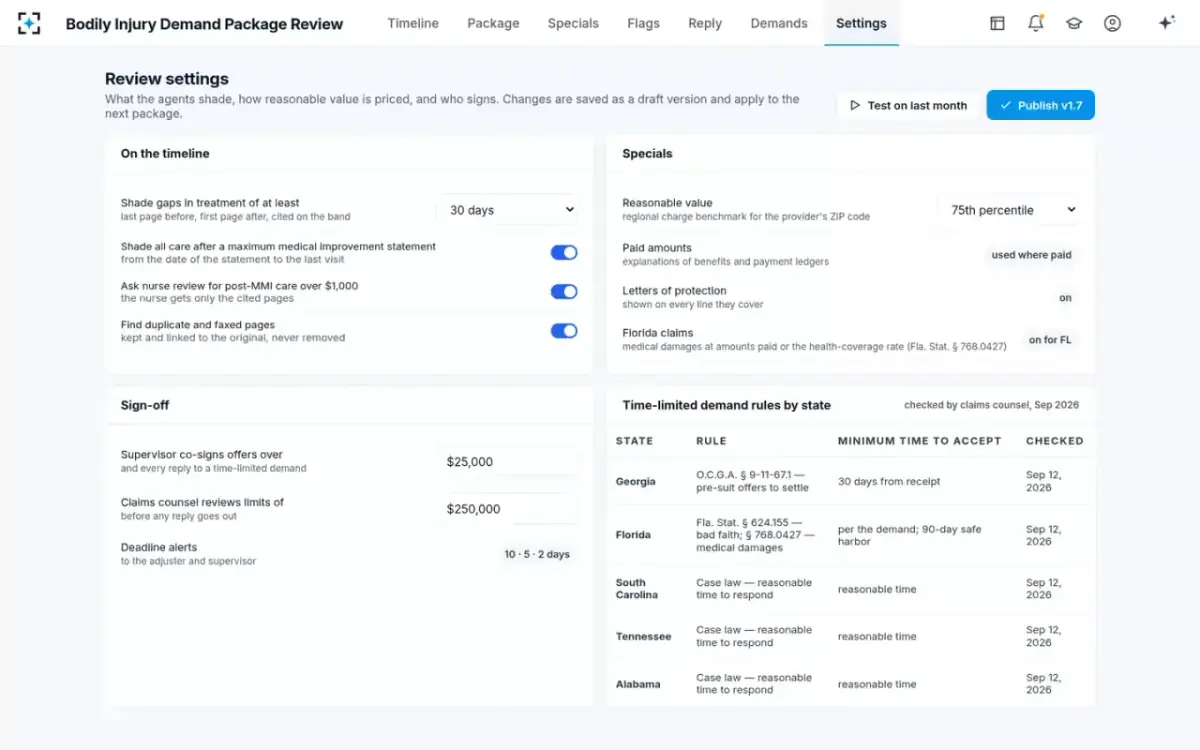
An AI summary that applies nobody's rules applies the vendor's. In the solution, every rule that changes what the adjuster sees is a carrier setting, saved as a draft version, testable on last month's packages and applied to the next package once published. Each has an owner on the carrier's side.
The settings a carrier owns, with the sample carrier's values
| Setting | Sample value | Options | Owned by |
|---|---|---|---|
| Shade gaps in treatment of at least | 30 days | 14, 21, 30 or 45 days | Claims standards |
| Shade care after a statement of maximum medical improvement | On | On or off | Claims standards |
| Nurse review for care after MMI | Over $1,000 | On or off, by amount | Medical review lead |
| Reasonable value | 75th percentile, regional charge benchmark by ZIP | 60th, 75th or 80th; paid amounts used where paid | Claims standards, with finance |
| Florida medical damages rule | On for Florida claims | Amounts paid or the health-coverage rate (§ 768.0427) | Claims counsel |
| Supervisor co-signs | Offers over $25,000 and every reply to a time-limited demand | By amount | Claims management |
| Claims counsel reviews | Limits of $250,000 or more | By amount | Claims counsel |
| Time-limited demand rules by state | Georgia, Florida, South Carolina, Tennessee, Alabama | Statute or case law per state, with the date checked | Claims counsel |
Review settings, saved as a version and tested on last month's packages
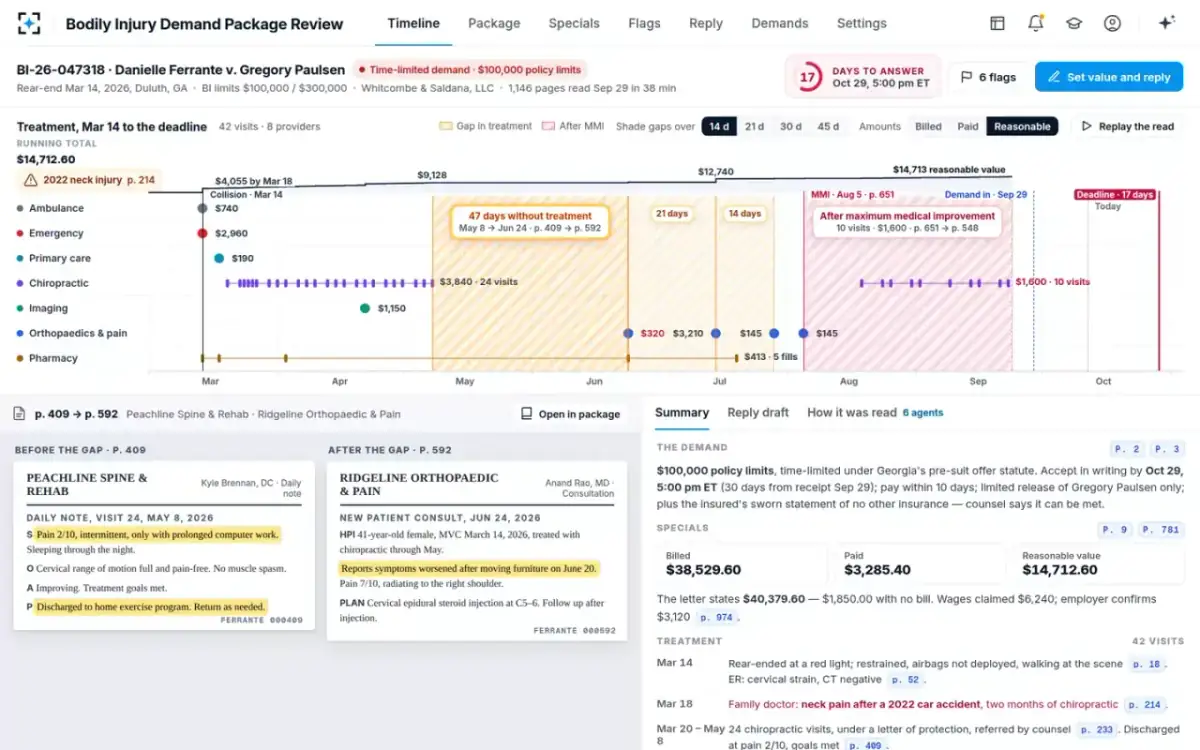
One click on the same timeline: gaps of 14 days and reasonable value
Is AI medical record review HIPAA compliant?
For a liability insurer, HIPAA is usually the wrong frame, and the state insurance privacy rules are the right one. HIPAA's privacy rule binds covered entities, which include health plans, and the federal definition of a health plan excludes any policy to the extent it pays "excepted benefits". Among those excepted benefits the Public Health Service Act lists "Liability insurance, including general liability insurance and automobile liability insurance." The records still reach the insurer through HIPAA: the claimant authorises her providers to release them, which is why demand packages carry signed authorisations.
Once the records are in the claim file, state law built on the NAIC's privacy model regulation governs them. The model applies to "All nonpublic personal health information" a licensee holds, requires the consumer's authorisation before disclosure in general, and lists the insurance functions for which no authorisation is needed, beginning with "claims administration; claims adjustment and management". Each state's version differs, so the practical answer is a set of controls rather than a label: only the claim's team sees the health information, the review nurse sees only the cited pages behind a flag, and every read, decision and signature is logged on the claim.
The rules on AI in claims, from the claim desk
None of the rules we found forbids an insurer to use AI to read medical records for a liability claim, but several now set expectations for how it is governed. The NAIC adopted its model bulletin on insurers' use of artificial intelligence in December 2023, and its adoption map lists 29 jurisdictions as having adopted it as of 8 October 2026. Among the factors it asks an insurer to weigh in setting controls is how much a person is involved in the final decision, a point taken further for valuation in what agents may not do in case evaluation. Colorado's 2021 statute bars unfair discrimination through external data, algorithms or predictive models "in any insurance practice".
Four rules a claim desk should know, and what each asks of an AI summary
| Rule | Where it applies | What it asks | How the solution meets it |
|---|---|---|---|
| NAIC model bulletin on AI (2023) | 29 jurisdictions listed as adopting it, as of 8 Oct 2026 | Governance, documentation and controls in proportion to risk, including human involvement in final decisions | Agents read, total and draft; the adjuster sets every value and signs; every step is logged |
| Colorado SB21-169 (2021) | Colorado insurers; “any insurance practice” | No unfair discrimination through external data, algorithms or predictive models | The agents do not score claimants; they cite pages and leave evaluation to people |
| California H&S Code § 1367.01(k) (2024) | California health care service plans, utilization review | AI may not deny, delay or modify care based on medical necessity | A health-plan rule, not a liability one; the solution draws the same line and sends necessity to the nurse |
| Florida SB 202 (2026) | Would have covered claim denials in Florida | Human decision-makers for denials | Died in committee on 13 March 2026; not law |
The California rule is worth reading even though it governs health plans, not liability insurers, because it states the principle precisely: an AI tool "shall not deny, delay, or modify health care services based, in whole or in part, on medical necessity", and the determination must be made by a licensed professional. A liability claim is not a request for care, but the line is the one an injury desk should draw anyway: the agents find the post-MMI visits and the pages behind them; the nurse says whether they were necessary. Florida's attempt to legislate human decisions on claim denials, SB 202, died in the Senate Rules Committee in March 2026. For governance of AI across a carrier, Botminds' AI Governance and Model Inventory covers the bulletin's requirements in depth.
Medicare and liens: one more item for the list
If the claimant is a Medicare beneficiary, Medicare's conditional payments have to be dealt with before or at settlement, on a clock of their own. Under CMS's recovery process for liability insurers, a conditional payment notice gives 30 days to act before a demand letter issues automatically, the demand asks for repayment within 60 days, and interest runs from the date of the demand. An AI summary will show the providers and payers in the bills; it will not by itself tell the adjuster whether Medicare paid any of them.
So the eighth item on the list has a ninth hiding inside it: the carrier's existing process for checking Medicare status, recording liens and letters of protection, and carrying them into the settlement. In the solution, letters of protection are shown on every bill line they cover and lien documents are read with the bills, so the adjuster sees which charges were paid, by whom, and which wait on the settlement. Whether a lien must be satisfied, and how, stays with the adjuster and counsel.
The people: who signs, who answers the medical questions
Every AI summary on a claim needs a named person at each decision, and the authority matrix is how a tool knows who that is. In the sample carrier, the adjuster sets the range and offer and signs every reply; a casualty supervisor co-signs every reply to a time-limited demand and every offer over $25,000; claims counsel reviews any reply on limits of $250,000 or more, and decides whether a demand is valid; and the medical review nurse answers medical questions with only the cited pages in front of her.
A sensible order for starting, from closed files to new demands
A person decides
Claims standards leadChooses twenty closed packages with known outcomes and sets the first version of the rules with counsel.
Agent
The six agentsRead the closed packages as if new: index, chronology, specials, flags and a draft reply from the value the adjuster had set.
Never: changes the outcome of a closed file
A person decides
Senior adjuster and review nurseCompare the output with the original work: wrong pages, missed visits, flags the adjuster had or had not found.
A person decides
Claims management and counselPublish the settings, the co-sign thresholds and the state rules as a version, with an owner for each.
Agent
The six agents, liveRead each new package the day it arrives; nothing goes out until the adjuster signs and, where required, the supervisor co-signs.
Never: sends; never sets a value
That order also answers the most common worry about AI on claims, which is that it will be trusted before it has earned it. Comparing its output with closed files the carrier's own people already worked is the honest test; what to measure in that comparison is set out in what to look for in medical chronology software, and the economics in medical records summary companies against in-house review.
Questions people ask
What file formats can an AI medical record summary read?
Demand packages arrive as scanned PDFs, faxes, portal downloads and paper. The pages are read as images and text, including bills on UB-04 and CMS-1500 forms and providers' own statements. In the sample, two hard-to-read pages out of 1,146 were flagged and re-read; legibility is a reason to keep the originals, not to retype them.
Who can see medical records in an injury claim?
The claim's own team: the adjuster, the supervisor who co-signs, claims counsel where needed and the review nurse, who sees only the cited pages behind a flag. State insurance privacy rules modelled on the NAIC's regulation permit use for claims adjustment, but access should still be limited by role and every view logged.
Does an AI medical record summary replace the nurse reviewer?
No. It changes what reaches her. Instead of a box of records, the nurse gets one question and the two pages that bear on it; in the sample she answered a question about ten post-MMI visits on 9 October. Medical necessity, relatedness and MMI remain her calls.
How long does it take to set up AI record review?
It depends on how quickly a carrier can gather closed packages, settle its rules with counsel and name its owners. The reading itself is fast: the sample package of 1,146 pages was sorted, summarised, totalled and checked in 38 minutes. Running the tool on closed files before live demands is the step not to skip.
Do I need consent from the claimant for AI to read her records?
The claimant's authorisation is what releases the records from her providers. Once the insurer holds them for the claim, state privacy rules based on the NAIC model generally allow the insurer to disclose them for claims administration and adjustment, to a vendor working on the claim for instance, without a new authorisation; check your state's version with counsel.