A demand package is the bundle a personal injury claimant, usually through a lawyer, sends to the at-fault party's liability insurer to ask for a settlement. At its front is the demand letter: the amount asked, often the policy limits, any deadline and conditions, and the argument for the value. Behind it is the evidence: medical records from every provider, itemised bills, letters of protection and liens, proof of lost wages, photographs and signed authorisations. Packages run from under a hundred pages to several thousand, and some of their contents are set by statute. The insurer's adjuster has to read it all to evaluate the claim and answer. Bodily Injury Demand Package Review, Botminds' solution for the insurer's side of injury demands, sorts each package into its documents the day it arrives, and this guide uses one it indexed: a fictional 1,146-page package for a rear-end collision in Duluth, Georgia, with invented people, providers and firm.
Where the 1,146 pages of one demand package go
Pages by section
- Medical records · 66%
- Itemised bills · 13%
- Faxed duplicates · 12%
- Letter, wages, photos, LOPs, authorisations · 9%
What is a demand package in a personal injury case?
It is the claimant's case for settlement, made before or instead of a lawsuit, and the insurer's main source of evidence about the injury. In the sample, the package arrived by certified mail on 29 September 2026 from the claimant's law firm. It made a time-limited offer to settle for the $100,000 bodily-injury limit, to be accepted by 29 October, and enclosed the records and bills of eight providers. Most of it, 755 pages, was medical records; the letter itself was 14 pages.
Demand packages are mostly a lawyer's product, and increasingly so. The Insurance Research Council, a non-profit research organisation supported by insurers, found in its 2026 study of auto injury claims that "Among BI claimants, the attorney involvement rate rose to 57 percent in 2022." A represented claimant's package is usually assembled over months as records arrive; the adjuster receives it whole.
The sample package, document by document
| Document | Pages | Count | What it is for |
|---|---|---|---|
| Demand letter | 1–14 | 14 | The offer, its terms, the specials claimed, wages and future care |
| Ambulance run report | 15–23 | 9 | Mechanism, condition at the scene |
| Emergency department | 24–209 | 186 | First diagnosis, imaging, discharge instructions |
| Family doctor | 210–231 | 22 | Follow-up; an earlier neck injury in 2022 |
| Chiropractor, 34 visits | 232–572 | 341 | Daily notes, pain scores, the discharge on 8 May |
| MRI | 573–590 | 18 | A 3 mm protrusion and degenerative changes |
| Orthopaedic and pain clinic | 591–686 | 96 | The June consult, MMI on 5 August |
| Surgery centre | 687–757 | 71 | The cervical epidural steroid injection |
| Pharmacy | 758–769 | 12 | Five fills |
| Itemised bills | 770–923 | 154 | Every charge, coded |
| Letters of protection and liens | 924–934 | 11 | Who waits to be paid from the settlement |
| Photographs | 935–970 | 36 | As the sender chose them; weighed by the reviewer |
| Wage loss | 971–991 | 21 | Employer letter and pay records |
| Authorisations and correspondence | 992–1,004 | 13 | Signed authorisations and letters |
What is the difference between a demand letter and a demand package?
The letter is the offer and the argument; the package is the letter plus the proof. In the sample, the letter's first pages carry the offer and its terms (pages 2 and 3), then the specials claimed (page 9), lost wages (page 10) and future medical care (page 11). Everything after page 14 is evidence the insurer can check those claims against, and the review is largely that check: does the evidence support the letter?
The letter and the evidence behind it, in the sample
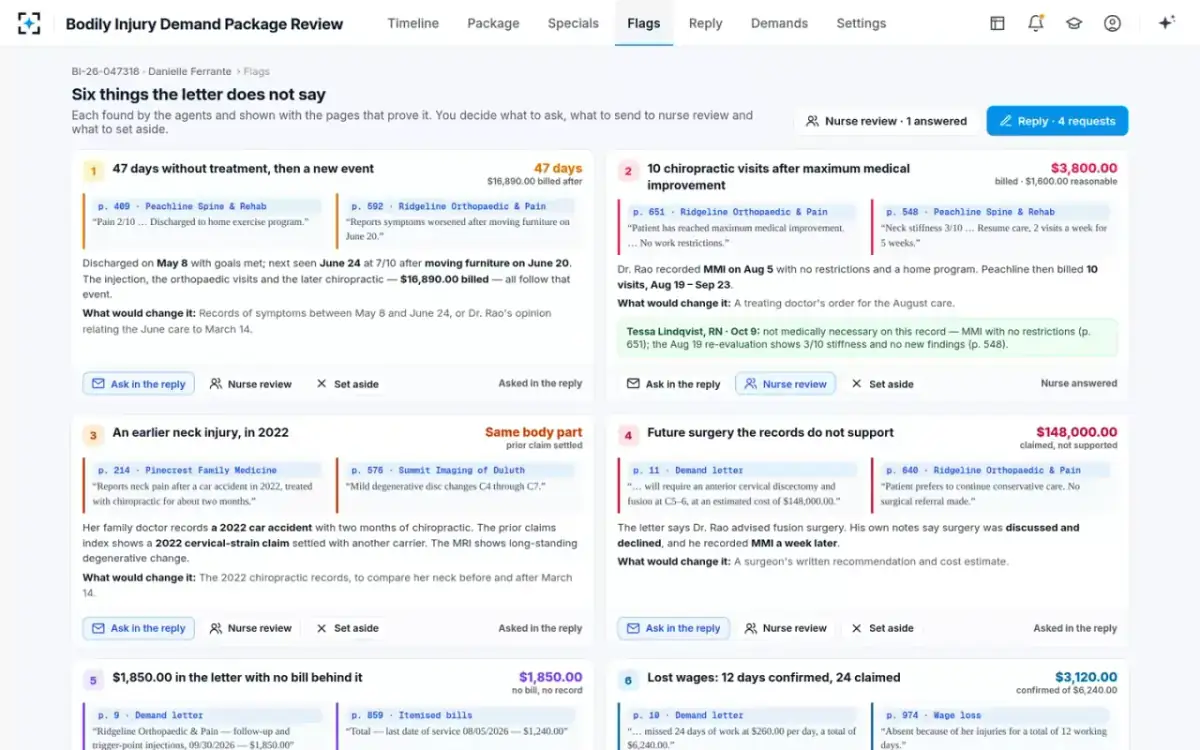
What the letter says: $40,379.60
What the package shows: Bills totalling $38,529.60; one $1,850.00 charge has no bill.
What the letter says: No gap mentioned.
What the package shows: A discharge on 8 May and no treatment for 47 days, then a consult after moving furniture.
What the letter says: A fusion surgery estimated at $148,000.
What the package shows: The surgeon’s note: the patient prefers conservative care; no surgical referral made.
What the letter says: 24 days at $260, $6,240.
What the package shows: The employer confirms 12 working days, $3,120.
What the letter says: Not mentioned.
What the package shows: The family doctor records neck pain after a 2022 car accident.
What the letter does not say, each point with the two pages that prove it
What the law requires a demand to carry
Where a state regulates time-limited demands, it often says what must come with them, which makes part of the package a statutory object. Missouri is the most specific. A time-limited demand there must be accompanied by "A list of the names and addresses of health care providers who provided treatment to or evaluation of the claimant or decedent for injuries suffered from the date of injury until the date of the time-limited demand, and HIPAA compliant written authorizations sufficient to allow the liability insurer to obtain such records from the health care providers listed", and, if wages are claimed, a list of employers with authorisations for their records.
California's statute lists, among the material terms of a time-limited demand, "Reasonable proof, which may include, if applicable, medical records or bills, sufficient to support the claim." A package that omits records is therefore a different problem in each state, and the response to it is a question for counsel.
What two statutes say a time-limited demand must contain or carry
| State | Must be in the demand | Must come with it |
|---|---|---|
| Missouri, § 537.058 | In writing, citing the section, by certified mail; at least 90 days to accept; amount or limits; date and place of loss; claim number if known; all known injuries; parties and claims released; an unconditional release. | Providers’ names and addresses with HIPAA-compliant authorisations; employers and their authorisations if wages are claimed. |
| California, CCP § 999.1 | In writing, labelled as a time-limited demand or citing the section; 30 or 33 days to accept; an offer to settle all claims within limits, including liens; a complete release; date and place of loss; claim number if known; known injuries. | Reasonable proof, which may include medical records or bills, sufficient to support the claim. |
The medical records: two-thirds of the pages
Records make up most of any package, and they are where value is won or lost, because they are where the letter's story can be tested. In the sample, the eight providers' records ran from a 9-page ambulance run report to 341 pages of chiropractic daily notes. The emergency department alone produced 186 pages, and the line a reviewer needs from them is short: cervical strain, CT negative.
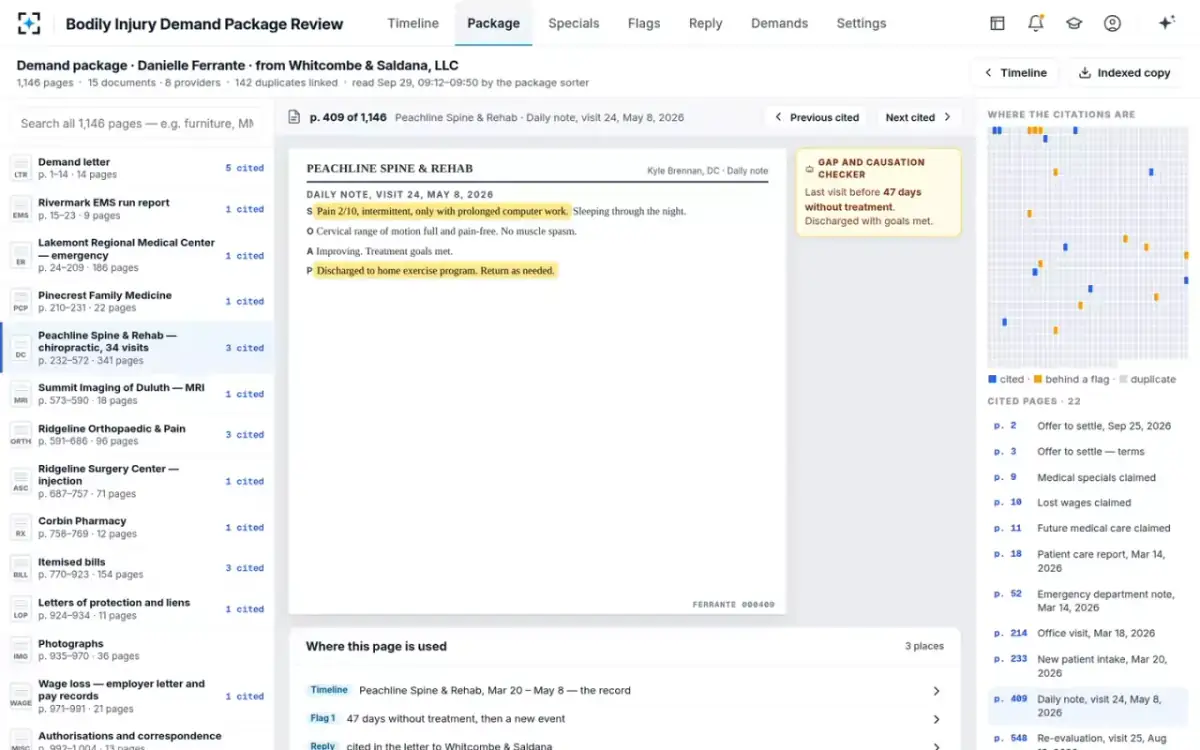
The value of reading every page shows in where the decisive sentences sat. The discharge that opens a 47-day gap is the last line of a chiropractic daily note on page 409. The intervening event, moving furniture, is in the history of a new consult on page 592. The statement of maximum medical improvement is on page 651, and the earlier neck injury on page 214, in the family doctor's notes. None of them is in the letter. How each is read is set out in what to look for in medical chronology software, and what the gap does and does not prove in the guide to gaps in treatment.
The package as Bodily Injury Demand Package Review indexed it: every cited page and where it is used
The bills: UB-04, CMS-1500 and providers' statements
Itemised bills come in a few standard forms, and knowing which is which tells a reviewer what codes to expect. A hospital, surgery centre or other institution bills on the UB-04; CMS explains that "The CMS-1450 form (aka UB-04 at present) can be used by an institutional provider". A physician, chiropractor or other practitioner bills on the CMS-1500, which CMS calls the Professional Paper Claim Form. The two carry different code sets, which is why Florida's letter-of-protection statute specifies CPT or HCPCS codes for provider-level bills and ICD codes for facility bills. Many packages also contain providers' own statements, which list charges and payments but may carry no codes at all.
In the sample, the bills ran to 154 pages and 211 coded lines, from ambulance codes A0427 and A0425 to the injection code 62321. The bill reader codes each line, places it beside the visit it pays for, and totals billed, paid and reasonable value. Where a line in the letter has no bill, as one $1,850 charge did, the difference is listed; that line is followed step by step in what medical specials mean.
Letters of protection, liens and authorisations
Eleven pages in the sample were letters of protection and liens, and they told the reviewer something the bills did not: which providers had not been paid and expected payment from the settlement. The chiropractor, the imaging centre and the surgery centre all treated under letters of protection, and the chiropractor's intake records that counsel made the referral. In Florida, such a letter now triggers specific disclosures in litigation; see the guide to Florida's letter of protection statute.
The authorisations at the back of a package are how the insurer gets records the claimant did not send. A HIPAA authorisation is valid only if it contains specific core elements, beginning with "A description of the information to be used or disclosed that identifies the information in a specific and meaningful fashion" and ending with the patient's signature and date; it must also warn that information released may be redisclosed and lose HIPAA's protection. An authorisation that is too narrow, expired or unsigned is worth catching in the first read, not at the deadline.
The potential for information disclosed pursuant to the authorization to be subject to redisclosure by the recipient and no longer be protected by this subpart.
45 CFR § 164.508(c)(2)(iii), a required statement in every HIPAA authorisation
Wages, photographs and the rest
The remaining sections are smaller but not minor. The 21 pages of wage proof in the sample decided the lost-wage claim: the letter claimed 24 days at $260, and the employer's letter confirmed 12 working days. The 36 pages of photographs are evidence too, weighed by the people evaluating the claim for what they show about the collision and the injuries; the reader's job is to make sure each is indexed, dated where possible and findable. The authorisations and correspondence at the back close the package.
How to read a demand package, in order
The order matters because the clock starts on receipt and the most time-sensitive facts are in the first few pages. A good first read establishes the deadline and terms before anything else, then builds the chronology and the specials from the same pages, then looks for what the letter left out.
Reading a demand package in the order Bodily Injury Demand Package Review does it
Agent
Package sorterSplits the package into documents by provider, date and type; dates every page; links duplicates to their originals. Nothing removed, nothing renumbered.
Never: discards or alters a page
Agent
Demand terms readerReads the offer, deadline, release, payment period and conditions; starts the clock from the date of receipt.
Never: decides validity
Agent
Summarizer and bill readerBuild the chronology and the specials from the same pages: 42 visits and 211 bill lines in the sample.
Agent
Gap and causation checkerLooks for gaps, care after MMI, earlier injuries, intervening events and future care the records do not support.
Never: decides causation
A person decides
Bodily-injury adjusterReads the pages behind each flag, sends medical questions to the nurse, sets the value and signs the reply.
Done by hand, the same order still works: deadline first, then the chronology and bills together, then the checks. What it costs in hours is set out in how long it takes to review 100 pages of medical records.
Questions people ask
What is a demand package in insurance?
It is a claimant's settlement demand to a liability insurer with the supporting evidence attached: the demand letter, medical records, itemised bills, liens and letters of protection, wage proof, photographs and authorisations. The insurer's adjuster uses it to evaluate the claim and respond, often against a deadline the letter sets.
Who prepares a demand package?
Usually the claimant's lawyer, though unrepresented claimants send them too. The Insurance Research Council found that 57 percent of bodily-injury claimants in its 2022 data had attorneys. The insurer does not prepare the package, but it can ask for missing records, and Missouri requires time-limited demands to come with authorisations to get them.
What is the difference between a UB-04 and a CMS-1500?
The UB-04, also called the CMS-1450, is the claim form institutional providers such as hospitals and surgery centres use; the CMS-1500 is the professional form used by physicians, chiropractors and other practitioners. In a demand package both appear among the itemised bills, alongside providers' own statements.
How many pages is a demand package?
There is no standard. The sample on this page is 1,146 pages, of which 142 are faxed duplicates; in the same fictional unit, open packages ranged from 162 to 2,384 pages. Surgical claims and long treatment periods produce the largest packages.
What should an insurer do first when a demand package arrives?
Record the date and method of receipt, then read the letter's terms: amount, deadline, release and conditions. Every statutory clock runs from receipt, so that comes before reading the records; how long the insurer then has is set out in the guide to responding to a demand letter.