Reviewing 100 pages of medical records takes roughly one to three hours if every word is read once, and more if the reader has to pull dates, findings and amounts into a chronology as they go. No regulator or professional body publishes a standard; the honest answer comes from reading-rate research and from the shape of the pages. That matters most to a bodily-injury adjuster, who receives a claimant's demand package of hundreds or thousands of pages and, under a time-limited demand, has a fixed number of days from receipt to answer it. Botminds' Bodily Injury Demand Package Review exists because those two numbers rarely fit together: six agents read every page the day the package arrives, build a cited treatment timeline and total the bills, and the adjuster spends her hours on the value.
The numbers behind a page of medical records
238
words a minute: the average adult silent reading rate for English non-fiction
meta-analysis of 190 studies
1–3h
to read 100 pages of records once, word for word
our arithmetic, below
60s
median to abstract one imaging report by hand
trained research abstractors
30days
minimum window from receipt under Georgia’s pre-suit offer statute
How long does it take to review 100 pages of medical records?
Between about one and three hours for a single careful read, depending on how much text is on each page. The best evidence on reading speed is a meta-analysis of 190 studies and 18,573 participants, which put the average adult's silent reading rate for English non-fiction at 238 words per minute, with most adults between 175 and 300. Medical records are harder than the essays most of those studies used, so 238 is a generous rate for a progress note full of abbreviations.
The other half of the sum is words per page, and medical records vary more than most documents. A typed consultation note or operative report can run to several hundred words. A nursing flowsheet, a run report with check boxes or a page of an itemised bill carries far fewer, but has to be read across columns. We assume three densities below; they are our assumption, not a measured average, and a reviewer can replace them with a count from their own files.
Minutes to read 100 pages once, at the average reading rate
Reading is not the slow part: abstraction is
Reading is also not the whole job. Building a chronology means stopping on each visit to write down the date, provider, complaint, findings, diagnosis and plan, and to note where it came from. A 2022 study of manual chart abstraction timed trained abstractors with stopwatches and found a median of 60 seconds per imaging report, and 21.5 minutes per patient, to pull a handful of fields from radiology reports. A demand package holds dozens of visits, each with more to extract than a scan report.
Why the hours go to scanning, not reading
Nobody on a casualty desk has three hours for every 100 pages, so packages get scanned, and scanning is where the important sentences are missed. By Botminds' estimate, an adjuster working a package of about a thousand pages by hand spends some 13 hours on it in total, four of them turning the records into a chronology. Spread over a thousand pages, those four hours leave about 24 seconds a page. That is enough to see a date and a provider. It is not enough to read the plan line at the bottom of a chiropractic daily note.
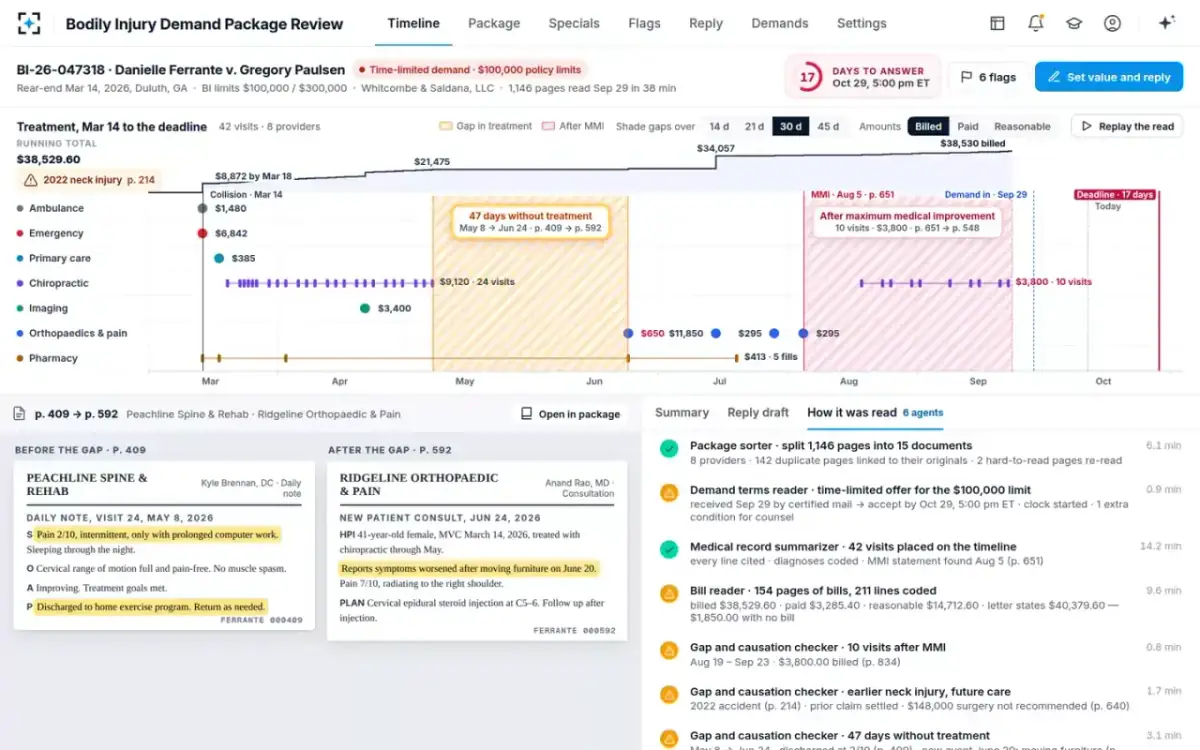
And the plan line is where claims turn. In the fictional sample package used on this page, the sentence that matters on page 409 is the last one: "Discharged to home exercise program. Return as needed." The one that matters on page 592 sits in the history of a new consultation, seven weeks later: "Reports symptoms worsened after moving furniture on June 20." Neither is in the lawyer's letter. A reader moving at scanning speed sees two visits to two providers. A reader who reads both sentences sees a discharge, a 47-day gap and an intervening event.
I have 17 days and 1,146 pages. I can't read them all and I can't afford not to.
Marisol Vance, the senior bodily-injury adjuster in the fictional sample
That is also why "how long does it take a lawyer to review medical records" and "how long does it take an adjuster" have different answers. The claimant's lawyer assembled the package over months, as the records arrived. The adjuster receives it whole, with the clock already started.
How many pages is a demand package?
There is no typical size; a demand for a soft-tissue claim can be under 200 pages and a surgical claim several thousand. The sample unit shown below is a reasonable picture of the spread: nine open demands in an Atlanta casualty unit, from 162 pages to 2,384, totalling 6,661 pages. Five are time-limited, and the next deadline is three days away.
Nine open demands, sorted by time left
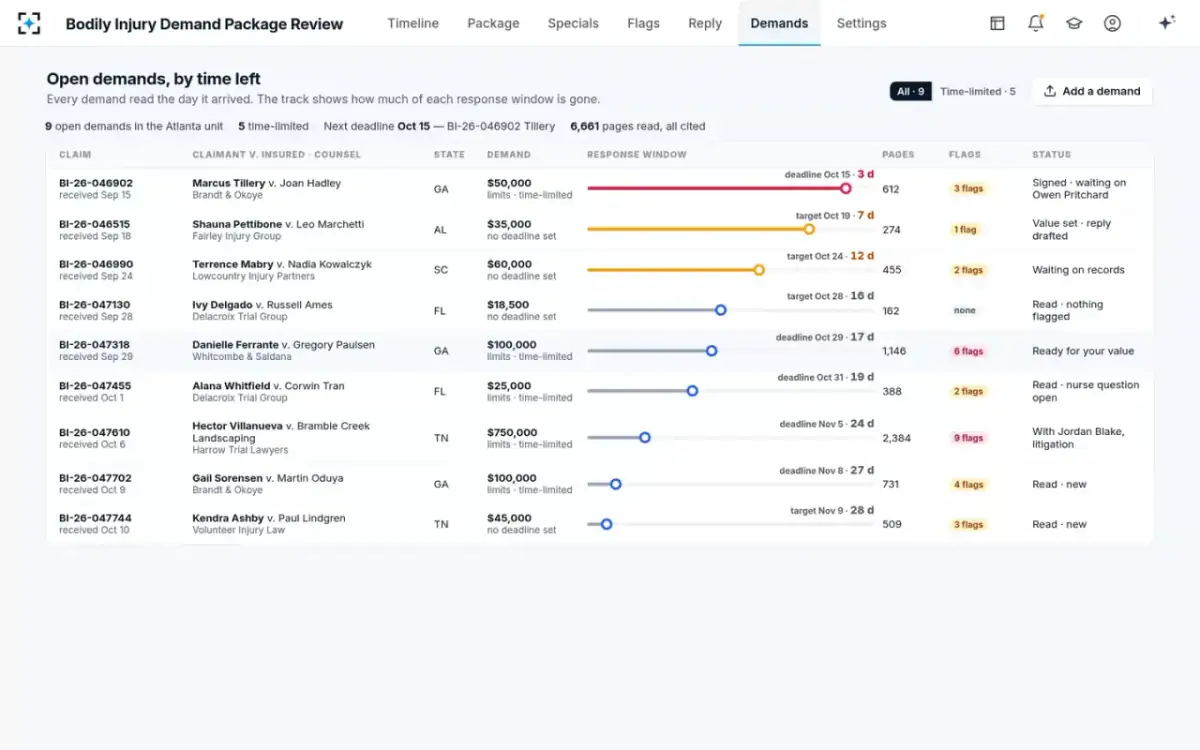
Apply the hand-work estimate of about 13 hours per thousand pages to that queue and it comes to roughly 87 hours of reading, totalling and checking, more than two full working weeks for one adjuster before any other claim on the desk, any recorded statement or any phone call. The arithmetic is ours; the estimate behind it is Botminds' and is described in the next section. Even halving it leaves a queue that cannot be read in full inside the shortest window on the list.
Hours to work the unit's 6,661 pages, against one working week
One adjuster's 30 days, from receipt to a signed reply
Under a time-limited demand, the review has to fit inside a window the statute sets as a minimum and the lawyer chooses in practice. In Georgia, a pre-suit offer on a motor vehicle claim must give the recipient at least 30 days from receipt; California's time-limited demands must allow 30 days, or 33 by ordinary mail (CCP § 999.1); Missouri's must stay open for 90 (§ 537.058). The rules for each, and what happens when an answer is late, are set out in how long an insurance company has to respond to a demand letter.
Take the sample package at the top of that window. Danielle Ferrante was rear-ended at a red light in Duluth, Georgia, on 14 March 2026; her lawyers' demand for the $100,000 bodily-injury limit, dated 25 September, arrived by certified mail on 29 September, giving the carrier until 29 October to accept. The people, firms, providers and carrier are invented; the timings are as the solution produced them.
The Ferrante demand: thirty days, and where they went
- Read, sorted and flagged in 38 minutes · 29 Sep
- Flags reviewed; nurse answers 9 Oct9 d
- Value set; reply signed and sent 12 Oct3 d
- Unused before the deadline17 d spare
The 38 minutes is the agents' time, not the adjuster's. In that window the package sorter split 1,146 pages into 15 documents and linked 142 faxed duplicates to their originals; the medical record summarizer placed 42 visits on a timeline; the bill reader coded 211 bill lines from 154 pages of bills; the demand terms reader started the clock; and the gap and causation checker went looking for what the letter left out. Each step's duration is shown with what it found.
How Bodily Injury Demand Package Review read the package, step by step
Where the thirteen hours go, by hand and with Bodily Injury Demand Package Review
The 13-hour figure is Botminds' estimate for one package of about a thousand pages worked by hand: an hour sorting and finding duplicates, four reading the records into a chronology, three totalling and reconciling the bills, two finding gaps, care after maximum medical improvement and earlier injuries, one checking the demand's terms and deadline, and two writing and signing the reply. With the solution, the same estimate puts the adjuster's own time at 2.7 hours, because the reading, totalling and first-pass checking are done before she opens the file.
Where an adjuster's hours go on one thousand-page demand
By hand · about 13 h
- Sorting · 8%
- Chronology · 31%
- Specials · 23%
- Gaps, MMI, priors · 15%
- Terms · 8%
- Reply · 15%
With the agents · about 2.7 h
- Sorting · 4%
- Chronology · 18%
- Specials · 11%
- Gaps, MMI, priors · 19%
- Terms · 11%
- Reply · 37%
The shape changes more than the total. By hand, more than half the time goes on producing the chronology and the specials, the raw material. With the agents, the largest share goes on the reply, which is where the adjuster's judgement is: what to offer, what to ask for and what to say about each flag. The checking does not disappear; it shrinks to confirming cited lines rather than finding them. Where the cost of those hours lands in a budget, and how it compares with an outside summary company, is worked through in medical records summary companies against in-house review.
Who reviews medical records for an insurance company?
The bodily-injury adjuster reviews them first and owns the evaluation; a medical review nurse answers the medical questions; a supervisor co-signs the larger or riskier answers; and claims counsel decides legal questions such as whether a demand is valid. Some carriers also send records to outside physician reviewers or summary vendors. The unfair claims practices model the states build on expects an insurer to set, and follow, reasonable standards for investigating and settling claims promptly, and who reads what is part of that standard.
Four people on one limits demand, and what their week holds
Today
Reads 1,146 pages page by page and totals the bills in a spreadsheet, against 17 days left.
With agents
Starts from a timeline with the gaps shaded and the pages open; spends her time setting the value.
Still theirs: The value, the offer and her signature
Today
Co-signs near the limits without seeing what the letter left out.
With agents
Co-signs every reply to a time-limited demand and every offer over $25,000 with the flags and their pages in front of him.
Still theirs: The co-signature
Today
Receives the whole box to answer one question.
With agents
Gets only the cited pages behind a flag and answers on the claim: relatedness, necessity, MMI.
Still theirs: Every medical judgement
Today
Rebuilds the chronology when the file goes into suit.
With agents
Takes the file with the same pages, citations and flags the adjuster valued it on.
Still theirs: The defence of the file
The nurse's question in the sample shows how narrow that role can be: were ten chiropractic visits after the treating doctor recorded maximum medical improvement medically necessary? She received the two pages that bear on it and answered in one line, on 9 October. The agents never make that call; they find the pages and route the question. Can a nurse review medical records for a claim? Yes, and the review is better for being narrow: the question, the two pages that answer it, and her answer saved on the claim beside them.
What a faster read does not change
Reading speed is not the measure of a good review; the measure is whether the evaluation can be traced to the pages behind it. A cited timeline built in 38 minutes is only useful if each line is right, and the adjuster still has to read the pages behind every flag before she relies on it. In the sample, that meant opening pages 409 and 592 side by side for the gap, pages 651 and 548 for the care after maximum medical improvement, and the family doctor's note on page 214 for an earlier neck injury. The difference is that the solution put those pages in front of her instead of leaving her to find them.
Nor does speed change who decides. The agents never set a value, never decide causation or medical necessity, and never send anything. The reply drafter writes only from a range and an offer the adjuster has set; the supervisor co-signs; counsel reviews anything on limits of $250,000 or more. The time saved is time moved from reading to judging. What a gap like the 47 days in this file does and does not prove is the subject of the guide to gaps in treatment.
Finally, the people doing this work are getting scarcer, not more numerous. Federal projections show the number of adjusters, examiners and investigators falling by about 6% over 2025–2035, with technology taking over part of the work as one of the reasons. Packages are not getting shorter. The pages a desk can no longer read by hand have to be read some other way, and cited when they are.
Questions people ask
How long does it take to review 1,000 pages of medical records?
At the average adult reading rate of 238 words a minute, a single word-for-word read of 1,000 pages takes roughly 10 to 30 hours, depending on how dense the pages are. Building a cited chronology takes longer than reading. By Botminds' estimate a hand-built chronology for a package of that size gets about four hours, which is why most packages are scanned rather than read.
How long does it take a lawyer to review medical records?
The same reading rates apply, but a claimant's lawyer usually reads the records as they arrive over months of treatment and assembles the package at the end. The adjuster receives the whole package at once. Under a time-limited demand, the adjuster's review then has to fit inside a window that runs from receipt: at least 30 days in Georgia for a motor vehicle claim.
How long does an adjuster have to review a demand?
As long as the demand and the state allow. A time-limited demand names its own date, within statutory minimums such as Georgia's 30 days from receipt, California's 30 or 33 days and Missouri's 90 days. A demand without a deadline is still a communication that needs a reply, which the NAIC model regulation puts at 15 days.
How many pages is a typical demand package?
There is no published average. In the fictional sample unit on this page, nine open demands range from 162 to 2,384 pages and total 6,661. Duplicates inflate the count: the 1,146-page Ferrante package contained 142 faxed copies of pages already in it.
Does speeding up the review make it less careful?
Only if the speed comes from skipping pages. The solution reads every page and cites the page for every line, so the adjuster's checking time goes into the pages behind each flag. Botminds' target is that 100% of figures in the reply link to the page they came from, which is something a reviewer can verify file by file.