"Paid vs billed" is the question of which figure for past medical expenses a jury hears and a claimant can recover: the amount the provider billed, or the amount actually paid to settle the bill, usually by a health insurer at a negotiated rate far below the charge. States answer it differently. Some limit evidence or recovery to the amount paid or incurred, by statute (Texas since 2003, Florida since 2023) or by court decision (California since 2011); some let the jury hear both numbers (Georgia since 2025); Missouri admits the "actual cost" of care; others keep the traditional collateral source rule, under which the billed amount comes in and payments by the claimant's own insurer are kept from the jury. There is no official national list, so this guide reads five states from their own sources. For an insurer evaluating an injury demand, the practical rule is to carry billed, paid and reasonable value on every line, which is what Bodily Injury Demand Package Review, Botminds' solution for injury demand review, does from the first read.
One Florida bill, as the Legislature's analysts told it
$574,554
billed by the plaintiff’s providers
$145,970
accepted by them under his insurer’s fee schedule
$400,000+
written off: the “phantom damages” the court set off
What does paid vs billed mean?
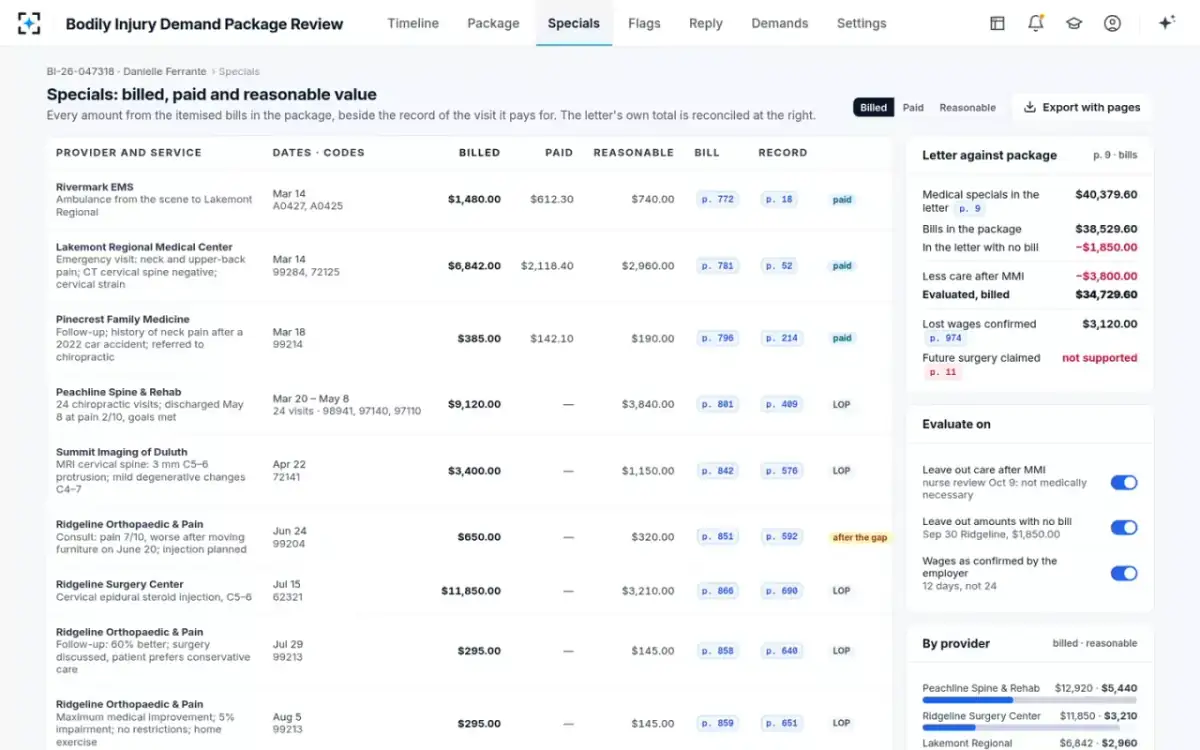
A provider's bill states its charge. When a health insurer pays, it pays a contracted rate and the provider writes off the rest; when Medicare or Medicaid pays, the rate is set by the program. The difference is often large. In the fictional sample package used across these guides, the three providers paid by the claimant's health coverage billed $8,707.00 and were paid $2,872.80, about a third. The question for the law is whether the claimant can recover, and the jury can hear, the $8,707 or the $2,872.80.
Three paid bills from the sample package: charged, paid, and valued
Billed, paid and reasonable value for every bill line, in Bodily Injury Demand Package Review
What are phantom damages?
"Phantom damages" is the name critics give to the written-off part of a bill: the amount charged but never paid by anyone, and never owed after the insurer paid. The Florida House's analysis of HB 837 used it of a 2005 Florida Supreme Court case in which providers billed $574,554 and accepted $145,970, holding that Florida's collateral source statute "prevented the plaintiff from receiving a windfall of over $400,000 in “phantom damages.”" The other side of the argument is the one the plaintiff made in California's Howell case: that the discount was itself a benefit of insurance she had paid premiums for, and so belonged to her under the collateral source rule. The court disagreed.
Whichever side one takes, the term points at a real problem for an adjuster: the same file is worth different amounts in different states, and sometimes in the same state before and after a change in the law. A claim valued on billed charges in a state that now admits paid amounts is over-valued; one valued only on paid amounts in a state that admits billed charges may be under-valued and refused.
Paid vs billed states: five rules side by side
The five states below are large casualty markets whose rules can be read in their own statutes or supreme court opinions. Each has nuances this table leaves out, and every state not listed has its own rule; treat it as a starting map, not an answer for a particular claim.
Which medical number reaches the jury, in five states
| State | Rule for past medical expenses | Source | Since |
|---|---|---|---|
| Texas | Recovery limited to the amount actually paid or incurred by or on behalf of the claimant. | Civ. Prac. & Rem. Code § 41.0105 | 2003 |
| California | A privately insured plaintiff recovers no more than the amounts paid by her or her insurer, or still owing. | Howell v. Hamilton Meats (Cal. 2011) | 2011 |
| Florida | Paid charges: evidence limited to the amount actually paid. Unpaid charges: coverage rates, 120% of Medicare, factoring price and reasonable billed amounts. | Fla. Stat. § 768.0427 | 2023 |
| Georgia | The jury may hear both the amounts billed and the amounts actually paid, and decides reasonable value. | SB 68 (2025), per the Governor’s summary | 2025 |
| Missouri | Parties may introduce the actual cost of care: amounts paid plus any amount still needed to satisfy the bill after discounts and write-offs. | Mo. Rev. Stat. § 490.715.5 | 2017 |
Texas: paid or incurred
Texas settled the question by statute in 2003. Section 41.0105 of the Civil Practice and Remedies Code reads, in full: "In addition to any other limitation under law, recovery of medical or health care expenses incurred is limited to the amount actually paid or incurred by or on behalf of the claimant." "Incurred" does the work for unpaid bills: a charge the claimant is still liable for counts, but an amount the provider has written off under a contract does not.
For a reviewer, the Texas rule makes the paid column decisive for any bill a health plan has settled, and makes it essential to know whether an unpaid bill is genuinely owed. A provider treating under a letter of protection has not written anything off, so its full charge may be "incurred"; the evidence of its reasonableness is then where the argument moves.
California: Howell, and the negotiated rate
California's rule comes from its Supreme Court. In Howell v. Hamilton Meats & Provisions (2011), the plaintiff's providers had accepted, under her health insurer's contracts, far less than they billed. The court held that "an injured plaintiff whose medical expenses are paid through private insurance may recover as economic damages no more than the amounts paid by the plaintiff or his or her insurer for the medical services received or still owing at the time of trial."
The court was careful to say it was not abolishing the collateral source rule: the plaintiff still recovers what her insurer paid, even though the defendant did not pay it. What changed was the measure. In the opinion's words, the reason the undiscounted bill could not be recovered was "the simple reason that the injured plaintiff did not suffer any economic loss in that amount."
Florida: paid amounts, coverage rates and the Medicare multiple
Florida rewrote its rules in HB 837, effective 24 March 2023. For satisfied charges the statute is blunt: evidence "is limited to evidence of the amount actually paid, regardless of the source of payment." For unpaid charges it lists evidence that "shall include, but is not limited to" several measures, depending on the claimant's situation. One is a formula: for a claimant with no health coverage, or with Medicare or Medicaid, the evidence includes 120 percent of the Medicare rate on the date of service or, where there is no Medicare rate, 170 percent of the state's Medicaid rate.
Before 2023, the analysis explains, Florida's collateral source statute let a court reduce an award after the verdict, but "a plaintiff may still introduce into evidence the full amount of his or her medical bills". The new statute moves the correction from after the verdict to the evidence itself. Its treatment of letters of protection, where nothing has been paid, is set out in the guide to Florida's letter of protection statute.
Georgia and Missouri: both numbers, or the actual cost
Georgia's 2025 tort reform, SB 68, signed on 21 April 2025, chose transparency over a cap. In the Governor's summary, the law "permits counsel in a jury trial to submit evidence of the medical bills charged by providers, as well as the evidence of what was actually paid by an insurer to satisfy those charges." The jury then decides the reasonable value with both in front of it. What the change does to valuations made before and after it is covered in Georgia tort reform 2025 and medical bills, from Botminds' Bodily Injury Claim Valuation.
Missouri amended its collateral source statute in 2017 to let either side introduce the "actual cost" of care, which section 490.715 defines as "a sum of money not to exceed the dollar amounts paid by or on behalf of a plaintiff or a patient whose care is at issue plus any remaining dollar amount necessary to satisfy the financial obligation for medical care or treatment by a health care provider after adjustment for any contractual discounts, price reduction, or write-off by any person or entity." The same section requires the actual cost to be reasonable, necessary and a proximate result of the defendant's fault.
Two ways to fix the billed-amount problem
Limit the number (Texas, California, Florida): The paid or incurred amount, or a statutory measure for unpaid bills.
Show both numbers (Georgia; Missouri’s actual cost): The charge and what was paid, or a defined actual cost, and decides value itself.
Limit the number (Texas, California, Florida): Out of the damages; the claimant recovers what was paid or owed.
Show both numbers (Georgia; Missouri’s actual cost): Into the evidence; the jury weighs it.
Limit the number (Texas, California, Florida): Argued on what is owed and on reasonableness; Florida adds coverage rates and the Medicare multiple.
Show both numbers (Georgia; Missouri’s actual cost): Argued on reasonable value, with the charge in evidence.
Limit the number (Texas, California, Florida): Paid amounts and payers, line by line; proof of what remains owed.
Show both numbers (Georgia; Missouri’s actual cost): Billed and paid on every line, plus a defensible reasonable value.
Collateral source rule by state: why it is not one rule
The collateral source rule has two parts, and states have changed them separately. One is about damages: a defendant does not get credit for benefits the claimant received from her own sources, such as her health insurance. The other is about evidence: the jury is not told about those benefits. Florida's analysts described their pre-2023 law in exactly those terms, saying the state had modified the first part but not the second. California's court insisted in Howell that it was not changing the rule at all, only the measure of the loss.
That is why searches for the "collateral source rule by state" turn up answers that seem to contradict each other. A state can keep the collateral source rule in name and still limit the medical measure to amounts paid; another can abolish part of it by statute and let the jury hear both numbers. For claims work, the useful question is narrower and answerable: in this state, for this kind of bill, which number comes in, and which number can be recovered?
Keeping both numbers on every line in Bodily Injury Demand Package Review
Because the answer depends on the state, on the payer and on whether the claim is ever tried, a review that records only one number has to be redone whenever any of those changes. The sound practice is to carry the billed charge, the amount paid and by whom, the amount still owed, and a reasonable value with its basis, on every line, and choose the measure at evaluation time.
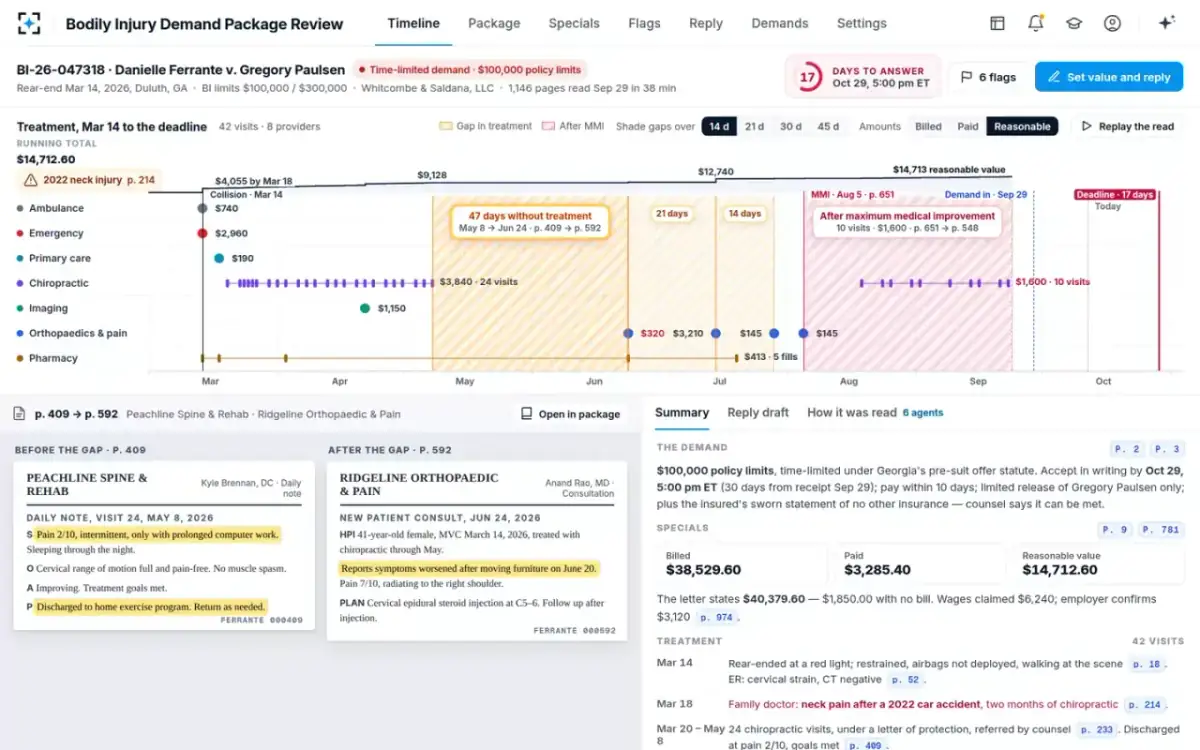
The same treatment timeline, re-priced at reasonable value in one click
Five things to record on every bill line, whatever the state
- The charge, with its codes
CPT or HCPCS for professional bills; ICD diagnosis (and, where they apply, procedure) codes on facility bills.
- What was paid, by whom, and when
Health plan, Medicare, Medicaid, med-pay or the claimant, from the explanation of benefits or the provider’s statement.
- What is still owed, and on what terms
Balance billed, written off, deferred under a letter of protection, or sold to a factoring company.
- A reasonable value and its basis
The benchmark and percentile your carrier has chosen, so the figure can be explained.
- The page for each of the above
The bill, the payment record and the visit note, so the number can be defended in any of the five regimes.
In the sample, that is what let the adjuster value a Georgia claim on all three bases at once: $34,729.60 billed and $13,112.60 at reasonable value after two adjustments she decided on, with the paid amounts visible where health coverage had paid. How those adjustments were reached is traced in what medical specials mean.
Questions people ask
Does billed mean paid?
No. The billed amount is the provider's charge; the paid amount is what someone actually paid to settle it. In the sample package, three bills totalling $8,707.00 were paid $2,872.80 by the claimant's health coverage, and the rest were unpaid because the care was under letters of protection.
Which states allow phantom damages?
There is no official list. States that keep the traditional collateral source rule generally let a plaintiff put the full billed amount in evidence; states such as Texas, California and Florida limit past medical damages to amounts paid or incurred, by statute or court decision. Georgia since 2025 lets the jury hear both.
What did Georgia tort reform change about medical bills?
SB 68, signed on 21 April 2025, lets counsel put both the billed charges and the amounts actually paid before a jury, which then decides reasonable value. It also restricts anchoring in arguments about pain and suffering and does not cap awards, according to the Governor's summary.
What is the collateral source rule in California?
California keeps the rule, so a defendant gets no credit for what the plaintiff's insurer paid. But under Howell (2011), a privately insured plaintiff recovers no more than the amounts paid or still owing for past care, not the undiscounted bill.
How should an adjuster value specials in a state that admits billed amounts?
Value on billed charges for the jury's starting point, but carry the paid amounts and a reasonable value beside them, because the claimant's lawyer and the jury will see the charge while the file should show what the market pays. A state's rule can also change, as Florida's did in 2023 and Georgia's in 2025.