Medical specials are the medical expenses claimed in a personal injury case: the ambulance, emergency room, doctor, therapy, imaging, surgery and pharmacy charges that make up the bulk of the claimant's special damages. "Specials" is the claims and legal shorthand for special damages, the losses that can be added up from documents, as opposed to general damages such as pain and suffering. In a bodily-injury demand, the lawyer's letter states a specials total, and the adjuster has to decide whether the bills and records in the package support it, line by line. Bodily Injury Demand Package Review is Botminds' solution for that work: its bill reader codes every line of the itemised bills, totals billed, paid and reasonable value, and reconciles the result to the letter, citing the page behind each figure.
This page follows one line through that reconciliation. It comes from a fictional sample claim: Danielle Ferrante, rear-ended at a red light in Duluth, Georgia, on 14 March 2026, whose lawyers' time-limited demand for the $100,000 limit arrived on 29 September. Every person, firm, provider and amount in it is invented.
One $1,850 line, traced through Bodily Injury Demand Package Review from the letter to the reply
Agent
Bill readerReads the letter’s specials page (p. 9): a Ridgeline Orthopaedic & Pain charge for a follow-up and trigger-point injections, dated 30 September 2026, $1,850.00.
Agent
Bill readerLooks for the charge in 154 pages of itemised bills. Ridgeline’s last bill (p. 859) ends on 5 August, total $1,240.00. No bill for 30 September.
Never: reduces a bill on its own
Agent
Medical record summarizerFinds no visit note for 30 September in Ridgeline’s 96 pages of records.
Agent
Gap and causation checkerRaises a flag with the two pages: the letter’s line and the statement that ends in August.
Never: decides what the flag means
A person decides
Bodily-injury adjusterLeaves the $1,850 out of the specials she evaluates on and asks, in her reply, for the bill and visit note for 30 September.
What are medical specials?
Medical specials are the medical-expense part of special damages, which the law treats as the losses that can be measured. Cornell's Legal Information Institute describes special damages in tort law as "damages like car dents or medical expenses that can actually be ascertained", contrasted with general damages that have no set monetary cost. California's statute on joint liability draws the same line in different words, defining economic damages as "objectively verifiable monetary losses including medical expenses, loss of earnings, burial costs" and similar items.
In an injury demand the term usually covers past medical bills, sometimes a projection of future medical care, and often lost wages alongside them. In the sample, the letter's specials page states $40,379.60 of past medical expenses, a claim for 24 days of missed work at $260 a day, and a $148,000 future surgery. Each of those is a different kind of special with a different kind of proof: an itemised bill, an employer's wage statement, a surgeon's recommendation and estimate. The word "specials" bundles them; a review has to unbundle them.
Special damages vs general damages: why one line counts more than once
The difference is proof. Special damages are proved with documents and can be totalled; general damages compensate for pain, suffering and loss of enjoyment and are argued, not added. The two are not independent in practice, because the medical specials are the most visible measure of how serious an injury was, and general damages tend to be argued from them.
The Insurance Research Council, a non-profit research organisation supported by insurers, measured that relationship across more than 7.4 million auto injury claims closed between mid-2017 and mid-2022. Bodily-injury claimants received "$2.00 in total settlement, excluding any legal fees, for every dollar of medical bills paid", a ratio that rose to more than $2.30 by mid-2022. That is an average across claims, not a multiplier any adjuster applies. It does mean that a dollar of unsupported medical expense in a letter is rarely only a dollar: if it stays in the specials, it is also in the base the rest of the value is argued from.
The bill reader never reduces a bill on its own; it shows the basis for every value.
The fictional sample's bill reader, on what it may and may not do
How do you calculate medical specials? Three numbers for every line
Start from the itemised bills, not the letter, and give every line three numbers where the evidence allows: what the provider billed, what was actually paid and by whom, and a reasonable value for the service. The total of each column is a different specials figure, and which one matters depends on the state and on whether the claim is ever tried. In the sample, the three columns come to $38,529.60 billed, $3,285.40 paid and $14,712.60 at reasonable value.
Billed, paid and reasonable value for six of the sample's bill lines
| Provider and service | Billed | Paid | Reasonable value | How it was paid |
|---|---|---|---|---|
| Ambulance, 14 Mar (A0427, A0425) | $1,480.00 | $612.30 | $740.00 | Paid by health coverage |
| Emergency department, 14 Mar (99284, 72125) | $6,842.00 | $2,118.40 | $2,960.00 | Paid by health coverage |
| Family doctor, 18 Mar (99214) | $385.00 | $142.10 | $190.00 | Paid by health coverage |
| Chiropractic, 24 visits, 20 Mar–8 May | $9,120.00 | — | $3,840.00 | Letter of protection |
| MRI cervical spine, 22 Apr (72141) | $3,400.00 | — | $1,150.00 | Letter of protection |
| Epidural steroid injection, 15 Jul (62321) | $11,850.00 | — | $3,210.00 | Letter of protection |
Two things stand out. The three early providers in the table were paid by the claimant's health coverage, $2,872.80 in all against $8,707.00 billed. The chiropractor, the imaging centre and the surgery centre treated under letters of protection, where the provider expects payment from any judgment or settlement, so there is no paid amount to set against the charge. For those lines the reasonable value column is the only market check on the bill. How Florida now treats exactly that situation is set out in the guide to Florida's letter of protection statute.
One $1,850 line, from the letter to the bills
The letter's specials page lists, among Ridgeline Orthopaedic & Pain's charges, "follow-up and trigger-point injections, 09/30/2026 — $1,850.00". It is a modest line in a $40,379.60 total, and it would pass a scan. The bill reader treats it like every other line: it looks for the bill that charges for it and the visit note that documents it.
Neither exists in the package. Ridgeline's itemised bills, on pages 851 to 859, carry three charges: $650.00 for the consultation on 24 June and two follow-ups at $295.00, on 29 July and 5 August. The last of them closes with "Total — last date of service 08/05/2026 — $1,240.00". The summarizer's chronology of Ridgeline's 96 pages of records has no visit on 30 September. And the date itself is telling: 30 September is the day after the carrier received the package and five days after the letter was dated. A charge for a visit that, on the evidence in the package, had not yet happened when the letter was written is not something a reviewer can value.
Six things the letter does not say, each with the two pages that prove it

What the reviewer does with it matters as much as finding it. The flag does not accuse anyone; a charge can be listed in error, sent before the visit or billed later. The adjuster's choice in the sample was the proportionate one: leave the $1,850 out of the specials she evaluated on, and ask in her reply for "the bill and visit note for the September 30 Ridgeline visit". If they arrive, the line goes back in.
What happens when the demand total does not match the bills?
The reviewer reconciles the two and evaluates on what the documents support, listing every difference so the claimant's lawyer can answer it. In the sample, the letter's $40,379.60 and the bills' $38,529.60 differ by exactly the $1,850 line. A separate decision, not a reconciliation error, then takes out $3,800 for ten chiropractic visits after the treating doctor recorded maximum medical improvement, which the review nurse found not medically necessary on the record. The specials the adjuster evaluated on were $34,729.60 billed and $13,112.60 at reasonable value.
From the letter's specials to the specials the adjuster evaluated on
Medical specials in the letter
$40,379.60
The total the claimant’s lawyer states on page 9.
Claimant’s letter
Line with no bill
− $1,850.00
Ridgeline, dated 30 September; the provider’s statement ends 5 August.
Bill reader finds; adjuster decides
Care after MMI
− $3,800.00
Ten chiropractic visits, 19 August to 23 September, after MMI on 5 August.
Nurse answers; adjuster decides
The same medical specials, four ways of counting them
The wages follow the same logic. The letter claims 24 days at $260, or $6,240; the employer's letter on page 974 confirms 12 days, $3,120. That is not a medical special, but it sits in the same reconciliation and the same reply. The general point holds for every line: a demand total is a claim, and the bills, records and wage statements are the evidence. When they disagree, the difference is listed, cited and asked about.
Billed, paid or reasonable value: which number counts?
It depends on the state, and the rules changed in several large states between 2011 and 2025. Florida now limits evidence of past medical expenses that have been satisfied to the amount actually paid and, for unpaid charges, admits evidence such as what the claimant's health coverage would have paid; its statute also says recoverable medical damages "may not include any amount in excess of the evidence of medical treatment and services expenses admitted" under those rules. Georgia's 2025 tort reform lets a jury see both the billed and the paid amounts. Texas limits recovery to what was actually paid or incurred. The state-by-state picture is in paid vs billed states.
For the review, the practical consequence is to keep all three numbers on every line, from the start. A demand evaluated only on billed charges has to be rebuilt the day it goes into suit in a state that admits paid amounts; one evaluated only on paid amounts says nothing about the letter-of-protection care that was never paid. The solution carries billed, paid and reasonable value on every line, so the adjuster can switch the whole timeline and running total between them in one click.
What reasonable value means, and who sets the basis
Reasonable value is an estimate of what a service is worth in the market where it was provided, as distinct from the provider's list price. There is no single official measure for liability claims, which is why the basis has to be a stated choice. In the sample, the carrier's setting is a regional charge benchmark for the provider's ZIP code at the 75th percentile, with paid amounts used wherever a bill was actually paid. The choices offered are the 60th, 75th or 80th percentile; a carrier picks one, and the solution applies it to the next package.
The rule that matters is that the bill reader never reduces a bill on its own. It shows the billed amount, the paid amount if there is one, the reasonable value and the basis for it, beside the page of the bill and the page of the visit. Whether to evaluate on a figure below the charge is the adjuster's decision, and in a state that admits billed amounts she will want to know both. A benchmark is evidence about value, not a ruling on it.
Reconciling the specials in Bodily Injury Demand Package Review
The specials screen puts every amount from the itemised bills beside the record of the visit it pays for, with the codes, the bill page and the record page, and reconciles the letter's own total at the side. The three switches on the right are the adjuster's: leave out care after MMI, leave out amounts with no bill, and use the wages the employer confirmed. Each switch carries the page and, for the post-MMI care, the nurse's answer.
Specials: billed, paid and reasonable value, reconciled to the letter
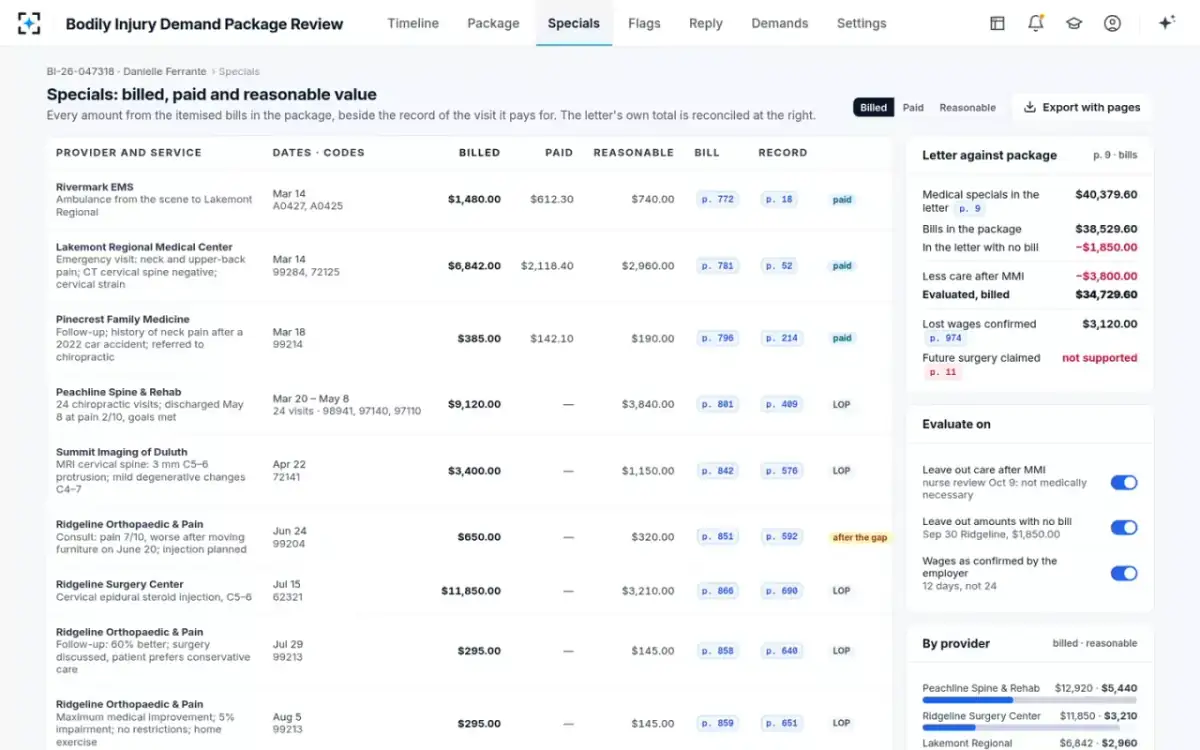
This is also where the chronology and the specials meet. The bill reader's 211 coded lines and the summarizer's 42 visits come from the same pages, so a visit with no bill and a bill with no visit both show up. In the sample, they found one of each kind of problem a reconciliation exists to catch: a charge with no bill, care after the treating doctor's own MMI statement, and a wage claim twice what the employer confirms. How the same pages feed the chronology is described in what to look for in medical chronology software.
Questions people ask
Are medical specials the same as medical bills?
Close, but not quite. Medical specials are the medical expenses claimed as damages, which usually start from the bills but may be argued at billed, paid or reasonable value depending on the state, and may include projected future care. In the sample, $38,529.60 was billed but only $3,285.40 had been paid.
Do lost wages count as specials?
Yes. Lost wages are special damages because they can be measured from documents, usually an employer's statement and pay records. They are not medical specials, and they need their own proof: in the sample the letter claimed 24 days of missed work and the employer confirmed 12.
Can a demand include future medical specials?
It can, but a future special needs a medical basis, usually a treating doctor's recommendation and a cost estimate. The sample letter claimed a $148,000 fusion surgery; the surgeon's own note on page 640 records that the patient preferred conservative care and that no surgical referral was made, so the claim was flagged as not supported by the records.
Why would a specials total not match the bills?
Common reasons are a charge listed before the bill was issued, a duplicate or faxed copy counted twice, a typing error, or care billed by a provider whose records were never sent. Each needs a different answer, which is why the difference should be listed line by line rather than written off as a percentage.
Who decides what the specials are worth?
The adjuster, within the carrier's own rules and the state's law. Software can code the lines, total them and show reasonable value at a benchmark the carrier chooses, but it should never reduce a bill on its own; in the solution, every figure the adjuster evaluates on carries the page it came from.