Medical chronology software reads a claimant's medical records and produces a chronology: one line per visit, in date order, with the provider, the complaint, the findings, the diagnosis, the procedures and the plan. For an insurer evaluating a bodily-injury demand, good software does three more things that matter more than speed. It cites the page behind every line, so the adjuster can check it in one click. It states what the record says without diagnosing or judging whether care was related or necessary. And it surfaces the entries that move value, such as a statement of maximum medical improvement, a work restriction, an earlier injury or a referral from counsel. Bodily Injury Demand Package Review is Botminds' software for the insurer's side of an injury demand, and its medical record summarizer is one of six agents that read each package; this guide uses it to show what to look for in any tool.
Two chronologies built from the same records, for different jobs
Built to present the claim: Tells the story of the injury and the treatment it required.
Built to evaluate the claim: Lets an adjuster test that story against the pages, line by line.
Built to present the claim: The visits, findings and opinions that support the damages.
Built to evaluate the claim: Every visit, including the discharge notes, gaps and statements that cut the other way.
Built to present the claim: May include an opinion on causation and future care.
Built to evaluate the claim: States what each record says; relatedness, necessity and causation go to people.
Built to present the claim: Useful, sometimes by exhibit rather than by page.
Built to evaluate the claim: Required on every line, to the original page number in the package.
Built to present the claim: Often a separate total.
Built to evaluate the claim: Each visit beside the bill line that charges for it, so chronology and specials agree.
What is a medical chronology, and what makes a claims chronology different?
A medical chronology is a date-ordered summary of a person's medical care, built from the records themselves. Lawyers, nurse consultants and claims professionals all build them, and the format looks the same on the surface. The difference is who reads it and what they do next. A claimant's chronology supports a demand; an insurer's chronology has to support an evaluation the insurer may later have to defend to a regulator, a jury or its own insured.
Why does every line need a page number?
Because the insurer has to be able to show how it reached its evaluation, and a page number is the shortest path from a conclusion back to its evidence. The NAIC's model claims regulation, which states draw on for their own claims rules, requires each claim file to carry enough detail for an examiner to reconstruct everything the insurer did on the claim. Examiners test that by sampling files. In one 2024 Florida market conduct examination of an auto insurer, for example, "A random sample of 109 claims was selected and reviewed by the examiners" for each category of claim. An evaluation that rests on a chronology nobody can trace back to a page is hard to reconstruct.
What should a medical chronology include?
At a minimum: the date, the provider, what the patient reported, what the clinician found, the diagnosis, any procedure with its code, the pain score where one is recorded, the plan, and the page. For injury claims, five further items earn their place because they change value: statements of maximum medical improvement, work restrictions, earlier injuries to the same body part, referrals (including referrals by counsel, which matter under a letter of protection), and the bill line that charges for the visit.
Eight lines from one sample chronology, and why each one matters
| Date | What the record says | Page | Why it is on the line |
|---|---|---|---|
| 14 Mar | Rear-ended at a red light; restrained, airbags not deployed, walking at the scene. ER: cervical strain, CT negative. | pp. 18, 52 | Mechanism and the first diagnosis, in the clinicians’ words. |
| 18 Mar | Family doctor: neck pain after a 2022 car accident, two months of chiropractic. | p. 214 | An earlier injury to the same body part, recorded by the claimant’s own doctor. |
| 20 Mar | New patient intake at the chiropractor; treating under a letter of protection, referred by counsel. | p. 233 | Who referred her and how the care is to be paid. |
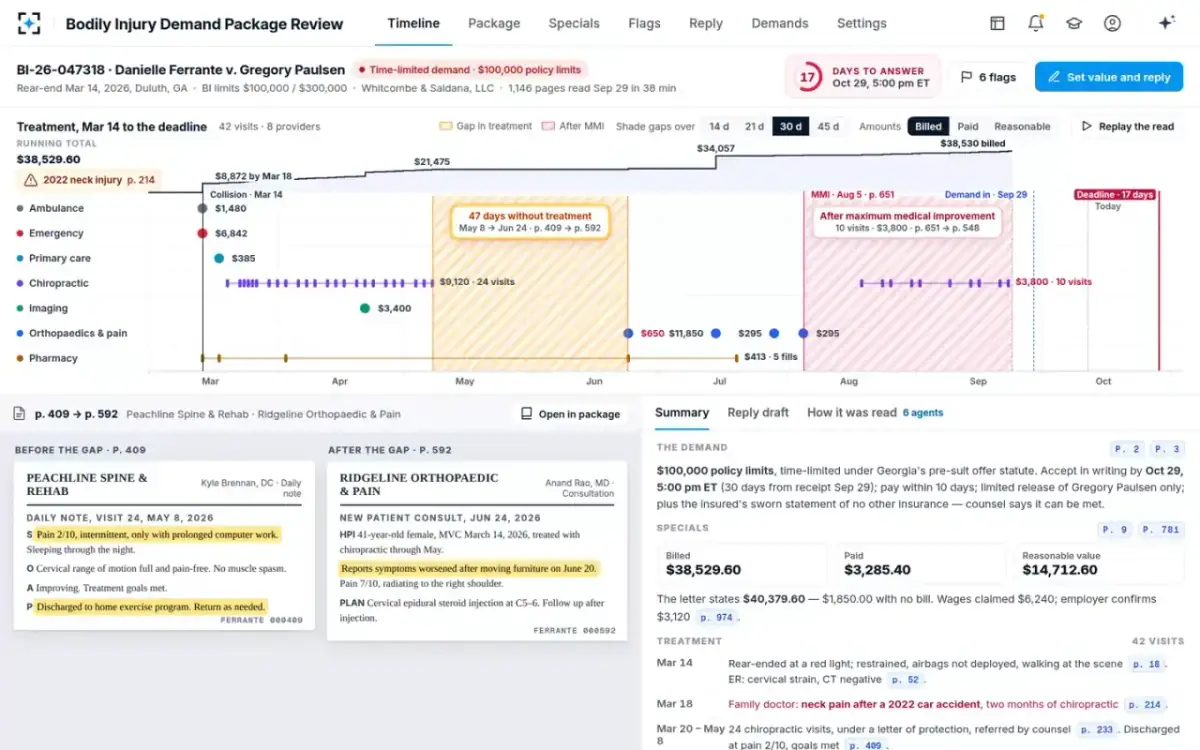
| 8 May | Pain 2/10, intermittent. Discharged to home exercise program. Return as needed. | p. 409 | The discharge that opens a 47-day gap. |
| 24 Jun | New consult: symptoms worsened after moving furniture on June 20. Pain 7/10. | p. 592 | An intervening event, in the history the claimant gave. |
| 29 Jul | Sixty percent better; surgery discussed; patient prefers to continue conservative care. No surgical referral made. | p. 640 | The record behind a $148,000 future surgery the letter claims. |
| 5 Aug | Patient has reached maximum medical improvement. Impairment 5%. No work restrictions. | p. 651 | The point after which further care needs its own support. |
| 19 Aug | Chiropractic re-evaluation: neck stiffness 3/10; resume care, 2 visits a week for 5 weeks. | p. 548 | Care that starts after MMI, with no new injury recorded. |
Notice what the right-hand column is not. It is not a conclusion that the 2022 injury caused the current complaints, or that the care after 5 August was unnecessary. Those are judgements for the adjuster, the review nurse and, if it comes to it, a physician. The chronology's job is to make sure nobody reaches them without seeing pages 214 and 651.
Inside the record summarizer: from one page to one line
The medical record summarizer works visit by visit. It reads each page the package sorter has dated and assigned to a provider, writes the visit's line, quotes the sentence it relied on and cites the original page number. It notes any statement of maximum medical improvement, restriction, earlier injury or referral as a separate field so the checker and the adjuster can find them without rereading. Every visit lands on the treatment timeline beside its bill, so the chronology and the specials come from the same pages.
One visit, from page 409 to a cited line the adjuster can open
Agent
Package sorterAssigns page 409 to Peachline Spine & Rehab, daily note, 8 May; links any faxed copy of it to this original.
Never: discards or renumbers a page
Agent
Medical record summarizerWrites the line: pain 2/10, intermittent; discharged to home exercise; return as needed. Quotes both sentences and cites p. 409.
Never: diagnoses or judges relatedness
Agent
Gap and causation checkerSees no visit until 24 June and shades the 47 days, citing p. 409 and p. 592.
Never: decides causation
A person decides
Bodily-injury adjusterOpens both pages side by side, reads them, and decides whether to ask for the records of the gap in her reply.
The chronology as a calendar, with the two pages behind a gap open below
How accurate is AI medical chronology?
Accurate enough to be useful and not accurate enough to go unchecked, which is why the citation matters more than the summary. The most detailed published error count we found comes from a 2025 study in npj Digital Medicine. Clinicians labelled every sentence of AI-generated clinical notes across 18 experiments and found "a 1.47% hallucination rate and a 3.45% omission rate" over 12,999 sentences; 44% of the hallucinated sentences were rated major. The task was writing notes from consultation transcripts, not summarising a demand package, so the rates do not transfer directly. The kinds of error do.
What kind of error an AI summary makes, in one published count
Two of those types are exactly the ones that move an injury claim. A negation turns "no surgical referral made" into a referral. A causal hallucination writes "due to the collision" where the record said nothing about cause. That is why the summarizer's rule is "no line without a page" and why it records what was said rather than what it implies: a reviewer who can open the quoted sentence will catch a negation in seconds, and a line that never states a cause cannot invent one. Omissions are the harder failure, because nothing on the screen shows what is missing. The defence there is completeness of the reading (every page assigned to a document and every visit on the calendar) and a checker that looks specifically for discharges, gaps and MMI statements.
The practical answer to "how accurate is it?" is therefore a test, not a vendor's percentage. Run the software on a set of your own closed files where a nurse or senior adjuster has already built the chronology, and count three things: lines that cite the wrong page, lines that say something the page does not, and visits or statements the software missed. How to set up that kind of start is covered in what you need to start an AI medical record summary.
Six tests for medical chronology software
Chronology tools are sold to both sides of an injury claim, and a tool built to help a firm prepare a demand can be very good at that. An insurer evaluating one needs to test for the things a claim file has to show. These six tests can be run in a demonstration on your own redacted packages, and a tool that cannot pass the first two is not a claims tool.
Six tests to run on any medical chronology software, on your own packages
- Open a random line and check its page
Every line should open the original page with the sentence it relies on visible. Pick ten lines at random; all ten should land on the right page.
- Find a sentence that cuts against the claim
A discharge note, a pain score of 2/10, “no surgical referral made”. If the chronology drops them, it was built to present, not to evaluate.
- Look for maximum medical improvement and restrictions
Ask where the MMI date and impairment rating are. They should be fields, not buried in a paragraph.
- Feed it the duplicates
Faxed copies and re-sent pages should be linked to the original, with the page numbers kept as received, not dropped or counted twice.
- Ask it a causation question
“Was the June care caused by the accident?” A claims tool should show the pages and decline to answer. A tool that answers is making a medical-legal call the file cannot defend.
- Reconcile it with the bills
Every visit should match a bill line and every bill line a visit. A chronology and a specials total built separately will disagree, and the disagreement is where the money is.
Where Bodily Injury Demand Package Review fits, and where it does not
It fits the insurer's side of a bodily-injury demand: a package arrives, often with a deadline, and someone has to evaluate it and answer. The summarizer is one of six agents; the others sort the package, read the demand's terms and start the clock, code and total the bills, check for gaps, care after maximum medical improvement and earlier injuries, and draft the reply from the value the adjuster sets. The chronology is therefore never a standalone document; it is the spine the specials, the flags and the reply all cite.
The package indexed in Bodily Injury Demand Package Review: fifteen documents, each cited page and where it is used
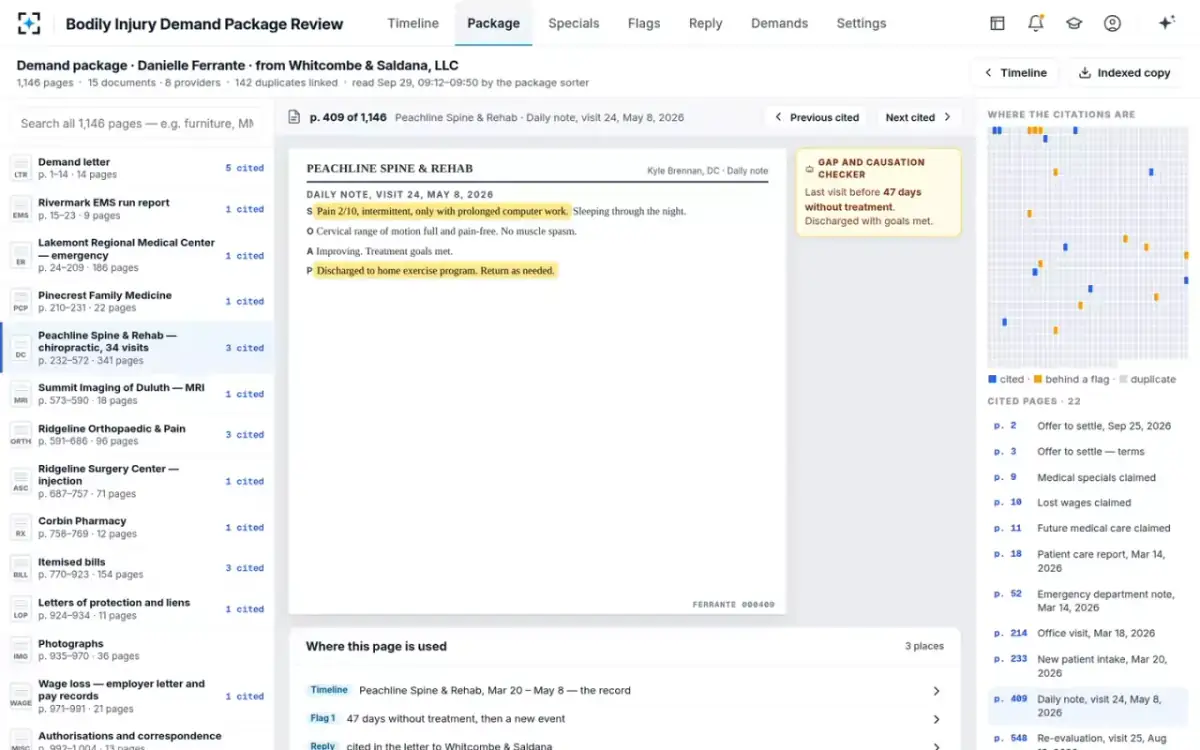
It does not fit everywhere. It is not a demand-writing tool for a claimant's lawyer, and it does not produce the narrative a demand letter needs. It is not a clinical tool: it never diagnoses, and it never decides relatedness, medical necessity or causation; those go to the adjuster and the medical review nurse, and legal questions to claims counsel. It is not a substitute for an independent medical examination or a physician review when a file needs one. And like any tool, it reads what is in the package; if the records of the gap were never sent, the right output is a request for them, which is what the reply in the sample asks for. For the comparison with outside summary vendors, see medical records summary companies against in-house review.
What the summarizer leaves to people, and why regulators care
The summarizer's limits are written into the product as rules, not settings: it never diagnoses, never judges relatedness or necessity, and never writes a line without a page. They exist because the decisions downstream are the insurer's, whichever tool helped. The NAIC's model bulletin on insurers' use of artificial intelligence, adopted in December 2023, is plain on the point: an insurer's actions are judged under the same unfair trade and unfair claims settlement laws whatever method was used to reach or support them. A valuation built on a chronology that missed a discharge note is the insurer's valuation.
Never diagnoses. Never judges relatedness or necessity. No line without a page.
The medical record summarizer's three fixed limits, as the solution states them
In practice that leaves four things firmly with people: the decision about what a gap or an earlier injury means for the value, any medical question (sent to the review nurse with only the cited pages), any question about the demand's validity (sent to counsel), and the value itself. The 47-day gap in the sample, and what such gaps prove and do not prove, is the subject of the guide to gaps in treatment.
Questions people ask
What is the difference between a medical chronology and a medical summary?
A chronology is ordered by date, one line per visit, and is built to be checked against the pages. A summary is a narrative that condenses the records into conclusions, and is easier to read but harder to verify. For claims, a cited chronology with a short summary on top gives both; the sample package on this page produced 42 visit lines and a one-screen summary, each line citing its page.
How do you write a medical chronology by hand?
Sort the records by provider and date, remove nothing but mark duplicates, then write one line per visit with date, provider, complaint, findings, diagnosis, procedure, plan and page. Note MMI statements, restrictions, earlier injuries and referrals in their own columns. Reconcile the lines against the itemised bills before relying on the totals.
Can AI create a medical chronology?
Yes, and it can do the reading and first draft in minutes; the sample package of 1,146 pages was placed on a timeline in about 14 minutes of the summarizer's time. Published error counts for AI clinical summaries are low but not zero, with omissions more common than fabrications, so the output needs page citations a person can check.
What should I ask a medical chronology software vendor?
Ask to run it on one of your own closed files, then open ten random lines and check each against its page. Ask how it handles duplicates, where it records maximum medical improvement and restrictions, and whether it will answer a causation question. A claims tool should show the pages and leave causation to people.
Is medical chronology software the same as medical bill review software?
No. Bill review software prices and edits medical bills, typically against fee schedules. A chronology summarises the clinical records. For an injury demand the two need to meet: each visit in the chronology should sit beside the bill line that charges for it, which is how the solution reconciles the lawyer's specials total to the bills.