Medical records summary companies are outside firms, often staffed by nurses, coders or legal assistants, that read a claimant's medical records and return a summary or a date-ordered chronology, usually priced per page or per file. For an insurer answering bodily-injury demands they are one of three ways to get a package read: by the adjuster in-house, by an outside summary company, or by software agents that read the package and leave the evaluation to the adjuster. The right choice depends on three things this guide puts numbers to: the cost per demand, the days the summary takes out of a response window, and who answers when a summary is wrong. Bodily Injury Demand Package Review is Botminds' solution in the third group; the comparison below is written to be useful whichever you choose.
Three ways to read an injury demand package
| In-house adjuster | Outside summary company | Agents, adjuster decides | |
|---|---|---|---|
| Who reads the pages | The adjuster, or a nurse on the carrier’s staff | The vendor’s reviewers | Six agents read every page; the adjuster reads the pages behind each flag |
| How it is paid for | Salaried hours | A fee per page, per file or per hour, plus the adjuster’s remaining hours | Software, plus the adjuster’s remaining hours |
| When the summary is ready | When the adjuster gets to it | After the vendor’s turnaround, plus sending and receiving | The day the package arrives |
| Page citations | As good as the adjuster’s notes | As the contract specifies | On every line, to the original page number |
| Specials and terms | Done by the adjuster | Sometimes included; often separate | Bills coded and reconciled; deadline started from receipt |
| Who answers for an error | The carrier | The carrier, with whatever recourse the contract gives | The carrier, with every line checkable against its page |
What do medical records summary companies do?
They turn records into something shorter that a decision-maker can use: a narrative summary, a chronology, sometimes a list of medical bills or a set of issues for a nurse or physician to look at. For a carrier, the value is capacity: a package that would take an adjuster a day goes out and comes back as a summary.
What they do not do is decide anything for the carrier. The evaluation, the value, the reply and the signature stay with the adjuster, and so does the reconciliation of the summary with the bills and the lawyer's letter unless the contract covers it. That is the first thing to price: not the fee, but the hours that remain on the desk after the summary arrives.
What does a medical record summary cost per demand?
Outside fees are quoted privately and vary by provider, page count and turnaround, so we found no independent published benchmark; ask each provider for a quote on the same three of your own packages. The in-house side can be priced. By Botminds' estimate, an adjuster working a package of about a thousand pages by hand spends about 13 hours on it. At the median pay the Bureau of Labor Statistics reports for claims adjusters, examiners and investigators, $37.51 an hour in 2025, that is about $488 of wages per package before benefits, overhead or the cost of the work it displaces.
Adjuster wage cost per thousand-page package, before any fee or software
Two things in that chart are easy to miss. The outsourced rows still carry five to eight hours of adjuster time, because finding gaps, care after maximum medical improvement and earlier injuries, checking the demand's terms and writing the reply are not usually what a summary company sells; and checking the vendor's summary against the pages costs time the chart leaves out. And the wage cost is not the main cost on a casualty desk. The main cost is the evaluations that go out on a partial reading.
A cost per demand you can compare across all three
Outside fee or software
price × pages, or per file
Zero for in-house. Quote on three of your own packages, not the provider’s sample.
Vendor manager
Adjuster hours left
hours × loaded hourly cost
Include checking the summary against the pages, reconciling it to the bills and writing the reply.
Claims operations
Nurse and specialist hours
hours × loaded hourly cost
Medical questions answered by the review nurse; BLS median pay for registered nurses was $46.90 an hour in 2025.
Medical review lead
Days of the window used
turnaround days ÷ window days
Not a dollar figure, but the one that turns a cheap summary into an expensive answer.
Casualty supervisor
What one week's queue costs to read
Scale makes the difference visible. The fictional sample unit used across these guides had nine open demands totalling 6,661 pages on 12 October 2026. At about 13 hours per thousand pages, that is roughly 87 adjuster hours, or about $3,250 of median wages, for one week's queue in one unit; at 2.7 hours per thousand pages it is about 18 hours, or $675. These are our sums on Botminds' estimate, not a measured result, and a carrier should replace the hours with its own. For the minute-by-minute reasoning behind them, see how long it takes to review 100 pages of medical records.
The hours that never leave the desk
Whichever way the package is read, four jobs stay with the adjuster: deciding what each gap, earlier injury and unsupported line means, setting the value, writing or approving the reply, and signing it. A fifth, the medical questions, goes to a nurse. None of them can be outsourced to a summary company or handed to software without the carrier losing the thing a regulator looks for, which is a decision someone at the insurer made and can explain. The NAIC's model unfair claims act puts the duty on the insurer, listing as an unfair practice not making a good-faith attempt at a prompt, fair settlement once liability is reasonably clear, when it is done flagrantly or as a general business practice. What that duty asks of the claim file is set out in the guide to bad faith failure to settle.
The useful question is therefore not "who reads the records?" but "how much of the adjuster's time goes into finding things, and how much into deciding?" By the same estimate, an adjuster working by hand spends most of her 13 hours finding: sorting, reading, totalling. With the agents, more than a third of her 2.7 hours is the reply, which is where judgement shows. A summary company moves some of the finding off the desk; it does not move the reconciliation of its summary with the bills and the letter unless it is paid to.
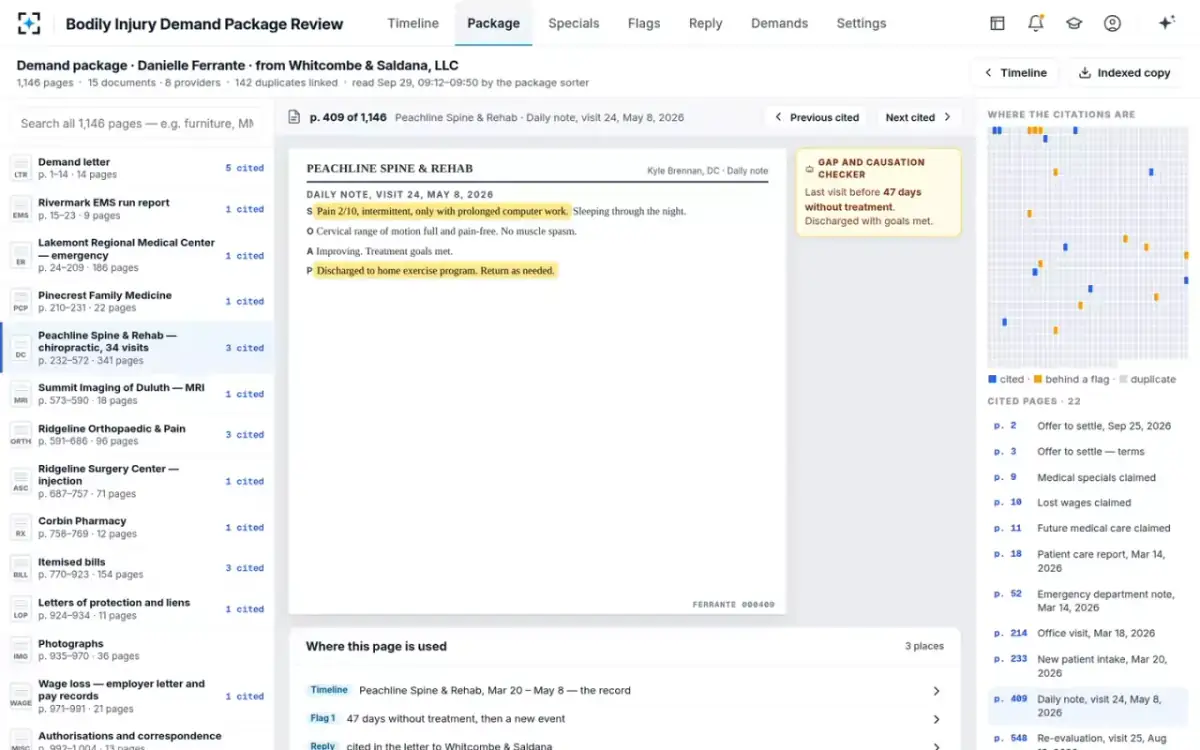
The package as indexed by the agents: what an outside summary would replace
The clock is a cost too
A summary that takes a week costs a week of the response window, and under a time-limited demand the window is fixed. Georgia's rewritten pre-suit offer statute requires at least 30 days from receipt for a motor vehicle claim; a lawyer can give more, but not less. Sending a package out, waiting for the summary and getting it back has to fit inside those 30 days together with everything else.
Thirty days to answer: a seven-day summary against a same-day read
- Packed and sent out
- Waiting for the summary7 d
- Review, nurse, value, reply12 d
- Spare10 d
- Read in 38 minutes
- Review, nurse, value, reply12 d
- Spare17 d
Spare days are not idle days. They are when the claimant's lawyer can answer a request for missing records, when counsel can review an unusual condition and when a supervisor can co-sign without a rush. The sample reply asked for four sets of records; with 17 days left, there was time for some of them to arrive before the deadline. What the rules require in that window is set out in how long an insurance company has to respond to a demand letter.
Who is responsible for errors in a medical summary?
The insurer. A summary is an input to the carrier's evaluation, and the duties to investigate, to evaluate fairly and to respond on time are the carrier's under its state's unfair claims rules, whoever produced the input. A contract can give the carrier recourse against a vendor; it cannot move the regulatory duty. That is why the page citation matters more than the polish of the summary: a claims file that shows the page behind each line lets the adjuster check the input before relying on it, and lets an examiner see that she did.
For software, the NAIC has said so explicitly. Its 2023 model bulletin on insurers' use of artificial intelligence expects a carrier's due diligence on systems bought from third parties to make sure any decision those systems make or support meets the legal standard the insurer itself is held to wherever a consumer could be harmed, and suggests contract terms giving the insurer audit rights and requiring the third party to cooperate with regulatory inquiries. A summary company that uses AI behind the scenes is a third-party AI system for this purpose, so ask whether it does.
Questions to put to any medical records summary company
The same questions work for an outside summary company, an in-house team and software, which is the point: they test the output a carrier relies on, not the provider's process. Ask for answers on your own redacted packages, not a provider's sample.
Eight questions for any provider of medical record summaries
- Does every line cite the original page number?
Not an exhibit or a document name: the page as received, so the adjuster can open it.
- Are discharges, gaps, MMI and restrictions captured as fields?
These move value. A narrative that mentions them in passing is easy to misread.
- Are duplicates kept and linked, never removed?
Removing pages changes the numbering the claimant’s lawyer and a court will use.
- Does the summary reconcile to the bills and the letter?
If not, the hours to do it stay on the adjuster’s desk; price them.
- What is the turnaround from receipt, in days, at your volumes?
Measure it against your shortest time-limited window, not your average.
- Who sees the health information, and where is it stored?
Name the people, the locations and the subcontractors. State privacy rules apply to the carrier’s handling.
- Is AI used, and how is it checked?
If yes, the NAIC bulletin’s third-party expectations apply: due diligence, audit rights, cooperation with regulators.
- What does the provider never do?
A claims provider should never diagnose, decide causation or medical necessity, or state a value. Ask to see it written down.
Where Bodily Injury Demand Package Review sits among the three
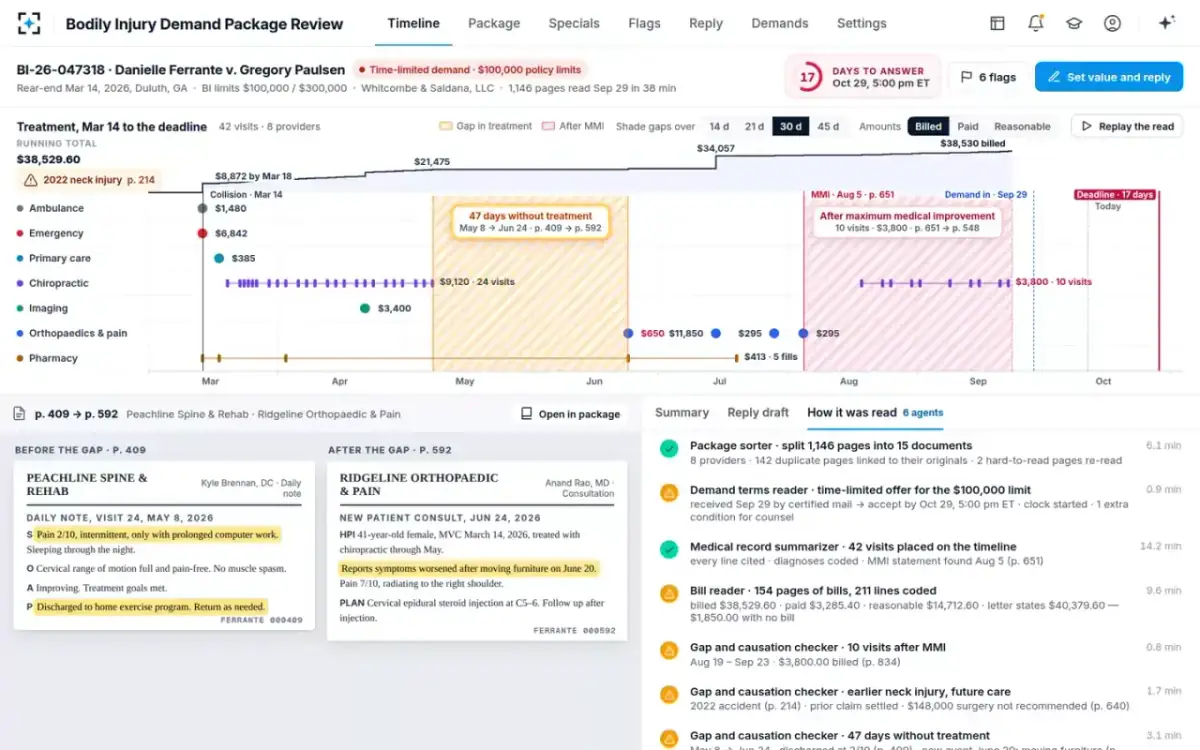
It fits a carrier that wants packages read the day they arrive, in-house, with every figure cited and the judgement left with its own people. The six agents sort the package, start the clock, build the chronology, code and total the bills, check for gaps, care after maximum medical improvement and earlier injuries, and draft the reply from the value the adjuster sets. The rules they apply are the carrier's settings, saved as a version and applied to the next package: the gap threshold, the reasonable-value benchmark, who co-signs and the state rules for time-limited demands.
How Bodily Injury Demand Package Review read the sample package: each step, what it found and how long it took
It does not fit everything a summary company may offer. It does not provide physician opinions, independent medical examinations or expert testimony; it routes medical questions to the carrier's own review nurse with the cited pages. It does not write demand letters for claimants. And it does not remove the need to check: the adjuster still reads the pages behind each flag before relying on it. A carrier that already uses a summary company for complex files can keep doing so; the solution reads the whole package either way, and the vendor's summary becomes one more document with pages to cite. Botminds offers to run it on a sample of a carrier's own past demand packages first, which is the right way to compare it with any provider. What to prepare for that is covered in what you need to start an AI medical record summary.
Questions people ask
How much does a medical record summary cost?
Outside providers quote privately, usually per page or per file, so get quotes on the same packages. The in-house side can be estimated: at the BLS 2025 median of $37.51 an hour for claims adjusters, about 13 hours of hand review on a thousand-page package is roughly $488 of wages, before benefits and overhead.
Should insurers outsource medical record review?
Outsourcing buys reading capacity, not decisions. It makes sense for overflow or unusual files if the turnaround fits the shortest response window and every line cites its page. The evaluation, the value and the reply remain the carrier's, and so does the responsibility for any error in the summary it relies on.
Who reviews medical records for insurance companies?
Bodily-injury adjusters review them for the evaluation, review nurses answer medical questions such as relatedness and necessity, and physicians or independent medical examiners are used where a medical opinion is needed. BLS reports a 2025 median of $46.90 an hour for registered nurses and $24.59 for medical records specialists, which is why who does which part of the reading matters to cost.
Is a medical records summary company covered by HIPAA?
It depends on whom it works for. A liability insurer is not a HIPAA health plan, so a vendor working for one is usually governed by the state privacy rules that apply to insurers and by its contract, not by a HIPAA business associate agreement. A vendor working for a provider or a health plan is a different case.
Can an outside summary company and software be used together?
Yes. The software reads every page on arrival and cites it; a vendor or nurse can then take the files that need clinical depth. In the solution, a vendor's summary is simply another document in the package, with its own pages, and the adjuster's evaluation still rests on the original records.