Attorney involvement in auto injury claims is now the normal case rather than the exception: about half of auto injury claimants had a lawyer in 2022, and the share of bodily injury claimants was higher. Represented claims cost more and stay open longer. How much of that cost the lawyer causes, and how much comes from the lawyer choosing the more serious claims, is the question that decides what early intervention is worth. Botminds' Litigation Propensity Prediction reads every open injury file each night, scores the chance that it turns toward a lawyer or a suit, and prices the options for each file that crosses the line. This guide sets out what the public research says representation adds, what it does not say, and how to build the unit cost of one turning file for a business case.
Attorney involvement in auto injury claims, 2017 to 2022
Half
of claimants represented in 2022 (nearly 50%), up from 40% in 2017, all coverages
18%
of claimants in litigation in 2022, up from 10% in 2017
7.8%
a year: growth in the average bodily injury payment, to more than $20,000
440days
nearly: the median time to closure for a represented BI claimant, more than double
How often are auto injury claimants represented by attorneys?
About half of them. The Insurance Research Council's 2026 study of 7.4 million auto injury claims found the share of claimants with attorneys rose from 40% in 2017 to nearly 50% in 2022 across all coverages, with bodily injury claimants seeing the largest increase, to 57%. Over the same years the share of claimants in litigation nearly doubled, from 10% to 18%.
The Council is supported by insurers, says it "does not lobby or advocate legislative positions", and drew its data from nine insurers with about 43% of the private passenger auto market. Its figures describe what happened to claims closed with payment. They do not say why claimants hired lawyers, or what the same claims would have cost without one.
Do represented claims cost more? Association versus cause
Yes, and by less than the raw gap suggests. Represented claims are, on average, the larger claims: more serious injuries, disputed liability, slower recoveries. A comparison of averages mixes the lawyer's effect with the injury's. The clearest public demonstration of the difference comes from workers' compensation, where the data cover every lost-time claim rather than only the ones that reach court.
Bogdan Savych of the Workers Compensation Research Institute, a non-profit whose funders include insurers and employers, and David Neumark of UC Irvine studied more than 950,000 workers' compensation claims with over a week of lost time, injuries from 2012 to 2019 in 31 states, published by the NBER in 2024 and in the Journal of Risk and Insurance in 2026. Unadjusted, represented workers received an average of $41,148 in indemnity against $7,957. Controlling for injury, worker, employer and location, the gap was about $30,500. Using instruments to strip out the selection of serious cases, the effect fell to "$7,700 to $12,400", which the authors call "a smaller effect than suggested by estimates that only reflect associations between payments and attorney involvement".
Three ways to measure what a lawyer adds to one claim, on the same 959,611 claims
What it compares: All represented claims against all unrepresented claims.
What it found: $41,148 against $7,957 in indemnity: a gap of about $33,000, mostly the selection of serious claims.
What it compares: Claims alike in injury type, hospitalisation, wage, age, industry, place and year.
What it found: About $30,500 more with an attorney: controls catch little of what lawyers select on.
What it compares: Only the variation in representation driven by local attorney use and by late first payments.
What it found: $7,700 to $12,400 more, still large: the median indemnity in the sample was $5,548.
Does attorney involvement increase settlements?
In workers' compensation, yes: the causal estimate is large, and the authors conclude that workers come out ahead even after their lawyer's fee. In auto liability, the public evidence is descriptive. The Insurance Research Council found that bodily injury claimants received about $2 in total settlement for every dollar of medical bills paid, a ratio that rose through the study period. It does not publish a causal estimate of what the lawyer added.
The Council also reports what claimants kept, and that figure points the other way. After medical costs and an assumed one-third legal fee, represented BI claimants kept $1.40 per dollar of medical bills, against $1.80 for claimants without a lawyer. The two findings can both be true, because the represented claims are different claims. What a carrier pays and what a claimant keeps are separate questions; the claimant's version is examined on should I get a lawyer for a car accident.
How long do represented injury claims take?
About twice as long. In the Council's data, the median represented bodily injury claimant waited nearly 440 days for the claim to close, more than double the wait without a lawyer. Part of the gap is the claims themselves: represented claims include more serious injuries, which take longer to treat, and a lawyer may wait until treatment ends before sending a demand.
Time is a cost in its own right. An open file carries a reserve, handling hours, diary reviews, records requests and the risk that the medical picture worsens. If it goes into suit, the federal courts' own statistics show the timescale: civil cases that end during trial take a median of 30.7 months from filing, and the distance from suit to trial is set out on what percentage of personal injury cases go to court.
How much do defense costs add to a claim?
Nationally, defense and cost containment ran at 3.9% of direct premiums earned for U.S. property and casualty insurers in 2023 and 2024, according to the Federal Insurance Office, "after having remained almost flat at about 4.5 percent between 2015 and 2020". That is a book-wide average across all lines. On a single litigated injury file the defense bill is a large share of the cost, and it is paid whether the case is won or lost.
The Florida series shows how much the law moves it. FIO reports that "Florida P&C insurers’ defense costs and containment expenses incurred as a percentage of direct premiums earned declined to 5.1 percent in 2024", after rising to 6.6% in 2022, before the state's 2023 reforms. For a unit cost, the right number is the carrier's own: defense paid per litigated injury file, by venue and line, from closed files.
The unit cost of one turning file
The unit cost of a file that turns is the difference between two routes for the same claim: resolved before a lawyer, or represented and sued, plus defense. Public research supplies the direction and the order of magnitude. The amounts have to come from the carrier's closed files, because they depend on its venues, its lines and its limits.
Take a fictional sample file as the solution prices it. Claim BI-26-118430: a commercial box truck rear-ended Denise Albright's car at a red light in Chicago, liability clear, an L4-L5 herniation on MRI and an epidural injection booked. Overnight, her file moved from 41 to 78 on a call note that said "my lawyer said". The next-step writer found 214 similar closed files on the sample carrier's books and priced three routes. In similar files, a letter of representation followed within two to four weeks in 7 of 10.
One sample file, two routes: what the solution estimates each would cost
Three routes for one file, priced from similar closed files
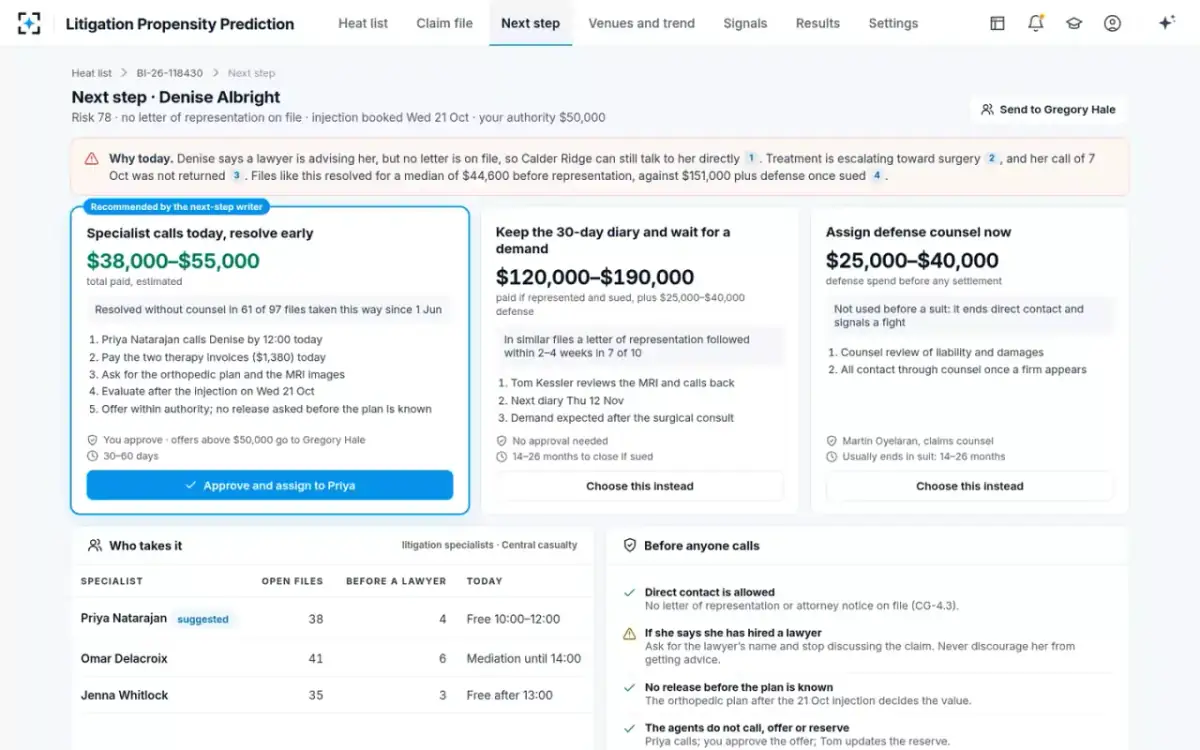
A carrier's business case multiplies that difference by two rates it can measure: how many files cross the threshold, and how many of those a specialist resolves before a letter. In the sample carrier's first four and a half months live, 168 files crossed 75, 97 were reached before a lawyer's letter and 61 resolved without counsel. Those are sample figures. The method is the point: count your own files, price your own routes, and count the early resolutions you would not otherwise have had.
Expected value, not the worst case
A business case built on the gap between the two routes overstates the saving, because not every flagged file would have turned and not every early call succeeds. The honest unit is the expected cost of each route. The sample figures allow a worked example, with its assumptions in the open.
In the solution's test on the sample carrier's 2025 closed files, 59% of files scoring 75 or above were sued. If the 41% that were not sued would have settled at about the early-resolution midpoint, waiting costs an expected 0.59 × $187,500 + 0.41 × $46,500, about $129,700 per file. Acting early succeeded on 61 of 97 files in the sample carrier's first months live; if every other file went the litigated route, acting early costs an expected 0.63 × $46,500 + 0.37 × $187,500, about $98,700. The difference is roughly $31,000 a file: real money, and less than a quarter of the $141,000 gap between the two midpoints.
The assumptions move the answer, and each can be replaced with the carrier's own measure: the suit rate in the band, what unsued files really settled for, how often early contact works, and what happened to the files that were represented anyway. The method also shows why the threshold matters. At a lower band, where only 30% of files were sued in the sample test, the expected saving per file falls sharply, and the specialist's time is better spent higher up the list.
What early resolution of a turning file is worth, term by term
Indemnity avoided
paid if represented − paid if resolved early
Use the causal share, not the raw gap: the raw gap includes injuries a lawyer would have chosen anyway.
Claims and actuarial, from closed files
Defense avoided
defense paid per litigated file × files kept out of suit
Book-wide DCC was 3.9% of premium in 2023–24; per litigated file it is far higher.
Claims legal, from counsel invoices
Months avoided
months open if sued − months if resolved early
Handling, reserves, records and the risk of a worse medical picture.
Claims operations
Cost of acting early
specialist hours + undisputed bills paid sooner
Some early payments are owed anyway; the true cost is mostly time.
Claims operations
The cost lever the insurer controls: delay
Some of what drives representation is the insurer's own pace. In the Savych and Neumark data, a first indemnity payment more than 30 days after the start of disability raised the chance of an attorney by 18 percentage points after controls; 50% of those workers had a lawyer, against 29% paid within 30 days. The authors' explanation is plain: "Workers may interpret a delay as a denial and may seek an attorney."
The liability-file equivalent is visible in the sample file: a voicemail about two unpaid therapy invoices, $1,380, not returned, and an offer nobody had begun to discuss. The specialist's first actions on approval were to call, send the two invoices for payment and ask for the orthopedic plan. Paying what is owed on time is not a concession. On the workers' compensation evidence, it is also one of the cheapest ways to keep a claim from becoming a represented one.
One driver of attorney involvement in the public data sits entirely with the insurer: how long it takes to pay what it already owes.
What the numbers do not justify
They do not justify discouraging anyone from getting advice, and the sample unit's guideline says so in terms: if a claimant says she has hired a lawyer, the specialist asks for the name and stops discussing the claim. They also do not prove that unrepresented settlements are the right amount. Savych and Neumark are explicit that their data cannot say whether lawyers recover benefits workers were entitled to or push payouts too high: "Establishing whether the latter is true or not is not possible with the data available for this study."
What they do justify is speed and attention. A file that is turning is cheaper to resolve fairly before both sides have spent money on it. That is the case for reading every open injury file nightly, and for pricing options from closed files instead of from instinct, as Litigation Propensity Prediction does. Where a valuation then has to be defended, the work moves to bodily injury claim valuation and to the person who holds settlement authority.
Questions people ask
How often are auto injury claimants represented by attorneys?
About half of auto injury claimants across all coverages had an attorney in 2022, up from 40% in 2017, and 57% of bodily injury claimants, according to the Insurance Research Council's study of 7.4 million closed claims. The Council is an insurer-supported non-profit.
Do represented claims cost more?
Yes, but much of the raw gap reflects which claims lawyers take. In a study of more than 950,000 workers' compensation claims, the unadjusted indemnity gap was about $33,000, while the causal estimate was $7,700 to $12,400.
How long do represented injury claims take?
The Insurance Research Council found a median of nearly 440 days to closure for represented bodily injury claimants, more than twice the time for those without a lawyer. Files that go into suit take longer still.
What is the cost of litigation on an injury claim?
Indemnity on the litigated route, defense spend and months of handling. In the sample file, the solution estimated $38,000–$55,000 to resolve early against $120,000–$190,000 plus $25,000–$40,000 of defense if represented and sued; a carrier's own figures come from its closed files.
How much do defense costs add to a claim?
The Federal Insurance Office puts industry-wide defense and cost containment at 3.9% of premium in each of 2023 and 2024. On a single litigated injury file the share is much larger, which is why it belongs in any unit cost.