A claims triage model sorts claims into handling routes: fast track or desk, field or specialist, special investigation or not. Most triage happens once, at first notice, on what is known that day; that kind is compared in claims triage solutions. Injury files need a second kind of triage that never stops, because the facts that decide their route arrive later: a lawyer mentioned on a call, a surgical consult, a bill nobody paid. Botminds' Litigation Propensity Prediction is a continuous triage model for that purpose. Six agents read every open injury file each night, score its chance of a lawyer or a suit from 0 to 100 with the phrase behind every point, and route it by thresholds the claims unit sets: a heat list at 60, a same-day specialist at 75. This guide is about those thresholds and the other settings around them, because they, not the model, decide what the desk does each morning.
The settings that make up an injury claims triage model, as one unit sets them
| Setting | Sample unit value | Who may change it | Why it matters |
|---|---|---|---|
| Lines in scope | Commercial auto BI · personal auto BI · general liability premises and products | Claims leadership | A score tested on one line is not tested on another |
| Read time | Every night at 02:00, and within 10 minutes of a letter of representation | Claims operations | A letter changes who may be contacted that day |
| Never read | Claims and defense counsel communications | Fixed | Counsel’s advice must not appear in a score others can open |
| Heat list | Files at 60 or above | With a second approver | Sets the length of the supervisor’s morning list |
| Moved overnight | 10 points or more, up or down | With a second approver | Movement, not level, is what a supervisor has not yet seen |
| Same-day specialist | 75 or above | With a second approver | Must match the specialists’ capacity |
| Who decides | Supervisor to $50,000; claims manager above; claims counsel assigns counsel | With a second approver | The score routes; a named person decides |
| Never in the score | Race, ethnicity, religion, national origin, sex, income, ZIP code | Fixed | Excluding a field is enforced in the product, not in a policy |
| Signal weights | Version 7, approved by claims counsel and model risk | After a closed-file test and a second approver | Every change is tested before it reaches a file |
What is a claims triage model?
A claims triage model is a rule, a score or both that decides which route a claim takes and who handles it. "Claims triage" in insurance usually means the first sort at first notice: by line, severity, coverage questions and fraud indicators. The model can be a decision table written by claims leadership or a statistical score with thresholds; in practice most are a score inside a table, because the routes and the authority to use them are business decisions.
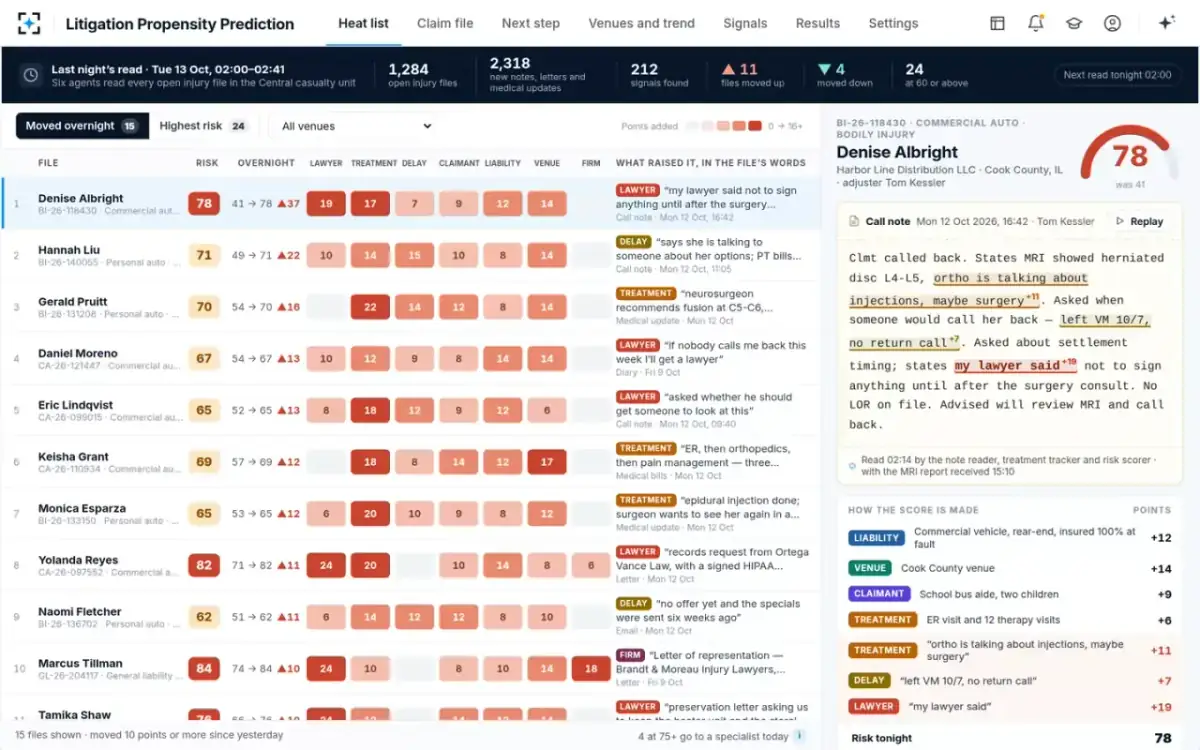
For bodily injury, a one-time sort is not enough. The facts that predict a lawyer or a suit appear weeks later, and they appear in text. A triage model for injury files has to re-score every open file as its notes, letters and medical updates arrive, and re-route the ones that move. The nightly read in the sample unit covers 1,284 open files and every new document since the night before.
How are injury claims triaged?
Twice, in a well-run unit: once at first notice and continuously afterwards. First-notice triage uses what is known on day one, the line, the vehicle, the injury described, the liability picture and the venue. In the sample file, those standing facts were worth 41 points by early September: a commercial truck, a rear-end collision with the insured fully at fault, Cook County, an emergency visit and twelve therapy sessions, and a claimant a jury would like.
Continuous triage adds what happens next. On 12 October the adjuster's call note recorded three new facts: surgery being discussed, an unreturned voicemail, and "my lawyer said". That night the file moved to 78, and the route changed from a 30-day diary to a specialist call the same day.
Score, threshold, route: one injury file through the triage model
Agent
ReadEvery open injury file at 02:00, only the documents new since the last read; again within 10 minutes of a letter of representation.
Never: reads claims or defense counsel communications
Agent
ScoreAdds each signal’s points, capped per family, into a 0–100 score with the change since the last read.
Never: uses race, ethnicity, religion, national origin, sex, income or ZIP code
Agent
Threshold60 or above: on the heat list. Moved 10 or more: on the overnight list. 75 or above: specialist the same day.
Agent
RouteDrafts the next step with options priced from similar closed files and names who may approve it.
Never: contacts, offers, reserves or assigns counsel
A person decides
Claim supervisorApproves, changes or rejects the route within her authority; dismisses any signal with a reason.
A person decides
Litigation specialistTakes the file with the contact rules and the release rules in front of her before the call.
What thresholds route a claim to a specialist?
The ones your own closed files and your specialists' capacity support, and nothing more general than that. A threshold trades how many turns it catches against how many files it sends. The sample carrier's 2025 closed-file test, scored 30 days before suit or closing, shows the trade in four bands.
Where a year of injury files and suits fell by score band, in the sample test
| Score band | Files | Share of all files | Suits | Share of all suits | Sued in the band |
|---|---|---|---|---|---|
| 75–100 | 240 | 3.5% | 141 | 49.3% | 59% |
| 60–74 | 268 | 3.9% | 80 | 28.0% | 30% |
| 40–59 | 1,014 | 14.6% | 41 | 14.3% | 4.0% |
| 0–39 | 5,402 | 78.0% | 24 | 8.4% | 0.4% |
| All | 6,924 | 100% | 286 | 100% | 4.1% |
Read across the rows. The top band holds 3.5% of files and half the suits. The two bands above 60 together hold 7.3% of files and 77% of suits. Lowering the line to 40 would add 1,014 files a year to the list to catch 41 more suits, one in every 25 files added. That is the arithmetic behind the sample unit's choice of 60 for the list and 75 for a same-day call.
Setting the same-day threshold from capacity
The same-day threshold must produce no more files than the specialists can call that day. In the sample test, 240 files a year scored 75 or above, between four and five a week. The sample unit has three litigation specialists carrying 35 to 41 open files each. Four or five new same-day files a week across three people is a load they can absorb; forty would not be, and a same-day rule that cannot be met becomes a next-week rule in practice.
The capacity check behind a same-day threshold, in the sample unit
240a year
files at 75 or above in the closed-file test
4.6a week
new same-day files for the specialist desk
3
litigation specialists, 35 to 41 open files each
59%
of files at 75 or above were sued in the test
What attributes cannot be used in a claims model?
Protected characteristics, and anything a state forbids, with the list depending on the state. Colorado's SB21-169 bars insurers from unfairly discriminating by race, color, national or ethnic origin, religion, sex, sexual orientation, disability, gender identity or gender expression through external data, algorithms or predictive models, and requires a framework to test for it, with an attestation by the chief risk officer that it has been "implemented the risk management framework appropriately on a continuous basis".
The sample unit's model excludes race, ethnicity, religion, national origin, sex, income and ZIP code, and both the exclusion list and the privileged-communication exclusion are fixed settings that no supervisor can change. A triage model also has to respect rules about what the route may do. Connecticut fined an insurer $2,500 in 2023 for a file where bodily injury negotiations were started or releases taken within 15 days of the accident, and the NAIC model regulation bars telling a third-party claimant that rights may be impaired if a form or release is not completed by a date. An early-contact route that ignores those rules creates the exposure it was built to avoid.
Thresholds, authority and exclusions, as settings
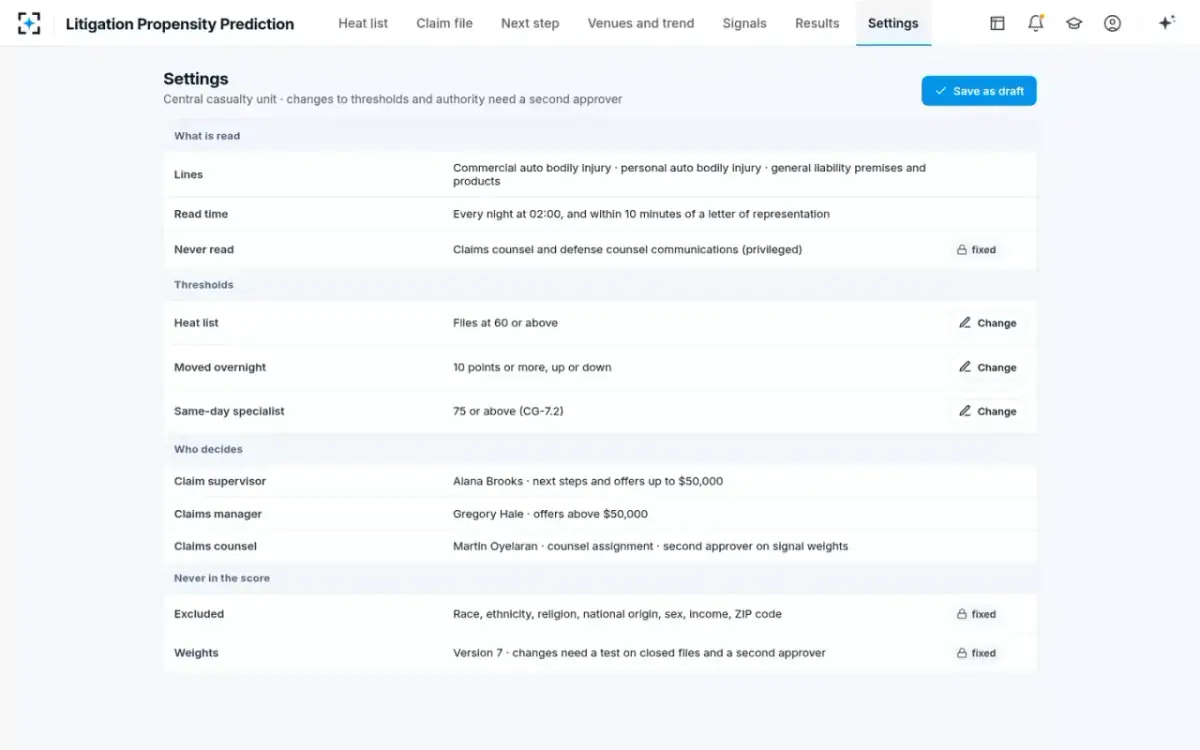
Who sets the rules for a triage model?
Claims leadership owns the routes and the thresholds; model risk and claims counsel own the weights; nobody owns them alone. The NAIC's model bulletin on insurers' use of AI asks insurers to document their governance structure, including "Scope of responsibility and authority, chains of command, and decisional hierarchies", and to identify "constraints and controls on automation and design".
In the solution that is literal. Each threshold and each authority amount is a setting; a change is saved as a draft and takes effect only when a second approver signs it, and signal weights change only after a test on closed files. The current weights, version 7, were approved by the sample unit's claims counsel and its model risk lead. A regulator asking who decided that a file at 74 waits for the diary gets a name and a date.
How often should triage thresholds change?
When the evidence or the capacity changes, and not otherwise. Good reasons: a closed-file test shows a band's suit rate has moved; the specialist desk has gained or lost a person; a law change has altered what turns a file, as Florida's 2023 move to modified comparative negligence did; or the share of files at 75 or above has drifted so far that the same-day rule is no longer being met. The NAIC bulletin expects "Validating, testing, and retesting as necessary", and a threshold is part of what was validated.
Bad reasons are just as common: a month with an unusual suit, or a wish to make the list look busier or quieter. A quarterly review of band outcomes and dismissal reasons, with a change only when both point the same way, keeps the thresholds stable enough for the desk to trust. What a validator looks for in that review is set out in what to validate in a litigation score.
The morning list the thresholds produce
Buying a claims triage model: settings you should own
A vendor that cannot show you these as settings, with who may change each one, is selling a score, not a triage model. Ask for the settings screen before the accuracy slide.
Before buying a claims triage model for injury files
- Are the thresholds yours?
List, movement and same-day lines set by you, changed with a second approver, with a history.
- Can you see the band outcomes on your closed files?
Files, suits and suit rate per band, so the thresholds can be argued from evidence.
- Does the triage run continuously?
Nightly on every open file, plus an immediate read when a letter of representation arrives.
- Are exclusions fixed?
Protected characteristics, income, ZIP code and counsel communications, enforced by the product.
- Does the route respect your contact and release rules?
Early-contact limits and release language belong in front of the specialist before the call.
- Is authority a setting?
Who approves what, by amount, so the score can route but never decide.
- What does a threshold change require?
A test on closed files and a named second approver, recorded with the date.
Litigation Propensity Prediction fits units that want a continuous triage of open injury files with every point shown and every line owned. It is not a first-notice triage engine for all claims, and it does not route fraud or coverage questions; those belong to other parts of the claim operation. The desk the routed files reach is described in the attorney represented bodily injury adjuster's desk.
Questions people ask
What is a claims triage model?
A rule, a score or both that decides which route a claim takes and who handles it. For injury files the triage has to run continuously, because the facts that predict a lawyer or a suit arrive weeks after first notice.
What does claims triage mean in insurance?
Sorting claims by complexity and risk so each gets the right handler and handling. In the sample injury unit, files at 60 or above go on the supervisor's list and files at 75 or above go to a litigation specialist the same day.
What thresholds route a claim to a specialist?
Ones your closed files and capacity support. In the sample test the top band held 3.5% of files and 49.3% of suits, and produced between four and five files a week for a three-person specialist desk.
What attributes cannot be used in a claims model?
Protected characteristics, and in Colorado any external data or model that unfairly discriminates by race, color, national or ethnic origin, religion, sex, sexual orientation, disability, gender identity or gender expression. The sample model also excludes income and ZIP code as fixed settings.
Who sets the rules for a triage model?
Claims leadership sets routes and thresholds, model risk and claims counsel approve weights, and every change needs a second approver. The NAIC's AI bulletin asks insurers to document exactly this kind of chain of authority.
How often should triage thresholds change?
When band outcomes, capacity or the law change, typically reviewed quarterly, and only after a closed-file test. Changing them for one unusual month makes the list harder to trust.