What percentage of personal injury cases go to court depends on what "go to court" means. If it means a lawsuit is filed, the best recent figure for auto injury claims is about 18% of claimants in 2022, from an insurer-supported study of 7.4 million claims. If it means a trial, the share is far smaller: of the federal motor vehicle injury lawsuits that ended in the year to September 2025, 0.7% ended during or after a trial, and in a national survey of state courts, trials were about 3% of civil dispositions. Most personal injury claims settle without a suit, and most suits settle or are dismissed without a trial. For an insurer the expensive turn is the first one, from claim to suit, and that is what Botminds' Litigation Propensity Prediction is built to see coming: it reads every open injury file each night and scores the chance of a lawyer or a suit, with the phrase behind every point. This guide walks the funnel, stage by stage, with the public numbers.
The personal injury funnel narrows twice: at the suit, and again before trial
Auto injury claimants, 2022 (all coverages)
- No lawyer · 50%
- Lawyer, no lawsuit · 32%
- In litigation · 18%
Federal motor vehicle injury cases ended, year to Sept 2025 (5,333)
- No court action · 20%
- Ended before pretrial · 53%
- During or after pretrial, incl. 37 trials · 27%
What percentage of personal injury cases go to court?
For auto injury claims, roughly one claimant in five ends up in litigation; well under one lawsuit in a hundred in federal court reaches trial. The first figure comes from the Insurance Research Council's 2026 study of claims closed with payment between mid-2017 and mid-2022, contributed by nine insurers with about 43% of the U.S. private passenger auto market: "Litigation rates nearly doubled over the same period, from 10% to 18% of claimants." The Council is supported by insurers, so its figures are best read alongside public court data, which tell the rest of the story.
The rest comes from the courts. The federal judiciary publishes every civil case it closes by type and by the stage at which it ended. Motor vehicle injury cases reach federal court mainly when the parties are from different states, so they are a slice of the total, not the whole; many more injury suits are filed in state courts, which do not publish a national table of this kind every year. The pattern, though, is the same in every source: suits are common, trials are rare.
How many personal injury claims go to court?
Fewer than are represented by a lawyer, and more than a decade ago. In the Council's data, the share of claimants with attorneys rose from 40% in 2017 to nearly 50% in 2022, and the share in litigation rose from 10% to 18%. A letter from a lawyer is not a lawsuit: about two in three represented auto injury claimants in 2022 were not in litigation, on our arithmetic from those two figures. What a letter of representation changes, and what it does not, is set out in the letter of representation guide.
The rise in litigation matters more to insurers than the rise in representation. A suit adds defense counsel, discovery, court deadlines and a trial date that both sides must prepare for even if it never comes. Defense and cost containment across the U.S. property and casualty industry ran at 3.9% of direct premiums earned in 2023 and 2024, according to the Federal Insurance Office.
Why litigation rates rose from 10% to 18%
The public sources describe the rise more precisely than they explain it. The Insurance Research Council reports the rise alongside growing attorney involvement and longer settlement timelines, and its press release frames rising representation and litigation as drivers of claim costs. It does not separate the causes of the rise, and as an insurer-supported body it measures what insurers see.
The Federal Insurance Office, part of the U.S. Treasury, lists what insurers point to: "Factors cited as contributing to litigation costs include: (1) class action lawsuits, (2) high jury verdicts, (3) litigation funding by outside third parties", among others. On the last of these it reports that "Currently, at least 21 states have adopted laws or regulations governing TPLF", the funding of lawsuits by outside investors. Those are factors cited, not measured causes. What can be said with confidence is that the share of auto injury claims that become suits nearly doubled in five years, and that each suit carries costs whether or not it is ever tried.
Where personal injury lawsuits are filed: mostly state court
Most personal injury suits go to state court because federal court is open to them only in limited cases. A typical car accident claim reaches federal court on diversity jurisdiction, which requires both that the parties are from different states and that the matter in controversy "exceeds the sum or value of $75,000, exclusive of interest and costs". A local crash between residents of the same state, or a smaller claim, stays in state court.
That is why the federal tables on this page describe a particular slice: larger claims between parties from different states, decided under federal procedure. State courts publish their own statistics, court by court, and the national state-court survey that would allow a direct comparison was last run for 2005. A reader comparing figures should compare like with like: claims with claims, suits with suits, and trials with trials.
Do most personal injury cases settle?
Yes. Most claims settle without a suit, and most suits end without a trial, by settlement, dismissal or another disposition. The federal courts' Table C-4 for the year to 30 September 2025 shows how the 5,333 federal diversity motor vehicle injury cases ended: 1,079 with no court action, 2,840 after court action but before pretrial, 1,377 during or after pretrial, and 37 during or after a trial, 34 of them before a jury.
How 5,333 federal motor vehicle injury cases ended, year to 30 September 2025
| Stage at which the case ended | Cases | Share |
|---|---|---|
| No court action | 1,079 | 20.2% |
| Court action, before pretrial | 2,840 | 53.3% |
| During or after pretrial | 1,377 | 25.8% |
| During or after trial (34 jury, 3 non-jury) | 37 | 0.7% |
| All cases | 5,333 | 100% |
The courts' tables count how cases end procedurally, not whether money changed hands. A case that ends "before pretrial" may have settled, been dismissed, or been resolved by a motion. Settlement amounts are generally private, which is why public research on injury values leans on trial verdicts, the small and unusual minority of cases that did not settle.
What percentage of lawsuits go to trial?
Under 1% of federal civil cases, and a few percent in state courts. Across all 407,379 federal civil cases terminated in the year to September 2025, Table C-4 prints 0.4% reaching trial. For motor vehicle injury cases on diversity jurisdiction it prints 0.7%. Motor vehicle injury cases in which the United States is a party reach trial more often: 32 of 894, 3.6%, all but one decided by a judge.
The most recent national survey of state courts is older. The Bureau of Justice Statistics found that in 2005, among the jurisdictions that could report all their dispositions, "trials collectively accounted for about 3% of all tort, contract, and real property dispositions in general jurisdiction courts". Motor vehicle accident cases were the most common type of civil case tried, 35% of the approximately 26,950 civil trials that year. The data are two decades old; the proportion, trials as a small minority, is consistent with the federal figures above.
Trials are the exception at every level of the court system
0.4%
of all federal civil cases ended in the year to Sept 2025 reached trial
U.S. Courts, Table C-4
0.7%
of federal motor vehicle injury cases on diversity jurisdiction
U.S. Courts, Table C-4
3%
about: the share of state general civil dispositions that were trials in 2005
Bureau of Justice Statistics
How long does it take to get to trial?
In federal court, a civil case that ends during trial has a median of 30.7 months from filing, about two and a half years. The same table, C-5 for the year to September 2025, gives 15.6 months for all civil cases and 5.1 months for cases that end with no court action. State court times vary by state and court and are not published in one national table.
Median months from filing to disposition, U.S. district courts, by when the case ended
Before the suit there is the claim. In the Council's auto injury data, represented bodily injury claimants waited a median of nearly 440 days for closure, more than twice as long as claimants without a lawyer. For a represented claim that becomes a suit and then goes to trial, the whole journey from accident to verdict can run three or four years.
Why trial numbers mislead claimants and adjusters
Because the cases that reach trial are the ones that could not settle, and they are not typical. They include claims where liability was genuinely disputed, where the two sides valued the injury very differently, or where one side wanted a verdict for its own reasons. Published verdicts are a filtered sample of an already rare event. They are useful for what juries in a venue do with a contested case, and misleading as a guide to what an ordinary claim is worth.
A suit is common and expensive. A trial is rare and memorable. Planning around the memorable one misprices the common one.
For an insurer, the practical risk sits at the suit. A suit starts court deadlines, defense spend and discovery on every case, and only a few of them ever see a jury. Venue and plaintiff firm still matter, because they shape what a case would be worth if it were tried, and that shapes every settlement before trial. The valuation side of that question, and how little the rare verdict should weigh in it, is taken up in jury verdict search for claim valuation.
What a litigation score should predict: the suit, not the trial
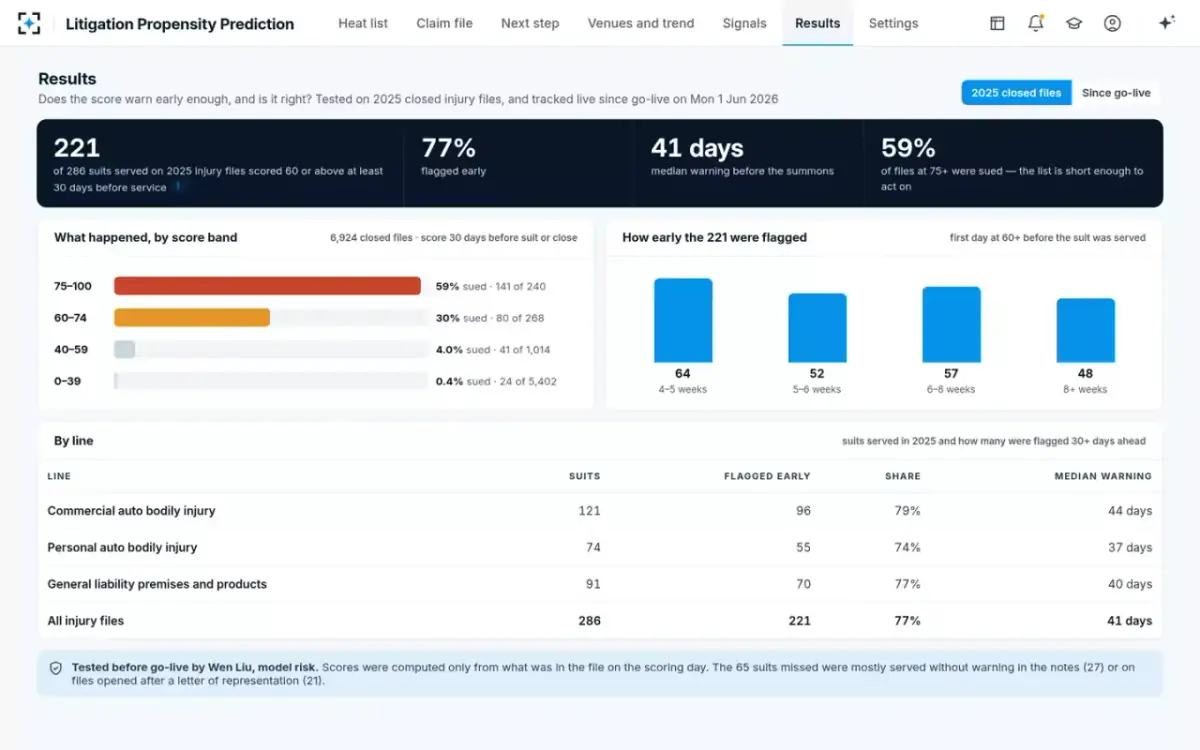
A score built to predict trials would be predicting an event too rare to act on. The useful target is the turn from claim to lawyer and from lawyer to suit, while a direct resolution is still possible. That is the target in Litigation Propensity Prediction, and its sample closed-file test shows what it looks like: in the fictional sample carrier's 2025 injury book, 286 of 6,924 closed files were sued, 4.1%, and 221 of those suits had scored 60 or above at least 30 days before service, with a median warning of 41 days.
Testing a suit score on a year of closed files
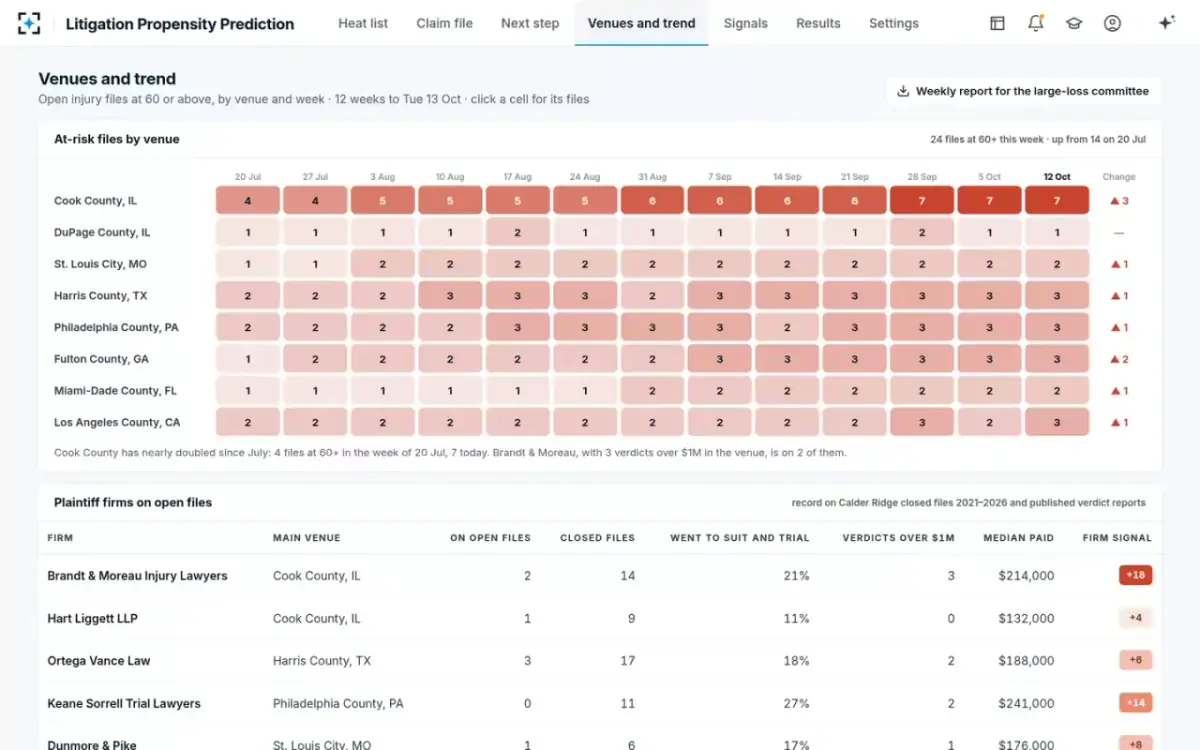
The venue and firm signals are where the trial-level data does come in. The solution's venue and firm profiler names the court a suit would be filed in and profiles plaintiff firms from closed files and published verdict reports, citing every number. A firm that tries cases more often than its peers changes the value of every file it takes, even though most of those files will still settle. How that differs from court analytics tools is covered in litigation prediction AI vs litigation analytics.
Where the at-risk files would be filed, and who would bring them
Questions people ask
What percentage of personal injury cases go to court?
For auto injury claims, about 18% of claimants were in litigation in 2022, according to the Insurance Research Council. Far fewer reach trial: 0.7% of federal motor vehicle injury cases that ended in the year to September 2025 ended during or after a trial.
Do most personal injury cases settle?
Yes. Most claims settle without a lawsuit, and most lawsuits end before trial; of 5,333 federal motor vehicle injury cases that ended in 2025, 73.5% ended before pretrial or with no court action at all.
What percentage of lawsuits go to trial?
About 0.4% of all federal civil cases terminated in the year to September 2025 reached trial. In the last national survey of state courts, for 2005, trials were about 3% of tort, contract and real property dispositions.
How long does it take to get to trial?
In federal court, cases that end during trial have a median of 30.7 months from filing. For the claim as a whole, represented auto injury claimants waited a median of nearly 440 days to closure in the Insurance Research Council's data.
What percentage of injury claims are litigated?
About 18% of auto injury claimants in 2022, up from 10% in 2017, in the Insurance Research Council's data across all coverages. About half of claimants had a lawyer, so most represented claimants were not in litigation.
What percentage of personal injury cases settle before trial?
Courts do not publish settlement rates, because settlements are rarely reported to them. What they publish is how cases end: in federal motor vehicle injury cases in 2025, 99.3% ended before reaching trial.