Machine learning on claims data is used across the claim's life: to triage first notice, flag fraud, estimate severity and reserves, and predict which claims will draw a lawyer or a lawsuit. Most of these models are trained on structured fields such as injury codes, payments, dates and claimant details. For litigation, those fields are thin. The signs that a bodily injury claim is turning are written down in the adjuster's notes, the claimant's letters, the medical bills and records, and they change daily. Botminds' Litigation Propensity Prediction is built for that text. Six agents read every open injury file each night, quote the phrase behind every point of a 0–100 score, and put the files that moved in front of a claim supervisor by morning. This guide follows one fictional sample file through one night to show what that reading involves, and what a buyer should ask of any vendor.
One night's read on a sample casualty unit
1,284
open injury files read between 02:00 and 02:41
2,318
new notes, letters and medical updates since the last read
212
signals found, each quoted from its document
24
files at 60 or above on the morning list
How is machine learning used on claims data?
In claims, machine learning ranks and estimates: which claims to look at first, how much one will cost, which look like fraud, which are likely to end in a suit. The classic inputs are columns. A claim system knows the line of business, the injury code, the date of loss, the payments made and the reserve. Models on those columns are good at averages and weak at turns, because a column changes only when someone updates it.
Regulators treat all of it as one category. The NAIC's model bulletin on insurers' use of AI names claim management and fraud detection among the stages of the insurance life cycle it covers, and expects insurers to inventory and validate the predictive models used there, including models a vendor built. A litigation score bought from a vendor is the carrier's model for that purpose. The questions a model risk team asks of one are set out in what to validate in a litigation score.
What structured claims data misses about attorney involvement
Structured fields carry some signal and leave most of it out. A study of attorney involvement by Bogdan Savych of the Workers Compensation Research Institute, a non-profit whose funders include insurers and employers, and David Neumark of UC Irvine, covering more than 950,000 lost-time workers' compensation claims, shows both halves. Injury type matters: 61% of workers with neurologic spine pain had an attorney, against 25% with fractures. Hospitalisation matters: 55% of workers with an inpatient stay, against 33% without. So does geography and the insurer's own speed.
But when the authors regressed attorney involvement on everything they had, worker age, gender, wage and tenure, industry, injury group, inpatient care, county unemployment, rural residence, state and year among them, plus whether the first payment was late, the model's R-squared was 0.16. A linear model built to measure a cause is not a tuned classifier, and a classifier on the same columns would rank files better. The figure still shows where the information is not. Most of what decides whether a claimant hires a lawyer was not in the columns.
Attorney involvement by what a claim system records: workers' compensation claims
| What the claim shows | Share with an attorney | Comparison |
|---|---|---|
| Neurologic spine pain | 61% | Fractures 25%; lacerations and contusions 22% |
| Inpatient stay during recovery | 55% | No inpatient stay 33% |
| First indemnity payment more than 30 days after disability began | 50% | Paid within 30 days 29% |
| Claim reported more than 14 days after injury | 57% | Reported within 14 days 34% |
| Metropolitan area | 35% | Small town or rural 26% |
One row in that table is a lever, not a trait. A first payment more than 30 days after disability began raised the chance of representation by 18 percentage points after controls, and the authors found it the stronger of their two predictors. The insurer controls that date. The equivalent on a liability file is the unpaid therapy bill, the unreturned call and the offer that has not come, and none of them is a field. They are sentences.
Can AI read adjuster notes? One call note, three phrases
Yes, if it quotes what it read and counts each fact once. Adjuster notes are written fast, in abbreviations, by people who know what they mean: "Clmt", "LOR", "left VM 10/7". A reader has to recognise that "my lawyer said" inside a sentence about not signing anything is a representation signal, that "ortho is talking about injections" means the treatment is escalating, and that the MRI received the same afternoon describes the same fact and must not be counted twice.
Tom Kessler's call note of 12 October, as the note reader read it
Call note · Mon 12 Oct 2026, 16:42 · Tom Kessler
Clmt called back. States MRI showed herniated disc L4-L5, ortho is talking about injections, maybe surgery+11. Asked when someone would call her back — left VM 10/7, no return call+7. Asked about settlement timing; states my lawyer said+19 not to sign anything until after the surgery consult. No LOR on file. Advised will review MRI and call back.
Treatment escalating +11 Surgery raised. Read with the MRI received 15:10, counted once.
Call not returned +7 Voicemail of Wed 7 Oct about the therapy bills, still unanswered.
Lawyer consulted, no letter yet +19 An attorney is advising her; no letter of representation on file.
What the reader does not do matters as much. It does not infer that "my lawyer" means a retained lawyer; the watcher checks for a letter, and finds none. It does not judge whether surgery is medically necessary; the treatment tracker records the path and its dates. And the claimant facts that count are the ones a jury would see, her work as a school bus aide and her two children, never her income or ZIP code.
One night's read, minute by minute
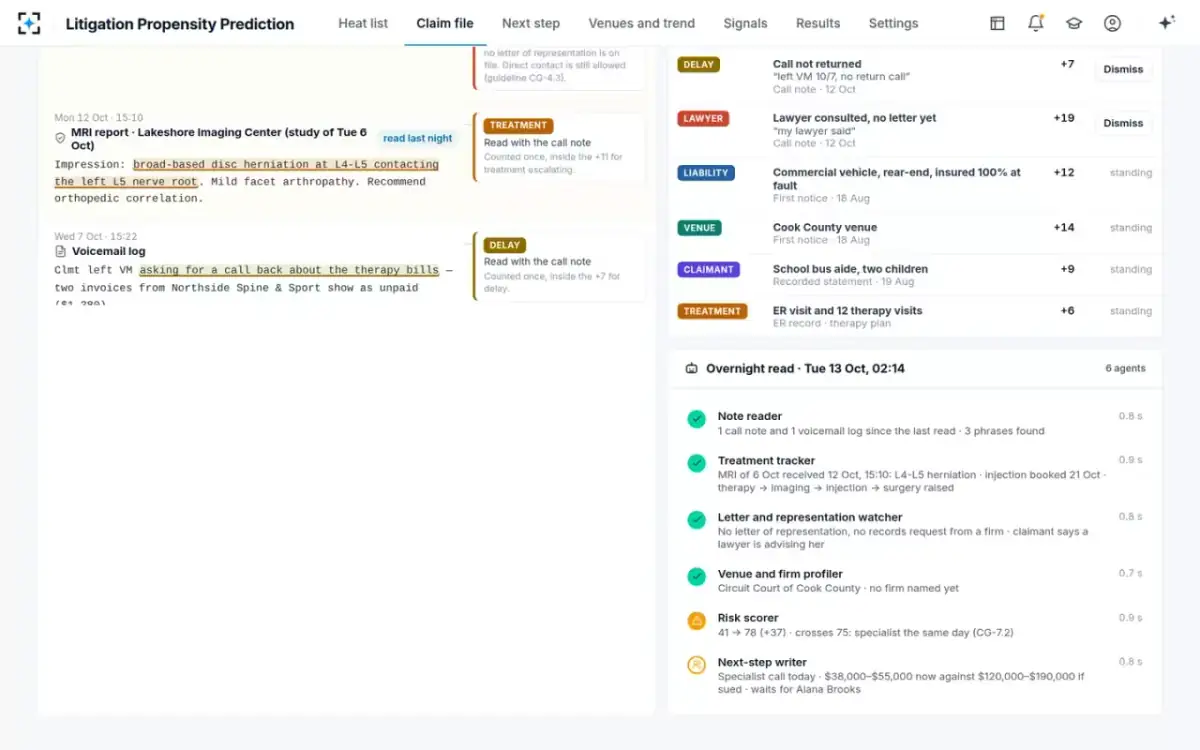
The trace below is the sample file's night, from the voicemail nobody returned to the supervisor's approval. The read of the whole unit took 41 minutes. The six agents spent under six seconds on this file between them. The time that mattered was the days the voicemail sat unanswered and the month until the next diary review.
One injury file through one night in Litigation Propensity Prediction
Wed 7 Oct · 15:22
Voicemail log
The claimant leaves a message asking for a call back about the therapy bills. Two invoices, $1,380, are unpaid.
Mon 12 Oct · 15:10
MRI report received
Study of 6 October: broad-based disc herniation at L4-L5 contacting the left L5 nerve root.
Mon 12 Oct · 16:42
Call note, Tom Kessler
She called back. “ortho is talking about injections, maybe surgery”; “left VM 10/7, no return call”; “my lawyer said” not to sign anything until after the surgery consult.
Tue 13 Oct · 02:00
Nightly read starts
Six agents begin on 1,284 open injury files in the unit and 2,318 new notes, letters and medical updates.
02:14 · 0.8 s
Note reader
One call note and one voicemail log since the last read; three phrases found, each quoted with document, author and time.
02:14 · 0.9 s
Treatment tracker
MRI read with the call note: therapy, then imaging, then an injection booked for 21 Oct, surgery raised. Counted once.
02:14 · 0.8 s
Letter and representation watcher
No letter of representation, no records request from a firm; the claimant says a lawyer is advising her.
02:14 · 0.7 s
Venue and firm profiler
Circuit Court of Cook County; no plaintiff firm named yet, so no firm points.
02:14 · 0.9 s
Risk scorer
41 → 78, up 37. Crosses 75, so the unit’s rule sends it to a specialist the same day.
02:14 · 0.8 s
Next-step writer
Specialist call today, $38,000–$55,000 estimated, against $120,000–$190,000 plus defense if represented and sued. Waits for the supervisor.
02:41
Read ends
212 signals across the unit; 11 files up, 4 down, 24 at 60 or above. Next read 02:00.
Tue 13 Oct · 08:52
Supervisor approves
Alana Brooks approves within her $50,000 authority and assigns Priya Natarajan, free 10:00 to 12:00.
Three design choices sit inside that trace. The read is incremental: only notes, letters and records new since the last read are opened, so a file with nothing new keeps its score and its reasons. Every signal is stored with the passage it came from, so the score can be rebuilt and challenged. And the last two steps belong to people: the next-step writer drafts options, and a named supervisor approves one inside her authority.
What each agent found on the file, step by step
What data predicts attorney involvement?
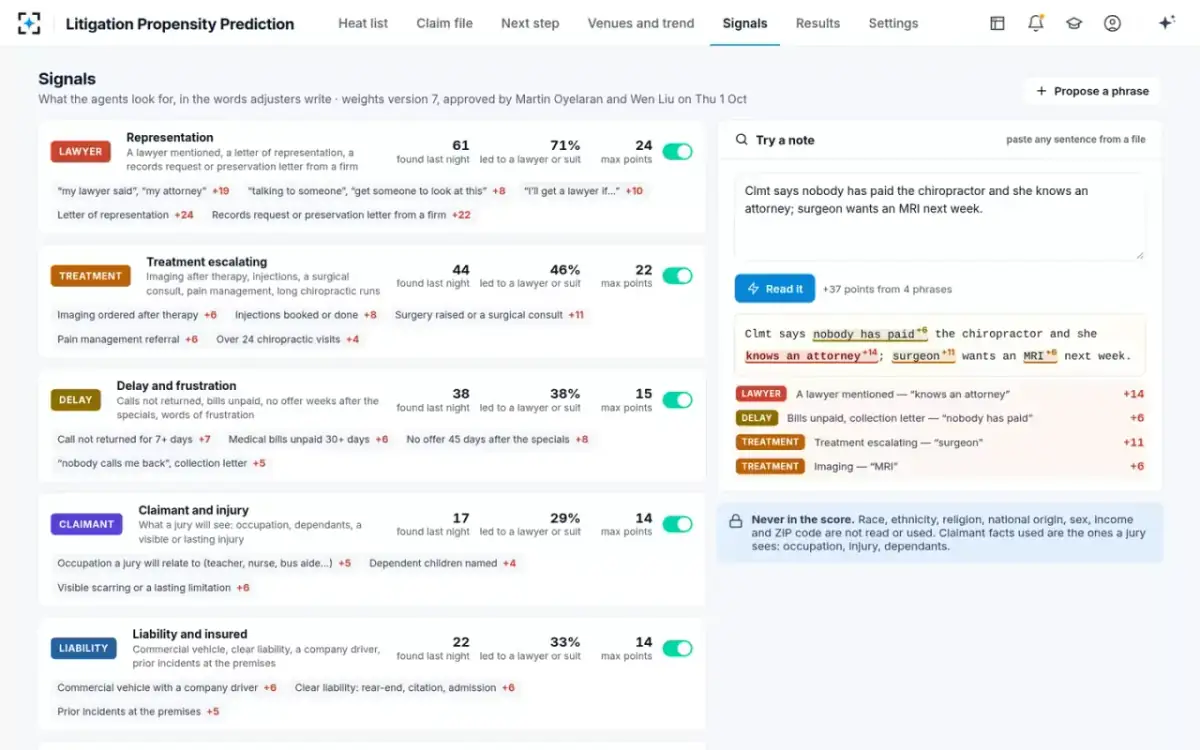
The signals fall into seven families in the solution: representation, treatment escalating, delay and frustration, claimant and injury, liability and insured, venue, and plaintiff firm. Public research supports several. Savych and Neumark's tables tie attorney involvement to spine injuries, hospital stays, late reporting and late first payments. The Insurance Research Council, an insurer-supported non-profit, ties it in auto injury claims to longer closures and higher settlements per dollar of medical bills.
The solution's own weights come from the carrier's closed files, and the screen shows how often each family was followed by a lawyer or a suit. In the sample unit's data, a representation phrase was followed by a lawyer or suit 71% of the time, treatment escalating 46%, delay and frustration 38%, liability 33% and claimant facts 29%. Those are sample figures; a real carrier's come from its own closed files, and change when its claims practice changes.
Paste any sentence and see what counts
Does a litigation model read privileged communications?
It should not, and a buyer should ask to see where that is enforced. In Litigation Propensity Prediction, communications with claims counsel and defense counsel are excluded from the nightly read, and the setting is fixed, not a preference a supervisor can switch on. The reason is practical as well as legal: a score that drew on counsel's advice would put that advice in front of everyone who opens the file.
The same question applies to other sensitive inputs. The solution never reads or uses race, ethnicity, religion, national origin, sex, income or ZIP code. Leaving a field out is the start of fairness testing, not the end, because other inputs can stand in for it; that test is a model risk question, covered on the validation page.
How often should claim files be scored?
Often enough that a signal is acted on while it can still change the outcome. In the solution, every open injury file is read each night at 02:00, and again within 10 minutes when a letter of representation arrives, because the letter changes who may be contacted. A monthly or quarterly rescoring suits a reserving model. It is too slow for a claimant who said "my lawyer said" yesterday.
The regulatory clocks point the same way. The NAIC model regulation gives an insurer 15 days to acknowledge a claim and 15 days to reply to other pertinent communications that reasonably call for a response, where a state has adopted it. A voicemail left on 7 October is inside that window for days, and a 30-day diary review may not see it until the window has closed.
Where the days go before a turning file is acted on
- Until a diary review reads the note30 d
- Four steps8 d
- All steps3 d
Buying machine learning for claims data: what to ask
Ask about the evidence before the accuracy. A vendor's accuracy figure is measured on someone else's files; the evidence is what your adjusters and examiners will see on yours. The questions below separate a model that reads claim text from a model that scores columns and calls it text.
Questions for any machine learning vendor working on your claims data
- Does every score point show the passage it came from?
Document, author, date and the exact words. A score with only a number cannot be challenged or defended.
- Is the same fact counted once?
An MRI and a note describing the MRI are one signal. Ask how duplicates are found.
- What is never read, and is that a fixed setting?
Counsel communications and protected characteristics, enforced in the product rather than by a policy.
- How often are files read, and what triggers an extra read?
Nightly plus a letter of representation is a sensible floor for injury files.
- Was the test on your closed files, scored only from what was in the file on the scoring day?
Anything else leaks the outcome into the test.
- Who can dismiss a signal, and where does the reason go?
Reasons are the cheapest training data you will ever get.
- What does the model do, and what may it never do?
Contact, offers, reserves and counsel assignment stay with named people.
Where the solution fits: carriers with open bodily injury and liability files whose signals live in text, who want every file read and every point shown. Where it does not: a carrier wanting an automated decision, or a score on lines where it has no closed-file history to test against. The desk the routed files land on is described in the attorney represented bodily injury adjuster's desk.
Questions people ask
How is machine learning used on claims data?
To rank and estimate: triage at first notice, fraud flags, severity and reserve estimates, and predictions of which claims will draw a lawyer or a suit. The NAIC's AI model bulletin, adopted in 29 jurisdictions as of 8 October 2026, treats all of these as AI systems an insurer must govern.
Can AI read adjuster notes?
Yes, if it quotes the phrase, the document and the time behind each point and counts each fact once. In the sample file, one call note produced three signals worth 37 points, and the MRI received the same day was folded into one of them rather than counted again.
What are litigation warning signs in a claim file?
A lawyer mentioned before any letter, treatment moving from therapy to imaging to injections or surgery, calls not returned and bills not paid, a commercial vehicle with clear liability, a venue with large verdicts and a plaintiff firm that tries cases. In workers' compensation data, a first payment more than 30 days late went with 50% attorney involvement against 29%.
Does a litigation model read privileged communications?
It should not. In Litigation Propensity Prediction, claims and defense counsel communications are excluded from the read by a fixed setting, and a buyer should ask any vendor where the same rule is enforced.
How often should claim files be scored?
Nightly for open injury files, plus an extra read when a letter of representation arrives. A claimant's words change faster than a claim system's fields, and the NAIC model regulation's 15-day reply clock on pertinent communications is shorter than a 30-day diary.