Litigation prediction AI means two different things, and buying the wrong one is an expensive mistake. Litigation analytics, the tools law firms and legal departments use, read court dockets and opinions to forecast how a filed case will go: how a judge rules on a motion, how long a case takes, what opposing counsel has won before. Claim-file litigation prediction, the tool a claims department needs, reads the open claims that have not been filed anywhere and estimates which are turning toward a lawyer or a suit. Botminds' Litigation Propensity Prediction is the second kind: six agents read every open injury file each night, score its chance of a lawyer or a suit from 0 to 100, show the phrase behind every point, and leave the decision to a claim supervisor. This guide explains why the two tools answer different questions, how to judge any vendor's accuracy claim, and where each belongs in a claim's life.
Two kinds of litigation prediction AI, side by side
Litigation analytics (court data): Dockets, filings, opinions and verdict reports for cases already in court.
Claim-file litigation prediction: Adjuster notes, letters, medical bills and records on open claims no court has seen.
Litigation analytics (court data): How a judge rules, how long a case runs, how a motion or appeal fares.
Claim-file litigation prediction: Whether a claimant will hire a lawyer or sue, and what each route would cost.
Litigation analytics (court data): After a complaint is filed: strategy, motions, staffing, settlement timing.
Claim-file litigation prediction: Before a letter of representation or a summons, while a claim can still be resolved directly.
Litigation analytics (court data): Defense counsel, litigation managers, legal operations.
Claim-file litigation prediction: Claim supervisors, litigation specialists, claims counsel.
Litigation analytics (court data): A case, a judge, a court, a law firm.
Claim-file litigation prediction: One open claim file, re-read every night.
Litigation analytics (court data): Public court records, collected at scale.
Claim-file litigation prediction: The carrier’s own claim system and correspondence, which nobody else has.
Can AI predict litigation?
Yes, in two senses, and the useful question is which. Once a case is filed, its docket is public, and models trained on thousands of past dockets can forecast outcomes better than chance. Before anything is filed, the information sits in the insurer's claim file, and a model that reads it can rank open claims by how likely they are to draw a lawyer or a suit. The first predicts how litigation goes. The second predicts whether there will be any.
For an insurer, the second question carries most of the money. In the Insurance Research Council's study of 7.4 million auto injury claims, the share of claimants in litigation rose from 10% to 18% between 2017 and 2022, while about half of claimants had lawyers. Every claim that becomes a suit was an open, unfiled claim first, and that is the only stage at which the insurer can still settle without counsel on both sides.
What is litigation analytics?
Litigation analytics is the analysis of court records to describe and forecast how litigation behaves. Federal case records are available through PACER, the federal judiciary's public access service, and state courts publish their own. Products built on those records answer questions such as how often a judge grants summary judgment, how long a court takes to reach trial, and how often a plaintiff firm tries cases rather than settling.
Those are real questions for a defense team. They start, though, with a case number. A claim that has not been filed has no docket, no judge and no motion history. Analytics on court data can tell a carrier about the venue a suit would land in and the firm that might bring it; it cannot tell the carrier which of its 1,284 open injury files is about to become a suit.
How is claims litigation prediction different from legal analytics?
It reads private, changing text instead of public, settled records, and it acts before the event instead of after it. On the sample file in Litigation Propensity Prediction, the turn was a sentence in an adjuster's call note: the claimant said her lawyer had told her not to sign anything until after a surgery consult, while no letter of representation was on file. No court record will ever contain that sentence. Overnight the file moved from 41 to 78, and by 08:52 a supervisor had approved a specialist call.
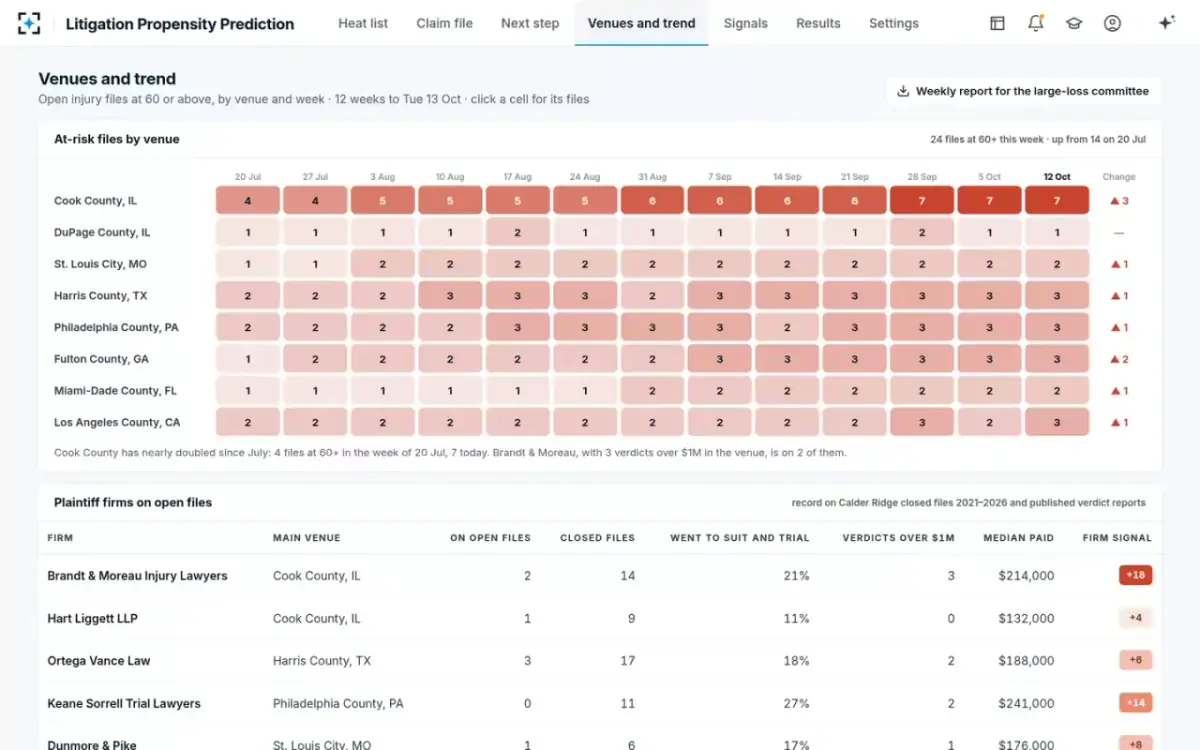
The two tools meet at venue and firm. The solution's venue and firm profiler names the court a suit would be filed in and profiles plaintiff firms from the carrier's closed files and published verdict reports, citing every number and refusing to score a firm it cannot cite. That is litigation analytics in miniature, used as one input among seven signal families. A carrier that already licenses court analytics should expect it to sharpen that input, not replace the read of the file.
Venues and plaintiff firms, from closed files and published verdicts
Can AI predict legal outcomes? What the research shows
It can beat simple baselines, by margins that are real and modest. One careful academic test is of the U.S. Supreme Court. Katz, Bommarito and Blackman built a model that used only information available before each decision, and over nearly two centuries of cases report: "we achieve 70.2% accuracy at the case outcome level and 71.9% at the justice vote level". Over the most recent century, they write, "we outperform an in-sample optimized null model by nearly 5%".
What a careful legal-outcome model achieved, and against what
70.2%
of Supreme Court case outcomes predicted correctly, 1816–2015
5%
nearly: the margin over the best simple baseline in the last century
28,000
cases and 240,000+ justice votes in the test
The lesson for a buyer is the baseline, not the 70%. On the sample book in the next section, where 4.1% of closed injury files were sued, a model that says no file will be sued is right 95.9% of the time and useless. Accuracy is meaningful only against the base rate, at a threshold someone will act on, with every score computed from what was known on the day. That is how to read any claim from any vendor, including this one.
How accurate is litigation prediction?
Ask for four numbers on your own closed files: the base rate, the share of flagged files that turned, the share of turns that were flagged, and how early. The solution's test on the sample carrier's 2025 closed injury files gives a worked example. Those are sample figures on invented files, not a customer result; the point is the shape of the answer a buyer should demand.
Four numbers to ask of any litigation prediction claim, with the sample test's answers
| Measure | What it tells you | Sample 2025 closed-file test |
|---|---|---|
| Base rate | How rare the event is without a model | 286 suits in 6,924 closed injury files: 4.1% |
| Share of flagged files that turned | Whether the list is worth working | 59% of files at 75+ were sued; 43.5% of files at 60+ |
| Share of turns flagged in time | How many suits the list would have caught | 221 of 286 suits (77%) scored 60+ at least 30 days before service |
| Warning time | Whether there is time to act | Median 41 days before the summons |
| Misses, by cause | What the model can never see | 27 suits with no warning in the notes; 21 on files opened after a letter of representation |
What data does litigation prediction use?
Court analytics uses dockets, filings, rulings and verdict reports. Claim-file prediction uses what the insurer holds: adjuster notes, diaries and call logs; correspondence including letters of representation, records requests and preservation letters; medical bills and records; claimant and liability facts; and the carrier's own closed-file history of venues and firms. In the solution, signals fall into seven families, and some data is never used: race, ethnicity, religion, national origin, sex, income and ZIP code are excluded, and so are claims and defense counsel communications.
The data question is also a governance question. The NAIC's model bulletin on insurers' use of AI covers claim management and applies to models bought from vendors as well as those built in house, so a carrier buying either kind of tool needs to know what it reads and be able to show it. What a validation team asks is covered in what to validate in a litigation score.
Where each tool sits in a claim's life
Claim-file prediction works on the large, early population; court analytics works on the small, late one. Of the federal motor vehicle injury cases filed on diversity jurisdiction and terminated in the year to September 2025, 5,333 in all, the federal courts' Table C-4 shows 37 reaching trial, 0.7%. Many more injury suits are filed in state courts, which are not in that table, but the proportion is the lesson: by the time a case has a docket rich enough to analyse, most of the cost decisions have already been made.
That is why the two tools belong to different people. Court analytics belongs with defense counsel and the litigation manager once a file is in suit, where the work moves to claims litigation management and the litigation adjuster's desk. Claim-file prediction belongs with the claim supervisor, every morning, on the files that have not turned yet. How far the funnel narrows from claim to trial is set out in what percentage of personal injury cases go to court.
Buying litigation prediction AI: questions for the vendor
Start by asking which question the tool answers. Then ask the accuracy questions on your own files, and the control questions a regulator will ask you later.
Ten questions before buying litigation prediction AI
- Does it predict outcomes of filed cases, or the turn of open claims?
Both are legitimate; only one serves a claim supervisor before suit.
- What does it read?
Court records, your claim files, or both. Ask for the list, and for what is never read.
- How often does it read each open file?
A claimant’s words change daily; a monthly refresh misses the turn.
- What is the base rate on our book?
Every accuracy figure is read against it.
- At the threshold we would use, how many files are flagged and how many turned?
The list has to be short enough to work and full enough to trust.
- How early, by line?
Median warning before service, and the spread.
- Was each test score computed only from what was in the file that day?
Closed files contain their own endings; leakage flatters results.
- Can every point be traced to a passage?
A supervisor and an examiner both need to see why.
- Who can change weights and thresholds?
A closed-file test and a second approver, with versions recorded.
- What may the tool never do?
Contact claimants, make offers, change reserves or assign counsel.
Where Litigation Propensity Prediction fits, and where it does not
It fits a carrier with open bodily injury and liability files whose early signals are written in notes, letters and medical records, and that wants every file read nightly, every point shown, and decisions kept with its supervisors under its own authority table. In the sample configuration the lines are commercial auto bodily injury, personal auto bodily injury, and general liability premises and products; the lines in scope are a setting.
It does not predict how a judge will rule, rank motions or forecast trial verdicts; those belong to court analytics and to counsel. It does not decide anything: the agents draft, and named people call, offer, reserve and assign counsel. And it is only as good as the closed files it is tested on, which is why the first step with any carrier is a test on its own closed injury files.
Questions people ask
Can AI predict litigation?
It can rank open insurance claims by their chance of drawing a lawyer or a suit, and it can forecast some outcomes of cases already in court. These are different tools: in the Insurance Research Council's data, only 18% of auto injury claimants litigated in 2022, so most of the decisions happen before any court record exists.
What is litigation analytics?
The analysis of court records, such as federal dockets available through PACER, to describe and forecast how judges, courts and law firms behave in filed cases. It serves defense counsel and litigation managers once a suit exists.
How is claims litigation prediction different from legal analytics?
It reads the insurer's own open claim files, before anything is filed, for signs that a claimant is turning toward a lawyer or a suit. In the sample file, the signal was "my lawyer said" in an adjuster's call note, which no court record would ever contain.
Can AI predict legal outcomes?
Better than simple baselines, by modest margins. One published model predicted 70.2% of U.S. Supreme Court case outcomes over two centuries, beating the best simple baseline by nearly 5% over the most recent century.
How accurate is litigation prediction?
Only answerable against the base rate on your own files. In the sample carrier's 2025 test, 4.1% of closed injury files were sued, 59% of files scored 75 or above were sued, and 77% of suits were flagged at least 30 days before service.