A letter of representation is a lawyer's written notice to an insurance company that the lawyer now represents the claimant on a claim. For the insurer, it changes who it deals with: claim communications go to the lawyer, requests for records and policy information come from the lawyer, and the claim is now valued against the possibility of a suit. It is not a lawsuit, and it does not by itself set a deadline the way a court summons does. On a bodily injury file it is the moment the claim becomes a represented claim, which about half of auto injury claims now are. Botminds' Litigation Propensity Prediction watches for these letters among the notes, mail and records it reads every night, and marks a file represented within 10 minutes of one arriving. This guide sets out what the letter changes, what the adjuster should do that day, and why the letter is usually the last sign of the turn, not the first.
The day a letter of representation arrives on an injury file
Agent
Letter and representation watcher, within 10 minutesRecognises the letter in the mail, email or scan feed; marks the file represented and names the firm.
Never: contacts the claimant or the firm
Agent
Contact rulesThe file’s contact panel switches to “through counsel only”; scheduled calls and letters to the claimant are held.
Never: sends anything
Agent
Risk scorerAdds the letter to the representation family and rescores the file; a named firm brings its closed-file record.
Agent
Next-step writerLists what the letter asks for: policy information, records, evidence preservation, liens, any time-limited demand.
Never: answers the firm
A person decides
Adjuster or specialistAcknowledges the letter to counsel, diaries each request with its clock, and moves all contact to the firm.
A person decides
Claim supervisorReviews the reserve, the route and whether the file belongs on the represented desk.
What is a letter of representation?
It is the lawyer's notice of appearance in a claim that is not yet in court. A typical letter names the firm and the client, states that the firm represents the client for injuries from a specific accident, asks that all contact go through the firm, and asks the insurer to preserve evidence and to send policy information. Some arrive with a records request and a signed HIPAA authorization; some with a lien notice from a hospital or health plan; some, in states that regulate them, with a time-limited demand.
For claims data, the letter is the point at which representation becomes a recorded fact. Savych and Neumark's study of more than 950,000 workers' compensation claims measures it exactly there: representation is "collected when the insurer receives a notice of representation or notice of appearance informing the insurer that the claimant is represented by an attorney". In the solution, a letter of representation is the single largest representation signal, worth 24 points in the sample unit's weights; a records request or preservation letter from a firm is worth 22.
What does a letter of representation mean for an insurance claim?
It means the claim is now handled with the claimant's lawyer, under the rules for represented claimants. The NAIC's model claims regulation defines the claimant to include "the claimant’s designated legal representative", and California's regulation names an attorney expressly in its definition of a claimant. Claim communications go to the lawyer from the day the letter arrives.
An injury claim the day before and the day after a letter of representation
Before the letter: The claimant, directly.
After the letter: The firm; the claimant only through the firm.
Before the letter: Owed to an unrepresented claimant in writing before the deadline, 60 days ahead in the NAIC model and California.
After the letter: California’s notice duty no longer applies; the lawyer watches the limitations period.
Before the letter: Medical authorizations and records gathered by the adjuster.
After the letter: The firm sends records and requests policy information, sometimes with a statutory clock.
Before the letter: Specials plus general damages, often settled in stages.
After the letter: Valued against a likely suit: venue, firm, defense cost and a demand package to come.
Before the letter: General injury desk on a diary.
After the letter: Often the represented or litigation desk.
Some protections switch off because the lawyer now provides them. California requires written notice of a limitations deadline at least 60 days before it expires, and then says: "This subsection shall not apply to a claimant represented by counsel on the claim matter." The NAIC model's version applies only to "a claimant who is not legally represented". An adjuster's limitations diary built around the unrepresented claimant has to be reconsidered when the letter arrives.
Can an insurance company contact me after a letter of representation?
About the claim, the insurer deals with your lawyer once it has the letter. That is what the letter asks for, and the claim regulations treat your lawyer as the claimant for claim communications. In the sample unit's guideline, a represented file's contact panel reads "contact through counsel only", and every scheduled call or letter to the claimant is held until the specialist has routed it to the firm.
Before a letter arrives, the position is different, and it is where most confusion starts. A claimant who says "my lawyer said" on a call has told the adjuster something important, but the insurer has no notice from a lawyer. The sample unit's guideline allows direct contact in that case and tells the specialist what to do if the claimant says she has hired someone: ask for the lawyer's name, stop discussing the claim, and never discourage her from getting advice.
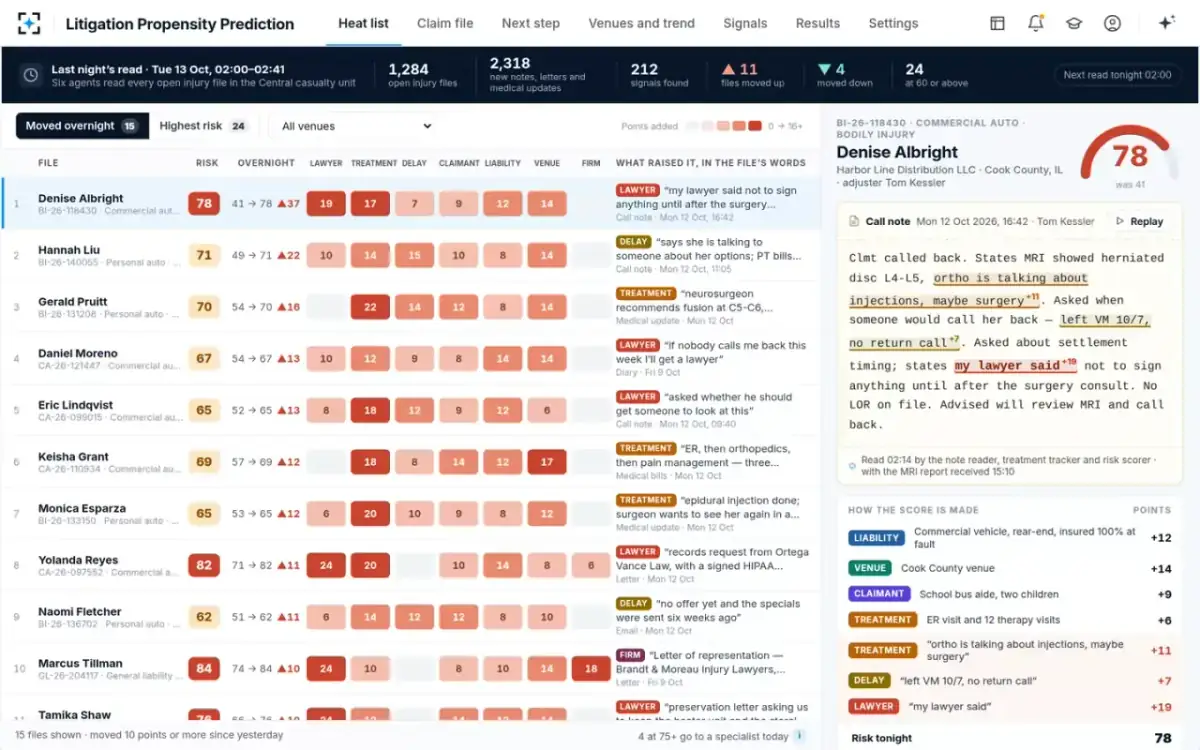
Letters and firms on the morning list
Is a letter of representation the same as a lawsuit?
No. A letter of representation is a private notice between a lawyer and an insurer. A lawsuit is a complaint filed in court and served on the defendant, which starts the court's own deadlines. Many represented claims never become suits. In the Insurance Research Council's auto injury data, about half of claimants were represented in 2022, while 18% of claimants were in litigation.
Even suits rarely end in a trial. Of 5,333 federal motor vehicle injury cases on diversity jurisdiction terminated in the year to September 2025, 37 ended during or after trial, according to the federal courts' Table C-4. The full funnel, claim to lawyer to suit to trial, is set out in what percentage of personal injury cases go to court.
Where a letter of representation sits in the auto injury funnel
Half
of auto injury claimants represented in 2022 (nearly 50%)
Insurance Research Council
18%
of claimants in litigation in 2022
Insurance Research Council
0.7%
of federal motor vehicle injury cases terminated in 2025 that reached trial
U.S. Courts, Table C-4
What happens after an attorney sends a letter of representation?
The insurer acknowledges it, redirects all contact to the firm, answers what the letter requests, and re-plans the file for a represented claim. The lawyer, meanwhile, gathers medical records and bills and often waits for treatment to reach a stable point before sending a demand. In the sample carrier's similar closed files, a letter followed a "my lawyer said" call note within two to four weeks in 7 of 10 files, and the represented files that were sued took 14 to 26 months to close.
The letter often starts clocks of its own. A request for policy information is one: in Florida, an insurer must answer a claimant's written request with a statement under oath within 30 days (§ 627.4137). A time-limited demand is another, and the most dangerous; its handling is the subject of the guide to policy limits demand letters.
Records, preservation and liens: the requests that come with the letter
A letter of representation is rarely only a notice. The requests that come with it each start a separate piece of work, and each is easier to handle on the day than a month later. In the sample unit's morning list, three files moved overnight on correspondence from firms: a letter of representation, a records request with a signed HIPAA authorization, and a preservation letter. Each is a representation signal in its own right, worth 22 to 24 points in the sample weights.
A records request asks the insurer for what it holds: photographs, statements, the police report, medical records it has gathered. A preservation letter asks the insurer and its insured to keep evidence, such as the vehicle, its data recorder, dash camera video and driver logs on a commercial claim. Neither is a lawsuit, but evidence lost after a preservation letter is the kind of fact a court may later hear about, so the adjuster's first task is to pass the request to the insured and record that it was passed.
Liens are the third strand. If the claimant is a Medicare beneficiary, Medicare's conditional payments for accident-related care have to be dealt with from any settlement, and its recovery contractor writes to the parties; CMS notes that "A courtesy copy of the CPN is sent to the beneficiary and beneficiary’s attorney or other representative." Once a lawyer is involved, the lawyer is part of that correspondence, and the settlement has to account for the lien before money moves.
How quickly should an adjuster respond to a letter of representation?
The same day it is found, and within whatever written clock applies. Where a state has adopted the NAIC model regulation, insurers must reply within 15 days to pertinent communications from a claimant that reasonably suggest a response is expected, and the regulation counts the claimant's representative as the claimant. Florida's 30-day sworn disclosure applies when the letter asks for policy information. A demand in the same envelope may set a shorter deadline still.
The practical risk is not the reply but the finding. A letter that arrives by mail at a branch, by fax to an old number or as an attachment to a records portal can sit unread. That is why the solution reads for letters within 10 minutes of arrival, outside the nightly cycle: a letter that changes who may be contacted cannot wait for tonight.
The day a letter of representation arrives: the adjuster's list
- Mark the file represented and name the firm
Before anyone calls the claimant again; hold scheduled calls and letters.
- Acknowledge the letter to counsel
In writing, inside the reply clock your state sets for pertinent communications.
- List every request in the letter, with its clock
Policy information, records, preservation, liens, any time-limited demand.
- Check what was promised or paid before the letter
Undisputed bills, outstanding medical payments, any offer made directly to the claimant.
- Review the reserve and the route
With the supervisor: represented desk, early evaluation, or counsel.
- Revisit the limitations diary
Unrepresented-claimant notices may no longer apply; the file still needs its own tracking.
The letter is a lagging signal
By the time a letter of representation arrives, the claimant's decision is made. The signs usually came earlier and were written down: "my lawyer said" on a call, an unreturned voicemail about unpaid therapy bills, a treatment plan moving toward surgery. On the sample file in the solution, those three phrases in one call note moved the score from 41 to 78 with no letter on file, and a specialist called the claimant that morning.
The sample carrier's closed-file test shows the other side. Of the 65 suits the score did not flag at least 30 days ahead, 21 were on files opened after a letter of representation had already arrived, so the carrier's first sight of the claim was the lawyer. No reading of the file can warn early on those. The only lever there is speed: finding the letter the day it lands, and handling the represented file well from the first reply.
The letter tells you the claimant has decided. The call note told you she was deciding.
The file the night before any letter: “my lawyer said”, no letter on file
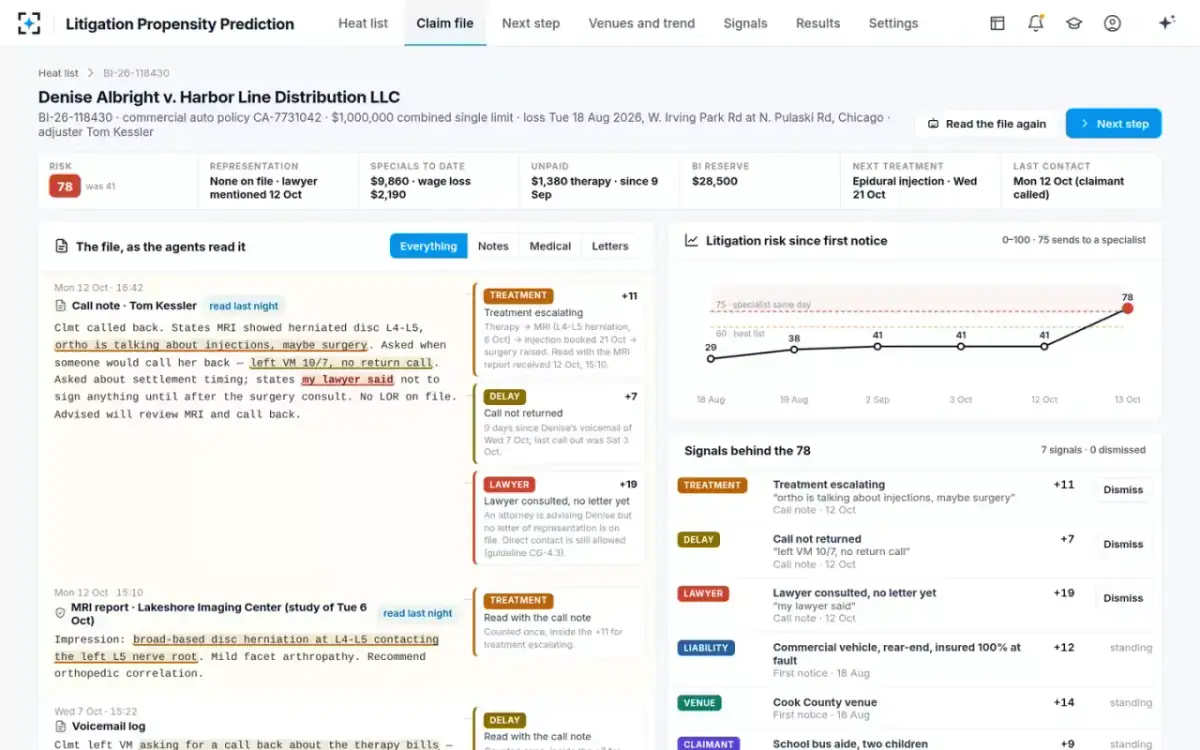
Litigation Propensity Prediction does both jobs: it finds the letter within minutes and it reads the file for the turn before any letter exists. It never contacts a claimant or a firm; the adjuster, the specialist and the supervisor do. How the routed desk is organised around those files is in the attorney represented bodily injury adjuster's desk.
Questions people ask
What is a letter of representation?
A lawyer's written notice to an insurer that the lawyer represents the claimant on a claim, usually asking that all contact go through the firm and that evidence be preserved. On an auto injury claim it marks the claim as represented, which about half of auto injury claims were in 2022.
What does a letter of representation mean for an insurance claim?
Claim communications go to the lawyer, requests for records and policy information come from the lawyer, and the claim is valued against the possibility of a suit. Some protections for unrepresented claimants, such as California's 60-day limitations notice, no longer apply.
Can an insurance company contact me after a letter of representation?
About the claim, the insurer deals with your lawyer once it has the letter; the claim regulations count your lawyer as the claimant for communications. Questions about the claim should go through your lawyer from then on.
Is a letter of representation the same as a lawsuit?
No. A letter is a private notice; a lawsuit is filed in court and served. In the Insurance Research Council's data about half of auto injury claimants were represented but 18% litigated in 2022.
How quickly should an adjuster respond to a letter of representation?
The day it is found. Where the NAIC model regulation is adopted, replies to pertinent communications are due within 15 days, Florida requires sworn policy information within 30 days of a written request, and any demand in the letter may set a shorter deadline.
What happens after an attorney sends a letter of representation?
The insurer redirects contact to the firm and answers its requests, while the lawyer gathers records and bills and often prepares a demand once treatment stabilises. In the sample carrier's similar closed files, represented files that went to suit took 14 to 26 months to close.