A litigation risk assessment, on an insurance claim, is a judgment of how likely an open file is to draw a lawyer, a suit or a large verdict, what that would cost, and what to do now. In a legal department the same words describe a likelihood-and-impact matrix for disputes already under way. On a claims desk the assessment has to be made on hundreds of open files that have not yet turned, and it is only worth making if a claim supervisor acts on it. Supervisors act on scores they can open, check and correct. Botminds' Litigation Propensity Prediction is built on that: six agents read every open injury file each night and score it 0–100, and every point names the phrase, the document and the date behind it. This guide shows what such an assessment looks like on one file, why opaque scores are ignored, and how to roll one out.
A litigation risk assessment you can open: one file at 78, every point shown
Denise Albright · commercial auto bodily injury · Cook County, IL
78 was 41 · up 37 overnight · past 75: specialist today
Lawyer+19
Lawyer consulted, no letter yet
“my lawyer said”
Call note · Tom Kessler · Mon 12 Oct, 16:42
New · can be dismissed
Treatment+11
Treatment escalating
“ortho is talking about injections, maybe surgery”
Call note 12 Oct, read with MRI of 6 Oct
New · can be dismissed
Delay+7
Call not returned
“left VM 10/7, no return call”
Call note 12 Oct; voicemail log 7 Oct
New · can be dismissed
Venue+14
Cook County venue
Circuit Court of Cook County
First notice · 18 Aug
Standing
Liability+12
Commercial vehicle, rear-end, insured 100% at fault
26-ft box truck, red light
First notice · 18 Aug
Standing
Claimant+9
School bus aide, two children
occupation and dependants
Recorded statement · 19 Aug
Standing
Treatment+6
ER visit and 12 therapy visits
ER record, therapy plan
Medical bills
Standing
19 + 11 + 7 + 14 + 12 + 9 + 6 = 78. No point is shown without its source.
What is a litigation risk assessment?
It is the answer to three questions about a specific claim: how likely is it to turn, what would it cost if it did, and who should do what about it today. A complete assessment states each driver with its evidence, the change since the last review, the cost of each option and the person who decides. That is different from a reserve, which is a number for the books, and from a legal department's risk register, which follows matters already in dispute.
Most claims operations already make the assessment, informally, in diary reviews. The weakness is coverage, not judgment: a supervisor with nine adjusters and more than a thousand open injury files reviews diaries by sample, and the turn is usually noticed when the summons arrives. A scored assessment run on every file is meant to fix coverage. Whether it does depends on whether the supervisor believes it.
Why do adjusters ignore risk scores?
Because a score they cannot question asks them to give up judgment, and people resist that even when the algorithm is better. Behavioural research has a name for it. Dietvorst, Simmons and Massey describe how forecasters "often fail to use them after learning that they are imperfect, a phenomenon known as algorithm aversion". In their experiments the cure was control: people given the power to adjust an imperfect algorithm's forecasts chose to use it far more often, and their forecasts improved.
Claims desks add two reasons of their own. A score that flags too many files is noise; in the sample unit, 24 of 1,284 open files sat at 60 or above after the night's read, a list a supervisor can work in a morning. And a score that cannot say why it moved gives the supervisor nothing to write in the file. An adjuster asked to justify a decision to a manager, an examiner or a jury cannot cite a number.
An opaque risk score against an assessment a supervisor can use
Opaque score: A number and a colour.
Every point shown: The number, the change since last night, and seven families with their points.
Opaque score: Not stated, or a list of model features.
Every point shown: The phrase in the adjuster’s note, with the date, time and author.
Opaque score: Ignored, or overridden with nothing written down.
Every point shown: A signal is dismissed with a reason; the score drops by its points at once.
Opaque score: “Risk score high.”
Every point shown: The passages, the options priced from similar closed files, and who approved.
Opaque score: Nothing from the desk.
Every point shown: Every dismissal and its reason, at the next weights review.
How should a risk score be explained?
With the evidence, in the reader's words, at the level of the decision. NIST's AI Risk Management Framework separates three things a user needs: "Transparency can answer the question of “what happened” in the system." Explainability answers how a decision was made, and interpretability why, and NIST adds that "Risks to interpretability often can be addressed by communicating a description of why an AI system made a particular prediction or recommendation."
For a claim supervisor the most useful "why" is the passage itself. "Representation +19" is a label. "Representation +19, because Tom Kessler's call note of 12 October at 16:42 says the claimant's lawyer told her not to sign anything until after the surgery consult, and no letter of representation is on file" is an explanation she can check in ten seconds and write in the file.
One click: the passage behind a heat cell
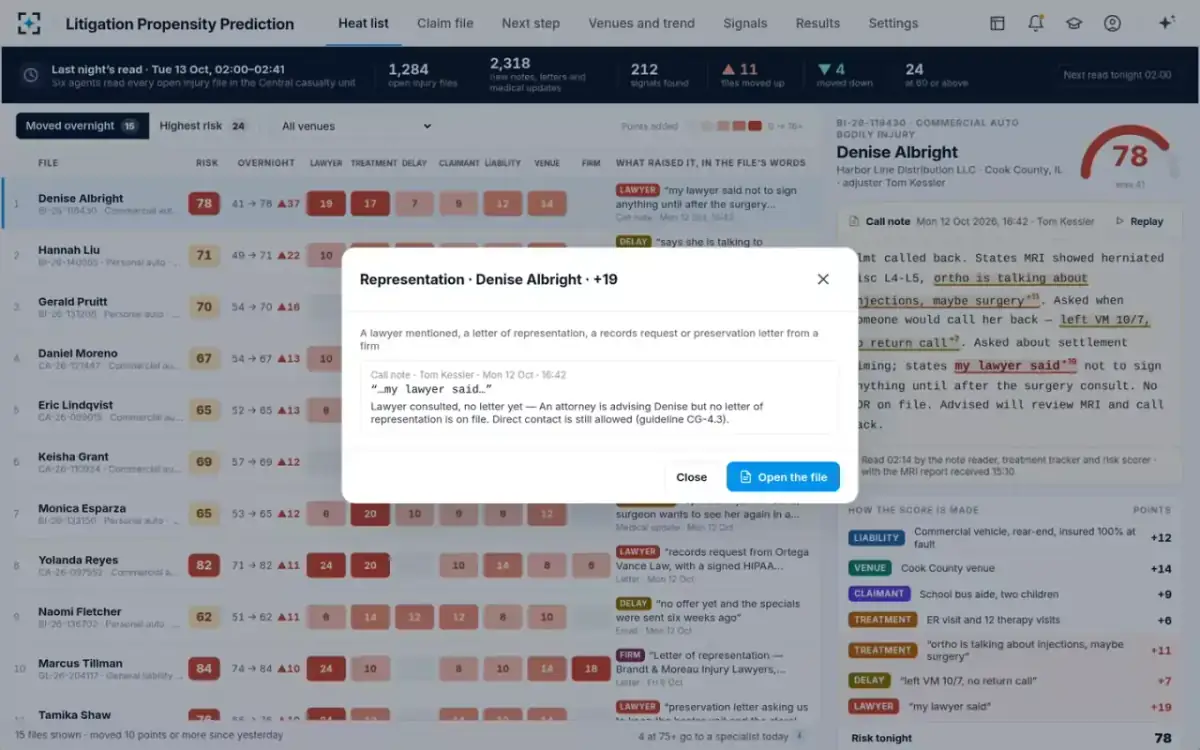
The change since last night matters more than the level
A supervisor acts on movement. A file that has sat at 66 for a month has been seen; a file that jumped from 41 to 78 overnight has not. The sample unit's heat list opens on "moved overnight": files that moved 10 points or more, up or down. After the 13 October read, 11 files had moved up and 4 down.
The downward moves deserve the same attention, because they are where trust is earned. In the sample unit, one file fell from 72 to 62 when the claimant went back to full duty, and another from 66 to 56 after the claimant agreed to an evaluation meeting. A score that only ever rises is a siren. A score that falls when the facts improve is a measurement.
How long the list is decides whether it is read
A litigation risk assessment fails quietly when its list is longer than the desk's day. The threshold, not the model, sets the length. In the sample carrier's 2025 closed-file test, 508 files scored 60 or above 30 days before suit or closing over the year, about ten a week across the unit, and 240 scored 75 or above, between four and five a week. The book produced 286 suits in the same year.
Those numbers are what make the list credible. At 60 or above, 43.5% of the files listed were eventually sued; at 75 or above, 59%. A supervisor who works the list sees, week after week, that roughly every other file on it was heading somewhere. Drop the threshold to 40 and the list grows by more than a thousand files a year, of which 4% were sued: the list stops being read, and the files that matter are buried again. These are sample figures and our arithmetic; the same calculation on a carrier's own closed files is the first step in setting its threshold.
Who decides what to do with a high-risk file?
A named person with authority, never the score. In the solution, the agents never contact a claimant, make an offer, change a reserve or assign counsel. The next-step writer drafts the options and names who may approve each one; the claim supervisor approves next steps and offers up to $50,000, the claims manager above that, and claims counsel assigns defense counsel. The NAIC's model bulletin on insurers' use of AI counts how far people are involved in the final decision among the factors that decide how much control a model needs.
Who decides on a high-risk injury file in Litigation Propensity Prediction
Today
Learns a file turned when the summons lands.
With agents
Opens the files that moved overnight, reads the passage behind each point, approves the next step.
Still theirs: next steps and offers up to $50,000
Today
Approves large offers without a cost of waiting.
With agents
Sees resolve-now, wait and counsel side by side, each priced from similar closed files.
Still theirs: offers above $50,000
Today
Meets each plaintiff firm when its letter arrives.
With agents
Sees at-risk files by venue and firm weekly, and signs off weight changes with model risk.
Still theirs: defense counsel assignment
Today
Reviews a model once, at approval.
With agents
Tests weights on closed files before each change, and reads the dismissal reasons.
Still theirs: second approval on signal weights
Dismissing a signal: the edit that builds trust
The Dietvorst experiments found that people kept using an algorithm they could adjust even when the adjustments allowed were tightly limited. A claims version of that restricted edit is dismissal with a reason. The supervisor cannot set the score by hand, but she can strike a signal that was read out of context, already handled in a later note, or counted twice. The score drops by that signal's points immediately, and the reason is saved.
The reasons are worth more than the edits. The bank regulators' 2011 model risk guidance, SR 11-7, written for banks rather than insurers and replaced in April 2026 by SR 26-2, built model control on challenge: "critical analysis by objective, informed parties who can identify model limitations and assumptions and produce appropriate changes". A supervisor dismissing a signal is that challenge, made daily by the person who knows the file. In the solution the reasons feed the next weights review, and weights change only after a test on closed files and a second approver. How a second line reads those reasons is covered in what to validate in a litigation score.
Dismissing a signal needs a reason
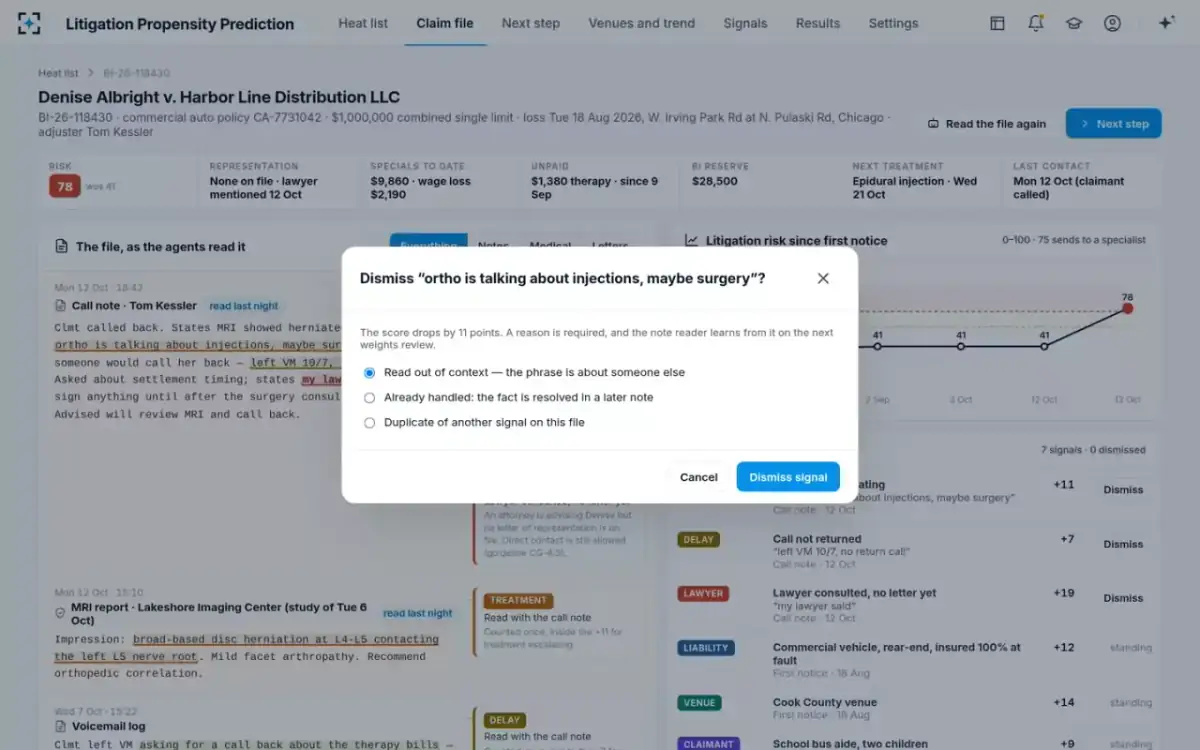
How do you roll out a litigation model to adjusters?
Show it working on their own closed files first, then let it run beside the diary before it changes anyone's day. The sample carrier's model risk lead tested the score on the carrier's 2025 closed injury files before go-live: 221 of 286 suits had scored 60 or above at least 30 days before service, and 59% of files at 75 or above had been sued. Those are sample figures, and they are the kind a desk will believe because the files are its own.
After the test, three choices decide adoption. The thresholds have to produce a list the desk can work; the same-day threshold has to match the specialists' capacity; and the first weeks should be spent dismissing signals freely, so the reasons arrive while the desk is still deciding whether to trust it. Setting those thresholds is covered in a claims triage model for injury files.
A litigation risk assessment template for a claim supervisor
Whether the assessment is written by hand or produced nightly, the same fields make it usable. The template below is what the solution fills for each routed file, and what a desk without software can adopt for its own diary reviews.
Litigation risk assessment template for one open injury file
- Score and change
Today’s level and the move since the last review, with the date of both.
- Drivers, each with its passage
Representation, treatment, delay, claimant, liability, venue, firm: the words, the document, the date.
- What is not in it
Protected characteristics, income and ZIP code, and counsel’s privileged communications.
- Contact status
Letter of representation on file or not, and the rule the specialist must follow if that changes on the call.
- Options with costs
Resolve now, wait, or counsel, each priced from named similar closed files.
- Decision and authority
Who approved which option, within what limit, and when.
- Dismissed signals
Which, by whom, and why.
Questions people ask
What is a litigation risk assessment?
For an insurance claim, an assessment of how likely the file is to draw a lawyer, a suit or a large verdict, what that would cost and what to do now. In Litigation Propensity Prediction it is a 0–100 score on every open injury file, rebuilt each night, with the passage behind every point.
How do claim supervisors use litigation scores?
As a morning worklist: files that moved overnight first, then everything above the heat-list threshold. In the sample unit that was 24 of 1,284 files after one night's read, and anything at 75 or above went to a specialist the same day.
Why do adjusters ignore risk scores?
Because a score they cannot question asks them to give up judgment. Research on algorithm aversion found people far more willing to use an imperfect algorithm when they could modify its output, even slightly, which is the role a dismissal with a reason plays.
How should a risk score be explained?
With the evidence behind each part of it, in the words of the file. NIST's AI framework notes that interpretability risks can often be addressed by describing why a system made a prediction; on a claim, that description is the adjuster's own sentence with its date.
Who decides what to do with a high-risk file?
A named person within an authority table. In the sample unit the supervisor approves next steps and offers up to $50,000, the claims manager above that, and claims counsel assigns counsel; the agents only draft.
How do you roll out a litigation model to adjusters?
Test it on the desk's own closed files, set thresholds the desk can work, and let supervisors dismiss signals freely with reasons in the first weeks. Change weights only after a fresh closed-file test and a second approver.