An attorney represented bodily injury adjuster handles the injury claims where the claimant has hired a lawyer: every call, request and offer goes through counsel, the file is valued against a likely suit, and the adjuster often works beside defense counsel and a litigation manager. Files usually reach that desk when a letter of representation arrives. That is late. The signs that a claimant is talking to a lawyer are usually written in the file weeks earlier, in an adjuster's call note or a bill nobody paid. Botminds' Litigation Propensity Prediction reads every open injury file each night, scores the chance it turns toward a lawyer or a suit, and puts the files that moved in front of a claim supervisor in the morning. This guide is about the desk those files go to, and when.
The numbers make it a staffing question. In a study of 7.4 million auto injury claims closed between mid-2017 and mid-2022, the Insurance Research Council, a non-profit research body supported by property and casualty insurers, found the share of claimants with attorneys "rose from 40% in 2017 to nearly 50% in 2022" across all coverages, and higher still for bodily injury. A desk that once took the exceptions now takes half the book.
The represented desk is no longer the exception
Half
of auto injury claimants represented by an attorney in 2022 (nearly 50%), up from 40% in 2017
Insurance Research Council, all coverages
57%
of bodily injury claimants represented in 2022
Insurance Research Council summary
18%
of claimants in litigation in 2022, up from 10%
Insurance Research Council
2×
median time to close a represented BI claim, against an unrepresented one
nearly 440 days, Insurance Research Council
What does an attorney represented bodily injury adjuster do?
The represented BI adjuster negotiates with the claimant's lawyer instead of the claimant, and builds the file for the case that lawyer may file. The job titles vary: attorney represented adjuster, represented BI specialist, litigation specialist, pre-suit or litigation adjuster. The work is consistent. The adjuster answers the lawyer's requests for policy information and records, evaluates a demand package rather than a stream of bills, sets and moves the reserve toward a litigated value, and decides with a supervisor whether to offer, wait or send the file to defense counsel.
Three things make the desk different from an unrepresented injury desk. The counterpart is a professional who decides when the demand comes and what it asks for. The file has a second clock, the statute of limitations, which the lawyer is now watching instead of the adjuster. And every exchange is evidence: a represented file is the one most likely to be read later by a jury, an examiner or a bad-faith expert, so the adjuster writes for that reader.
How is a represented claim handled differently?
The rules shift from protecting an unrepresented person to dealing with their agent. Under the NAIC's model claims regulation, the word claimant already "includes the claimant’s designated legal representative", and California's regulation names the attorney expressly in its definition of a claimant: "an attorney, any person authorized by operation of law to represent the claimant". Communications go to that representative. Several protections that exist only because the claimant has no lawyer switch off.
What changes on a bodily injury file when the claimant has a lawyer
Unrepresented claimant: The claimant directly, by phone, letter and email.
Represented claimant: The claimant’s lawyer; regulations count the lawyer as the claimant for claim communications.
Unrepresented claimant: Written notice of the statute of limitations owed before it expires: 60 days for third-party claimants in the NAIC model and in California.
Represented claimant: California’s notice duty does not apply to a claimant represented by counsel; the lawyer watches the deadline.
Unrepresented claimant: No statement that rights may be impaired unless a form or release is signed by a date, except to give limitations notice.
Represented claimant: Releases are negotiated with counsel, and their terms become part of any settlement agreement.
Unrepresented claimant: Bills arrive as treatment happens; the adjuster can pay undisputed amounts and settle in stages.
Represented claimant: The lawyer decides when the demand comes, often after treatment; a time-limited demand may set its own deadline.
Unrepresented claimant: Specials plus general damages, often settled before treatment is complete.
Represented claimant: Valued against a likely suit: the venue, the firm’s record and defense cost come into it.
The NAIC model draws the line in its own words. No insurer may keep negotiating "directly with a claimant who is not legally represented" when a limitations period could cut off the claim, unless it has given written notice of it, and for third-party claimants that notice comes at least 60 days before the date. California's version of the rule ends by exempting any claimant represented by counsel, which explains the represented desk in miniature. The lawyer has taken over the job of protecting the claimant. The adjuster's job is to deal with the lawyer well.
Why the represented desk is now half the injury book
Representation grew faster than injury claims. In the Insurance Research Council's data, bodily injury claimants saw the largest gain of any coverage, and the litigation rate nearly doubled, from 10% to 18% of claimants. Represented claims also stay open longer: the median represented BI claimant waited nearly 440 days for closure, more than twice as long as claimants without a lawyer. A desk sized for the old mix carries more files, each open for twice as long.
The Council's figures come from insurers' own claim files and describe association, not cause: represented claims are also the more serious ones. The best causal evidence comes from workers' compensation, where a study of more than 950,000 lost-time claims by Bogdan Savych of the Workers Compensation Research Institute, a non-profit whose funders include insurers and employers, and David Neumark of UC Irvine found that attorney involvement raises indemnity even after allowing for injury severity. Their analysis is set out, with what it does and does not show, in attorney involvement in auto injury claims.
When does a file move to a litigation specialist?
Usually when the letter of representation arrives or the suit is served. Both are late. The letter is the claimant's lawyer announcing a decision already made, and the suit is a decision about the file already taken out of the adjuster's hands. Research measures representation at the same late point: in the Savych and Neumark study, attorney involvement is "collected when the insurer receives a notice of representation or notice of appearance".
The earlier signs are in the adjuster's own writing. A claimant says a friend's lawyer told her not to sign anything. A call goes unreturned for a week. A therapy bill sits unpaid. An MRI comes back and the orthopedist starts talking about injections. In workers' compensation, Savych and Neumark found that a first indemnity payment more than 30 days after the start of disability raised the chance of representation by 18 percentage points, and suggest that workers may read a late payment as a denial and look for a lawyer. The signal and the cause sit in the same file, and some of them are the insurer's own delays.
Two routes to the represented desk: at the letter, or at the first written sign
Agent
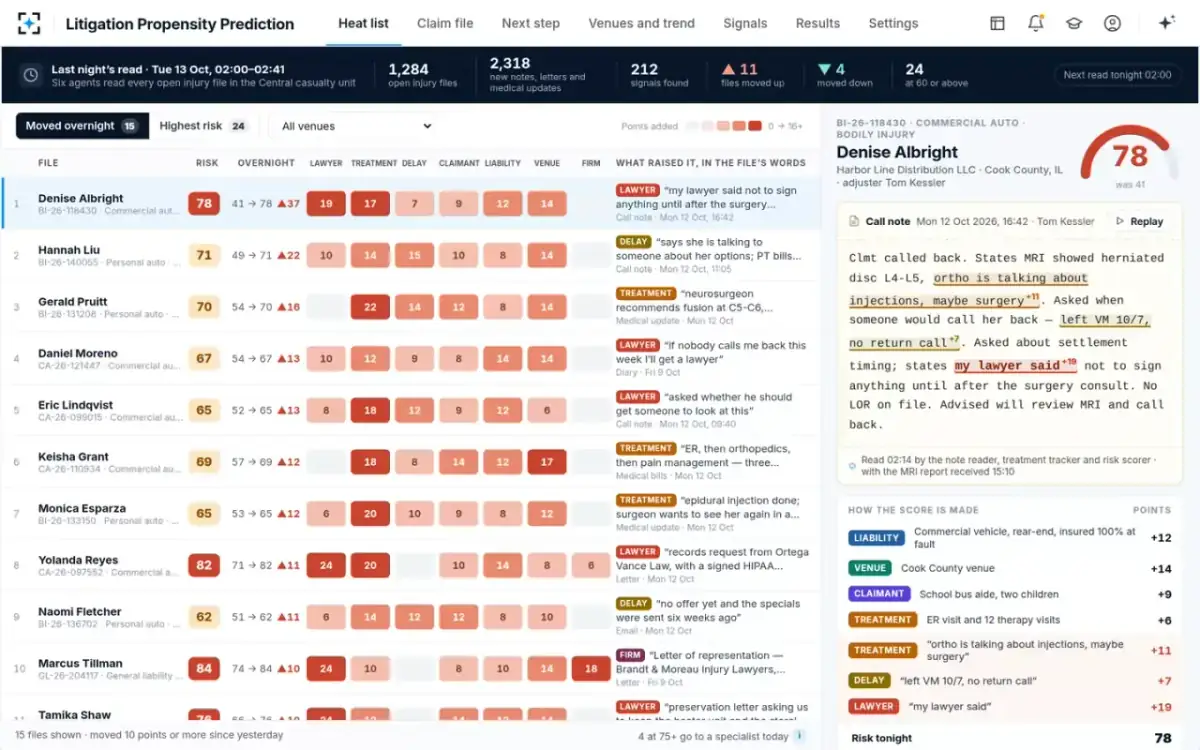
Note reader, 02:14Finds “my lawyer said” in yesterday’s call note, with the date, time and adjuster, and a voicemail of 7 Oct left unreturned.
Never: infers a fact that is not written
Agent
Letter and representation watcherConfirms no letter of representation, no records request and no preservation letter is on file.
Never: contacts a claimant
Agent
Risk scorerMoves the file from 41 to 78; past 75 the unit’s rule sends it to a specialist the same day.
Never: uses race, ethnicity, religion, national origin, sex, income or ZIP code
Agent
Next-step writerPrices three options from similar closed files and names who may approve each.
Never: sends, offers or changes a reserve
A person decides
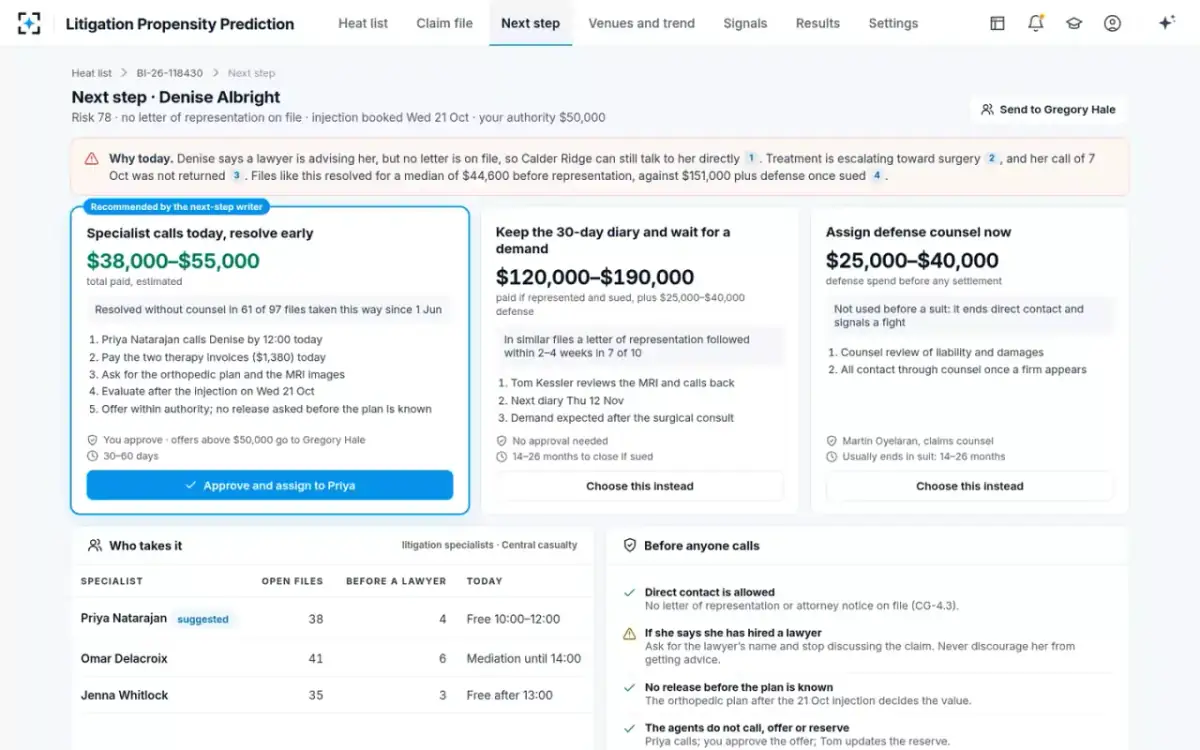
Claim supervisor, 08:52Approves a specialist call today within her $50,000 authority, and assigns it.
A person decides
Litigation specialist, by noonCalls the claimant, has the two unpaid therapy invoices sent for payment, asks for the orthopedic plan; no release before the plan is known.
The routed desk, seat by seat
A routed desk changes who sees a file first and on what evidence. The heat list is the supervisor's morning: the files whose score moved overnight, not a sample of diaries. The specialist gets the file before a lawyer's letter, with the treatment path, the unpaid bills and the contact rules laid out. Claims counsel sees the venues and plaintiff firms weekly instead of one letter at a time.
Litigation Propensity Prediction on a casualty unit: the five seats around one represented-risk file
Today
142 open files on 30-day diaries. Writes “my lawyer said” in a call note, and nobody else reads it until the summons lands.
With agents
The note is read the same night, quoted with what it added, and the file is with a specialist next morning.
Still theirs: the relationship, the reserve and the facts of the file
Today
Nine adjusters and 1,284 open injury files, reviewed by sampling diaries.
With agents
Starts on the files that moved overnight, opens the phrase behind each point, approves the next step within $50,000.
Still theirs: every decision on the next step within authority
Today
Gets the file after the letter of representation, when contact must go through counsel.
With agents
Gets it before a letter, with the treatment path, unpaid bills and contact rules, while direct talks are still possible.
Still theirs: the call, the offer and the release terms
Today
Meets each plaintiff firm when its letter arrives.
With agents
Sees at-risk files by venue and firm each week, and is second approver on any change to signal weights.
Still theirs: assigning defense counsel
Today
Asks for every offer above $50,000: what do we pay if we wait?
With agents
Gets resolve-now, wait and counsel options side by side with ranges from similar closed files.
Still theirs: offers above the supervisor’s authority
The design choice that matters is the threshold. The sample unit sends any file at 75 or above to a specialist the same day and lists everything at 60 or above. Those numbers are settings with a second approver, because they decide how many files reach the represented desk early and so how big that desk has to be. How a unit sets them is the subject of a claims triage model for injury files.
Before anyone calls: who takes the file, and the contact rules
Can an adjuster talk to a represented claimant?
Once the insurer knows a lawyer represents the claimant, claim communications go to the lawyer: the NAIC model and California's rules count the lawyer as the claimant, and the sample unit's guideline routes all contact through counsel from that point. The harder case is the one in the screen above: a claimant who says a lawyer is advising her, with no letter on file. The sample unit's guideline allows direct contact until a letter or attorney notice arrives, and tells the specialist what to do the moment the claimant says she has hired someone: ask for the name, stop discussing the claim.
The guideline also says never to discourage her from getting advice, and that line has a history. When Texas legislators considered a ban in 1999 (the bill did not become law), the House bill analysis described insurers mailing claimants a leaflet on whether they needed a lawyer, and recorded that "The Connecticut Legislature enacted legislation prohibiting insurance companies from sending letters that advise claimants not to hire an attorney." Early contact is legitimate claims handling. Early contact designed to keep a claimant from a lawyer is the practice regulators have acted on.
Timing rules apply to early contact too. Connecticut fined an auto insurer $2,500 in 2023 for one file where "bodily injury claim negotiations were started, or releases were taken in less than fifteen (15) days from the date of the tortious act". A desk that moves files earlier needs those rules in front of the specialist before the phone call, not in a manual.
How many represented files does an adjuster carry?
There is no published benchmark from a regulator or research body for represented BI caseloads, and the right number depends on how early files arrive. In the sample unit, the generalist adjuster carries 142 open files on 30-day diaries, while the three litigation specialists carry 35 to 41 each, three to six of them taken before a lawyer's letter. The ratio is the point: a specialist file needs more contact, more documents and more decisions per month.
Moving files earlier changes the mix rather than the count. A file taken at "my lawyer said" may close in 30 to 60 days without counsel; the same file taken at the summons sits on the desk for 14 to 26 months in the sample unit's estimates. In the solution's test on the sample carrier's 2025 closed injury files, 240 files scored 75 or more 30 days before suit or closing, and 141 of them were sued. A unit can size the specialist desk from its own version of that count, not from an industry ratio.
What the desk should measure
A routed desk is judged by warning time and by what happens to the files it takes early, not by how many files it closes. Four measures carry most of it: how many days before service the suits it eventually faces were flagged; how many flagged files the specialist reached before a lawyer's letter; how many of those resolved without counsel; and how many dismissed signals and overrides there were, with the reasons. The last is the one that improves the score.
The supervisor's morning: files that moved overnight
Designing an attorney represented BI desk: questions to settle first
- What moves a file to the desk?
The letter, the suit, or a score built from written signals. Write the trigger down and give it an owner.
- Who may contact a claimant who mentions a lawyer?
Set the rule before the call: what to ask, when to stop, and that no one discourages advice.
- Which early-contact limits apply in your states?
Release timing such as Connecticut’s 15 days, limitations notices for unrepresented claimants, and release language.
- Who approves what?
Next steps and offers by amount; defense counsel assignment by claims counsel.
- How big must the desk be?
Count your own files that crossed the threshold last year and how long each stayed open.
- What does the desk report?
Warning days before suit, files reached before a letter, resolutions without counsel, and overrides with reasons.
Litigation Propensity Prediction supplies the routing and the evidence; it never calls, offers, reserves or assigns counsel, and its thresholds and authority table are the carrier's own settings. How each night's read works, file by file, is in machine learning on claims data.
Questions people ask
What is an attorney represented bodily injury adjuster?
An adjuster who handles bodily injury claims where the claimant has a lawyer, negotiating with counsel and building the file for a possible suit. With nearly half of auto injury claimants represented in 2022 according to the Insurance Research Council, many carriers staff it as a separate desk or unit.
How is a represented claim handled differently?
Communications go through the lawyer, and protections built for unrepresented claimants change. California, for example, requires written notice of a limitations deadline at least 60 days before it expires, but not for a claimant represented by counsel on the claim.
Can an adjuster talk to a represented claimant?
Once the insurer knows a lawyer is involved, claim communications go to the lawyer, whom the NAIC model and California's rules count as the claimant. Before a letter or attorney notice arrives, carriers' own guidelines decide, and in Connecticut, starting negotiations or taking releases within 15 days of the accident drew a regulator's fine.
When does a file move to a litigation specialist?
Traditionally at the letter of representation or at suit. A routed desk moves it on written signals instead; in the sample unit, any file scoring 75 or more goes to a specialist the same day, and everything at 60 or more is listed for the supervisor.
How many represented files does an adjuster carry?
No regulator or research body publishes a benchmark. In the sample unit, specialists carry 35 to 41 files against 142 for a generalist, and the right size for a real desk comes from counting how many of its own files cross the threshold each year.