Should you get a lawyer for a car accident? There is no answer that fits every claim, and this page gives no legal advice. What it can do is set out what the evidence says. Represented injury claims take much longer to close: a median of nearly 440 days for represented bodily injury claimants in one large insurer-supported study, more than double the wait without a lawyer. On money, the research points both ways: in that study, represented claimants kept less per dollar of medical bills after fees, while a study of workers' compensation published by the National Bureau of Economic Research found lawyers raised what injured workers received even after fees. Both studies compare different kinds of claims, so neither settles your case. This page is written by Botminds, which makes Litigation Propensity Prediction, software insurance companies use to read their open injury files each night and see which claims are turning toward a lawyer or a lawsuit. We think a claimant should be able to see the same data the insurer sees, and the rules the insurer has to follow either way.
An injury claim with and without a lawyer: what the data and rules say
| Without a lawyer | With a lawyer | |
|---|---|---|
| Who the insurer deals with | You, directly. | Your lawyer, for everything about the claim. |
| Time to close | Less than half as long, at the median, in the Insurance Research Council’s auto data. | A median of nearly 440 days for bodily injury claimants in the same data. |
| Gross amount | Lower on average in workers’ compensation data, partly because represented claims include more serious injuries. | Higher in workers’ compensation even after allowing for injury severity, in the Savych and Neumark study. |
| What you keep | No legal fee. $1.80 per dollar of medical bills in the IRC auto data, after medical costs. | $1.40 per dollar of medical bills in the IRC auto data, after medical costs and an assumed one-third fee. |
| Deadlines | Where the NAIC model rule applies, the insurer must warn you in writing before a limitations deadline: 60 days ahead for a third-party claimant. | Your lawyer tracks the deadline; California’s notice rule no longer applies once you have counsel. |
| Releases | You read and sign the release yourself; once signed, the claim is over. | Your lawyer negotiates the release terms. |
Should I get a lawyer for a car accident? What the data can and cannot say
The data can describe what happens to claims like yours on average; it cannot say what would happen to your claim either way. The core problem is selection. People hire lawyers more often when they are badly hurt, when fault is disputed or when an offer seems low, so represented claims differ from unrepresented ones before any lawyer does anything. Researchers who study the question spend most of their effort separating the lawyer's effect from the claim's.
Two large studies frame the evidence. One describes auto claims, is funded by the industry, and looks at what claimants kept. The other studies workers' compensation, uses methods built to isolate the lawyer's effect, and looks at what claimants received. They are summarised side by side below, so you can weigh them.
Two large studies, and what each one measured
| Insurance Research Council (2026) | Savych and Neumark (NBER, 2024) | |
|---|---|---|
| Claims | 7.4 million auto injury claims closed with payment, mid-2017 to mid-2022 | More than 950,000 workers’ compensation claims with over a week off work, 2012–2019 |
| Who funded or published it | Non-profit research body supported by property and casualty insurers | National Bureau of Economic Research; authors from UC Irvine and the Workers Compensation Research Institute, a non-profit whose funders include insurers and employers |
| What it measured | Payments, closure time, and net per dollar of medical bills | Total wage-replacement benefits, with methods to isolate the lawyer’s effect |
| Finding on money | Represented claimants netted $1.40 per medical dollar against $1.80, after medical costs and fees | Lawyers increased benefits substantially, and workers came out ahead after fees |
| Limits | Describes association: represented claims are different claims | Workers’ compensation, not car accidents; cannot say whether amounts were too low or too high |
Do you get more money with a lawyer?
The evidence is mixed, and it depends on whether you count gross or net. The workers' compensation study found that, comparing otherwise similar claims, a lawyer raised the benefits workers received by $7,700 to $12,400, and the authors concluded that "workers receive substantially higher indemnity benefits when attorneys are involved, even after accounting for the fees that workers pay to attorneys". They are careful about what that means: their data cannot tell whether lawyers recover money workers were owed or push payouts too high.
The auto study reports the other side. After medical costs and an assumed one-third legal fee, represented bodily injury claimants "netted less per dollar of medical bills ($1.40 versus $1.80) after accounting for medical costs and legal fees". That figure compares different groups of claims, and it is published by a body supported by insurers. Workers' compensation is also a different system from a car accident claim against another driver's insurer. A reader can fairly take from the two studies that the answer depends on the claim, which is why the decision is yours to make with advice you trust.
What the Insurance Research Council found on represented auto injury claims
Half
of auto injury claimants had a lawyer in 2022 (nearly 50%), up from 40% in 2017
440
days, nearly: the median time to closure for represented bodily injury claimants
$1.40
kept per dollar of medical bills with a lawyer, after fees
$1.80 without
33%
the legal fee the study assumed (one-third)
its estimate, not a measured fee
How much do personal injury lawyers take?
Personal injury lawyers commonly work on a contingency fee, a percentage of what they recover. The percentage depends on the lawyer, the agreement and the state, and some states regulate it. The Insurance Research Council assumed one-third of the settlement when it calculated what represented claimants kept. In workers' compensation, where fees are more tightly regulated, Savych and Neumark report fees of "typically 20 to 33 percent" of benefits.
The fee agreement is the place to check the details: the percentage, whether it changes if a lawsuit is filed or the case goes to trial, and whether case costs such as records and expert fees come out before or after the percentage. Those details change what you keep as much as the percentage does.
How long do injury claims take with a lawyer?
Longer, at the median. The Insurance Research Council found represented bodily injury claimants waited nearly 440 days for closure, which it describes as "more than double the time for unrepresented claimants". Part of that is the claims themselves, since serious injuries take longer to treat, and part is the process: lawyers often wait until treatment reaches a stable point before making a demand, and a lawsuit adds court time. In federal court, civil cases that end during a trial take a median of 30.7 months from filing, though few injury cases get that far, as what percentage of personal injury cases go to court explains.
Can I settle an injury claim without a lawyer?
Yes. Many people do, and insurers handle unrepresented injury claims every day. The one step to be sure about is the release. Texas's Office of Public Insurance Counsel, a state agency that represents insurance consumers, puts it plainly: "The other insurance company will make you sign a release waiver for all claims." And then:
“Once you sign that release, you are not going to get more money for your injury.”
Texas Office of Public Insurance Counsel
That is why timing matters. A release signed before you know how an injury will heal closes the claim at what was known that day. Some states restrict early releases: Connecticut fined an insurer $2,500 in 2023 over a file where injury negotiations were started or a release taken within 15 days of the accident.
What the insurer must do when you have no lawyer
Where a state has adopted the NAIC's model claims rules, an insurer may not keep negotiating with an unrepresented claimant near a limitations deadline without written notice, given to third-party claimants "at least sixty (60) days before the date on which such time limit may expire". The same model bars an insurer from "statements indicating that the rights of a third party claimant may be impaired if a form or release is not completed within a given period of time", unless it is explaining a statute of limitations. California has its own version of both rules.
There is also a history of rules about discouraging claimants from hiring a lawyer. When Texas legislators considered a ban in 1999 (it did not become law), the House bill analysis described insurers mailing claimants a document titled "Do I need an attorney?", and recorded that Connecticut had enacted a law against letters advising claimants not to hire one. Your state's insurance department can tell you which rules apply to your claim.
When official guidance mentions a lawyer
Consumer agencies tend to describe situations rather than give a general rule. The Texas Office of Public Insurance Counsel's page on third-party auto claims points to one: when the other driver has no insurance or not enough to cover your damages, you file under your own policy's uninsured or underinsured motorist coverage, and "You may want to talk to an attorney who handles auto accident cases."
The claim research suggests other situations where a claim is more likely to involve a lawyer: serious injuries with surgery or long treatment, disputed fault, a commercial vehicle, and delays in payment. In the workers' compensation data, workers whose first payment came more than 30 days after their disability began had a lawyer 50% of the time, against 29% when it came sooner. Those are descriptions of what people did, not recommendations.
Facts worth having in front of you, whichever way you decide
- Your state’s deadline to sue
The statute of limitations for injury claims differs by state; the insurer’s notice duty, where it exists, is a backstop, not a substitute.
- Where your treatment is heading
A settlement and release close the claim at what is known that day.
- Every coverage that may apply
The other driver’s liability limits, and your own medical payments, PIP, uninsured or underinsured motorist coverage.
- Bills paid and unpaid
And whether a health plan or hospital will claim repayment from a settlement.
- What the release says
Who and what it releases, and whether it covers injuries not yet diagnosed.
- If you speak to a lawyer
The fee percentage, whether it changes at suit or trial, and how case costs are charged.
What Litigation Propensity Prediction does when a claimant mentions a lawyer
Some insurers read their claim files with software, and it is fair to ask what that software does with a claimant's words. Litigation Propensity Prediction reads the adjuster's notes, the letters and the medical bills on every open injury file each night. If a claimant says "my lawyer said" on a call, it records the phrase, raises the file's score and sends it to a supervisor, who may ask a specialist to call. It never calls, offers or decides anything itself, and it never uses race, ethnicity, religion, national origin, sex, income or ZIP code.
The rules the specialist works under in the solution's sample setup are on the screen below. If the claimant says she has hired a lawyer, the specialist asks for the lawyer's name and stops discussing the claim. The specialist must never discourage her from getting advice, and no release is asked for before her treatment plan is known.
The contact rules a specialist sees before calling, in Litigation Propensity Prediction
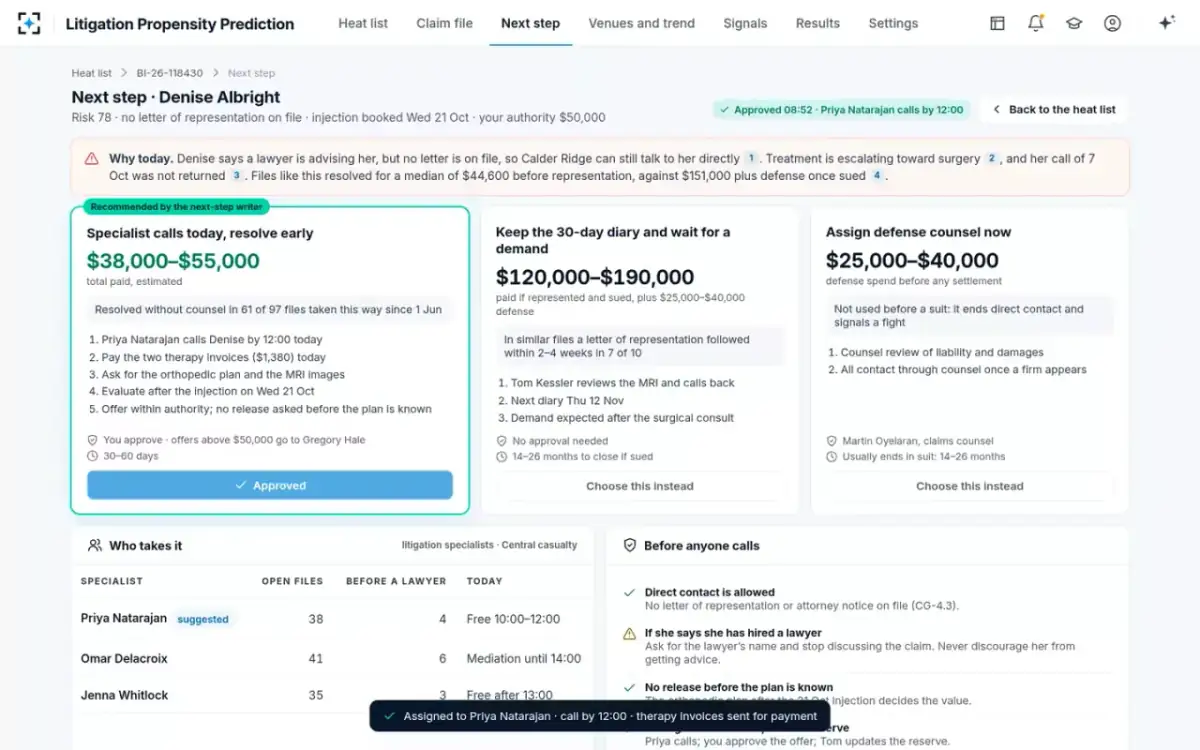
The delay signals in the same software, unpaid bills and unreturned calls, point insurers at problems they can fix, which is in claimants' interest too. How insurers' handling changes once a claimant does have counsel is set out in what a letter of representation changes.
Questions people ask
Do I need a lawyer for a personal injury claim?
No law requires one, and many claims settle without a lawyer. About half of auto injury claimants had one in 2022, according to the Insurance Research Council; whether you should is a decision to make with advice you trust, for example through a state bar's lawyer referral service.
Do you get more money with a lawyer?
The research is mixed. A workers' compensation study found lawyers raised benefits even after fees, while an insurer-supported auto study found represented claimants kept $1.40 per dollar of medical bills against $1.80 without, after fees. Both compare different kinds of claims.
How long do injury claims take with a lawyer?
In the Insurance Research Council's data, represented bodily injury claimants waited a median of nearly 440 days for closure, more than twice as long as those without a lawyer. More serious injuries and lawsuits account for part of the difference.
How much do personal injury lawyers take?
Usually a contingency percentage of the recovery, set in the fee agreement and limited by some states. The Insurance Research Council assumed one-third for its calculations; workers' compensation fees are typically 20% to 33%, according to Savych and Neumark.
Can I settle an injury claim without a lawyer?
Yes. Read the release carefully: as Texas's consumer insurance counsel warns, once you sign it you will not get more money for that injury. Where the NAIC model rules apply, the insurer must also warn you in writing before a limitations deadline.
Should I get a lawyer for a car accident that was not my fault?
Fault affects whose insurer pays and how much; it does not by itself answer whether you need a lawyer. Official consumer guidance in Texas mentions talking to an attorney in particular when the at-fault driver has no insurance or too little; the decision otherwise depends on your injuries, your coverage and the offer.