Claims triage solutions read each new claim, estimate how serious and complex it is, and send it to the right handling track: a photo estimate, a desk appraiser, a field adjuster, a liability or complex desk, an injury unit or large loss. Buyers usually compare them on overall accuracy, and that number hides the error that costs most: an injury said late in a call, by a passenger or in another language, that never reaches the injury desk. Botminds' FNOL & Claims Triage Automation scores severity from published signals and applies routing rules in which any injury, to anyone, goes to the injury unit. Whatever a carrier buys, the way to judge it is the same: plant injuries you already know about in your own past notices and count how many come back on the right desk.
Examples from the solution use a fictional carrier, Tallowmere Mutual, and its sample data. The industry figures come from the NAIC's survey of private-passenger auto insurers, NHTSA and peer-reviewed research. The seeded test and its arithmetic are our method, set out so a carrier can reproduce it.
How large auto insurers already use models to assign claims
195
claim assignment models in use or being built, across 193 auto insurers surveyed
106
of them run as automation: no human intervention on execution
81
suggest an answer and advise the person who decides
79%
of claim assignment models were built in-house rather than bought
What is claims triage?
Claims triage is the first sorting of a new claim by severity and complexity, so it reaches people with the right skills, authority and licence before the first decision is made on it. In auto claims the main question is whether a person was hurt, and the second is how complex the vehicle and liability picture is. In property claims it is whether the home can be lived in and how large the loss is. Claims triage meaning, in one line: deciding who handles a claim, not what the claim is worth.
The NAIC's survey shows how far automated routing has already gone. It defines claim assignment as "Recommending which adjusters are assigned to which claims", and found that "Claim assignment decisions tend to be automated or at least the models provide augmentation." Of 195 claim assignment models in use or under construction, 106 ran with no human intervention on execution. Insurers' own write-in answers named further uses, among them claims triage, speech analysis and models that "listen to voice calls". A triage solution is no longer an experiment. It is a decision system that regulators expect insurers to govern, and testing it is part of that governance.
Claim severity meaning: a score is not a verdict
Claim severity, in triage, is an estimate of how serious a claim is likely to be, made from what is known at first notice; it is not the claim's value and not a judgement about fault. In actuarial usage severity means the average cost per claim. At first notice nobody knows the cost, so a triage score stands in for it with signals: an ambulance, airbags, a tow, a commercial vehicle, an attorney letter.
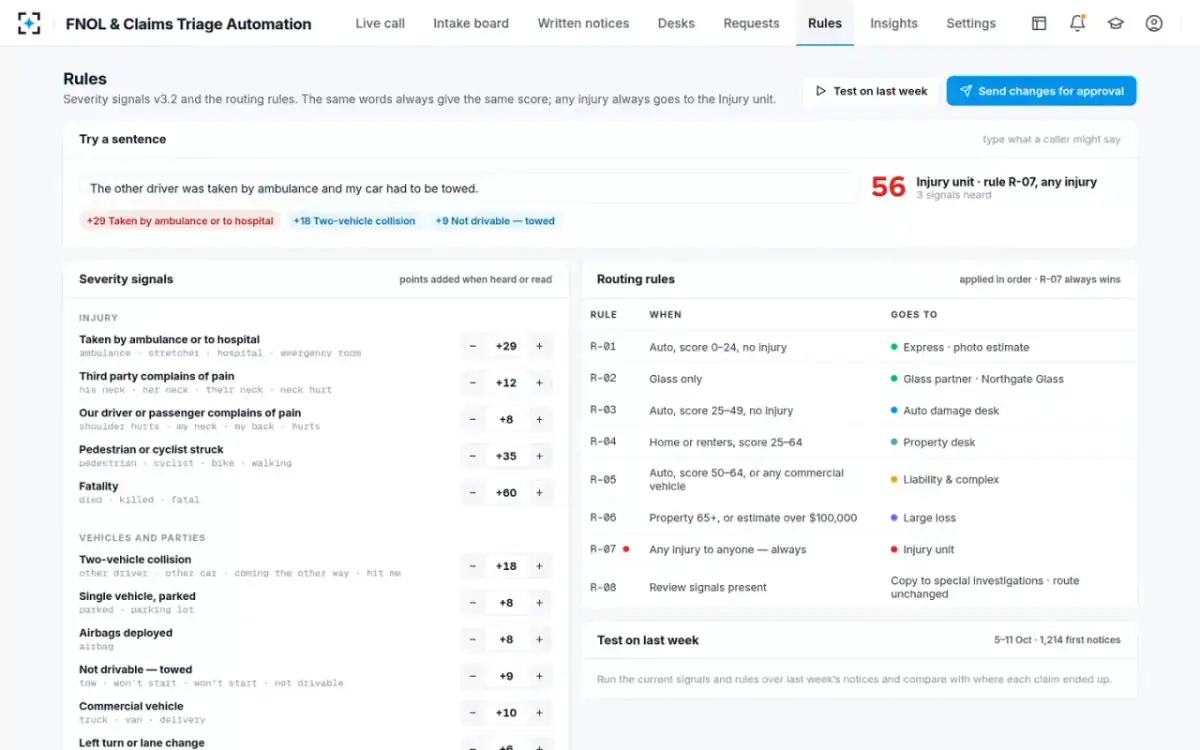
The solution's score is a sum of published, versioned signals (version 3.2 on the sample carrier), each shown with the sentence that triggered it. The sample left-turn collision scored 41 from four signals before the injury came out, and 78 after: +18 two vehicles, +6 left turn across traffic, +8 airbags, +9 towed, +29 the other driver taken by ambulance, +8 a passenger complaining of pain. A transparent sum like this can be argued with line by line, which is its strength. Its weakness is the same as any score's: a low total can hide one decisive fact. That is why the routing rules are applied in order after the score, and why one of them overrides it.
Signals with their trigger words, and rules applied in order
Why injury recall is the number that matters in claims triage
Injury recall, the share of claims with an injury that reach the injury desk on the first routing, is the measure to buy on, because a missed injury is the error with a clock attached. A collision routed to the wrong appraiser costs a day and a re-assignment. An injury routed to a damage desk can cost the first contact with the injured person, and with it the chance to explain the process before someone else does. The sample carrier's injury unit works to a 24-hour contact clock that starts the moment an injury is heard; a missed injury starts nothing.
Overall accuracy hides missed injuries because injuries are a minority of first notices. On the sample carrier's last 30 days, 326 of 4,912 first notices ended in the Injury unit. A triage tool could route every one of those 326 elsewhere and still be right on more than 93% of claims. Recall on the injury class, and the count of misses behind it, is the honest number.
The four outcomes a seeded triage test counts
Caught
Injury said · routed to the injury desk
The outcome the test exists to count. Every planted injury should land here.
Missed injury
Injury said · routed anywhere else
The costly error: the injured person waits for a desk that does not handle injuries, and the contact clock is lost.
False alarm
No injury · routed to the injury desk
Costs capacity on the busiest desk. Tolerable in small numbers; worth counting.
Clear
No injury · routed elsewhere
Correct, and most of the volume. Tells you little about injury handling.
The false-alarm cell matters too. A triage design that sends every doubtful claim to the injury unit will catch every injury and swamp its busiest desk; on the sample carrier the injury unit stood at 65 of 70 open files on the morning shown. The test should report false alarms, but the pass mark is set on misses.
The seeded test: 200 injuries, hidden five ways
A seeded test takes notices whose outcome you already know, plants injuries the way real callers mention them, and checks where each one lands. Use your own closed notices, because they carry your callers' words, your channels and your policy forms. Two hundred injuries is a practical size: large enough for the arithmetic below to mean something, small enough to assemble by hand from past files in a few days.
The planting is the craft. An injury stated first and plainly ("I'm hurt, I'm at the hospital") tests little; any tool worth trialling should catch it. Seed the ways injuries actually arrive. NHTSA's crash-report guideline is a useful reminder of how broad the category is: its "Possible Injury" class covers "any injury reported or claimed that is not a fatal, suspected serious, or suspected minor injury", and "Possible injuries are those that are reported by the person or are indicated by their behavior, but no wounds or injuries are readily evident." Those are the injuries a first-notice tool is most likely to miss.
A 200-injury seed set, split by the way each injury is hidden
Then build the negative set: 200 notices with no injury, including the near-misses that trip keyword matching. "Nobody was hurt." "The airbag went off but we're fine." "My neck of the woods." "The car took a hit." A tool that routes these to the injury unit is reading words, not meaning. On the sample carrier the rules screen has a box for exactly this: type the sentence a caller might say and see the score, the signals heard and the rule applied, before any change goes live.
How to test claims triage software on your own notices
Run the test the way the tool will run in production: same channels, same timing, no human correction. If the tool will listen to live calls, feed it audio or transcripts at call speed, not a finished summary; a tool that only scores once the call ends has not been tested on the injury said at minute two. If it will read written notices, feed the attachments, not a typed extract.
A seeded triage test, step by step
- Pull 400 closed first notices from the last year
200 with a confirmed injury, 200 without. Keep the original audio, forms, emails and attachments.
- Plant or select injuries across the five hiding places
Late, passenger, third party, Spanish, written. Note for each the exact words and the time or page.
- Freeze the tool’s version and settings
Signals, rules, thresholds and model version, written down before the run; any change restarts the test.
- Run in production mode, without people correcting
Live-speed audio for calls, raw attachments for written notices.
- Count the four outcomes, and read every miss
For each miss: which words were said, when, and what the tool did with them.
- Repeat for each language and channel you will switch on
A pass in English on calls says nothing about Spanish emails.
Read the misses one by one. A tool that missed "my son says his shoulder hurts" because it attached the pain to the caller, who was fine, has a speaker problem. A tool that missed "le duele el cuello" has a language problem. Each has a different fix, and a vendor should be able to say which fix applies and show the re-run. For speech in particular, the research gives reason to test by speaker group: a 2020 study of five commercial speech recognition systems found "an average word error rate (WER) of 0.35 for black speakers compared with 0.19 for white speakers" (Koenecke et al., PNAS). Systems have changed since, which is the point: measure yours on your callers.
Reading the result: what zero missed injuries proves
Zero misses in 200 seeded injuries proves less than it sounds, and more than one in 200 should fail a tool. With no misses in n trials, the true miss rate could still be as high as roughly 3/n at 95% confidence; the problem of interpreting a zero count is set out in Hanley and Lippman-Hand's "If nothing goes wrong, is everything all right? Interpreting zero numerators" (JAMA, 1983). The table gives the exact bounds.
What a seeded injury test can and cannot rule out
| Injuries seeded | Misses seen | Miss rate could still be as high as | Injury recall at least |
|---|---|---|---|
| 50 | 0 | 5.8% | 94.2% |
| 100 | 0 | 3.0% | 97.0% |
| 200 | 0 | 1.5% | 98.5% |
| 200 | 1 | 2.4% | 97.6% |
| 200 | 2 | 3.1% | 96.9% |
| 500 | 0 | 0.6% | 99.4% |
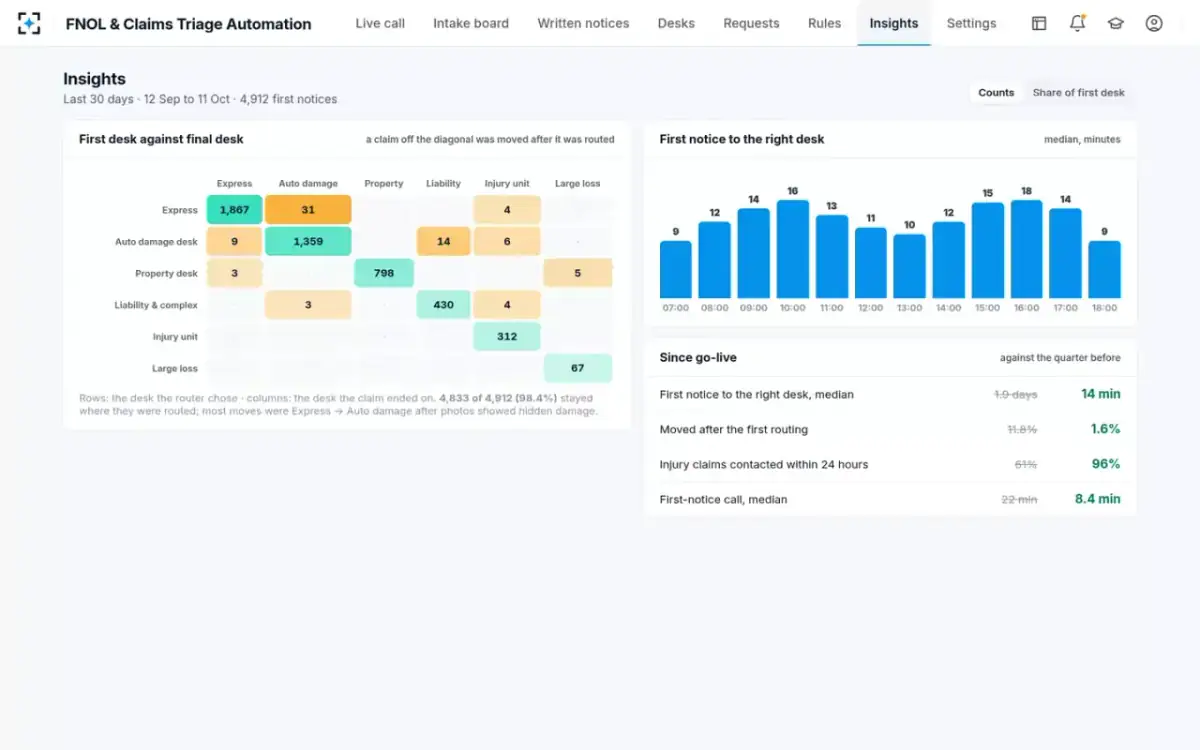
Set the pass mark before the run. A sensible rule for injuries is zero misses on the seed set, with every near-miss (an injury caught only after the call ended, or only by a person) counted and explained. Then keep measuring in production, where the sample carrier's insights screen shows the desk each claim was first routed to against the desk it ended on.
First desk against final desk, 30 days of sample notices
Claims triage solutions compared: rules, scores and models
Claims triage solutions come in three designs, and each fails a seeded test in its own way. Rules alone (if injury, then injury desk) are transparent but brittle: they catch the words they were written for and miss the rest. A model score alone ranks claims well on average and can still send a low-scoring injury to a damage desk. A transparent score with overriding rules, the sample carrier's design, keeps the ranking and makes some outcomes non-negotiable.
Three triage designs and what a seeded test tends to expose
| Design | How it routes | Typical failure on a seeded test | What to ask the vendor |
|---|---|---|---|
| Keyword or rules only | Fixed words or form answers map to desks | Injuries phrased indirectly, said by a passenger or in another language | Show the word list and every phrase the test missed |
| Model score only | A trained model ranks severity; thresholds pick the desk | A low score on a real injury; no reason anyone can read | Show the score’s reasons per claim, and the misses by threshold |
| Published signals plus rules in order | A readable sum of signals; rules override it, with any injury always winning | Signals not yet written for a new pattern | Show how a new signal is tested on last week’s notices before approval |
Where the solution fits is first-notice routing: sizing every new claim as it arrives, on any channel, and putting it on the right desk with an adjuster who has room and a licence in the loss state. Where it does not fit is equally specific. It does not predict litigation; that is a different question, asked of open files over weeks, and Litigation Propensity Prediction is built for it. It does not call claims fraudulent: review signals send a quiet copy to special investigations without changing the route. And it does not decide coverage or fault. A buyer who needs those should test them separately, against their own measures.
Whatever the design, the governance is the insurer's. The NAIC's model bulletin on AI says insurers' decisions made with AI systems "must comply with the legal and regulatory standards that apply to those decisions", and its expectations reach AI systems bought from vendors as well as those built in-house (what the bulletin asks for). A seeded test, kept with its frozen settings and every miss explained, is the kind of evidence a governance programme needs. The questions to put to a vendor before any test are collected in FNOL software: 15 questions to ask before you buy.
What is claim segmentation, and where does it stop?
Claim segmentation is the grouping of claims into handling tracks by expected complexity: fast-track, desk, field, complex, specialist. It is the operating model triage feeds. The sample carrier's segments are six desks: Express for photo estimates (scores up to 24 with no injury), the Auto damage desk, the Property desk, Liability & complex (from a score of 50, or any commercial vehicle), the Injury unit and Large loss.
Segmentation stops where judgement starts. Putting a claim in the complex segment says a senior adjuster should look at it; it does not say liability is disputed or the claim is worth more. A triage tool that starts writing conclusions into the segment (likely fraud, likely litigated, likely total) has moved from routing to deciding, and should be tested and governed as a decision system.
What a seeded triage test cannot tell you
A seeded test measures routing on the notices you seeded, at the version you froze. It does not measure how the tool behaves on a catastrophe weekend, when a new kind of claim appears, or after the vendor updates a model. Repeat it at every version change and every new channel, and keep the production measure (first desk against final desk) running between tests.
It also does not measure the people. A tool that routes correctly but proposes the wrong adjuster, or drafts a message nobody reads before sending, fails in ways a routing test will not catch. The sample carrier keeps those steps with named people: the first-notice specialist confirms the claim and every message, and the intake supervisor approves route overrides and any assignment over an adjuster's cap. How the injury rule plays out on a single call, second by second, is traced in the claims FNOL process flow.
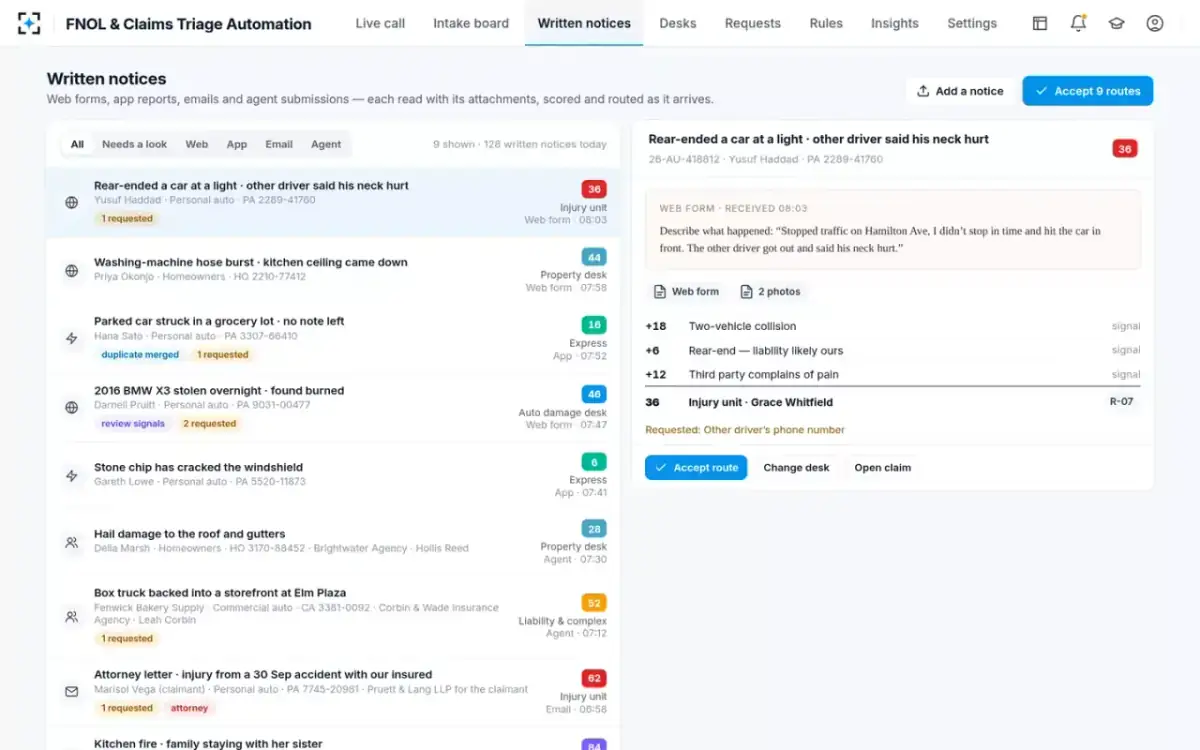
A score of 36, and still the Injury unit
Questions people ask
What is triage in insurance?
Triage in insurance is the first sorting of a new claim by severity and complexity, so it reaches the right people before decisions are made. In auto claims the central question is whether anyone was hurt. The NAIC's survey of large auto insurers counted 195 claim assignment models in use or being built, 106 of them running with no human intervention on execution.
How accurate is AI claims triage?
No public benchmark measures it across carriers, so accuracy has to be measured on your own notices. Measure injury recall rather than overall accuracy, because injuries are a minority of claims. With 200 seeded injuries and none missed, the miss rate could still be up to about 1.5% at 95% confidence.
How many injuries should a triage test include?
Enough for the bound to be useful: with zero misses, 100 seeded injuries rules out a miss rate above about 3%, 200 above about 1.5%, and 500 above about 0.6%. Spread them across the ways injuries are actually reported: late, by a passenger, about a third party, in another language and in writing.
What is the difference between claims triage and claim segmentation?
Triage is the act of sorting each new claim; segmentation is the set of tracks it is sorted into, such as express, desk, field, complex and injury. Triage quality is measured by how often claims land in the right segment first time. On the sample carrier, 98.4% of 4,912 notices stayed where they were first routed over 30 days.
Can a triage tool decide fraud or litigation risk?
It can flag, but a first-notice tool should not decide either. The sample carrier's scorer never calls a claim fraudulent; review signals send a quiet copy to special investigations without changing the route. Litigation risk is a question about open files over time, answered by a different kind of tool.