A first notice of loss job description, written honestly, says this: take the first report of every new claim by phone, app, web form, email or agent; identify the policyholder and the policy; capture what happened, who was involved and who was hurt; send the claim to the right desk; tell the customer what happens next; and do all of it while a frightened person is still talking. The job title varies (FNOL representative, first-notice specialist, claims intake specialist, claims customer service representative), but the work is the same, and it is where a carrier's regulatory clocks start. Botminds' FNOL & Claims Triage Automation was built for that desk: it does the typing, the searching and the routing while the call happens, and leaves the listening and the confirmation with the person.
The examples below come from the solution running on a fictional carrier, Tallowmere Mutual; its people, claims and figures are sample data. Pay and work-conditions figures come from the US Department of Labor's O*NET and the Bureau of Labor Statistics.
The closest official job category to a first-notice representative
$23.67
median hourly wage, insurance claims and policy processing clerks, 2025
239,100
people employed in the category in 2025
17,500
projected job openings, 2025–2035, with employment in decline
83%
say telephone conversations are an every-day part of the job
What does a first notice of loss representative do?
A first notice of loss representative turns a customer's account of a loss into a claim the carrier can act on, and gets it to the person who will handle it. The representative does not decide coverage, fault or the amount; those belong to the adjuster. What the representative owns is the first hour: whether the claim is complete enough to route, whether anyone was hurt, and whether the customer leaves the call knowing what happens next.
The official job data put this work under insurance claims clerks. O*NET's task list for the category reads like a first-notice shift: "Prepare insurance claim forms or related documents, and review them for completeness", "Contact insured or other involved persons to obtain missing information" and "Transmit claims for payment or further investigation". It also lists "Review insurance policy to determine coverage", which is where a well-run first-notice desk draws a line: the representative confirms the policy was in force and lists the coverages, and the adjuster decides whether any of them applies.
A carrier may split the job by channel, with phone representatives on a claims line and a written-notice team reading forms, emails and agents' submissions. On the sample carrier's morning both kinds arrive on one board, and the work is the same: read, match, size, route, ask for what is missing.
FNOL claims handler job description, duty by duty, and the rule behind each
Most of the duties in an FNOL claims handler job description exist because a regulation says the carrier must do something soon after notice. A trainer who teaches the duties with their reasons gets representatives who understand why a note, a disclosure or a text matters. The table pairs each duty with the rule behind it.
Duties of a first-notice representative and the rules they serve
| Duty | Why it matters | Rule behind it |
|---|---|---|
| Acknowledge the claim | The acknowledgement is the carrier’s first regulated act on the claim. | California: within 15 calendar days of notice; Ohio: within fifteen days; Washington: 10 business days |
| Note an oral acknowledgement in the file | A phone acknowledgement that is not noted did not happen, as far as an examiner can tell. | California requires a dated notation; Washington requires one "describing how, when, and to whom" |
| Tell the claimant what they need to send | Missing items are the first cause of a second call. | California: forms, instructions and reasonable assistance within the same 15 days |
| Offer an in-person vehicle inspection (Washington) | New since 18 October 2026, and due at notification, not later. | WAC 284-30-390 as amended by WSR 26-17-089 |
| Explain towing and storage cover (Washington) | Storage bills start at the tow, often before an adjuster is assigned. | Within five business days of notification, in writing |
| Route the claim | A claim on the wrong desk loses days that the clocks above do not give back. | The clocks run from notice; notice to an agent is notice to the insurer in Ohio, New York and Washington |
The note matters more than new representatives expect. California's regulation says: "If the acknowledgement is not in writing, a notation of acknowledgement shall be made in the insurer's claim file and dated." Washington's amended rule asks for a notation "describing how, when, and to whom the notice was made". A representative who acknowledges a claim on the phone and moves straight to the next call has done the right thing and left no proof of it. In the solution, the acknowledgement text, the call time it was sent and the representative who confirmed it are kept in the claim's run log.
Claims intake specialist job description against the adjuster's: where the job ends
The claims intake specialist job ends where judgement about the claim's value begins. Intake captures, identifies, sizes and routes; the adjuster investigates, decides coverage and liability, sets reserves and pays. BLS describes adjusters' work as one where they "interview the claimant and witnesses, inspect the property, and do additional research", and the category pays a median of $78,020 a year, against $49,230 for claims clerks (2025). The gap is the decision-making.
Intake and adjusting on the same claim: who does what
Claims intake specialist: Finds it, confirms it was in force and paid on the date of loss, lists coverages and limits.
Claims adjuster: Decides which coverage applies, if any, and whether to reserve rights.
Claims intake specialist: Takes the caller’s account in their words, with the police report number.
Claims adjuster: Takes recorded statements, reads the report, inspects, decides liability.
Claims intake specialist: Asks whether anyone was hurt, in either car, and who.
Claims adjuster: Contacts each injured party, values the injury, negotiates.
Claims intake specialist: Sizes the claim from what was said, so it reaches the right desk.
Claims adjuster: Sets the reserve and revises it as the claim develops.
Claims intake specialist: Acknowledges, explains next steps, asks for what is missing.
Claims adjuster: Keeps the claimant informed until it closes.
What the job pays: FNOL claims handler salary against the adjuster track
An FNOL claims handler's salary sits close to the claims-clerk median, $23.67 an hour or $49,230 a year in O*NET's 2025 data, with state figures that vary widely. For a representative who moves on into adjusting, the official figures show what the move is worth: claims adjusters, examiners and investigators earned a median $78,020 in the BLS data.
The outlook for both is flat to falling. O*NET projects a decline for claims clerks, with 17,500 openings over 2025–2035 even as employment shrinks. BLS projects adjusters, appraisers, examiners and investigators to "decline 6 percent from 2025 to 2035", from 389,700 jobs. Those projections are the context for any automation on the desk: carriers are not adding first-notice headcount, and the people they keep are the ones who can do what software cannot.
Is FNOL a stressful job? What the people who do it report
Yes, for a specific reason: the representative has to be accurate and kind at once, on the phone, all day. In O*NET's survey of claims clerks, 83% have telephone conversations every day, 60% report "Constant contact with others", 48% face time pressure every day, and 65% say being exact or accurate is "Extremely important". Hostility is not the main load: for dealing with unpleasant or angry people, the answer O*NET reports is once a month (27%). The load is precision under emotion.
"I'm typing while they're crying. I can't also work out which desk it goes to."
Marcus Bell, the sample carrier's first-notice specialist (a fictional character)
The line belongs to a fictional character, but every trainer on a claims line will recognise it. The stress is not the volume alone. It is the three-way split of attention: the person on the phone, the claim screen, and the policy system in another window. A representative who has to search for a policy while a caller describes an ambulance will miss something, and the thing most often missed is the detail that should have changed the desk.
A claims-line morning, notice by notice
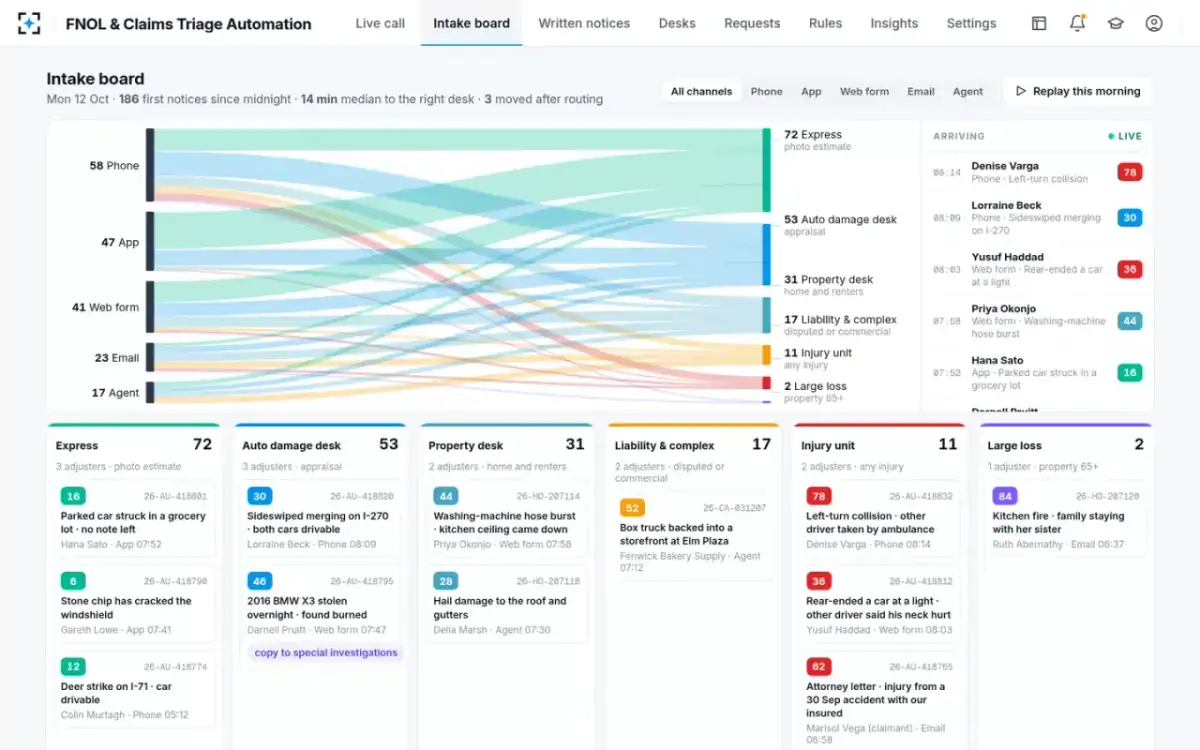
A first-notice morning is a run of very different claims, most of them small and a few of them urgent, arriving in no particular order across five channels. The sample carrier's board on Monday 12 October counted 186 first notices between midnight and 08:14: 58 by phone, 47 by app, 41 by web form, 23 by email and 17 from agents. Twelve of them, in the order they arrived, show what one desk has to sort.
Twelve first notices from one sample morning, and where each went
| Time | Channel | What came in | Score | Desk |
|---|---|---|---|---|
| 05:12 | Phone | Deer strike on I-71, car drivable | 12 | Express (photo estimate) |
| 06:37 | Kitchen fire; the family is staying with her sister | 84 | Large loss | |
| 06:58 | Attorney letter about a 30 Sep accident the insured has not reported | 62 | Injury unit | |
| 07:12 | Agent | Box truck backed into a storefront | 52 | Liability & complex |
| 07:30 | Agent | Hail damage to roof and gutters; date of loss missing | 28 | Property desk |
| 07:41 | App | Stone chip has cracked the windshield | 6 | Express |
| 07:47 | Web form | SUV stolen overnight, found burned | 46 | Auto damage, with a quiet copy to special investigations |
| 07:52 | App | Parked car struck in a grocery lot; app and web reports merged | 16 | Express |
| 07:58 | Web form | Washing-machine hose burst, kitchen ceiling came down | 44 | Property desk |
| 08:03 | Web form | Rear-ended a car at a light; the other driver said his neck hurt | 36 | Injury unit |
| 08:09 | Phone | Sideswiped merging on I-270, both cars drivable | 30 | Auto damage desk |
| 08:14 | Phone | Left-turn collision; the other driver taken by ambulance | 78 | Injury unit |
Three things stand out. The urgent claims are not the high scores alone: a rear-end collision scoring 36 went to the Injury unit because the other driver said his neck hurt. Written notices carry as much risk as calls: the attorney letter at 06:58 is about an accident the insured has not reported. And a representative cannot sort these by reading the list once; each needs the policy, the account and a rule. That is the part of the job the solution does on every notice as it arrives.
186 first notices since midnight, five channels into six desks
What changes on the first-notice desk with agents, and what does not
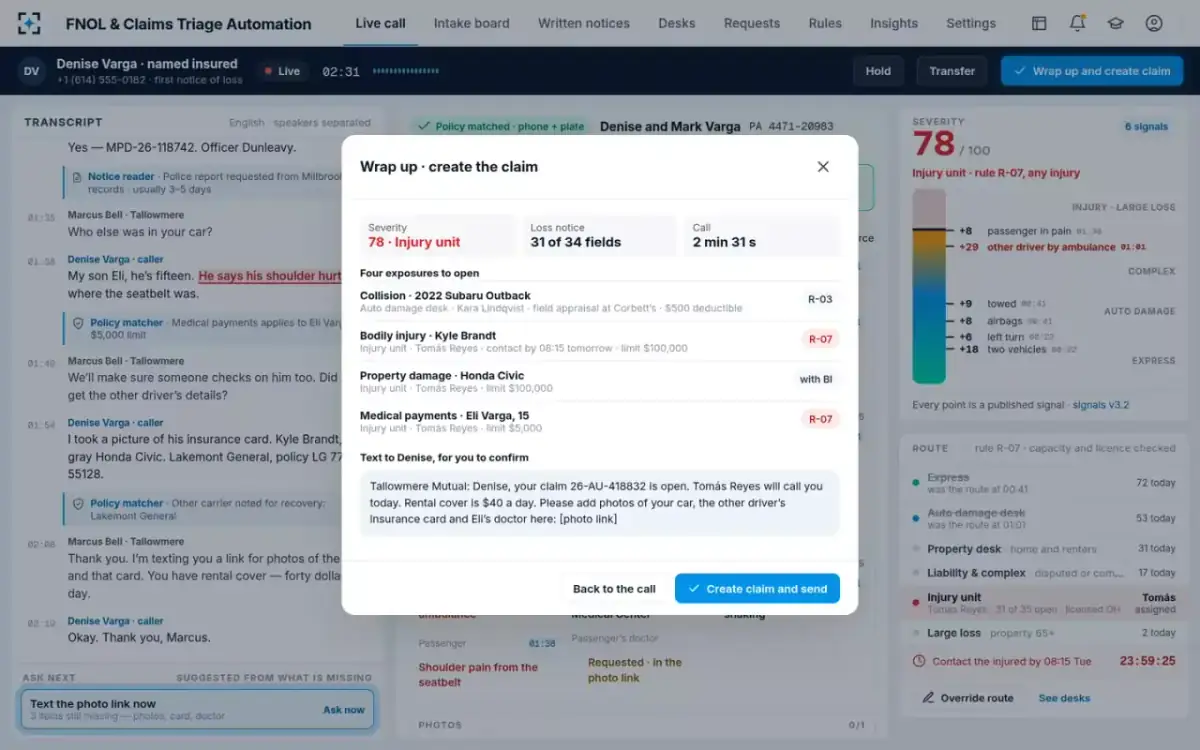
What moves to software is the typing, the searching and the first sorting; what stays is the listening, the questions that need judgement and the confirmation. On the sample call, the representative never typed a field or searched for a policy. Agents filled 31 of the notice's 34 fields from the conversation and the policy system, matched the policy in seven seconds, scored severity and proposed the desk. The representative asked the suggested questions, comforted the caller, and confirmed the claim and the text before anything was created or sent.
Who did what on one 2-minute-31-second first-notice call
Loss-notice fields (34)
- Filled from the call by agents · 91%
- Requested by text · 9%
Decisions on the call
- Proposed by agents: policy, score, desk, adjuster, text · 71%
- Made by the person: confirm claim, confirm text · 29%
The job changes shape rather than disappearing. The representative's attention moves from the screen to the caller, and the hard questions (was anyone else in the car, did the other driver say anything about pain) get asked because the screen suggests them from what is missing. The four people who touch the same claim each see a different change.
Four people who carry the same first notice, before and after
Today
Takes calls across three screens; types, searches the policy and picks a desk while the caller talks.
With agents
Listens and asks the suggested question; the notice fills and the route is shown with its rule.
Still theirs: Confirms the claim and every message before it is created or sent.
Today
Assigns the overnight pile every morning and fixes misroutes.
With agents
Sees open files against each adjuster’s cap and their state licences; approves overrides.
Still theirs: Route overrides and any assignment over an adjuster’s cap.
Today
Hears about an injury days into the claim, sometimes after a lawyer does.
With agents
Gets the claim the minute the injury is said, with the contact clock already running.
Still theirs: Coverage, liability, valuation and every payment.
Today
Cannot see which claims were sized wrong until they move desks.
With agents
Sees the desk chosen against the desk each claim ended on, every month.
Still theirs: Approves changes to severity signals, routing rules, bands and clocks.
The two clicks that stay with the person
Skills to hire for on the first-notice desk now
Hire for the part of the first-notice job that does not move to software: listening for the detail that changes a claim, asking the next question, and checking what an agent proposes before confirming it. Typing speed and memory for policy-system screens matter less each year. A representative who confirms 186 proposals a morning needs to know when to say no, which means knowing the routing rules well enough to spot one applied wrongly.
What to test for when hiring a first-notice representative
- Asks about injuries in both cars, unprompted
The detail most often said late, and the one that changes the desk and starts the injury contact clock.
- Hears who is speaking
An insured, a passenger and the other driver have different claims; a good listener separates them on the call.
- Explains next steps in plain words
What the customer must send, who will call and when, and what the policy pays for rental or towing.
- Knows the routing rules and their reasons
So a wrong proposal is caught before it is confirmed, not after it reaches the wrong desk.
- Writes a precise note
Regulators read acknowledgement notes years later; "called insured" is not a note.
- Can work in the caller’s language, or knows how to bring in someone who can
A Spanish-speaking caller who mentions pain in passing has to be understood the first time.
The last item gets its own guide: a first notice taken in the caller's language. For the second-by-second sequence of the call this page describes, see the claims FNOL process flow; for why the first hour shapes the rest of the claim, see why FNOL matters in claims processing.
Questions people ask
What is a first notice of loss associate?
It is one of several titles for the person who takes a claim's first report and routes it, alongside FNOL representative, first-notice specialist and claims intake specialist. The official job data place the work under insurance claims and policy processing clerks, whose reported titles include claims customer service representative. The duties are the same: capture, identify, size, route and acknowledge.
Does an FNOL representative need a licence?
Licensing is set by each state and turns on what the person does, so check the state's adjuster-licensing rules before giving intake staff any role in settling claims. The sample carrier keeps settlement with licensed adjusters: its router checks the adjuster's licence in the loss state before assigning a claim, because the adjuster, not the intake representative, will handle it.
What does an insurance claims intake specialist do in a written-notice team?
They read web forms, app reports, emails and agents' submissions with their attachments, fill the loss notice from them, merge duplicates and ask for what is missing. On the sample carrier's morning, 128 written notices arrived, including an attorney letter and an app report that duplicated a web form. The same routing rules apply as on the phone.
How many calls does an FNOL representative take?
No public source we can rely on measures it; call volume depends on the carrier, the season and catastrophes. On the sample carrier's morning, 58 of 186 first notices since midnight came by phone. The useful measure for a desk is not calls per hour but how many claims reach the right desk on the first try.
Is FNOL a good entry job into claims?
It teaches policies, coverages and how claims are routed, which is the grounding an adjuster needs. The pay gap to adjusting is large: in 2025 data, a median of $49,230 a year for claims clerks against $78,020 for adjusters, examiners and investigators.