To file a claim in Spanish, call the claims number on your insurance card or use the insurer's app or web form and ask for Spanish ("¿Puedo hacer la reclamación en español?"); the line may take the report in Spanish or bring in an interpreter, and the claim itself is the same claim in either language. The rules that define a notice of claim describe what it must tell the insurer, not what language it must be in. For a carrier, the harder question is not whether to accept a first notice in Spanish but whether it hears everything in it: the detail most often lost in translation is the one that should change the claim's desk, such as a passenger's pain or the other driver taken to hospital. Botminds' FNOL & Claims Triage Automation transcribes, fills the loss notice and writes to the customer in English or Spanish, keeping the caller's own words beside each value.
This page is for Spanish-speaking policyholders and for the claims teams who serve them. It is general information, not legal advice. Examples of the solution come from a fictional carrier, Tallowmere Mutual, with sample data; the Spanish phrases in the routing examples are our own illustrations.
The same Spanish first notice, through English-only intake and through bilingual intake
English-only intake: An interpreter’s summary, or the representative’s understanding of it.
Bilingual intake: The caller’s words, transcribed in Spanish, with each loss-notice value beside them.
English-only intake: "Mi hijo dice que le duele el hombro" can become "son fine" in a summary.
Bilingual intake: The phrase is a pain signal for a passenger; the claim routes to the injury desk.
English-only intake: Speakers merged; the caller, a relative and an interpreter in one voice.
Bilingual intake: Speakers separated, so the person in pain is attached to the right exposure.
English-only intake: A letter in English the caller may not read.
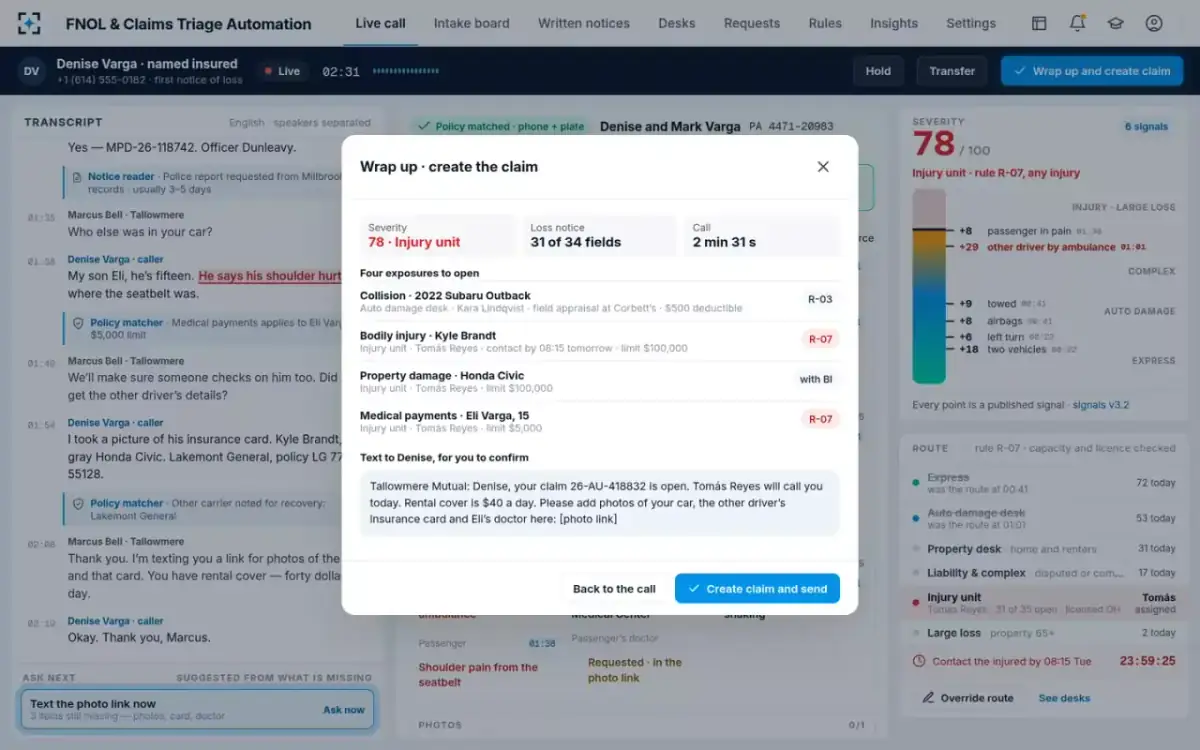
Bilingual intake: A text from an approved Spanish template, confirmed by a person before sending.
English-only intake: The adjuster reads the English notes only.
Bilingual intake: The adjuster can open the original Spanish sentence behind any value.
Can you file an insurance claim in Spanish?
Yes, in the sense that matters: notice of a claim does not depend on the language. California defines notice of claim as any written or oral notification that reasonably tells the insurer the claimant wishes to make a claim and that the policy may be involved (10 CCR 2695.2), and the same regulation bars an insurer from requiring notice in writing unless the policy says so (10 CCR 2695.5(f)). A clear call in Spanish reporting an accident tells the insurer what it needs to know, and starts the insurer's clocks the same way.
What varies is the service. Insurers handle Spanish in different ways: Spanish-speaking representatives, interpreters, Spanish web forms and apps. If the line answers in English, ask for Spanish at the start; if an interpreter is used, ask that your own words about any injury be repeated back. Keep the claim number, which is the same in any language.
How to say insurance claim in Spanish, and the words around it
"Insurance claim" in Spanish is "reclamación de seguro", the form a US regulator uses: the Texas Department of Insurance's Spanish auto glossary defines the claimant as "La persona que presenta una reclamación de seguro". "Reclamo" is also common in Latin American Spanish, and in Spain and much of Latin America an insured event is a "siniestro", so a first notice of loss can be "aviso de siniestro". The table pairs the English terms a claims line uses with the regulator's Spanish where it gives one.
Claims words in English and Spanish
| English | Spanish | Where it comes from |
|---|---|---|
| Insurance claim | Reclamación de seguro | Texas Department of Insurance glossary |
| Claimant | El reclamante | Texas Department of Insurance glossary |
| Adjuster | El ajustador | Texas Department of Insurance glossary |
| Bodily injury | Lesiones corporales | Texas Department of Insurance glossary |
| Collision coverage | Cobertura contra choque | Texas Department of Insurance glossary |
| Liability insurance | Seguro de responsabilidad civil | Texas Department of Insurance glossary |
| Deductible | El deducible | Texas Department of Insurance glossary |
| File a claim | Presentar una reclamación | Common usage |
| First notice of loss | Aviso de siniestro | Common usage outside the US; US carriers vary |
What regulators already publish in Spanish
Regulators publish key claims materials in Spanish, which tells carriers what a Spanish-speaking customer may already have read. The Texas Department of Insurance publishes its auto insurance glossary in Spanish, the "Glosario de Terminología de Seguros de Automóvil", with definitions such as "Lesiones corporales (bodily injury, BI) – Las lesiones físicas que sufre una persona." California's DMV links a "Spanish version (PDF)" of the SR-1 accident report from the same page as the English form.
The same DMV page carries a caution worth copying into any bilingual process. Its site uses machine translation, and it states: "The web pages currently in English on the DMV website are the official and accurate source for the program information and services the DMV provides." A carrier that writes to customers in Spanish has the same choice to make: which text governs, who approved the translation, and how a customer is told.
Where a first notice in Spanish goes wrong
A Spanish first notice goes wrong in the same place an English one does, only more often: the detail said in passing. A caller describing the collision says, almost as an aside, that her son's shoulder hurts or that the other driver was taken away in an ambulance. In an English-only process with an interpreter, that aside is the sentence most likely to be compressed into a summary, and a summary that loses it sends the claim to a damage desk.
Automated systems have a version of the same problem. The CFPB's study of chatbots in consumer finance warned that a limited system "can be particularly problematic for people with limited English proficiency", "where the technology trained on a limited number of dialects makes it difficult for consumers with diverse dialect needs to use chatbots to receive help from their financial institution". That was banking, not insurance, and chatbots, not transcription, but the risk is the same: a system that works well on standard English can fail quietly on everyone else. Speech recognition research points the same way, with error rates that differ by speaker group (Koenecke et al., PNAS, 2020).
Injury claim in Spanish: the phrases that must change the route
An injury claim in Spanish has to route on the same words an English one does, translated by meaning rather than keyword. NHTSA's crash-report guideline treats a complaint of pain as a possible injury even with no visible wound (MMUCC, 6th edition), and a carrier's triage should do the same in either language. The phrases below are our illustrations of what a bilingual triage rule set has to recognise, with the sample carrier's signal each one would match.
Spanish phrases a first-notice line hears, and what each should do
| What the caller says | In English | Signal it should match | Route |
|---|---|---|---|
| Al otro conductor se lo llevaron en ambulancia | They took the other driver away in an ambulance | Taken by ambulance or to hospital | Injury unit, whatever the score |
| Mi hijo dice que le duele el hombro | My son says his shoulder hurts | Our driver or passenger complains of pain | Injury unit |
| El otro señor decía que le dolía el cuello | The other man was saying his neck hurt | Third party complains of pain | Injury unit |
| Atropellaron a un ciclista | A cyclist was hit | Pedestrian or cyclist struck | Injury unit |
| Nadie salió herido | Nobody was hurt | None: a negation, not an injury | By score, as usual |
| Tengo una carta del abogado | I have a letter from the lawyer | Attorney letter | By score (+22 on the sample carrier) |
Two rows deserve a note. The negation in "Nadie salió herido" is the trap for keyword matching in either language: "herido" means injured. And the third row is said about someone else in the past tense ("decía"), which is how a passing complaint by the other driver can sound. A system that only matches "me duele" (it hurts me) will miss both the son and the other driver.
Claim form in Spanish, and the English that governs
A claim form in Spanish helps a customer report; it does not change which text governs the policy. The DMV's caution shows one approach: the English version is official and the translation is a service. For a first-notice line that means three things. The transcript keeps the Spanish as said. The loss notice carries each value with the Spanish sentence behind it, so a translation can be checked. And every message to the customer comes from a template that compliance has approved in Spanish, not from a machine translation of the English letter.
A first notice in Spanish, step by step
Agent
Call listenerTranscribes in Spanish as spoken, separating the speakers.
Never: Speaks to the caller, or replaces the original words with a translation.
Agent
Notice readerFills each loss-notice field, keeping the Spanish sentence it came from beside the value.
Never: Guesses a value that was not said.
Agent
Severity scorerAdds the published signals heard in what was said, with the sentence for each point.
Never: Decides fault.
Agent
Follow-up writerDrafts the acknowledgement and the missing-items request from the approved Spanish template.
Never: Promises coverage or payment.
A person decides
First-notice specialistConfirms the claim and the Spanish message before either is created or sent.
Does my insurer have to accept a claim in Spanish?
The claims rules cited here do not make the language of a notice a condition: notice is defined by whether it reasonably tells the insurer about the claim. California also requires an insurer, within 15 calendar days of notice, to provide the forms, instructions and reasonable assistance a claimant needs (10 CCR 2695.5(e)). Whether a particular state requires Spanish materials or interpreters for property and auto claims is a separate question this page does not answer; ask your state insurance department; some, such as Texas, publish consumer material in Spanish.
Can an insurance letter be sent in Spanish? Yes, if the insurer chooses to. The care needed is on the insurer's side: an approved template, a clear statement of which version governs if there is a dispute, and a person checking the message before it goes. On the sample carrier the text to the customer is drafted in the customer's language and is never sent without the specialist's confirmation.
The message the caller receives is confirmed by a person first
Testing a bilingual first-notice line
Test Spanish as its own group, because a pass in English says nothing about it. Take past Spanish calls and written notices with known injuries, including the hard ones (an injury said about a passenger, said in the past tense, or said in a mix of Spanish and English), and check every one reaches the injury desk. The full method is in claims triage solutions: plant 200 injuries, count what comes back.
What to check before switching on Spanish first notices
- Injuries said in Spanish reach the injury desk
Seed them: passenger, third party, past tense, mixed language, written.
- Negations do not trigger injury
"Nadie salió herido" must not route as an injury.
- The transcript keeps the original Spanish
A translation can be added; the words as said cannot be replaced.
- Every Spanish message comes from an approved template
Compliance signs off the Spanish text, not only the English.
- Results are reported by language and by caller group
One overall accuracy figure hides the group that fails.
- A Spanish-speaking person can review any call
The specialist or a reviewer who can check the original words.
Language and speakers are set from the first second
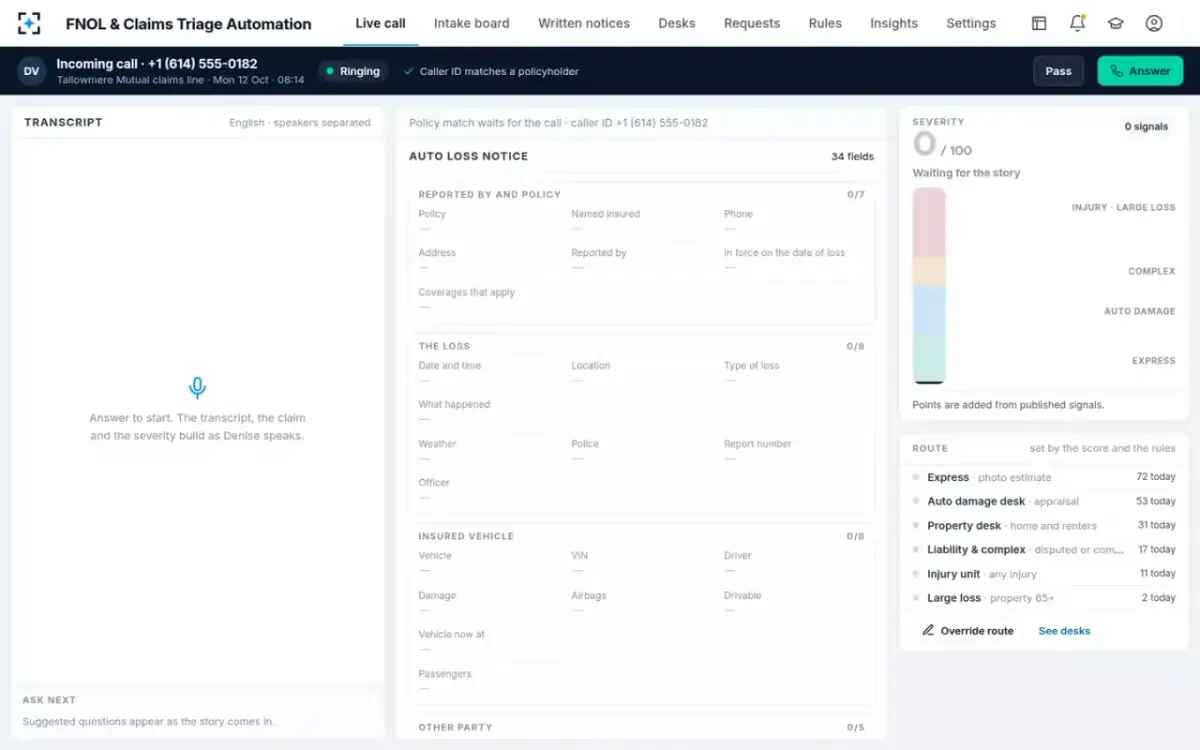
A Spanish notice also has to be complete, and the missing-items request is where language matters most to the customer: asking for photos, the other driver's insurance card and a doctor's details is easy to ignore in a language you read slowly. The rest of the call's sequence is traced in the claims FNOL process flow.
Questions people ask
How do you say insurance claim in Spanish?
"Reclamación de seguro", the term the Texas Department of Insurance uses in its Spanish glossary, where the claimant is "el reclamante". "Reclamo" is also common, and "siniestro" is the word for an insured event in Spain and much of Latin America. To file a claim is "presentar una reclamación".
Is "file a claim" en español the same as reporting an accident?
Not always, in either language. California's claims regulation excludes a communication made solely for informational or incident-reporting purposes from its definition of notice of claim. Say clearly whether you want to make a claim ("quiero presentar una reclamación"), and ask the insurer to note the date.
Can I get the claim form in Spanish?
Often, yes; ask the insurer. Some public forms already have Spanish versions, such as California's SR-1 accident report for the DMV. The English version is usually the official one, so keep a copy of both.
What if the interpreter leaves something out?
Ask the representative to read back what was written about injuries and the other driver before the call ends. A missing passenger injury can send the claim to the wrong desk. A transcript that keeps your Spanish words lets the adjuster check later what you actually said.
Does an injury claim in Spanish take longer?
It should not, if the injury is heard. On the sample carrier, rule R-07 routes any injury mentioned to anyone to the injury unit the moment it is heard and starts a 24-hour contact clock. The rule does not depend on the language; hearing the injury does, which is what testing in Spanish is for.