The difference between first party and third party claims is whose policy the claimant is claiming under. A first party claim is made by someone insured under the policy, such as the named insured, another insured driver or a passenger covered for medical payments, against their own insurer. A third party claim is made against the insured by someone else, such as the other driver whose car was hit, and is paid, if at all, under the insured's liability coverage. One two-car crash usually creates both kinds at once, and each needs a different desk, different rules and a different conversation. Botminds' FNOL & Claims Triage Automation sorts them on the first call: it reads who is speaking and about whom, opens each exposure under the right coverage and routes it, while fault stays with the adjuster.
The examples follow one collision reported to a fictional carrier, Tallowmere Mutual: its insured, Denise Varga, turned left across traffic and was hit by Kyle Brandt's car. The people and figures are sample data. This page is general information, not legal advice.
One sample crash, four claims, split by kind of claimant and by desk
Exposures by kind of claimant
- First party: collision, medical payments · 50%
- Third party: bodily injury, property damage · 50%
Exposures by desk
- Auto damage desk: 1 · 25%
- Injury unit: 3 · 75%
First party vs third party claims: the difference in law
State claims rules define the two claimants precisely, and the definitions turn on the policy, not on fault. California's regulation reads: "First party claimant" means any person asserting a right under an insurance policy as a named insured, other insured or beneficiary under the terms of that insurance policy, and including any person seeking recovery of uninsured motorist benefits; and "Third party claimant" means any person asserting a claim against any person or the interests insured under an insurance policy.
How three rulebooks define the two claimants
| Rulebook | First party claimant | Third party claimant |
|---|---|---|
| NAIC Model 902 | Asserts a right to payment under a policy, arising out of the loss the policy covers | Asserts a claim against any person under a policy of an insurer |
| California 10 CCR 2695.2 | A named insured, other insured or beneficiary, including anyone seeking uninsured motorist benefits | Asserts a claim against any person or the interests insured under a policy |
| Ohio Adm. Code 3901-1-54 | Asserts a right to payment under a policy arising out of the covered loss | Asserts a claim against any other individual or legal entity |
Two consequences follow. A passenger in the insured's car can be a first-party claimant, for medical payments under the insured's policy, and a third-party claimant against the other driver at the same time. And an uninsured motorist claim, though caused by another driver, is first-party, because it is made under the claimant's own policy.
What is a first party claim in insurance?
A first party claim is a claim on your own policy for your own loss: your car's damage under collision coverage, your medical bills under medical payments or personal injury protection, your injuries under uninsured motorist coverage. Ohio's rule puts it in one line: "First party claimant" means any individual, corporation, association, partnership or other legal entity asserting a right to payment under an insurance policy or insurance contract arising out of the occurrence of the contingency or loss covered by the policy or contract.
The relationship is contractual. The insurer owes the claimant what the policy promises, and the rules that protect claimants are at their most detailed here. The NAIC's model regulation, for example, says "Within twenty-one (21) days after receipt by the insurer of properly executed proofs of loss, the first party claimant shall be advised of the acceptance or denial of the claim by the insurer."
What is a third party claim, and who is a third party claimant?
A third party claim is a claim against an insured by someone the insured harmed: the other driver's car, the other driver's injuries, a pedestrian, a storefront. The third party claimant has no contract with the insurer. The insurer's duty runs to its insured, to defend and, where the insured is liable, to pay within the liability limits. The Texas Department of Insurance's glossary describes the coverage that pays: "Liability insurance - Pays for injuries to the other party and damages to the other vehicle resulting from an accident you caused."
That last phrase is the hinge. A third party claim depends on liability, and liability is a judgement about fault that no first-notice process should make. A first party collision claim does not: the same glossary says collision coverage "Pays for damage to your car without regard to who caused an accident." At first notice, the useful work is to open both kinds of claim correctly and leave the question of who caused the crash to the people who investigate it.
One crash, four exposures, two kinds of claimant
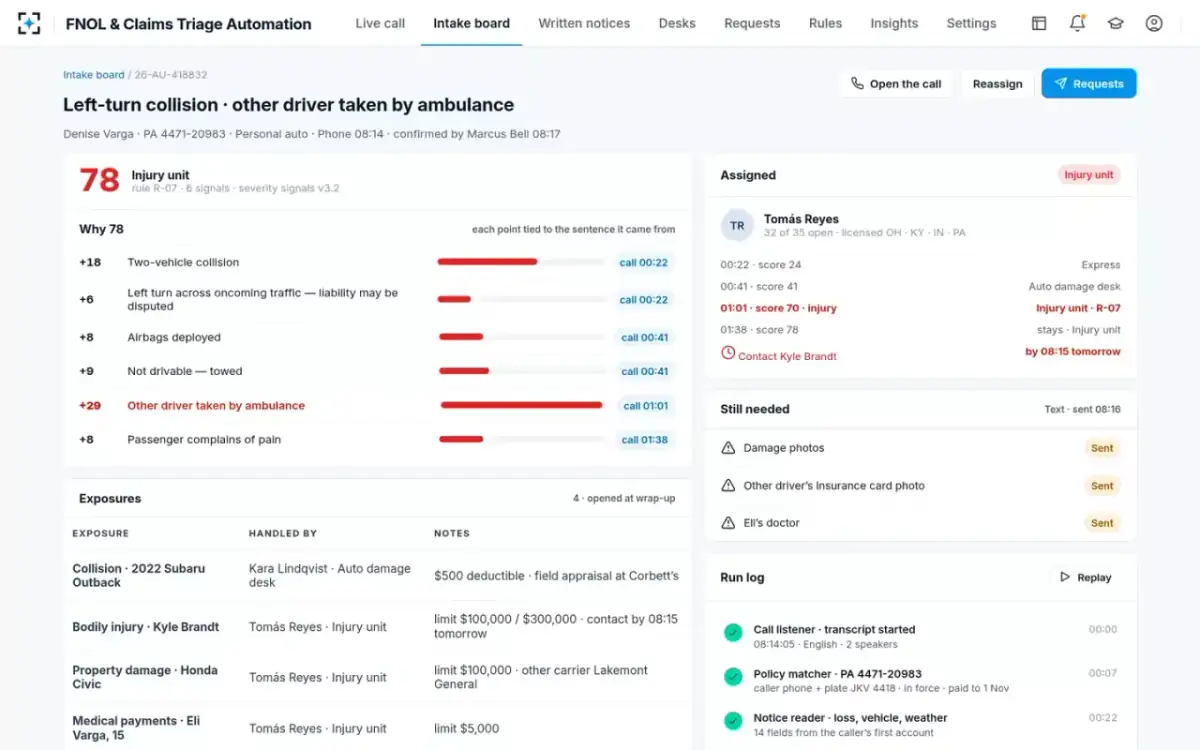
The sample collision shows how one call becomes several claims. Denise Varga turned left across traffic and was hit by Kyle Brandt's Honda Civic. The airbags went off, her Subaru was towed, Kyle Brandt was taken from the scene by ambulance, and her son Eli, 15, a passenger, said his shoulder hurt. At wrap-up, the first-notice specialist confirmed four exposures.
Four exposures from one sample crash
| Exposure | Claimant | Kind | Coverage on the sample policy | Desk and rule |
|---|---|---|---|---|
| Collision, 2022 Subaru Outback | Denise Varga, named insured | First party | Collision, $500 deductible | Auto damage desk (R-03); field appraisal at the tow yard |
| Bodily injury | Kyle Brandt, the other driver | Third party | Bodily injury liability, $100,000 per person | Injury unit (R-07); contact within 24 hours |
| Property damage, Honda Civic | Kyle Brandt | Third party | Property damage liability, $100,000 | Injury unit, with the bodily injury claim |
| Medical payments | Eli Varga, 15, passenger | First party | Medical payments, $5,000 | Injury unit (R-07) |
Notice what the routing did and did not do. It kept the two third-party exposures with one adjuster: the same injured person makes both claims, which lets one conversation handle them. It sent the first-party medical payments claim to the same injury adjuster, because the claimant is injured. And it sent the insured's own car to the damage desk, because that claim depends on the damage, not on anyone's injury. None of those choices needed a view on fault.
Two first-party and two third-party exposures on one claim
What is a first party physical damage claim?
A first party physical damage claim is a claim on your own policy for damage to your own vehicle, under collision coverage (a crash) or comprehensive coverage (theft, hail, fire, an animal). On the sample, Denise Varga's Subaru claim was first-party physical damage: collision, with a $500 deductible, sent for a field appraisal at the tow yard where the car was taken.
Physical damage claims have their own clocks. New York gives an insurer six business days after notice to inspect an insured's damaged vehicle on a first-party claim. Washington's amended rule requires a first-party claimant to be told in writing how towing and storage are covered within five business days of notice, and to be told of the right to an in-person inspection (WSR 26-17-089). If the car turns out to be a total loss, a further set of steps follows, from valuation to title, set out in the total loss process and its two clocks.
Should I file with my insurance or theirs?
It depends on what each policy covers and on who is likely to be found at fault, and either route can be right. Filing with your own insurer under collision coverage gets your car repaired regardless of fault, minus your deductible; your insurer may then pursue the other driver's insurer. The Texas Department of Insurance describes that step: "Subrogation - The legal right of insurance companies to pursue another person's insurance company after the other person caused a loss to their policyholder." Filing with the other driver's insurer avoids your deductible but waits on that insurer's view of liability.
Two practical points apply whichever route a policyholder chooses. Report the accident to your own insurer anyway, because your policy's notice condition may apply even if you claim against the other driver; the time limits on both sides are set out on a separate page. And in no-fault states, the first injury benefits are claimed first-party: Florida's personal injury protection, part of what its statutes call the Florida Motor Vehicle No-Fault Law, and New York's mandatory no-fault benefits each come with their own deadlines (Fla. Stat. 627.736; 11 NYCRR 65-1.1).
How do insurance companies determine fault?
Insurance companies determine fault through the adjuster's investigation: the parties' and witnesses' statements, the police report, photos, the damage itself and the state's law on negligence. It is a decision made after first notice, not at it. On the sample carrier, nothing at first notice decides fault, and the severity scorer is configured never to.
The first notice still captures what the investigation will need. The sample score includes signals with liability in their names, "Left turn across oncoming traffic — liability may be disputed" (+6) and, on another notice, "Rear-end — liability likely ours" (+6), but they add to severity, not to a fault finding: they tell the adjuster where the argument will be. The caller's own words about the crash, with their call times, go to the adjuster unchanged. Valuing the injury claims that liability opens is a separate discipline, and Botminds' Bodily Injury Claim Valuation is built for that stage.
The rules that differ for first and third party claimants
The basic claims-handling rules protect both kinds of claimant, but some apply only to first parties. California's acknowledgement rule covers every "claimant", first or third party, and its decision rule says that on receiving proof of claim the insurer "shall immediately, but in no event more than forty (40) calendar days later, accept or deny the claim, in whole or in part." Washington's new 30-day accept-or-deny deadline, counted from notification, is written for first-party claimants, as are its towing and storage explanation and the NAIC model's 21-day decision rule above.
Routing both kinds of claim from one call
Agent
Call listenerSeparates the speakers and keeps who said what, with the call time.
Never: Merges a passenger’s words into the caller’s.
Agent
Notice readerFills the insured vehicle, other party and injuries sections, one person per field.
Never: Assigns an injury to the wrong person.
Agent
Policy matcherLists the coverages each claimant may claim under, and the other party’s carrier for recovery.
Never: Confirms or denies coverage.
Agent
RouterSends injured claimants’ exposures to the injury desk and the insured’s car to the damage desk.
Never: Decides fault.
A person decides
First-notice specialistConfirms each exposure, its claimant and its desk before the claim is created.
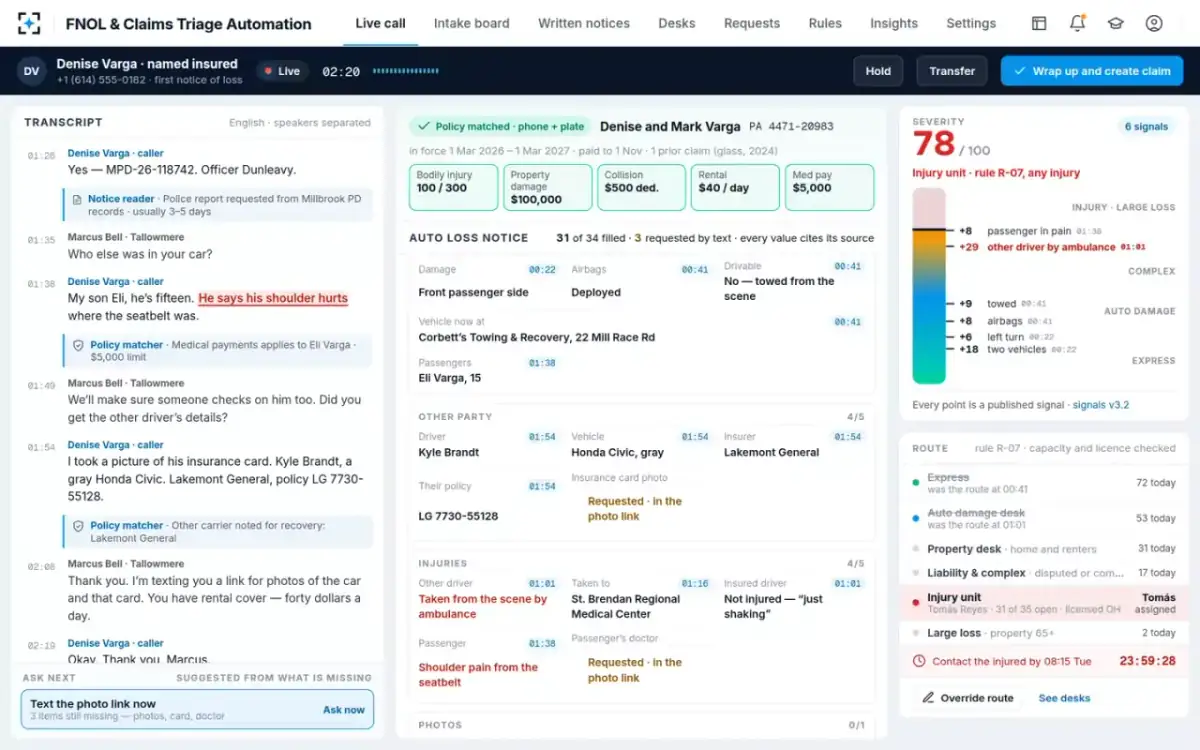
The practical difference shows up in the conversation. A first-party claimant is the carrier's customer and is owed explanations under the policy. A third-party claimant is someone the customer may have harmed, who may be represented, and whose first contact matters for a different reason. On the sample claim, the injury adjuster's 24-hour clock to contact the other driver started at 01:01, the second the ambulance was mentioned, while the insured was still on the line.
Questions a first-notice desk should ask to separate the claims
The questions that separate first- and third-party claims are about people, not fault: who was in each car, who was hurt, who owns what was damaged and who insures them. Asked on the first call, they let every exposure open with the right claimant.
What a first notice needs to open each claim correctly
- Who was in your car, and is anyone hurt?
Each injured passenger may have a first-party medical claim and a third-party claim of their own.
- Who was in the other car, and is anyone hurt?
Injury to a third party sends the liability exposures to the injury desk.
- Who owns the other vehicle or property?
The property damage claimant is the owner, not always the driver.
- Who insures the other driver, and what is the policy number?
For the third-party claim and for any later recovery.
- Was anyone else involved: a pedestrian, a cyclist, a building?
Each is a separate third-party claimant.
- Do you want to claim under your own coverage now?
Collision pays regardless of fault, minus the deductible; the adjuster explains the options.
Both kinds of claimant captured on one call
Questions people ask
What is the difference between a first party claim and a third party claim?
A first party claim is made under the claimant's own policy, for their own loss; a third party claim is made against someone else's insured, under that insured's liability coverage. California's regulation defines the first as a claim by a named insured, other insured or beneficiary, including uninsured motorist claims, and the second as a claim against any person or the interests insured.
What is a third party claimant?
Someone who asserts a claim against an insured, such as the other driver in a crash, a pedestrian or a property owner. They have no contract with the insurer; the insurer's duties to them come from claims-handling rules and from its insured's liability coverage. Ohio defines a third party claimant as anyone asserting a claim against another person or entity.
Is an uninsured motorist claim first party or third party?
First party. Although another driver caused the loss, the claim is made under the claimant's own policy. California's definition of first party claimant expressly includes anyone seeking uninsured motorist benefits.
Can a passenger make both kinds of claim?
Yes. A passenger may claim medical payments or personal injury protection under the policy of the car they were in, a first-party claim, and claim against the at-fault driver's liability coverage, a third-party claim. On the sample crash, the insured's 15-year-old son was a first-party medical payments claimant from the first call.
Does the first notice decide who was at fault?
It should not. Fault is decided by the adjuster after investigation, using statements, the police report, photos and the state's negligence law. On the sample carrier, the severity scorer never decides fault, and liability-related signals only add to the severity score.