How long a total loss claim takes depends on who is counting, because it runs on two clocks. For the owner it ends when the money arrives, and the law sets that pace: in Texas an insurer must acknowledge a claim within 15 days, accept or reject it within 15 business days of receiving the last document it asked for, and pay within five business days of saying yes (Tex. Ins. Code ch. 542). For the carrier it ends only when the lien is released, the title is in hand, the salvage title has been issued and the wreck is sold, and if the title never comes, Texas will not issue the insurer one in its own name before the 30th day after payment. Between those two clocks the file mostly waits on someone else, while a tow yard bills for every day. Botminds built Total Loss Claims Management for that gap: software that carries each totaled car from the decision to a closed file, with specialist agents doing the reading, checking and chasing, and people approving every step that moves money, a car or a filing.
The law times the owner’s clock; the carrier’s runs on after it
15days
for a Texas insurer to acknowledge a claim, start investigating and ask for what it needs
Tex. Ins. Code §542.055
5business days
to pay once the insurer has accepted the claim, or once the owner has done what payment depended on
Tex. Ins. Code §542.057
30days
after payment: the earliest a Texas insurer can get a title in its own name when the owner or lender never sends one
Tex. Transp. Code §501.0925
56%
rise in US repair prices from January 2020 to September 2026, against 36% for used cars: why more crashes end as totals
BLS consumer price indexes
Volume makes the gap matter more each year. From January 2020 to September 2026 the US consumer price index for vehicle repair and maintenance rose 56% while the index for used cars and trucks rose 36% (BLS repair index; BLS used-car index; our arithmetic). When the repair bill outruns the car’s value, more crashes cross the line into a total, and why so many cars are now totaled is a story of its own. No public body publishes the share of claims that end in a total, but every public measure of repair cost against car value points the same way.
How long does a total loss payout take? Weeks for the owner, longer for the car
The owner is usually paid within a few weeks of the crash, on deadlines the state sets; the carrier’s file runs on until the title is in hand and the wreck is sold. The owner’s clock runs from the crash to the payment, and the carrier’s runs from the crash to a closed file. They share their first two weeks, then part. Once the offer is accepted and the payment leaves, the owner is done, but the carrier still needs a lien release from the lender, a signed title from the owner, a salvage title from the state, a monthly line in the federal register, and a sale at auction.
Published measures of the two clocks are thin, and that is itself a finding. No regulator publishes how long total losses take on either clock; what the rules publish is the deadline, not the result. Nobody publishes the carrier’s full clock, from first notice to a sold wreck and a closed file. Most desks do not measure it either, because the title and salvage dates sit outside the claim system.
Regulation sets the pace of the first clock and almost none of the second. The NAIC model regulation most states adapted asks an insurer to acknowledge a claim within 15 days, accept or deny within 21 days of proof of loss, and pay within 30 days once liability is affirmed. New York requires that no more than 20% of a sample of physical-damage claims take longer than 30 calendar days to pay. Nothing comparable governs how long the carrier may take to get a title or sell a wreck. That clock is paid for in storage, not in complaints.
One sample car, two clocks: what each party was doing on each day
The sample car shows the shape in miniature. Twelve days after the tow, the owner had her money and the lender had its payoff. Then nothing the carrier did could move the file: the lender released the lien nine days after the payoff went out, mailed the title to an address the owner had left in August, and the carrier’s rule held the car in the yard until the title was in hand. Of its forty days, twenty-eight were spent at one stage, waiting on a title. The case study of this one CR-V follows it day by day.
What is the total loss claim process? Thirteen steps from first notice to a closed file
A total loss runs through thirteen steps, and only the first eight concern the owner. Texas’s Office of Public Insurance Counsel gives the owner’s side in a few lines: the insurer “will then pay the lienholder first. If you owe less than the car is worth, you will get the difference”, and “you will sign over the title and send it to the company” (OPIC). Behind that sit the tow, the inspection, the value and the offer. Around that core sit the steps that make a file closable: the payoff, the signatures, the salvage title, the federal report and the close itself.
The total loss process: thirteen steps, and who each one waits on
- 1Tow and first noticeWaits onTow yard or body shopWhat crossesTow ticket; the storage meter starts
- 2Inspection and repair estimateWaits onAppraiser, or the owner’s photosWhat crossesEstimate, photos, mileage, options
- 3Total-loss decisionWaits onAdjusterWhat crossesRepair cost and salvage against value, under the state’s rule
- 4ValuationWaits onValuation vendorWhat crossesComparable listings, adjustments, the valuation report
- 5OfferWaits onOwnerWhat crossesSettlement letter: value, taxes, fees, deductible, notices
- 6Acceptance and signaturesWaits onOwner and any co-ownerWhat crossesPower of attorney, odometer statement
- 7PayoffWaits onLender or lessor; GAP administrator when the loan is underwaterWhat crossesPayoff letter with a good-through date and daily interest
- 8PaymentWaits onCarrier’s payment systemWhat crossesLender paid first, the balance to the owner
- 9TitleWaits onLender (lien release), owner, the mailWhat crossesSigned title, lien release, or the state’s no-title route
- 10Salvage titleWaits onState motor vehicle agencyWhat crossesSalvage-title application
- 11Federal total-loss reportWaits onCarrier (monthly)What crossesThe car’s entry in the national title register
- 12Salvage saleWaits onAuction and its buyersWhat crossesAssignment, reserve, pickup, proceeds
- 13CloseWaits onOwner’s reopen windowWhat crossesStorage and rental closed, proceeds booked
Steps 1–8 are the owner’s clock. Steps 9–13 run after the owner has been paid.
Three steps carry fixed rules that shape the calendar. The federal step is a monthly report: carriers must report every car they have determined to be a total loss to the National Motor Vehicle Title Information System. The close is held open by the owner’s right of recourse: under the NAIC model, the file reopens if the owner reports within 35 days of receiving the payment that no comparable car can be bought for the money. And the title step carries clocks of its own: a Florida insurer must send a total loss’s title to the state within 72 hours of receiving it, while a Texas insurer that never receives one can apply for a title in its own name only from the 30th day after payment, after at least two written notices.
Who waits on whom: the lender, the owner, the state and the yard
Most of the carrier’s clock is spent waiting on four outside parties: the lender for a payoff letter and a lien release, the owner and any co-owner for signatures and the title, the state for a salvage title, and the auction for pickup and sale. Each one has its own queue, its own channel and no stake in the carrier’s cycle time.
The lender wait is the most common and the most mechanical. Florida shows how hard the lender step is: an insurer that cannot get the title may apply for one in its own name only once it has the lien released, or has paid the lienholder and holds proof that the lienholder accepts the payment as settling the debt (§319.30). A payoff letter is good only until a stated date, so a slow signature can force a second request. When the loan is larger than the payout, a GAP administrator joins the chain. How often that happens is not published for totaled cars, but the CFPB found that 11.6% of auto loans in 2018–22 rolled in negative equity from a previous car, and those loans averaged 119.3% of the car’s value at the start, a reasonable sign of how often a payout will not clear the loan.
The owner wait is the most human. Owners move, travel, misplace titles and stop answering once the money has arrived. A co-owner who never wanted the claim may not sign at all. New York lets an insurer hold back at least half the payment until the title arrives when the owner keeps the car, which shows how much leverage the carrier loses once it has paid.
Who 46 sample cars were waiting on, on one Monday morning
The split is the useful part. A desk that cannot see who each car waits on treats all 46 the same: it works the ones in front of it and chases the rest when someone remembers. Splitting the queue by who holds the next move turns the outside waits into a chasing list and the inside ones into a work list. Each seat on the desk owns part of one or the other, and the total loss desk, seat by seat shows how each week changes.
Today’s desk: a claim system, a valuation report and a phone
On a typical desk the total loss lives in several places at once, and none of them holds the whole file. The claim system holds the claim. The valuation comes as a report from a vendor such as CCC, Mitchell or Audatex. The payoff sits in a lender portal, an email or a fax. The title is a paper envelope or an electronic record at the state. The salvage sale lives in the auction’s portal. Storage arrives as an invoice from the yard. Texts and calls with the owner sit in another tool, and the payment goes out through a third.
The work between those systems is done by people, by phone and by inbox. Regulators see the result from the outside: auto claim delay was the most common topic among the 2,167 complaints Massachusetts’ insurance regulator closed in 2025, with 349, and auto total loss had a line of its own with 127 (Massachusetts Division of Insurance). The defining feature of the legacy desk is not any one slow system. It is that nobody sees the car’s whole route at once, so a stopped car is noticed when the yard bill arrives.
Today’s desk and Total Loss Claims Management, step by step
Today’s desk: Noticed when the yard sends the bill, or the owner calls.
With the solution: Each stage has a target; a car past it is pulled aside with the reason it stopped and what it has cost.
Today’s desk: A vendor report the owner cannot follow; disputes start from the total.
With the solution: Each listing, adjustment and exclusion is shown with its source, and the owner can dispute one line.
Today’s desk: Requested by phone or portal; expiry noticed when a payment bounces.
With the solution: Requested and read by an agent, good-through date tracked, re-requested before it lapses; bank details checked against the lender’s record.
Today’s desk: Chased by calls to lenders about titles they already mailed.
With the solution: Tracking and addresses read; a title sent to an old address is found and the next notice drafted for approval.
Today’s desk: Paid from the invoice at the end.
With the solution: Priced every morning per car and per stage, with a “+7 days if nothing moves” projection.
Today’s desk: The car waits where it was towed until the title is in hand.
With the solution: Bids compared; where an auction takes cars before the title, a move that stops the meter is proposed for approval.
Today’s desk: Spread across the claim notes, inboxes and vendor portals.
With the solution: One history that cannot be edited, and an audit packet per claim exported in one step.
Where the days go on a total loss
The days go to the title. In the solution’s sample book, Title received is the stage where cars pile up and overrun, and it is the stage with the most storage: $3,420 of the $6,410 accrued across the book. State law points the same way: when the title does not come, Texas makes the insurer wait until the 30th day after payment, with two written notices sent, before it can apply for a title in its own name (§501.0925).
The book on one route: six stages, each with a target, and the stopped cars pulled out
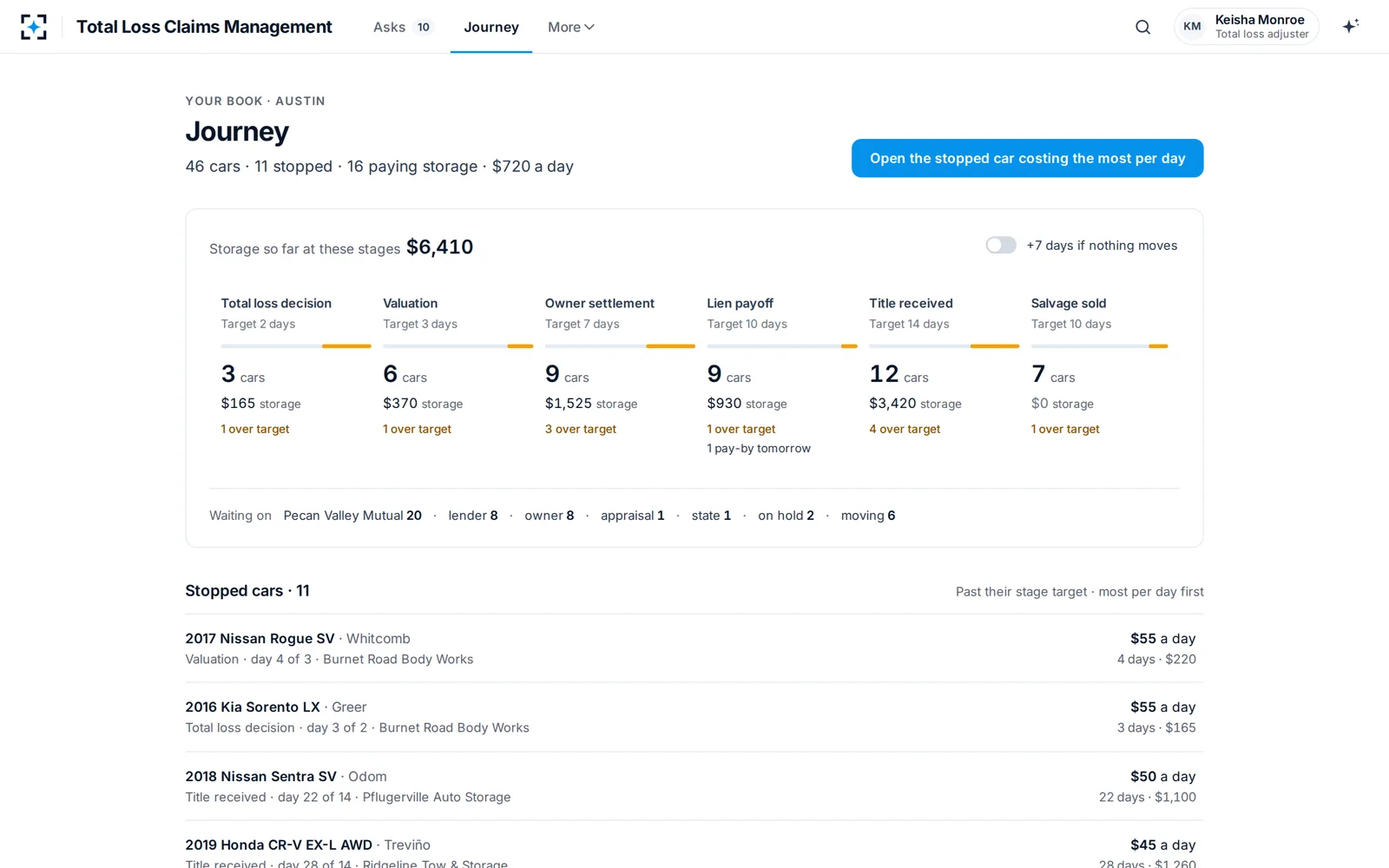
The “Waiting on” line is the split in the chart above: the first thing a manager needs is to know which cars the desk itself is holding up.
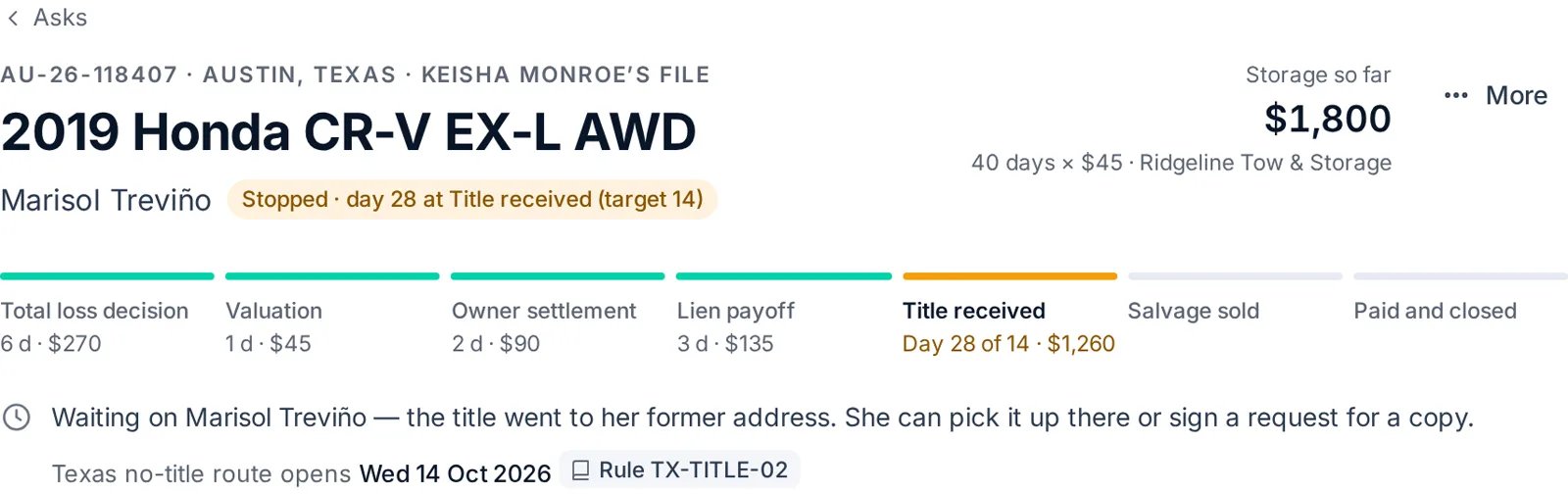
One car makes the arithmetic plain. The sample CR-V spent six days at the decision, one at valuation, two at settlement and three at payoff, then 28 at Title received against a target of 14. Twelve days to get the owner paid, then 28 days waiting on a title, each billed at $45.
One stopped car: days and dollars at every stage, and the reason it stopped
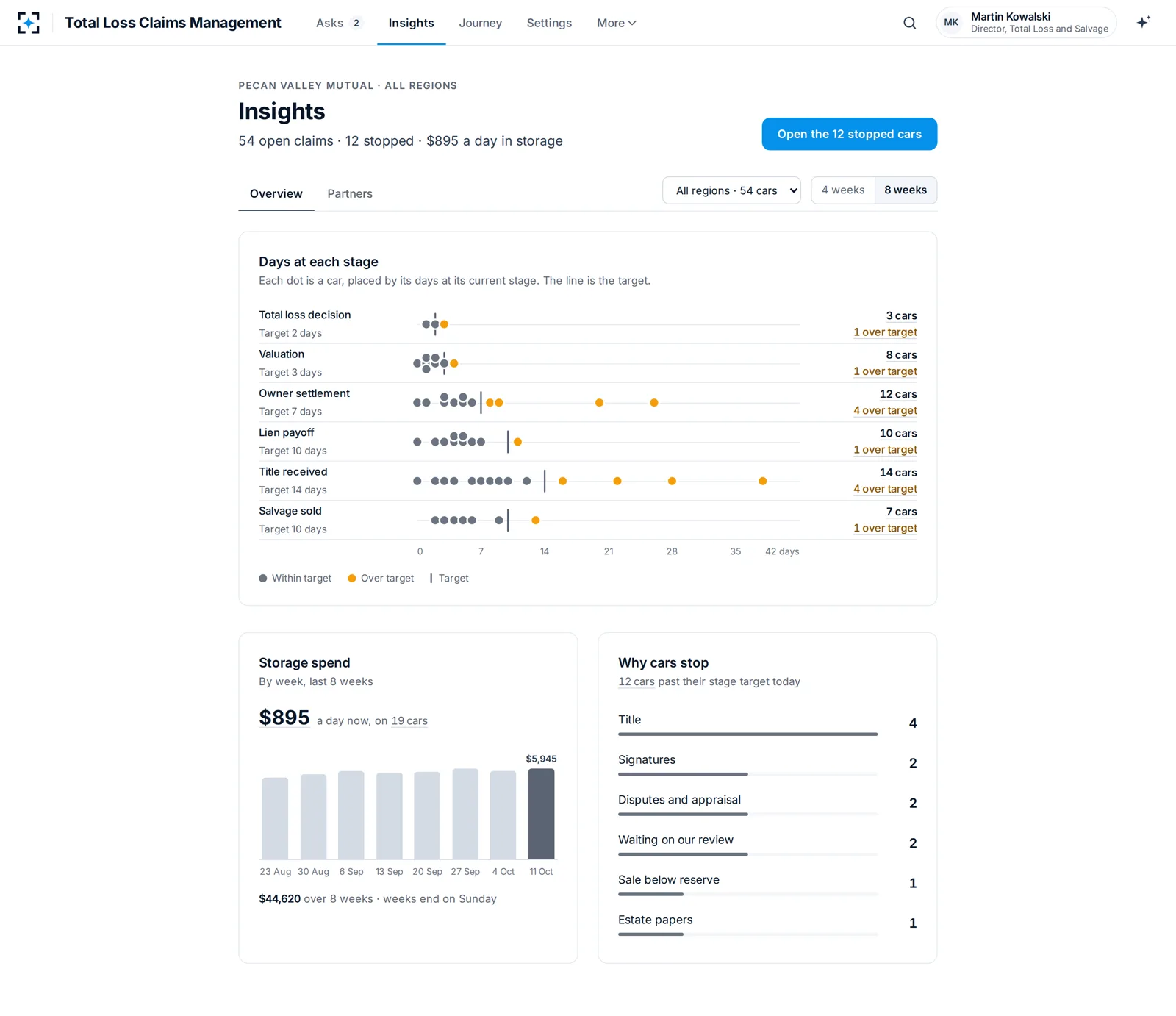
Across a whole team, the same view becomes a distribution. The director’s page places every open car as a dot by its days at its current stage, against the target line. In the sample team, the dots past target cluster at Title received and Owner settlement. Those are the two stages that wait on people outside the carrier.
Days at each stage across a team, with storage by week and why cars stop
What a day of that waiting costs, in storage, rental and a falling salvage price, is the subject of what a totaled car costs while it waits.
What the agentic way changes, step by step, and what it leaves alone
It changes who does the reading, checking, drafting and chasing, and leaves every decision with a person. In Total Loss Claims Management, specialist agents read every incoming document, build the value from nearby listings, draft the letter, request and watch payoffs, follow the title, collect salvage bids and price storage. Each finding cites its source. Each step that moves money, a car, a filing or a message to an owner or lender becomes a single request to a named person, who approves it or sends it back with a reason.
Agents carry the file between the waits; people make every decision
Agent
Valuation analystBuilds the value from comparable listings, with each adjustment and each excluded listing explained.
Never: use a branded-title listing or set the offer
A person decides
Adjuster approves the valueWithin her dollar limit; above it, the value goes up the chain with its evidence.
Agent
Settlement explainerDrafts the offer letter; a pre-send check blocks a letter missing a required line.
Never: send anything without a person
A person decides
Adjuster sends the offerOnly once the pre-send check passes; the owner accepts, signs or disputes one line on their own page.
Agent
Lien payoff agentRequests and reads the payoff, watches the good-through date, flags negative equity and gap.
Never: pay, or let a payoff lapse silently
A person decides
Two people on the paymentOne prepares the split, lender first; a different person approves it.
Agent
Title trackerFollows the title, lien release, mail tracking and addresses; drafts notices and the salvage-title application.
Never: file with a state on its own
A person decides
Specialist files the salvage titleFrom the drafted application; a no-title statement also needs the supervisor’s co-signature.
Agent
Storage watch and salvage assignerPrice storage every morning, collect bids and propose the move or sale that stops the meter soonest.
Never: move or sell a car without approval
A person decides
Specialist approves the move or saleEach move that stops a meter, and each sale at or near reserve; more than 10% under reserve goes to the supervisor.
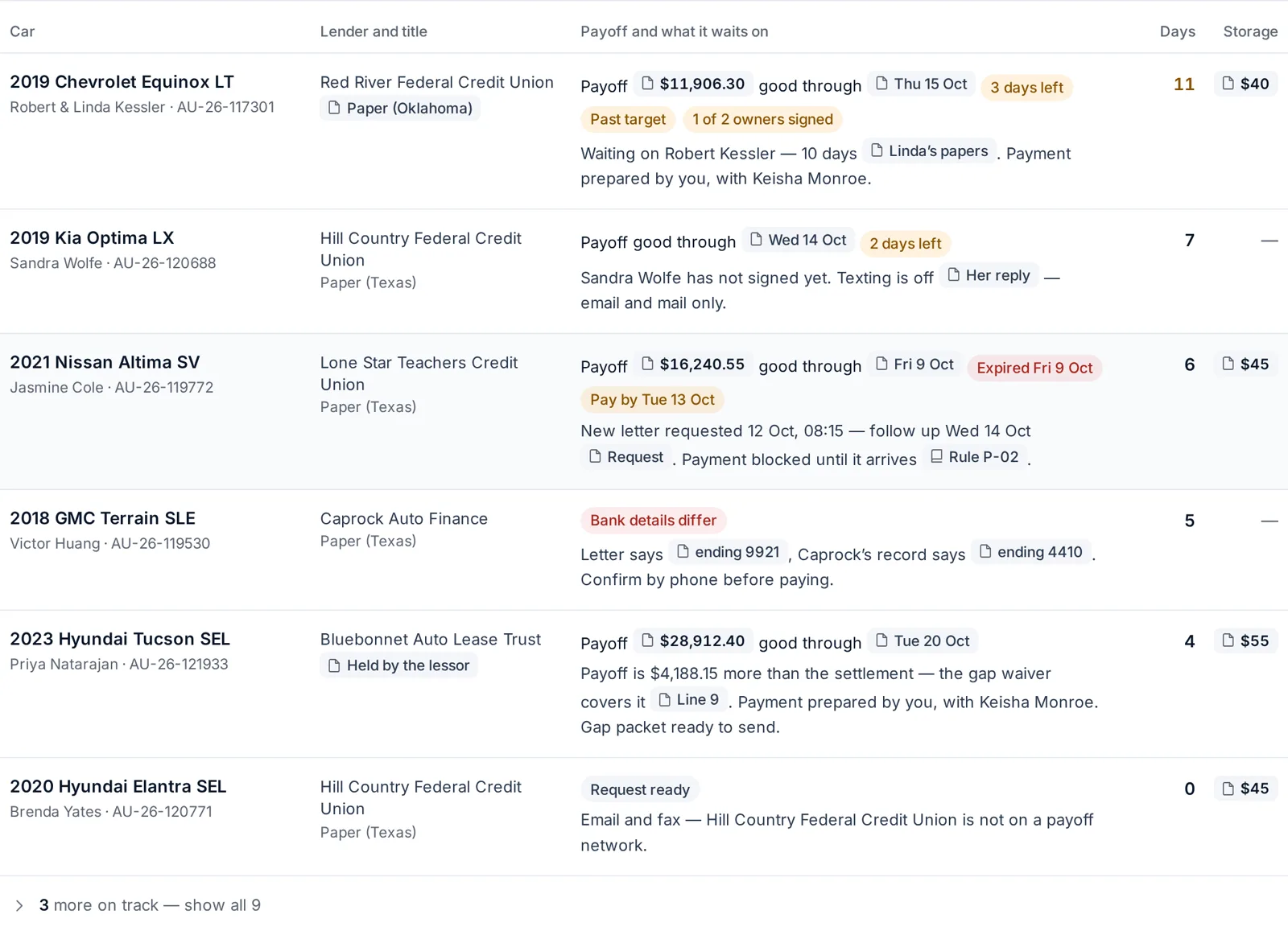
The change is largest in the steps that wait. A person can only chase what they remember to chase; an agent watches every open payoff’s good-through date and every title’s tracking, and a request lands on the right desk before the wait turns into a stall. On the sample book, the payoff rows show it: one letter three days from expiry, one already expired with a new request out and the payment blocked until it arrives, one where the bank details on an emailed letter do not match the lender’s record.
Every car between payoff and title, with what it waits on
What it leaves alone is just as deliberate. The adjuster still confirms the total and approves the value. The owner still signs. The supervisor still co-signs a no-title statement and approves a sale well under reserve. Nothing in the product moves money: approved payments are handed to the carrier’s own payment system. What each agent may and may not do is set out in the agents on a total loss desk.
What it does not change: the vendors you keep
The solution sits across the carrier’s existing vendors rather than replacing them. A carrier that buys valuations from CCC, Mitchell or Audatex keeps buying them; the agents read the report and show each listing and adjustment, and flag patterns worth a second look, such as one condition deduction applied identically to every listing. Salvage still sells through the carrier’s auctions. Payments still go out through the carrier’s payment system, and the claim system remains the system of record.
That choice follows from where the time goes. The waits are between vendors, not inside them: between the valuation and a letter the owner believes, between the payoff and the payment, between the lender’s envelope and the right address, between the title and the auction’s truck. One route, one storage meter and a set of chasing agents across those seams changes the clock without asking anyone to rip out a vendor. In the current version the lender, state, federal-register, auction and payment connections are simulated; connecting them to a carrier’s own vendors is the work of a pilot, which a 30-day pilot on your own closed total losses sets out.
How to measure your own two clocks
Start with your last hundred closed total losses and time both clocks, stage by stage. Most desks can produce the owner’s clock from payment dates. Few can produce the carrier’s, because the title and salvage dates live in other systems. The solution’s design targets give a sense of what to aim at, and none of them has yet been measured on a carrier’s book: a median of 10 days or less from first notice to the car’s release; a median of 21 days or less from settlement to title in hand; a payoff letter within one business day for at least 80% of financed cars; no payment ever made on an expired payoff; and 10 fewer billable storage days per car.
Questions to ask of your last 100 total losses
- How many days from first notice to payment, and from payment to a closed file?
The second number is the one few desks report, and on a financed car it is likely the larger.
- On each day a car was open, who was it waiting on?
Split the days into carrier work, lender, owner, state and auction. The outside waits are a chasing problem, not a staffing one.
- How many payoff letters expired before payment?
Each one is a second request, a delayed payment and more storage.
- How long did titles take after the lien was paid, and how many went to a wrong address?
That gap is where the sample car lost 28 days.
- How many storage days did each car bill, and at which stage?
If you learn it from the invoice, you learn it too late to stop it.
- How many cars sat in a billing yard when an auction would have taken them before the title?
Each is a meter that could have stopped.
Questions people ask
What happens after a car is declared a total loss?
The carrier values the car, sends an offer, and once the owner accepts and signs, pays the lender first and the owner the balance. It then collects the title, applies for a salvage title, reports the car to the federal title register and sells the wreck at auction. The owner’s part usually ends with the payment and handing over the title.
Why does a total loss take longer than a repair?
A repair ends when the car goes back; a total loss needs a value both sides accept, a payoff from the lender, signatures and a title. The value is a common sticking point: the UK’s Financial Conduct Authority found some insurers made low first offers expecting to raise them only if the customer pushed back, and said “we therefore consider this can be unfair” (FCA, 2024).
Can a salvage car be sold before the title arrives?
Only to a narrow set of buyers. In Texas, until the state has issued a salvage or nonrepairable title, the car may go only to a licensed salvage dealer, a parts or metal recycler, an insurer that paid a claim on it, or a government body; once that title is issued, it can be sold to anyone (§501.095). Some auctions accept cars into their yard before the title, which stops the storage bill at a tow yard or body shop while the paperwork finishes.
Does disputing the value stop the clock on a total loss claim?
It pauses the owner’s part, not the car’s. In Texas the insurer’s 15-business-day decision clock runs from the last document it asked for, so new listings or receipts restart the look, and the owner can ask for appraisal under the policy if the two sides still differ (OPIC). The car meanwhile stays where it is and keeps billing. In the sample book a disputed F-150 valued at $41,830 went to appraisal, and the clock that mattered became the date by which the supervisor had to name the carrier’s appraiser.
How long will insurance pay for a rental car after a total loss?
As long as the policy’s rental coverage allows, which is set in the policy, not by statute: rental reimbursement is written with a daily and a total limit, and many policies end it a set number of days after the insurer makes its offer. Read the declarations page and the offer letter for the end date. For the carrier, every rental day that runs past the offer is a cost of a slow file, which is why pricing each day a totaled car waits counts rental beside storage.
Why can the carrier not just close the file once the owner is paid?
Because the car is still the carrier’s problem. Until the title is in hand, the salvage title issued, the federal report filed and the sale reconciled, the car is either costing storage or not yet sold, and the owner’s reopen window may still be running.