Total loss title procurement, the work of getting a totaled car's title into the carrier's hands, is where a paid claim most often stalls, because paying the loan does not deliver the title. The lender releases the lien and mails the title, often to the address on its own loan record. Until the signed title or a state-approved substitute reaches the carrier, it cannot apply for a salvage title. While the carrier waits, a car held at a yard that bills by the day keeps costing money. In the file on this page nothing was wrong with the value, the offer or the payoff. The title went to an address the owner had left in August, and the car waited 28 days at the yard.
Total Loss Claims Management is Botminds' software for the part of a total loss that comes after the decision: value, settlement, lien payoff, title, salvage and storage, with specialist agents doing the reading and chasing and named people making each decision. Take a fictional sample file as it runs through the solution: claim AU-26-118407, Marisol Treviño's 2019 Honda CR-V EX-L AWD, totaled in Austin, Texas. The carrier, people, lender and yards are invented. Title and salvage specialists will know the delay well.
One stopped car on the morning of Monday 12 October
28days
at Title received, against a target of 14
$1,260
storage billed while the car sat at this stage
$45 a day at the tow yard
18of 28
days came after the title had already been delivered
6days
for valuation, settlement and lien payoff together
The file at 09:41 on Monday 12 October
By the morning of 12 October the claim was 40 days old and every step that usually draws scrutiny was done. The car was rear-ended at a red light on US-183 on 2 September and towed to Ridgeline Tow & Storage at $45 a day. On 8 September a $19,840 repair estimate plus $5,100 of projected salvage exceeded the car's value, so the adjuster, Keisha Monroe, confirmed a total loss. Seven comparable listings and a $520 deduction for unrepaired hail, backed by appraisal photos 14 to 17, gave a value of $21,503.
The offer of $22,379.94 went out on 10 September. Ms. Treviño accepted the next evening and e-signed the power of attorney and odometer statement. On 14 September the payment was split: $14,862.17 to Caprock Auto Finance against a payoff letter good through 24 September, and $7,517.77 to her. Caprock's payment cleared the next day. The valuation, settlement and payoff stages took six days together, and they are where a total loss process is usually measured. Then the file stopped.
Forty days on one claim, and where Title received spent its 28
- Decision, value, settlement, payoff12 d · $540
- Title received28 d · $1,260
- Lender releasing8 d · $360
- Mail2 d
- At the old address18 d · $810
How long does it take for a lienholder to release the title? Where the 28 days went
The lender took eight days to release the lien, the mail took two, and the title then lay at the wrong address for eighteen. The first ten days are ordinary. The last eighteen are the delay, and nothing in the stage name tells you so. "Waiting on title" covers a lender that has not acted, a title in the post, a title at the wrong door and an owner who has the title but has not signed it. Each needs a different next step.
Published data does not break this stage down. What the law publishes is how long a carrier must wait before it can act without the owner's title. In Texas, an insurer that has paid a claim but cannot get the title may apply for one in its own name "not earlier than the 30th day after the date of payment of the claim", and only after "at least two written notices". Florida requires the insurer, once it has the title, to send it to the state within 72 hours. We found no published measure of how much of that time is spent waiting on lenders, mail or owners. A desk that wants the number has to take it from its own files.
It matters more as the volume rises. Between January 2020 and September 2026 the consumer price index for vehicle repair rose 56%, against 36% for used cars and trucks (BLS data; our arithmetic), so more crashed cars cost more to fix than they are worth. Every one the carrier takes title to passes through this stage, and the paperwork has to clear before the car can be sold.
The reason, found: the tracking record against the claim address
The cause was a comparison of two addresses, available from the afternoon the title was delivered. Caprock mailed the title to 4417 Larkspur Bend, the address on its loan record. Ms. Treviño had moved to 902 Mesquite Hollow Dr in August, and the policy and claim already carried the new address. The lender had no reason to know that, and nobody at the carrier was watching the envelope.
Where the title went, and where the owner lives
Where Caprock sent the title
4417 Larkspur Bend
Austin, TX 78745
The address on the loan record. The owner's former home.
USPS: mailed 23 Sep · delivered Fri 25 Sep, 2:14 pm
Where the owner lives
902 Mesquite Hollow Dr
Austin, TX
The address on the policy and the claim since she moved in August.
Claim: every notice to the owner goes here
In the solution, the title tracker agent follows the lender's mail tracking along with the lien release, and compares the delivery address with the addresses on the claim. At 14:14 on 25 September it recorded "Title delivered to 4417 Larkspur Bend, her former address", citing the tracking number. The cited line is highlighted in the record itself, so the specialist does not have to take the agent's word for it.
The cited line: delivered, but to the wrong door
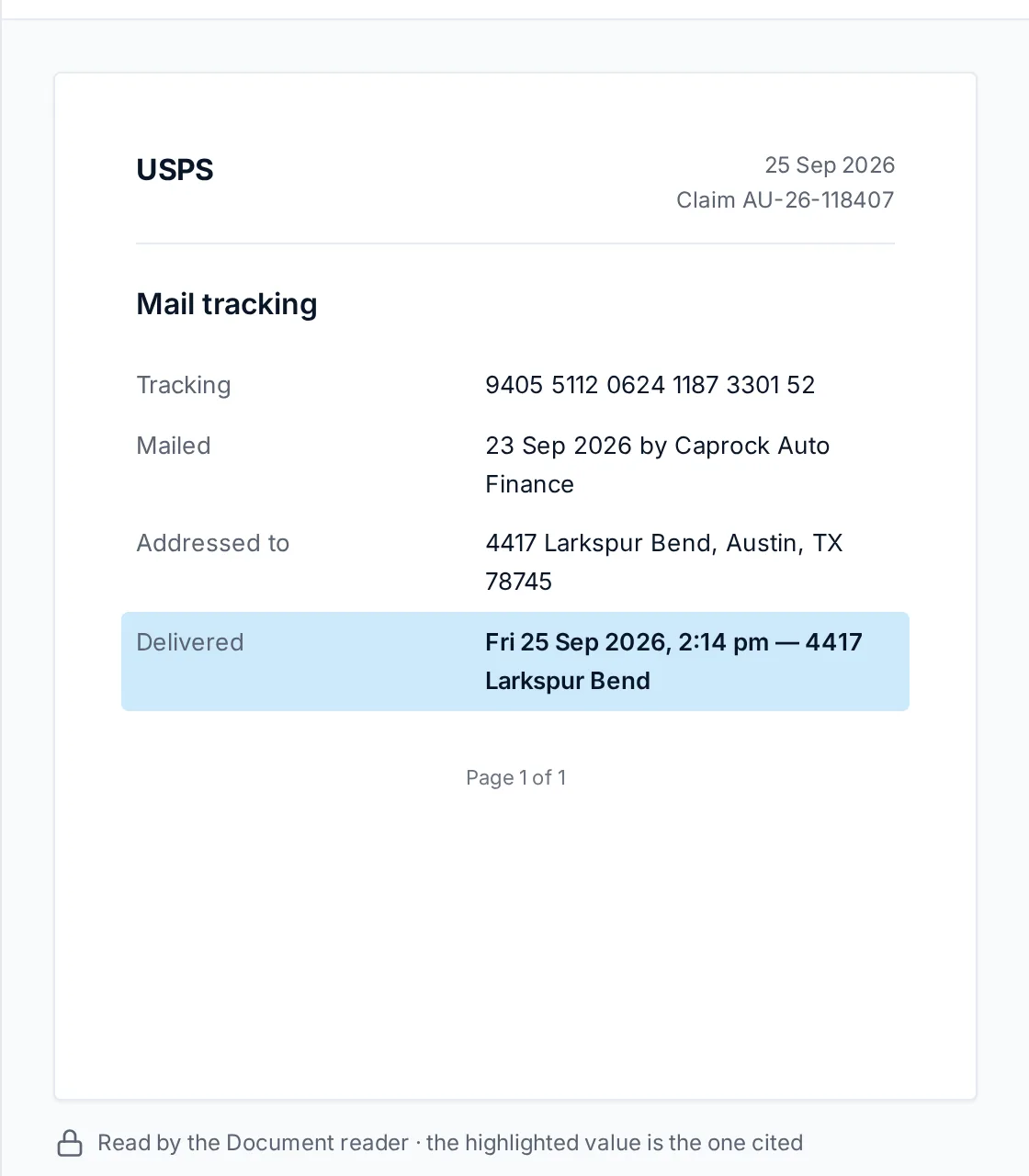
Across a queue, a title delivered to the wrong door is a different job from a title the lender has not released, and the specialist in this story knows the cost of confusing them:
"Half my day is calling lenders about titles they already mailed."
Luis Ortega, the sample file's title and salvage specialist
A lender call is the wrong next step once tracking says delivered. The lender has done its part. The next step is with the owner, who needs to fetch the title from her old address, sign it over, or sign a request for a copy.
Which paper does the carrier need? Payoff letter, letter of guarantee, lien release, title
A carrier needs a document that lets it apply for the salvage title. On a financed car that means the lender's lien released, then the title signed over by the owner, or a substitute the state accepts. A letter of guarantee is the lender's promise to release the lien and send the title once it is paid. It lets a carrier pay a lender that still holds the title, and it belongs to the payoff stage. It had no use on the CR-V, because Caprock was already paid and had released the lien.
Six documents in a title chase: what each proves and what it unlocks
| Document | Who issues it | What it proves | What it lets the carrier do | On this CR-V |
|---|---|---|---|---|
| Payoff letter | Who issues itLender | What it provesThe balance, the date it is good through and the daily interest after that. | What it lets the carrier doPay the lender the right amount, on time. | On this CR-VUsed. Letter of 10 Sep, paid 14 Sep. |
| Letter of guarantee | Who issues itLender | What it provesA promise to release the lien and send the title once it is paid. | What it lets the carrier doPay while the lender still holds the title. | On this CR-VNot needed. The lien was already paid and released. |
| Lien release | Who issues itLender | What it provesThe loan is satisfied; the lender no longer has a claim on the car. | What it lets the carrier doTransfer ownership free of the lien. | On this CR-VReceived 23 Sep. |
| Title, signed over | Who issues itOwner (title issued by the state) | What it provesOwnership, assigned to the carrier. | What it lets the carrier doApply for the salvage title, then sell. | On this CR-VSitting at 4417 Larkspur Bend. |
| Certified-copy request | Who issues itOwner (Texas Form VTR-34) | What it provesThe owner asks the state for a certified copy of the title. | What it lets the carrier doReplace a title that is lost or out of reach. | On this CR-VOffered to the owner on her page. |
| Insurer statement, no title | Who issues itCarrier (two signatures) | What it provesThe title could not be obtained after the required notices, under penalty of perjury. | What it lets the carrier doApply for the salvage title without the owner’s title. | On this CR-VRoute opens Wed 14 Oct. |
With the lien released, the CR-V had two routes left. Ms. Treviño could collect the title from her old address and sign it over, or sign a request for a certified copy (Texas Form VTR-34) on her own claim page. If neither happened, Texas law opens a no-title route 30 days after payment, once two written notices have gone to the owner. Payment was made on 14 September, so the route opens on Wednesday 14 October. The carrier then makes a statement under penalty of perjury and files for the salvage title without hers. The solution makes that two people's decision: the specialist prepares the statement and a supervisor co-signs it.
Those routes differ by state, and so do the forms, notice counts and waiting periods. The total loss rules that change by state are set out on a separate page.
Can a totaled car leave the yard before the title arrives?
Yes, where the buyer will take it. The salvage title still has to come before the sale, but the car does not have to wait for it at a yard that bills by the day. An auction that accepts cars pending title, as one does in this file, can store the car and sell it once the paperwork clears. The title and the car are on separate clocks, and only the car's clock costs money every day.
On the morning of 12 October the salvage assigner agent collected three bids for the CR-V. Northgate Salvage Auction, Austin South, takes cars before the title, charges no storage for 30 days, and was also the highest net bid at $5,100, 23.7% of the car's value. The other two bids, $4,850 and $4,600, both needed the title first. At 07:30 the storage watch agent proposed the move: it stops $45 a day at Ridgeline, and the paper can catch up at Northgate.
Three bids, one storage meter
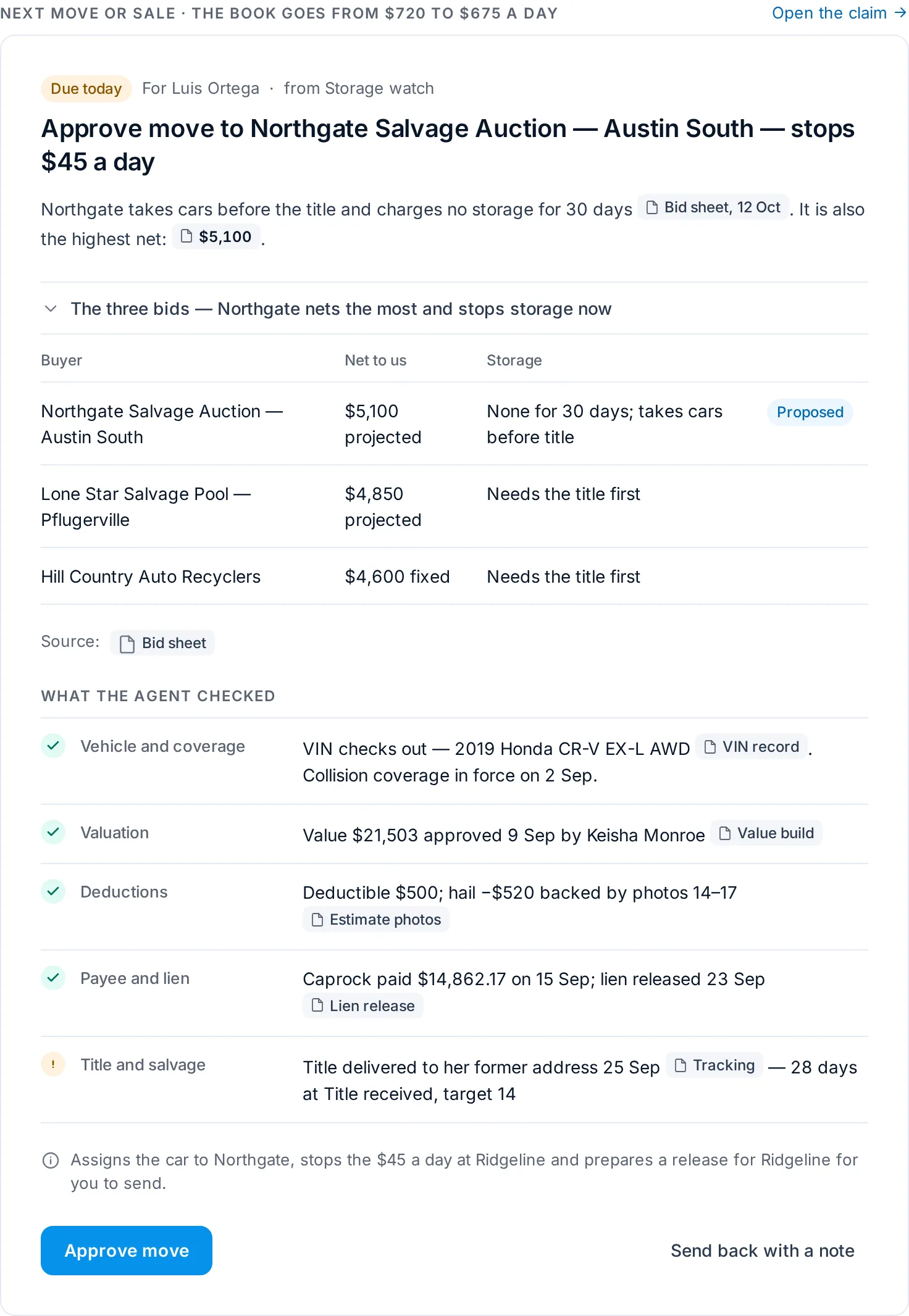
Here the choice was easy. It gets harder when the bids are close: a buyer that needs the title first may bid $250 more than one that takes the car now, but every week the car waits for the title at $45 a day costs $315. The salvage assigner's rule is to prefer the buyer that stops storage soonest when bids are close. It never sells on its own: a sale at the reserve, or up to 10% under it, needs the specialist, and anything further under goes to a supervisor.
Two clocks, one decision: what the paper and the car did
The paper's clock and the car's clock had been running together since 15 September, with the car waiting on the title. Separating them is what the 12 October decision did. The title chase carried on at its own pace, through notice 2 and towards the no-title route. The storage meter stopped.
The paper and the car, side by side
Mon 14 Sep
Payments handed off: $14,862.17 to Caprock Auto Finance, the rest to the owner.
Ridgeline Tow & Storage
$540
Wed 23 Sep
Caprock releases the lien and mails the paper title to 4417 Larkspur Bend.
Ridgeline · day 9
$945
Fri 25 Sep
Delivered 2:14 pm to the former address. Flagged: it is not the address on the claim.
Ridgeline · day 11
$1,035
Mon 28 Sep
Title-request notice 1 mailed, certified. Delivered 30 Sep.
Day 14 · stage target passed
$1,170
Fri 9 Oct
Text to the owner about the title at her old address.
Ridgeline · day 25
$1,665
Mon 12 Oct
Notice 2 drafted for approval. The owner can sign a request for a certified copy.
Move to Northgate approved 09:41
Stops at $1,800
Wed 14 Oct
Texas no-title route opens: 30 days after payment, once two notices have gone out.
Northgate · no storage for 30 days
$0 a day
Laid out this way, the timeline makes an uncomfortable point. The reason was known on 25 September, when the title was delivered to the old address. The car question, whether anyone would take it before the title, could have been asked that afternoon. On this file it was asked 17 days and $765 later, because the carrier's practice was to hold cars at the yard until the title was in hand. A reason that is found and recorded does not by itself stop the meter. Someone has to connect it to the car.
The approval, and the meter stopping
Luis Ortega, the title and salvage specialist, approved the move at 09:41. The request showed the three bids, a five-row checklist of what the agent had verified with each source, and what would happen on approval: the car is assigned to Northgate, Ridgeline's meter stops, and a release authorization for Ridgeline is drafted for him to send. Nothing moved until he clicked.
Approved at 09:41: the claim after the move
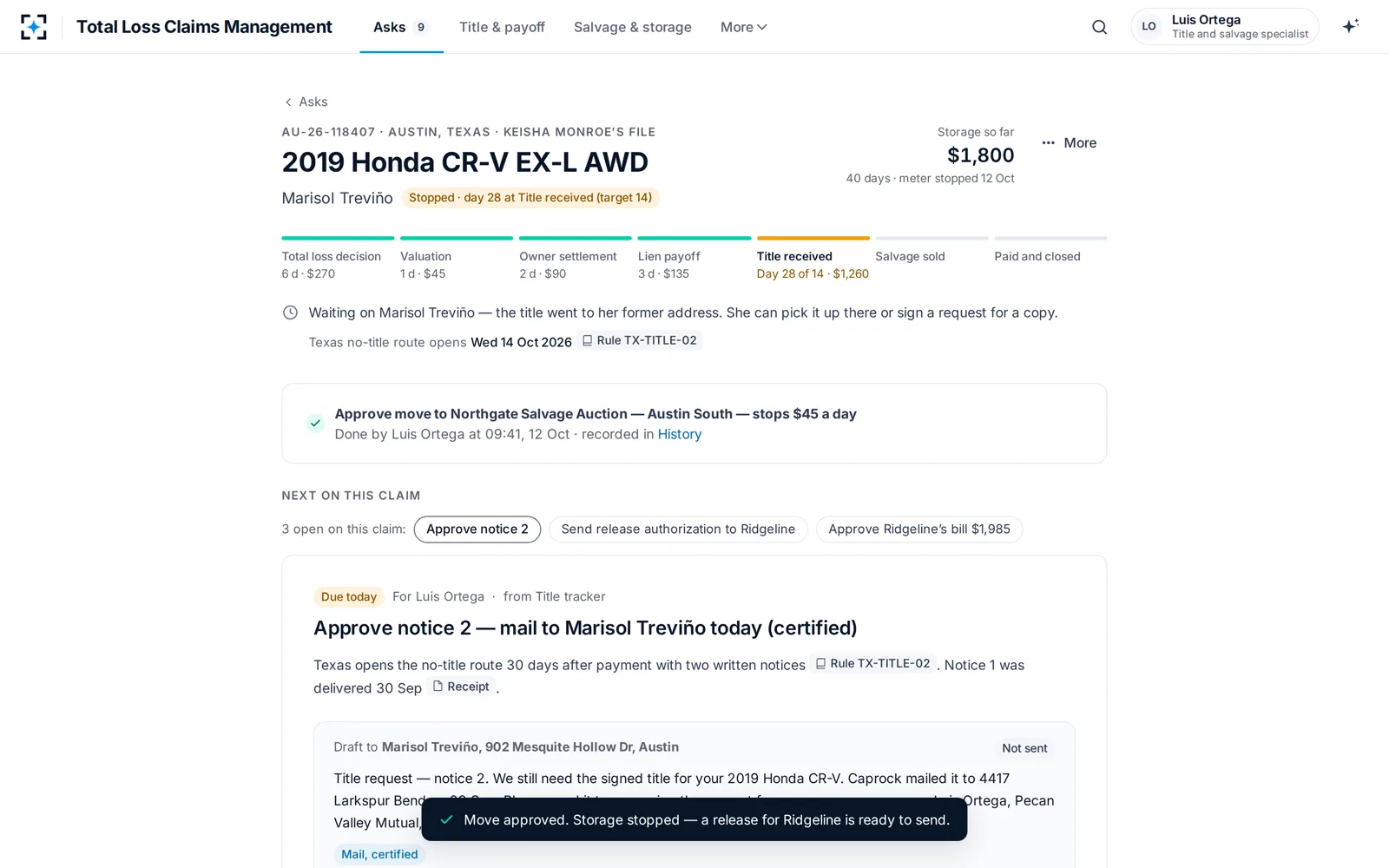
The claim's storage closed at $1,800 for 40 days, $1,260 of it at Title received. Across the adjuster's book of 46 open total losses, daily storage fell from $720 to $675. Every step is in the claim's history, which cannot be edited: who proposed, who approved, the source each relied on and the version of the rule applied. For the per-car arithmetic of what days like these cost across a whole book, see what a totaled car costs while it waits.
The federal side was already handled. Insurers must report total losses to the National Motor Vehicle Title Information System on a monthly basis. The solution created the CR-V's record on 8 September, the day the total was confirmed, so the title delay did not hold up the report.
The other files on the title desk that morning: an expired payoff, a lease underwater, a forged account
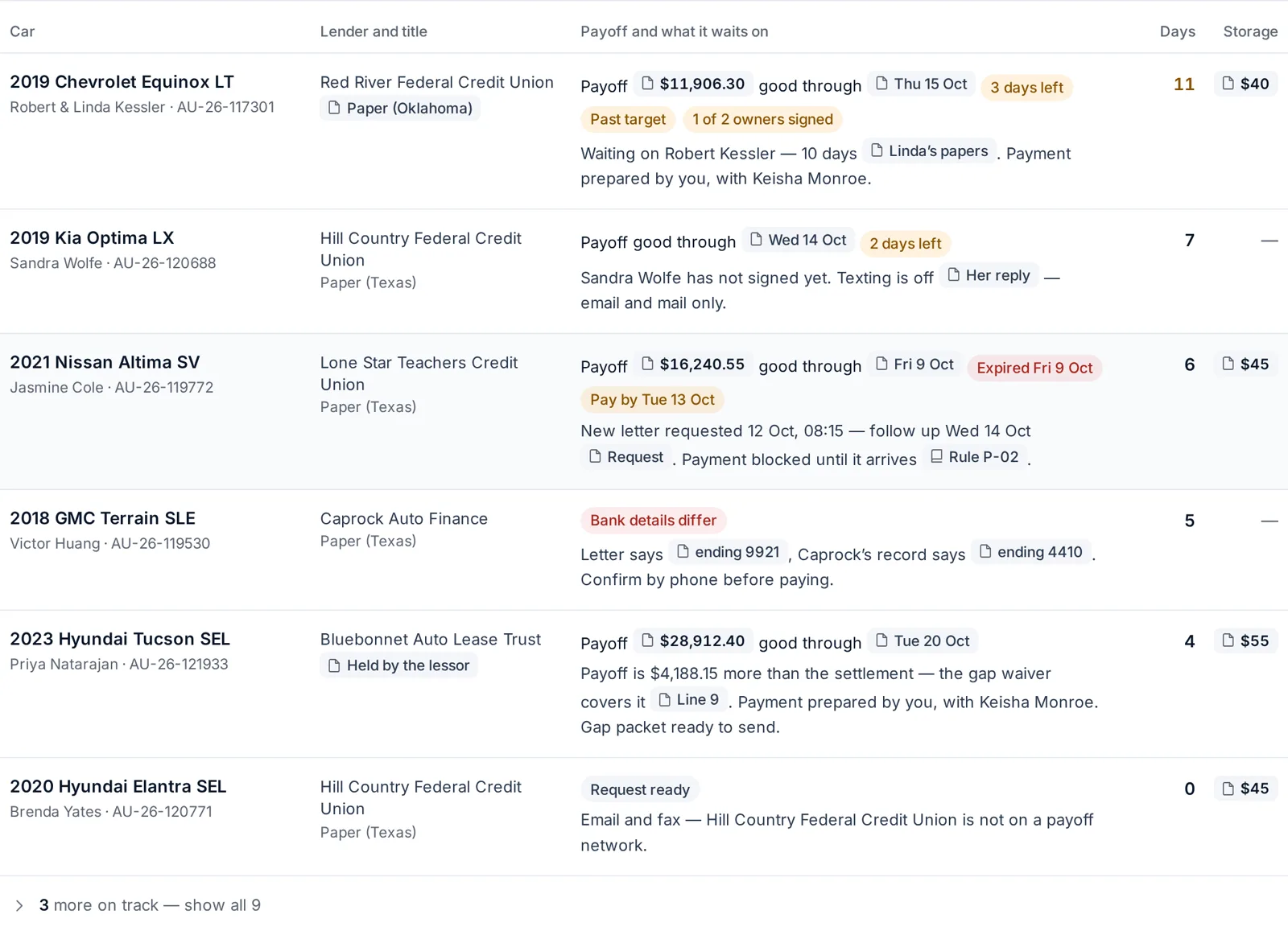
Title delays are one kind of stop between payoff and title; three others sat in the same queue. The specialist's screen lists every car between payoff and title with what each is waiting on. On 12 October it held 21 cars, 5 of them past target.
Between payoff and title: what each car waits on
The payoff letter that expired
A 2021 Nissan Altima's payoff letter for $16,240.55 expired on Friday 9 October, and the Texas pay-by date in the carrier's rules is Tuesday 13 October. The lien payoff agent requested a new letter at 08:15 on 12 October and blocked the payment until it arrives. The solution will not let anyone approve a payment against an expired payoff, because the per diem has changed the amount owed and an underpayment leaves the lien open.
The lease worth less than its payoff
A 2023 Hyundai Tucson on a lease carries a payoff of $28,912.40 against a settlement of $24,724.25. The $4,188.15 difference is negative equity, and here the lease's gap waiver covers it, so the agent drafted the gap packet for the lessor. That is not rare. In the CFPB's data, 11.6% of vehicle loans made from 2018 to 2022 rolled in negative equity from a previous car, and those loans averaged 119.3% of the vehicle's value. They are loans at signing, not total losses, but they show how often a loan starts out bigger than the car.
The bank account that did not match
A payoff letter for a 2018 GMC Terrain, sent by email under Caprock's name, gave a bank account ending 9921. Caprock's record on file ends 4410. The payment is blocked until a call-back to the number on file is recorded. The check runs against the lender's record, never against the PDF alone, because a convincing letter is exactly what a fraudster can produce.
One more row shows the route the CR-V did not need. A 2019 Chevrolet Equinox has its title held by an out-of-state lender, and only one of its two owners has signed. There the lien is still open, so the agent works from a letter of guarantee for $11,906.30 while the second signature is chased. The way these roles share one desk is covered in the total loss desk, seat by seat.
Title procurement in-house, outsourced or automated: what to look for
Whoever does the title procurement, judge it by whether it can tell the four kinds of "waiting on title" apart and act on each the day it changes. Carriers do it in one of three ways: a desk of title specialists working by phone and post, a title service bought from the salvage auction that will sell the car, or software that reads the documents and drafts the chasing for people to approve. Most mature desks mix them. The CR-V shows what each has to get right.
Title procurement as many desks run it, against what one stuck CR-V needed
Desk or outsourced service: Tracking is checked when someone calls the lender or the lender calls back.
What the CR-V needed on 25 September: The delivery scan read the afternoon it posted, and compared with the claim address.
Desk or outsourced service: "Waiting on title" is one status; the lender is chased by default.
What the CR-V needed on 25 September: A delivered title moves the chase from the lender to the owner the same day.
Desk or outsourced service: The no-title route is remembered when a file is already old.
What the CR-V needed on 25 September: Notice 1 dated so the Texas route opens on day 30 after payment, not later.
Desk or outsourced service: The car stays in the yard until the paper is done.
What the CR-V needed on 25 September: A buyer that takes cars pending title found, and the move put to a person.
Desk or outsourced service: Scans and notes in a vendor portal or an inbox.
What the CR-V needed on 25 September: The tracking record, notices and lien release on the claim, each one cited.
The state rules are the part a buyer most often under-asks about, because they differ in ways that move the calendar. Texas counts its no-title route from the date the claim is paid, after at least two written notices (§501.0925). Nebraska counts from the owner's acceptance instead: the insurer may apply once "at least thirty (30) days" have passed since it obtained "oral or written acceptance" and after "at least two written attempts" to get the endorsed title (Nebraska DMV). New York sets a clock in the other direction, giving the insurer 10 business days to forward a title it has received to the state (11 NYCRR 216.7). A title process that runs on one generic reminder schedule will open some states' routes late.
Questions to put to any title procurement service or software
- Does it read mail and electronic-title status itself?
Or does a person have to look? The CR-V lost 17 days between a delivery anyone could see and a decision about the car.
- Does it compare the delivery address with the claim?
The lender mails to its loan record; your policy has the newer address.
- Does it start each state’s no-title clock from the right event?
Payment in Texas, acceptance in Nebraska. Ask to see the rule it applied, with its source and effective date.
- Who approves the notices, filings and the statement under penalty of perjury?
A named person at the carrier, with a second signature on the no-title statement.
- Can you open every document it relied on?
If the evidence lives only in the vendor’s portal, the carrier cannot show it to an examiner or a court.
- Does it connect the paper to the car?
A title chase that never asks whether the car can move is still paying the yard.
Where the solution fits is narrow and honest. Botminds' Total Loss Claims Management does not replace an auction's title service or a carrier's title clerks; it sits across them, reading the tracking, the lien release and the addresses, drafting the notices and the salvage-title application, and putting every send, filing and move to a named person. In the current version the lender, state and auction connections are simulated, so connecting them to a carrier's own lenders and auctions is the first job of a pilot.
What to check on every title in your own queue
Most of the CR-V's delay could have been seen from the desk without new software: tracking, the claim address and a list of buyers that take cars pending title. The solution runs them on every car. A team can start doing them by hand today.
A title-queue checklist for a total loss desk
- Split "waiting on title" into its real states
Lender not released, in the mail, delivered, with the owner unsigned. Each has a different next step and a different person to chase.
- Compare the delivery address with the claim address
The lender mails to its loan record, which can be older than your policy. A delivered title at the wrong door is a call to the owner, not to the lender.
- Tell the lender where to send the title, with the payoff
Most cheaply fixed before it is mailed.
- Start the no-title clock on the payment date
Where your state has a route for a title you cannot get, count from the day it allows and send the notices on time, so the route is open the day you need it.
- Ask the car question as soon as the title goes astray
If an auction will take the car pending title, the yard bill can stop while the paper catches up.
- Re-request a payoff before it expires
An expired letter blocks payment, and every day of per diem changes the amount.
- Check bank details against the lender record
Never against the letter alone, and with a call-back to the number on file when they differ.
- Report the total federally when it is confirmed
The monthly report does not need to wait for the title.
In the solution, these checks belong to the title tracker, lien payoff, salvage assigner and storage watch agents, and each ends in a request to a named person rather than an action. What each agent may and may not do is set out in six agents on a total loss desk. The cost of a stalled total loss is not only storage: rental, handling time and salvage value move with it, and how to price each day of delay sets out how to put a number on each line. To see this file screen by screen, start from Total Loss Claims Management.
Questions people ask
The insurer paid off my loan, but I have no title. What happens?
The lender releases the lien and sends the title, either to the insurer or to you. If it went to you, or to an old address, the insurer will ask you to sign it over or to request a copy from the state. If neither happens, a state with a no-title route lets the insurer apply for a salvage title without yours; in Texas, under §501.0925, that comes after two written notices and no earlier than 30 days from payment.
How long does a lender take to release a title after a total loss payoff?
There is no published industry figure. In this sample file the release came eight days after the payment cleared, and the title was delivered two days after that. A carrier can measure its own lenders from payment and tracking dates.
Can salvage be sold before the title?
Only to certain buyers. In Texas, until the salvage or nonrepairable title is issued, the car may be sold, transferred or released only to a licensed salvage dealer, a parts or metal recycler, an insurer that paid a claim on it, or a government body; once the title is issued, it can go to anyone (§501.095). It can often be moved before then, to an auction that accepts cars pending title, which ends the daily storage bill at the first yard.
Does the owner have to sign the title over after a total loss?
Yes, when the insurer takes the car. Texas's consumer counsel tells owners that once they accept the value "you will sign over the title and send it to the company", which pays the lienholder first (OPIC). An owner who keeps the car keeps the title, though in New York the insurer can hold back at least half the payment until a title it must brand reaches it.
Is a letter of guarantee the same as a lien release?
No. A letter of guarantee is a lender's promise, given before it is paid, to release the lien and send the title. A lien release says the loan has been satisfied. Once the lien is released, as on the CR-V, a letter of guarantee has nothing left to guarantee.