AI agents for insurance claims earn their keep where the work is slow, and on a total loss claim that is not the decision. Software has called totals from photos for years. The days go afterwards: settling a value the owner believes, paying off the lender before its letter expires, chasing the title, filing the salvage title, selling the wreck, while a tow yard bills storage every day. Botminds' Total Loss Claims Management splits that tail into narrow jobs. Agents read, check, draft and chase; a named person approves every payment, payee, letter, move, filing and sale.
The design question is not how much the agents can do. It is what each may never do, who acts instead, and how a carrier proves it later. This page answers that agent by agent, then follows one sample claim through every step.
Total loss AI so far predicts; the costly work is settling
Predicting a total at first notice: Repair it or total it?
Settling a total after the decision: What is it worth, who is paid what, where is the title, who buys the wreck, and what is the yard charging?
Predicting a total at first notice: One classification from photos and an estimate.
Settling a total after the decision: A chain of steps, most waiting on someone outside the carrier: the owner, a co-owner, the lender, the state, the yard, the auction.
Predicting a total at first notice: One call, made once the photos and the estimate are in.
Settling a total after the decision: Weeks. In Texas, an insurer that has paid but cannot get the title may apply for one in its own name only from the 30th day after payment.
Predicting a total at first notice: Already common: large auto insurers report models that evaluate images of loss and flag early total losses.
Settling a total after the decision: Mostly as advice to the adjuster; few surveyed insurers let a model approve a claim, and none let one deny.
Predicting a total at first notice: Accuracy: did the model call the total correctly?
Settling a total after the decision: Whether every value line, payment and filing is right, explained and approved by the person entitled to approve it.
Predicting a total at first notice: A repairable car is totaled, or the reverse.
Settling a total after the decision: A payoff lapses, a forged bank account is paid, a letter misses a required line, a car sits in a billing yard.
How is AI used in insurance claims today? Predicting a total, rarely settling it
Predicting a total is a single classification, and carriers already use models for it. Settling one is a chain of documents, counterparties and clocks, and that is where AI agents earn their place. In the NAIC's survey of large private passenger auto writers, 55 of 193 companies used AI or machine learning to evaluate images of loss, and the uses companies wrote in included "early total loss recognition". The Bureau of Labor Statistics expects more of the same: "computer software can evaluate photographs of damaged property and calculate an estimated claim amount". The decision is fast and well served.
What follows the decision is not. The car is towed to a yard that bills by the day. The NAIC's Model Regulation 902, the template many states adapted, requires the value's deductions to be "measurable, discernible, itemized and specified as to dollar amount" and the basis fully explained to the owner. Many of these cars carry a loan, and the payoff letter has a good-through date. The title may sit with the lender, the owner, or at the owner's old address. The salvage title and the federal total-loss report follow, and in most states the car cannot be sold before the salvage title arrives.
After the decision, the tail runs on other people's clocks
5business days
for a Texas insurer to pay once it accepts a claim, or once the claimant does what payment depends on
Tex. Ins. Code §542.057
72hours
for a Florida insurer to send the title to the state once it has it in hand
Fla. Stat. §319.30
30days
after payment before a Texas insurer that cannot get the title may apply for one in its own name
Tex. Transp. Code §501.0925
Each of those clocks depends on someone outside the carrier: the owner who must sign, the lender who must release the title, the state that must issue a new one. The Texas title route also asks for proof of effort, a statement that the insurer sent "at least two written notices attempting to obtain the certificate of title". That is chasing, recording and drafting, the work agents suit, and none of it is the repair-or-total call. For how the work is spread across systems and people today, see today’s total loss process and its two clocks.
Why the tail splits into narrow agents, not one model
Each part of the tail has its own documents, its own counterparty and its own clock, so each is a separate job with a separate test. A model that values cars should not also be able to release a payment. A single assistant with every permission is hard to review, and harder to defend when a regulator asks who decided what.
Narrow agents fix the boundary in advance. The valuation analyst never sees a bank account; the lien payoff agent never writes to the owner; the title tracker can draft a salvage-title application but cannot file it. When one behaves badly, the fault is local and its permissions are already small. In Total Loss Claims Management the arithmetic, eligibility filters, rule lookups and day counts are ordinary deterministic code, not the language model, and every agent output is checked against a fixed format before anyone sees it. The model reads and drafts. The code counts.
The agents in Total Loss Claims Management: what each reads, produces and may never do
Document reader
Reads
Titles, payoff letters, yard invoices, appraisal photos, signed forms
Produces
An extract with the page cited, and a verdict: complete, or missing a named item
Never Treat a document as proof of a bank account without checking the lender record
Valuation analyst
Reads
The appraisal estimate, the VIN build, comparable listings, the state or carrier rule
Produces
The total-loss sum with its rule; a value build with every listing, adjustment and exclusion
Never Use a branded-title listing, take a negotiation-type deduction, or set the offer
Settlement explainer
Reads
The approved value, tax and fee rules, the payment split, the state notices
Produces
A plain-words offer letter, line by line, and drafted replies to disputes
Never Send anything to an owner, claimant or lender without a person
Lien payoff agent
Reads
Payoff letters, letters of guarantee, the lender record on file
Produces
Payoff requests, good-through and per-diem tracking, gap and negative-equity flags, a prepared payment
Never Pay, or let a payoff letter lapse without saying so
Title tracker
Reads
The title, lien release, mail tracking, the owner’s addresses, signatures
Produces
Notices, the salvage-title application, the no-title route, the federal total-loss report
Never File anything with a state on its own
Salvage assigner
Reads
Auction and recycler bids, reserves, pickup windows
Produces
A proposed buyer, reserve and pickup; the sale reconciled afterwards
Never Sell under reserve without a person
Storage watch across every stage
Reads
Tow and storage invoices, yard rates, state rate caps
Produces
Every storage day priced by stage each morning; proposed moves that stop the meter
Never Move a car without a specialist's approval
What each agent does, and where its job ends
The valuation analyst does the two calculations owners argue about. First, the total-loss sum: repair cost plus projected salvage against the value, under the state's rule. Texas, for example, leaves repainting and repair sales tax out of its threshold. Then the value: comparable listings of the same model year within the carrier's radius and age window, adjusted for mileage, trim, drivetrain and documented condition. Listings it leaves out are shown with the reason. It cannot take a negotiation-type deduction, and no setting turns one on. Deductions of that family are where the litigation is: the Ninth Circuit, recounting its Jama decision, noted that Washington law "explicitly prohibited the use of 'negotiation adjustments'", and in Drummond the Third Circuit described Progressive's projected sold adjustment as averaging a 6.7% reduction in base value. How a value build is checked line by line is the subject of defensible total loss valuations.
The settlement explainer turns the approved value into a letter: each listing and adjustment, taxes, fees, deductible, who is paid what, and the state's notices, such as the appraisal right and the reopen window. A pre-send check blocks a letter missing a required line. The Unfair Claims Settlement Practices Act asks for "a reasonable and accurate explanation of the basis" of an offer; this agent writes it, and the adjuster sends it. The explanation is where trust is won or lost. When the UK's Financial Conduct Authority reviewed total-loss valuations, it called "communicating the settlement offer ... a vital step in the claims-handling process", and found some firms made low first offers they expected to raise only if the customer pushed back.
The lien payoff agent requests and reads the payoff letter or letter of guarantee, tracks the good-through date and daily interest, re-requests before it expires, and flags negative equity and gap. Underwater loans are common: in the CFPB's auto finance data, loans that rolled in negative equity from a previous car averaged a loan-to-value ratio of 119.3%, and even loans with no trade-in averaged 101.6%, so a payout at market value may not clear the loan. It checks the lender's bank details against the record on file, never against the PDF alone. It prepares the payment; it cannot pay.
The title tracker follows the title, paper or electronic, with the lien release, signatures, mail tracking and the owner's addresses. It drafts notices, the salvage-title application, the state's no-title route where the title cannot be had, and the monthly report insurers owe the federal total-loss register. A person files every one.
The salvage assigner collects bids and proposes the buyer, reserve and pickup, preferring the buyer that stops storage soonest when bids are close. Storage watch prices every storage day by stage each morning, checks yard rates against state caps, and proposes moves. A document reader sits in front of all of them, reading what arrives and citing the page.
What none of the agents may do, and who decides instead
No agent pays, moves a car, files with a state, or sends anything to an owner, claimant or lender. Each of those steps reaches a named person as a single request: what the agent proposes, the evidence behind it, a five-row check (vehicle and coverage, valuation, deductions, payee and lien, title and salvage), and two answers, approve or send back with a reason. Dollar limits route larger items up the chain, and the person who prepared a payment can never approve it.
In Total Loss Claims Management, every consequential step has a named decider
| Step | Proposed by | Decided by | Second check or limit |
|---|---|---|---|
| Confirm the total loss | Proposed by Valuation analyst | Decided by Adjuster | Second check Supervisor when the sum is within 5% of the threshold |
| Approve the value | Proposed by Valuation analyst | Decided by Adjuster, up to $40,000 | Second check Supervisor to $75,000; director above |
| Send the offer letter | Proposed by Settlement explainer | Decided by Adjuster | Second check Pre-send check must pass; consent per channel |
| Approve a payment | Proposed by Lien payoff agent | Decided by Specialist or adjuster prepares | Second check A different person approves; never on an expired payoff |
| Change a payee or bank details | Proposed by No agent | Decided by Adjuster or specialist | Second check Supervisor, always |
| Move a car between yards | Proposed by Storage watch | Decided by Specialist | Second check A hold blocks the move |
| File the salvage title | Proposed by Title tracker | Decided by Specialist | Second check Recorded with the rule version |
| Sign the no-title statement | Proposed by Title tracker | Decided by Specialist prepares | Second check Supervisor co-signs (penalty of perjury) |
| Sell the salvage | Proposed by Salvage assigner | Decided by Specialist, at reserve or up to 10% under | Second check Supervisor when more than 10% under |
| Monthly federal total-loss report | Proposed by Title tracker | Decided by Specialist prepares | Second check Compliance approves; the preparer never can |
| Change a state rule | Proposed by No agent | Decided by Compliance proposes | Second check Director approves |
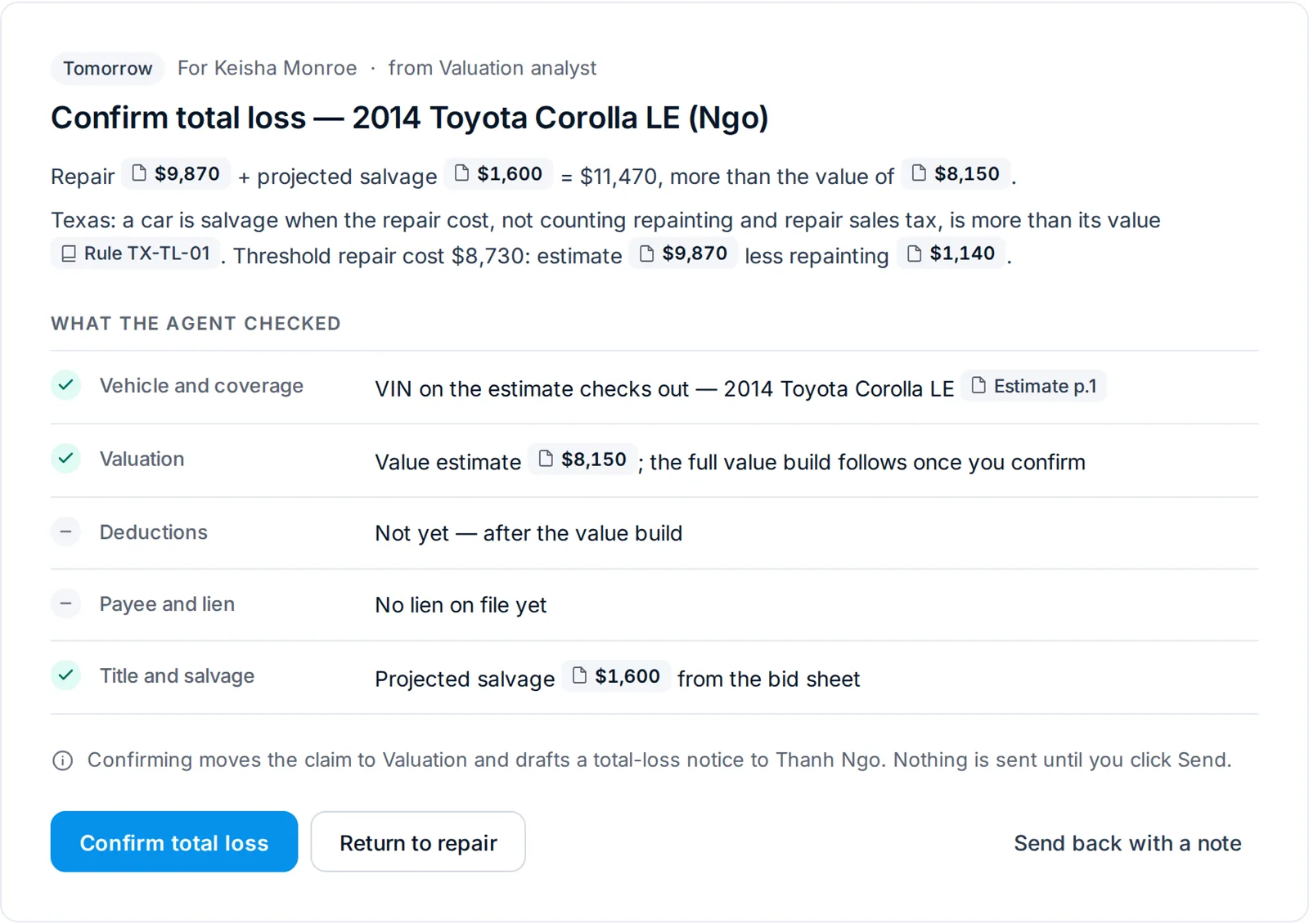
The request looks the same whatever the step. Below, the valuation analyst proposes a total on a sample Corolla: the sum with each figure linked to its document, the Texas rule cited, and the checks it ran. Nothing goes to the owner until the adjuster acts.
An agent proposes; the adjuster confirms or returns the car to repair
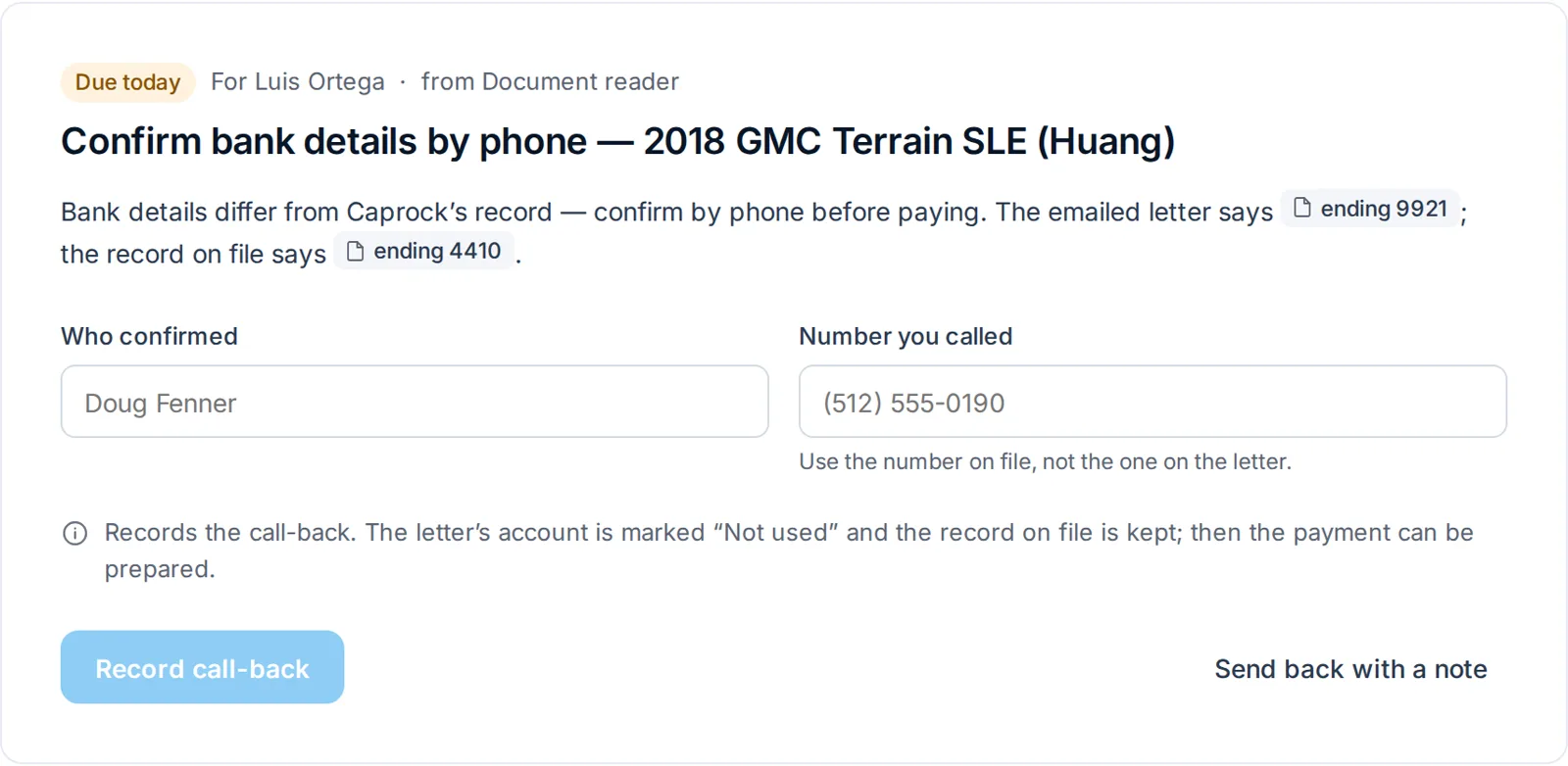
Some limits exist because documents lie. A payoff letter arrives by email with an account number that differs from the lender's record on file. The document reader does not decide which is right. It blocks the payment and asks for a call-back to the number on file, not the one on the letter.
A payoff letter with the wrong bank account stops the payment
One car, one run: the agents on a stopped CR-V
Take a claim from the solution's fictional Austin book: Marisol Treviño's 2019 Honda CR-V, rear-ended on 2 September and towed to a yard billing $45 a day. By 12 October it has spent 28 days at "Title received" against a target of 14. The history shows each step, who took it and the document it rests on.
One run, traced: agents propose, people decide, every step cites its source
The run found the reason the car stopped by reading two records kept in different places: the lender's tracking record and the address change already on the claim. It proposed the fix the rules allow. The auction takes cars before the title and charges no storage for 30 days, and its bid was the best net of three. The agents also drafted the owner's second notice and a text asking her to collect the title or sign a request for a certified copy, ready for a person to send. The full story, with the screens, is in the CR-V case study.
Count the green discs. The adjuster confirmed the total and approved the value. One person prepared the payment and another approved it. The specialist approved the move. No agent step in that history moved money, sent a message or moved a car.
Every finding cites its source, or it is not a finding
Each number an agent produces carries a link to where it came from: the listing, the appraisal photo, the payoff letter, the tracking record, the yard invoice or the rule. Clicking it opens the document with the cited value highlighted. That is what lets an adjuster check a proposal in a minute instead of rebuilding it, and what lets a supervisor answer an owner's dispute from the same page the owner sees.
It also changes what can be audited. The claim's history cannot be edited, and each row keeps who acted, when, the inputs and the version of the rule applied. A claim's audit packet exports in one step. If a value is challenged two years later, the question "which listings, which adjustments, which rule, approved by whom" has a stored answer rather than a reconstruction.
Autonomy, limits and state rules are settings, and versioned
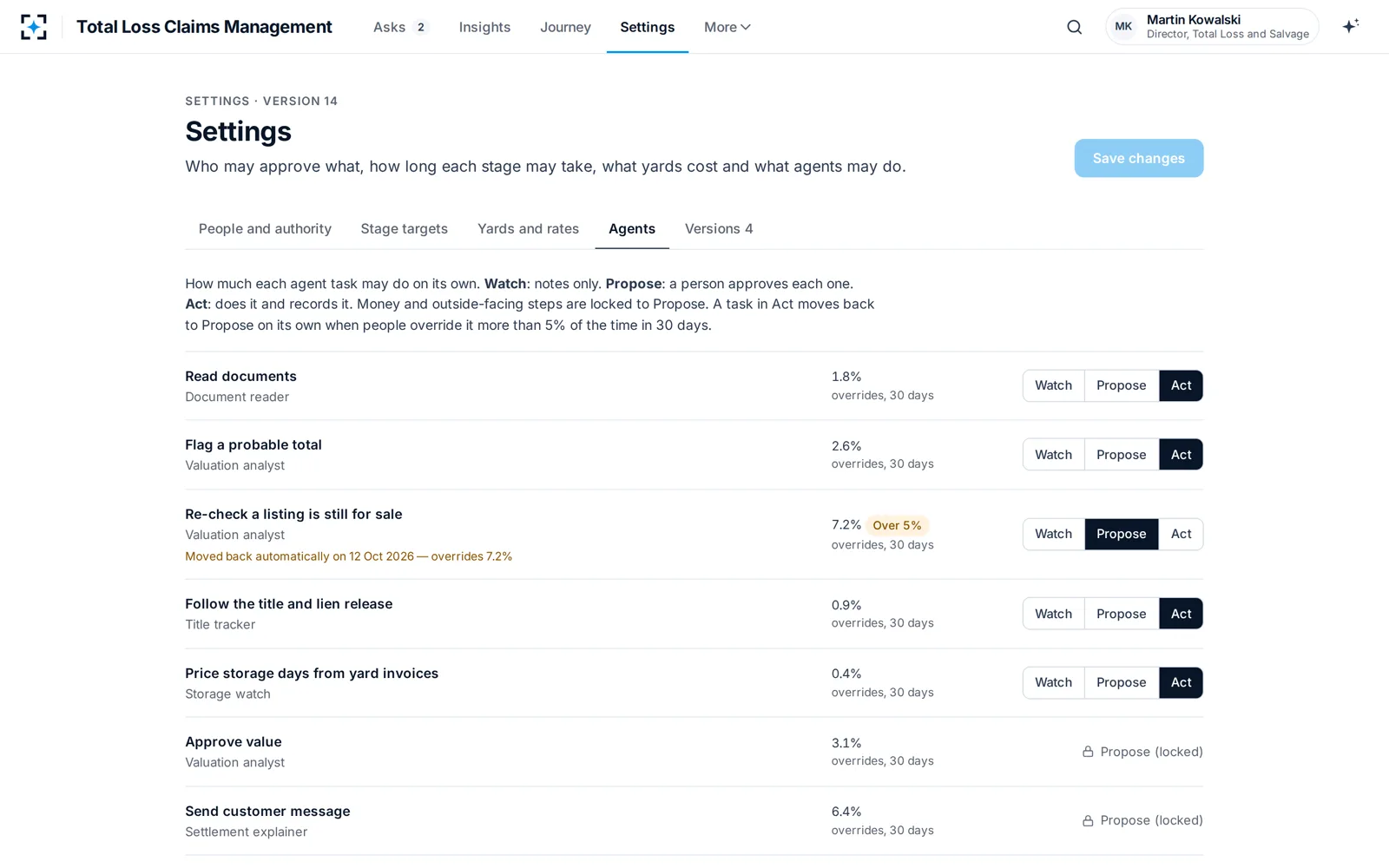
How far each agent task may go is a setting, not a property of the model. Each task is set to Watch (notes only), Propose (a person approves each one) or Act (it does the task and records it). Money and customer-facing steps are locked to Propose. A task in Act that people override more than 5% of the time over 30 days moves back to Propose on its own.
Each agent task has an autonomy level, and an override rate that can demote it
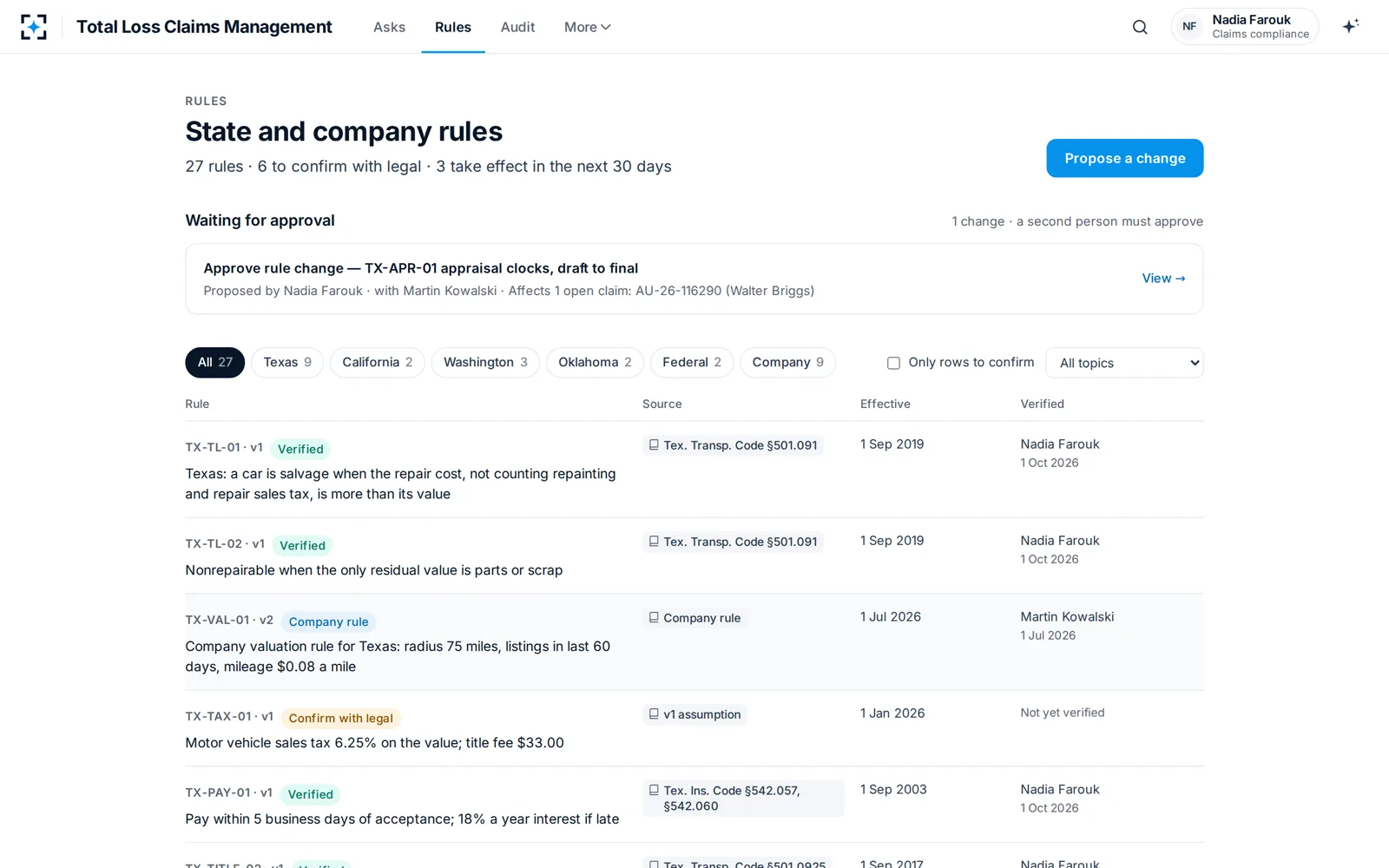
State rules get the same treatment. Each is a row with its source, effective date, status and the person who verified it, and a change waits for a second person. A rule the carrier has not yet confirmed with counsel is shown as such, and such rows must be confirmed before go-live. The rules themselves, from thresholds to reopen windows, are mapped in the total loss rules by state.
State rules are dated, sourced rows, and an unverified one says so
Is AI allowed to make insurance claim decisions? What the NAIC bulletin asks
The NAIC's model bulletin does not ban automated claims decisions; it makes the insurer answer for them. It names claim management among the uses it covers and states that insurers' actions "must not violate the UTPA or the UCSPA, regardless of the methods the Insurer used to determine or support its actions". By the NAIC's own map, 29 jurisdictions had adopted it as of 8 October 2026, and California, Colorado, New York and Texas have their own guidance. New York's circular letter covers underwriting and pricing, not claims.
Carriers have mostly kept AI in claims advisory. In the NAIC's survey of large private-auto writers, 135 of 193 used AI or machine learning in claims, mostly as information for adjusters. Nine used it for approvals; none for denials.
Where large auto insurers use AI in claims, and where they stop
A design in which agents propose and named people decide sits on the conservative side of that line. It also leaves the kind of evidence a governance programme under the bulletin draws on: an inventory of what each agent may do, a record of each human decision with its evidence, and a measure, the override rate, of whether an agent is still trusted. The detail, state by state, is a matter for counsel.
Which kind of AI claims software does a total loss desk need?
It depends on where the desk loses its days, and on a total loss most of them are lost after the decision. Three kinds of product are sold as AI for insurance claims, and they answer different questions. Buying the wrong one is the commonest mistake: a fast total call on a car that then waits five weeks for its title has not shortened the claim.
Three kinds of AI sold for claims, and the total loss work each one reaches
Where it helps: The repair-or-total call, early, from photos and an estimate; most large auto writers already use models of this kind.
Where it stops on a total loss: At the decision. It does not value the car to a state rule, pay a lender, chase a title or price storage.
Where it helps: Answers questions, summarises notes and drafts replies for whoever asks.
Where it stops on a total loss: It waits to be asked. Nothing watches a payoff’s good-through date or a title’s tracking unless someone thinks to ask.
Where it helps: Carry each car from value to salvage: read, check, draft, chase and propose, each step to a named person.
Where it stops on a total loss: They decide nothing. Every payment, send, move, filing and sale still needs a person, and the connections to lenders, states and auctions must be built.
Botminds' Total Loss Claims Management is the third kind, and it is narrow on purpose: personal auto total losses, from the decision to a closed file, first and third party, financed and leased cars. It is not a photo estimator, it does not handle first notice of loss, and it leaves the valuation vendor, the auction and the payment system in place. A carrier whose days are lost before the total call needs the first kind; one whose cars sit at Title received after the owner is paid needs the third.
How do you evaluate AI agents for insurance claims before you buy?
Ask what the agents may not do, then try to make them do it. A demonstration of a correct value says little; a demonstration that a forged bank account, an expired payoff or a missing letter line is stopped says a great deal. These are the questions we would put to any vendor, ourselves included.
Questions to put to any total loss agent, before a pilot
- List what each agent can never do, in writing
Payment, payee changes, sends, moves, filings and sales below reserve should each have a named human decider.
- Show the arithmetic is not the model
Values, taxes, splits, day counts and thresholds should be deterministic code whose output can be re-run.
- Open the source of any number
Each listing, adjustment, payoff figure and storage day should link to the document and the rule version behind it.
- Try to pay a forged payoff letter
Bank details must be checked against the lender record on file, never the letter alone.
- Try to approve your own payment
The preparer should be unable to approve, at every dollar amount.
- Ask how autonomy is withdrawn
An agent task that people keep overriding should lose its autonomy automatically, with the reason recorded.
- Ask for the audit packet of one claim
Who approved what, the inputs, the agents and versions, and what the customer was told, in one export.
- Ask what is simulated
Lender, state, auction and payment connections: which are live, and which are test doubles?
The last question applies to us. The first version of Total Loss Claims Management runs against simulated lender, motor-vehicle department, federal-register, auction, listing, VIN and payment connections; the product moves no money and hands each approved payment to the carrier's own payment system. A practical way to test it is to replay your own closed files, as set out in the 30-day pilot. The people who approve each request are described in the desk, seat by seat, and the solution itself is on the Total Loss Claims Management page.
Questions people ask
Can AI settle an insurance claim on its own?
It can do most of the work of settling one: read the documents, build and explain the value, prepare the payment and track the title. In this design it cannot make the settlement happen. Sending the offer, approving the payment and selling the salvage are each a person's decision, and the payment itself runs through the carrier's own system.
Why not let an agent act when it is almost always right?
Some tasks may: reading documents, flagging a probable total, following a title and pricing storage can run in Act when the carrier chooses. The steps that move money or speak to a customer stay locked to Propose, because a wrong one cannot be taken back, and because the unfair claims practices rules hold the insurer to account whatever method it used.
What does an agent run cost?
The engineering target is a language-model cost of $1.00 or less per claim, from the total-loss decision to a closed file. It is a target, not yet a measured result. Most of the work is deterministic code, which is cheap; the model is used for reading and drafting.
What is the best AI for insurance claims?
The one aimed at the step where your claims lose time, with limits you can read. For total losses, measure first: if cars wait at the decision, a prediction tool helps; if they wait on payoffs and titles after the owner is paid, agents that chase and propose help more. Whatever you buy, the NAIC bulletin leaves the insurer answerable for the outcome, so ask to see what the product may never do.
Do AI claims agents need access to the payment system?
Not in this design. The lien payoff agent reads the payoff letter and drafts the split, a specialist prepares the payment and a different person approves it, and the approved payment is handed to the carrier's own payment system with a duplicate-payment guard. The product itself moves no money.
How is this different from a chatbot on top of a claims system?
A chatbot answers questions; these agents carry work items with deadlines, each producing a structured, checked proposal for one named person. The solution also has an assistant that answers questions about a claim with citations. It can open an approval for the right person, and it cannot approve anything itself.