There is no single total loss threshold by state that a desk can copy: some states set a percentage of the car's value, some use a formula that adds salvage to the repair cost, and several percentages decide the title brand rather than whether the insurer must total the car. Of the texts we read, Texas draws its salvage line at 100% of value, Iowa at 70%, New York at 75% for a car the owner keeps, and Florida defines an insured total by the insurer paying to replace it. Beyond the threshold, a totaled car in US personal auto is settled under two layers of rules. The first is national in shape: many states built their claims rules on the NAIC’s model regulation, which asks for two or more local comparables, taxes and transfer fees, itemized deductions, and a 35-day right to reopen. The second is the state’s own text, which changes the search radius, the look-back window, which taxes and fees are owed, how fast payment must go out and what happens to the title. With repair prices up 56% since January 2020 against 36% for used cars (BLS repair index, used-car index, January 2020 to September 2026), more crashed cars cross the line into a total, and a multi-state desk applies those differences on file after file. Botminds’ Total Loss Claims Management exists to carry each totaled car from the decision to a closed file, with the state rule for that car cited at every step.
Every rule below was read from the regulation or statute text, links to it and is dated October 2026; states not read from their text are left out rather than guessed. It is not legal advice: confirm each rule with counsel.
The NAIC baseline that state rules adapt
2+cars
comparables in the local market, available within the last 90 days
Model 902 §8A(2)(a)
35days
for the insured to say no comparable can be bought for the money, which reopens the file
Model 902 §8A(2)(e)
21days
after proofs of loss to accept or deny; a status letter at 45 days and every 45 after
Model 902 §7A–B
30days
to pay once liability is affirmed and the amount is not in dispute
Model 902 §7F
What the NAIC model requires on every total loss
The NAIC model gives the insurer two ways to settle and fixes what each must include. It can offer a replacement car of the same make, same or newer year, similar body style, options and mileage, in as good or better condition, with all taxes and transfer fees paid. Or it can pay cash: the cost of a comparable car, less the deductible, including all applicable taxes, license fees and other fees to transfer ownership.
The cash route names its evidence. The cost comes from two or more comparables in the local market within 90 days; failing those, from nearby markets including the closest major metro area; failing those, from licensed dealer quotes; or from a computerized source whose database values at least 85% of makes and models for the last 15 model years. Any deduction, including salvage, must be “measurable, discernible, itemized and specified as to dollar amount”, and the basis of the settlement “shall be fully explained to the first party claimant” (Model 902 §8A).
Behind it sits the Unfair Claims Settlement Practices Act, Model 900. It names the conduct regulators examine for: not trying in good faith to settle once liability is reasonably clear, offering substantially less than suits later recover, and failing to give a reasonable explanation of a compromise offer. A breach counts when it is flagrant or frequent enough to be a general business practice. That is why a state rule is a desk-wide setting, not a judgment made file by file: a pattern is what gets examined.
A model binds only where a state adopted it, and states adopted it with changes. The rest of this page is about those changes.
What is the total loss threshold in each state? Four read from the text
The four thresholds we read from the statute or rule text are below; for any other state, read its own vehicle title statute and insurance regulation before relying on a published number. The 50-state tables online come from consumer and comparison sites, and they disagree with each other on states as basic as Iowa and Minnesota.
Four state thresholds, as the texts write them, October 2026
| State | The line | What it decides | Source |
|---|---|---|---|
| Texas | Repair cost above 100% of actual cash value, leaving out repainting and sales tax on the repair | Whether the car is a salvage motor vehicle and needs a salvage title | Tex. Transp. Code §501.091(15) |
| New York | Repair cost above 75% of actual cash value | For a car eight model years old or newer that the owner keeps: the title goes to the insurer and comes back “REBUILT SALVAGE” | 11 NYCRR 216.7(b)(16) |
| Florida | Insured car: the insurer pays to replace it. Uninsured: repair 80% or more of replacement cost | Whether the car is a total loss; at 90% on a late-model car worth $7,500 or more, it is unrebuildable | Fla. Stat. §319.30(3) |
| Iowa | Repair cost above 70% of fair market value (50% before 1 July 2021) | Whether the car needs a salvage title | Iowa DOT, ARC 6066C |
One damaged car shows how far apart those lines sit. Take a car worth $10,000 with a $7,200 repair estimate and a wreck that would fetch $2,000 at auction. At 72% of value it needs a salvage title in Iowa, which draws its line at 70%. In New York, if the owner keeps it, it falls just under the 75% line, so no title surrender. In Texas it is nowhere near the 100% salvage line. And under a total loss formula, $7,200 of repair plus $2,000 of salvage is $9,200, still under the $10,000 value, so the formula says repair (our arithmetic on each text).
The insurer's own decision can differ from all four. The salvage-title lines tell the state how to brand a title; the carrier still weighs repair cost, value and the salvage it expects to sell, plus rental and storage while a long repair runs. That is why a car can be totaled below a state's percentage, and why the next question matters.
Is the total loss threshold the same as the salvage title threshold?
No. The carrier decides whether to pay for repairs or total the car; the state decides when a damaged car must carry a salvage or rebuilt brand. The two use different tests and can give different answers on the same car.
The carrier’s decision is economic. Texas’s Office of Public Insurance Counsel puts it in one line for consumers: a total loss “means that your vehicle costs more to fix than to replace”, and when the owner keeps the car “the company deducts the amount they would get for selling the car as salvage from your claim payment” (OPIC, Your Options After a Total Loss). Expected salvage proceeds therefore sit on the carrier’s side of the comparison next to the repair estimate and the pre-accident value. The state’s test is about the title. Texas defines a salvage motor vehicle as one whose repair cost exceeds its actual cash value, with repainting and repair sales tax left out of the cost (§501.091(15)). Iowa raised its salvage-title line from 50% to 70% of fair market value for cars transferred from 1 July 2021 (Iowa DOT, ARC 6066C).
Some state texts are not thresholds at all. Florida defines an insured car as a total loss when the insurer pays to replace it; its 80% test applies to uninsured cars (§319.30(3)(a)). New York’s 75% rule governs the car the owner keeps: for cars eight model years old or newer, above 75% of value the insurer must collect the title and withhold at least half the payment until it arrives (216.7(b)(16)).
This is also why the threshold tables published online disagree. Many still show Iowa at 50%, five years after the rule moved to 70%, and they flatten Florida’s insured and uninsured tests into one “80% state”. A table copied from a consumer site is a starting point at best; the statute or rule text is the only reference a desk can defend. Our page on why so many cars are now totaled follows the economics of the carrier’s side.
Two tests that get mixed up
The carrier’s total loss decision: Is repairing this car worth more than paying for it?
The state’s salvage title test: Must this car’s title now carry a brand?
The carrier’s total loss decision: Repair estimate, pre-accident value, expected salvage proceeds, the customer
The state’s salvage title test: Repair cost against value, as the statute defines both
The carrier’s total loss decision: Costs more to fix than to replace, with expected salvage proceeds counted
The state’s salvage title test: Texas: repair, without repainting and repair sales tax, above value. Iowa: above 70%
The carrier’s total loss decision: Valuation, settlement, title transfer and auction
The state’s salvage title test: Salvage title application, brand, federal report
Total loss rules by state, read from the regulation text
Seven states and the federal register rule, with the citation and the date each applies from. Each card keeps to what the text says; where a card is short, it is because the part of the text we read is about one question. A state that is missing has not been read from its text for this page.
Seven state rule sets and one federal rule, as of October 2026
California
10 CCR §2695.8Text as read, October 2026
- Comparables must have been for sale to the public in the local market within 90 days of the final offer, each identified by VIN, dealer stock number or plate, with the seller’s phone or address.
- No condition deduction unless the car’s documented condition is below average for its year, make and model.
- Pays taxes and one-time transfer fees, plus the license and annual fees for the unused registration term, whether or not a replacement is bought.
- Owner keeps the car: sales tax is discounted by the tax on the salvage value, and salvage is priced at what a pool, auction or dismantler will pay.
- Written notice, when payment or the final offer goes out, of a 35-day reopen right.
New York
11 NYCRR 216.7 (Regulation 64)Text as read, October 2026
- Minimum cash offer: the average of two approved guides (Redbook and NADA), a dealer quote within 25 miles held for three days, or an approved database.
- A detailed copy of the valuation goes to the insured no later than the payment date.
- Payment within five business days of acceptance; an offer on an unrecovered stolen car by day 25.
- Cars eight model years old or newer that the owner keeps: above 75% repair-to-value, the insurer withholds at least half the payment until it has the title, which is branded “REBUILT SALVAGE”.
- Reopen if the insured writes within 35 days of the payment being mailed.
Washington
WAC 284-30-391Amended rule in force 18 October 2026
- Comparables within a reasonable distance of where the car is garaged, never more than 150 miles; the search widens in 25-mile steps.
- A computerized source must use cars available within 90 days before or after the loss, and list the comparables it used (30 is enough).
- Taxes and fees are paid whether or not the claimant keeps or later transfers the car.
- Adjustments from a closed list only: prior paid damage, other unrepaired damage up to its effect on value, and salvage if the claimant keeps the car.
- Reopen within 35 days of final payment; rental stays usable for up to seven days after payment.
Georgia
Ga. Comp. R. & Regs. 120-2-52-.06Text as read, October 2026
- Two or more comparables of the same model year within 50 miles of the county seat where the car was garaged, available in the last 30 days.
- If none, 100 miles, including the nearest major metro area, in or out of state.
- Taxes, license and transfer fees are capped at what would have been paid on the totaled car.
Texas
Tex. Transp. Code §501.091(15)Text as read, October 2026
- A salvage motor vehicle is one whose repair cost exceeds its actual cash value just before the damage.
- Repainting materials and labor, and sales tax on the repair, are left out of that repair cost.
- A nonrepairable vehicle is one whose only residual value is as parts or scrap.
Florida
Fla. Stat. §319.30(3)Text as read, October 2026
- An insured car is a total loss when the insurer pays to replace it; the 80% repair-cost test applies to uninsured cars.
- Repaired by agreement at more than 100% of replacement cost: the owner asks for a “Total Loss Vehicle” brand within 72 hours.
- Late-model cars worth at least $7,500 with repairs at 90% or more of retail are declared unrebuildable.
Iowa
Iowa Code §321.52, as amended by SF 230 (2021)For vehicles transferred from 1 July 2021
- Salvage title when repair cost exceeds 70% of fair market value, up from 50%.
- Fair market value is the average retail value in the NADA guide.
Federal
28 CFR §25.55 (NMVTIS)Monthly, every carrier
- Report every car of the current or four prior model years taken as junk or salvage, whether a total under state law or under the policy.
- Each entry carries the insurer, VIN, the date of the designation, who held the car and the owner at filing.
How far can a comparable vehicle be? From 25 to 150 miles, depending on the state
The answer ranges from a 25-mile dealer quote in New York to a 150-mile ceiling in Washington, and several texts give no mileage at all. The NAIC model and California say “local market area” and leave the distance to the insurer, which then has to defend it.
How far a comparable may come from, by state
The look-back window moves too. Georgia counts comparables available in the last 30 days; the NAIC model and New York’s approved databases use 90 days before the loss; California counts 90 days back from the final offer; and Washington’s computerized sources may use cars available 90 days before or after the loss. A valuation built to one state’s window can fail another’s with the same listings.
Then comes what may be done to the price. California bars a condition deduction unless the car’s documented condition is below average, and makes the insurer identify each comparable by VIN, stock number or plate with the seller’s phone or address (§2695.8(b)(2)). Washington now lists the adjustments it allows and calls the list exhaustive: “Insurers may adjust a total loss settlement through the following methods only” (WAC 284-30-391(5)). New York lets the insurer deduct documented dealer preparation charges of up to $100 from the guide average. How a value is built line by line, and how to show it is fair, are the subjects of how total loss value is calculated and defensible total loss valuations.
Washington’s rule is the newest in this set. It was filed on 18 August 2026 and took effect on 18 October 2026 (WSR 26-17-089). Among other changes, the amended text caps the search for comparables at a reasonable distance from where the car was garaged, “not to exceed 150 miles”, and keeps taxes and fees owed whether or not the owner keeps the car (WAC 284-30-391). A desk with Washington files open on 17 and 18 October was valuing under two rules in the same week, which is why each rule is kept with the date it applies from.
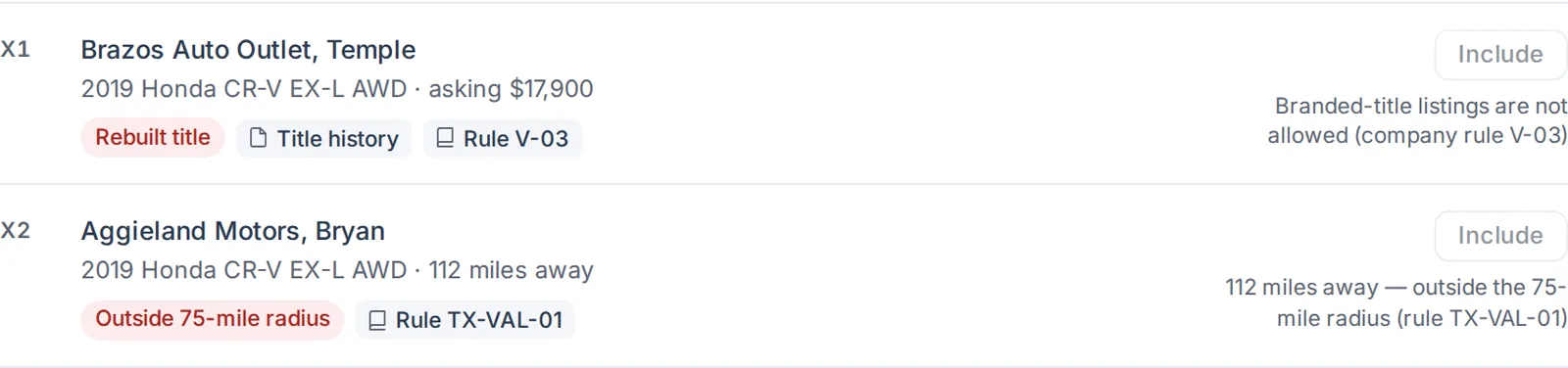
A listing left out, with the rule that excluded it
Do insurers have to pay sales tax and fees on a total loss?
Under the NAIC model and in California, Washington and Georgia, yes: the cash settlement includes the taxes and fees to transfer a comparable car. The states then differ on which fees, how much, and whether it matters that the owner never buys a replacement.
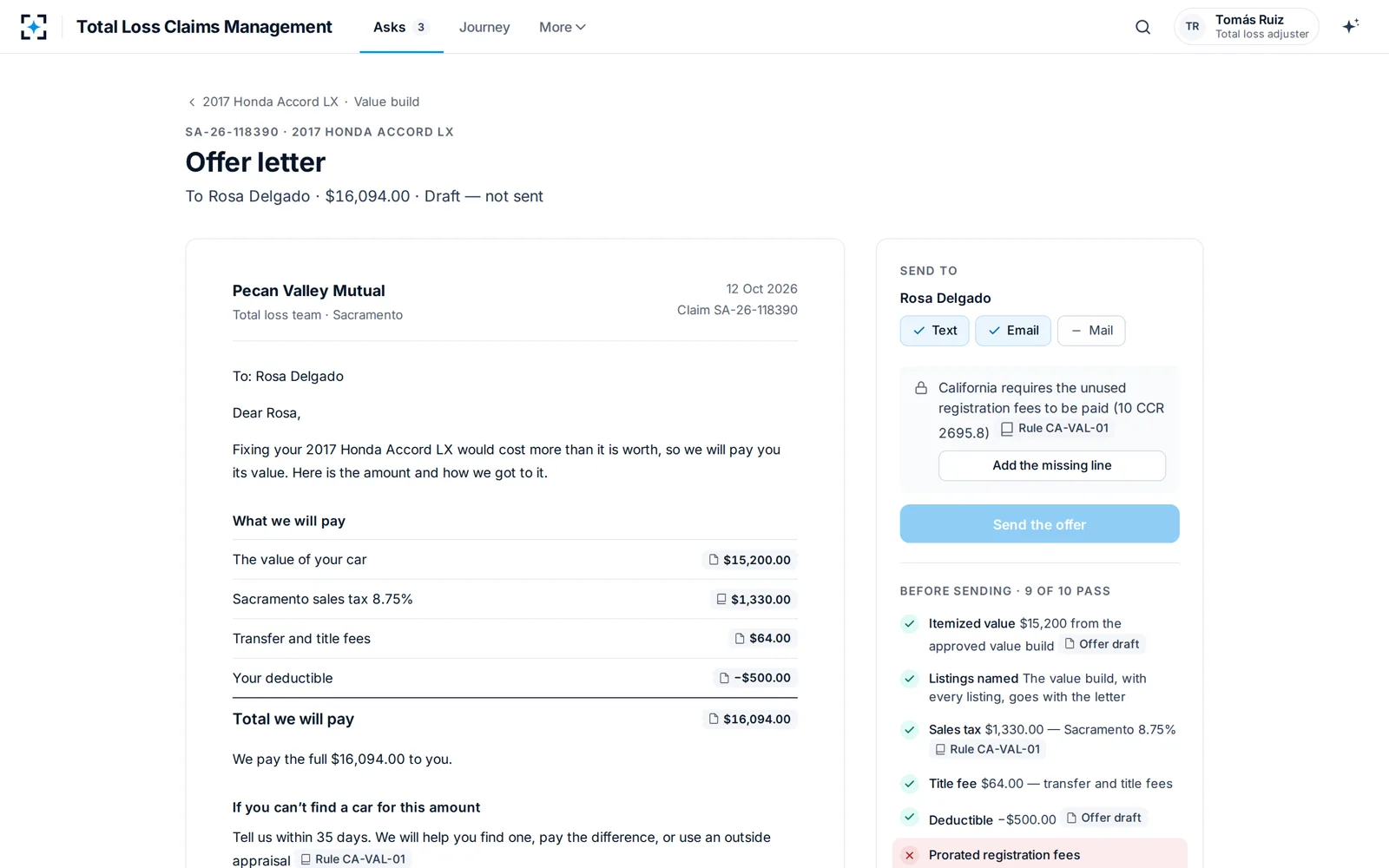
California pays taxes and one-time transfer fees and adds the license and annual fees for the unused term of the totaled car’s registration, “whether or not a replacement automobile is purchased” (§2695.8(b)(1)). If the owner keeps the car, the sales tax is reduced by the tax attributable to the salvage value. Washington pays taxes and fees “whether or not the claimant retains or subsequently transfers ownership of the loss vehicle”. Georgia caps them at what would have been paid on the totaled car.
Where the regulation sets conditions, the policy language and the state text decide the case. The Seventh Circuit, on an Illinois claim, rejected the premise that tax and fees “are always part of ‘replacement cost’ in a total-loss claim — regardless of whether the insured incurs these costs” (Sigler v. GEICO, 2020).
The reason was a documentation rule. The court read the Illinois Administrative Code as requiring “a settling auto insurer to pay these costs only if the insured actually incurs and substantiates them with appropriate documentation”; because Sigler had not, the dismissal stood (Sigler v. GEICO). Set that beside California and Washington, which owe the taxes and fees whether or not a replacement is bought, and the same line on two letters is mandatory in one state and conditional on a receipt in another. A desk that applies one habit everywhere either overpays or leaves out a line a regulation requires. The owner’s view of these lines is on the valuation page.
A California letter that cannot be sent without the registration line
How long does an insurer have to pay a total loss claim?
Under the NAIC model, 30 days after liability is affirmed and the amount is not in dispute. New York is tighter: five business days after the insured accepts the offer (216.7(b)(17)). Around those sit clocks for acknowledging, deciding, explaining delay and reopening, and each starts from a different event.
The total loss clocks in the rule texts, in days
New York also measures the desk as a whole. Unless clear justification exists, no more than 20% of a representative sample of physical damage claims chosen by Department of Financial Services examiners may take more than 30 calendar days from notice to payment, and each claim beyond that can count as a separate violation (216.7(d)(1)). That is a statistical standard, so the measure that matters is the share of files past 30 days, not the average.
The reopen window is the same 35 days in four texts, but it starts from four different events: receipt of the claim draft under the NAIC model, receipt of the payment or final offer in California, mailing of the payment in New York, and the date final payment is sent in Washington. A file that closes on the payment date can close before the window has run.
Title, salvage title and the federal total loss report
Once a car is totaled, three title duties follow: get the owner’s title, apply for a salvage title, and report the car to the National Motor Vehicle Title Information System. The first two are state law; the third is federal and monthly.
The state texts here set their own conditions. New York requires the title from an owner who keeps a car above its 75% line, and the insurer must forward it to the DMV within 10 business days. In Florida, when a car is repaired by agreement at more than its replacement cost, the owner must ask for a “Total Loss Vehicle” title brand within 72 hours, and a late-model car worth at least $7,500 with repairs at 90% or more of retail is declared unrebuildable. Florida also sets the insurer’s own clock: having paid a total loss, it must obtain the title, notify the national title system and, “within 72 hours after receiving such certificate of title”, forward it to the state (§319.30(3)(b)).
The federal rule is the same in every state. Each month, a carrier reports every car of the current or four prior model years that it took and decided was junk or salvage, whether it is a total “under the law of the applicable jurisdiction” or “designated as a total loss by the insurance company under the terms of its policies” (28 CFR §25.55). The report names the insurer, the VIN, the date of the designation, who held the car and the owner at the time of filing; a carrier may report through an approved third party instead.
When the title cannot be had at all, because an owner has moved, died or stopped answering, the insurer needs a state procedure to obtain a salvage title without it, and the procedure has its own clock. In Texas, an insurer that paid the claim but “is unable to obtain” the title may apply for one in its own name “not earlier than the 30th day after the date of payment of the claim”, with a statement that it “has provided at least two written notices attempting to obtain the certificate of title” (Tex. Transp. Code §501.0925). Florida allows the same once the liens are released or the lienholder paid, with a sworn account of the attempts made and that “all attempts are to no avail” (§319.30(3)(b)). Either way the notices have to be sent and dated early, or the 30 days have not started. The title delay case study follows one through a file.
AI in claims: the same rules apply to a model
The NAIC’s 2023 model bulletin on AI does not create a new total loss rule. It says existing ones apply whatever the method: “Actions taken by Insurers in the state must not violate the UTPA or the UCSPA, regardless of the methods the Insurer used to determine or support its actions”, and it names claim administration and payment among the uses an AI program must govern (NAIC Model Bulletin, December 2023).
As of 8 October 2026, the NAIC’s map lists 29 adopting jurisdictions, 27 states plus DC and Puerto Rico, and four states with their own AI guidance: California, Colorado, New York and Texas (NAIC adoption map). New York’s circular is limited to underwriting and pricing and “is not intended to address” other phases (DFS Circular Letter No. 7, 2024). In the NAIC’s survey of large private passenger auto writers, 50 companies used AI or machine-learning models to help set claim settlement amounts, nine for claim approvals and none for denials (NAIC, 2022). What agents may and may not do on a total loss desk is the subject of the agents page.
How to keep fifty rule sets current
Treat each state rule as a dated, sourced setting that compliance owns and a second person approves, not as logic buried in valuation code or an adjuster’s memory. A rule that carries its citation and effective date can be checked against the text, changed on the day the text changes, and shown to an examiner with the claims it touched.
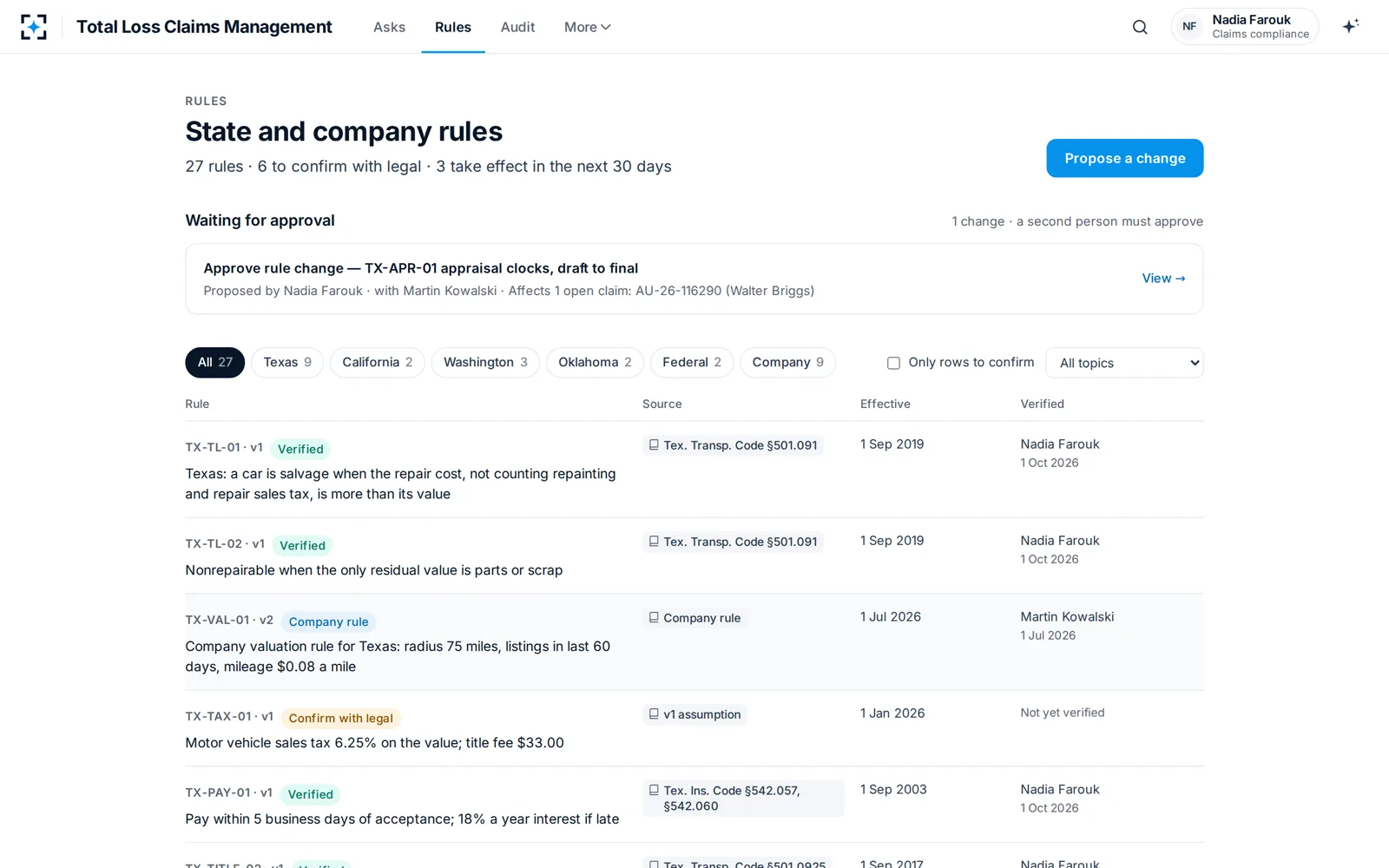
That is how Total Loss Claims Management holds them. Each state or company rule is a row with its source, its effective date, a status (verified, company rule, or confirm with legal) and the person who verified it. Compliance proposes a change and a director approves it; every claim’s history records the rule version it was decided under. Company rules, such as a carrier’s 75-mile radius for Texas, sit in the same table but are labelled as company rules, so nobody mistakes them for law. The agents cite the row they used; letters check for each required line before they can be sent; and a row still marked “confirm with legal” is shown as unconfirmed rather than applied as settled.
State rules as dated, sourced rows
Keeping state total loss rules current: a working checklist
- Store the citation and the effective date with every rule
Washington’s amended rule took effect on 18 October 2026; a rule without a date cannot tell you which files it governs.
- Separate law from company policy
A carrier’s radius or look-back can be stricter than the state’s, but it must be labelled as the company’s choice.
- Read the text, not a summary table
Published threshold lists still show Iowa at 50%; the statute moved to 70% in 2021.
- Record which rule version decided each claim
An examiner sampling New York files asks what applied on that date, not what applies today.
- Start every clock from the event its text names
The 35-day reopen runs from the offer, the draft, the mailing or the payment, depending on the state.
- Block, rather than warn, on a missing required line
Missing tax and fee lines are what the GEICO and Progressive settlements above were about.
Questions people ask
Is Texas a total loss formula state?
Some summaries say so. The statute text we read, Texas Transportation Code §501.091(15), defines a salvage motor vehicle by repair cost exceeding actual cash value, leaving out repainting and repair sales tax, and does not mention salvage value. A carrier may still weigh salvage proceeds in its own decision to total a car.
How do I find my state's total loss threshold?
Read two texts, not a table: the vehicle title statute, which sets when a car must carry a salvage brand (in Texas, Transportation Code chapter 501; in Florida, §319.30), and the insurance department's claims regulation, which sets how a total is valued and paid. Check the effective date as well as the number: Iowa's line moved from 50% to 70% for cars transferred from 1 July 2021, and many published lists still show the old figure.
Does California have a total loss threshold?
The California rule we read, 10 CCR §2695.8, governs how a total loss is valued and paid, not when a car becomes one: comparables within 90 days, taxes and fees whether or not a replacement is bought, and a 35-day reopen notice. When to total the car is left to the insurer's economics under the policy.
Can a newer model year be used as a comparable?
It depends on the state. California allows newer model years only when there are not enough comparables of the same year. Georgia’s cash method asks for the same model year. The NAIC model allows “same or newer year” for a replacement car offered in place of cash.
Does a 75% rule mean a car is totaled at 75% damage?
Not in New York, where the 75% line decides whether an owner who keeps a car eight model years old or newer must surrender the title for a “REBUILT SALVAGE” brand. Whether to total the car remains the insurer’s decision, made on its own economics.