Total loss storage fees are the daily charges a tow yard, body shop or storage facility bills while a totaled car waits, and they are the most visible part of a larger cost. The cost of total loss cycle time is the sum of what a totaled car runs up each day between the total-loss decision and the day it leaves the yard: storage at the tow yard or body shop, a rental while the owner is without a car, the hours staff spend chasing it, and any value the salvage loses before it sells. The trouble is that almost nobody sees it as it happens. The paperwork after the decision waits on the owner, the lender, the state and the auction, and the yard's statement arrives weeks later. Botminds' Total Loss Claims Management carries each car from the decision to a closed file and prices every day of storage, car by car and stage by stage. This page sets out how to put a price on a day of delay, which numbers to measure, and how to calculate the return on moving faster with your own figures instead of anyone's averages.
The volume makes it worth the effort. Between January 2020 and September 2026 the consumer price index for vehicle maintenance and repair rose 56%, against 36% for used cars and trucks (BLS data; our arithmetic). When repairs outrun the value of the cars being repaired, more crashed cars cross the line into a total loss, as why so many cars are now totaled explains. Each of those cars sits somewhere while its title is chased.
The published clocks and rate behind a waiting total loss
56%
rise in US vehicle repair prices, January 2020 to September 2026, against 36% for used cars
BLS CPI, our arithmetic
5business days
to pay a Texas claim once the insurer has accepted it, or once the claimant does what payment waits on
Tex. Ins. Code §542.057
30days
after payment before a Texas insurer that cannot get the title may ask the state for one, after two written notices
Tex. Transp. Code §501.0925
$22.85/day
the most a licensed Texas storage facility may charge for a car
TDLR, 2023 adjustment
What does a day of total loss delay cost? Four lines, each priced differently
A day of delay costs storage if the car is in a yard that bills, rental if the owner's rental is still open, handling time every time someone chases the file, and possibly salvage value. Each line runs at different stages of the claim and comes from a different system, which is why no single "cost per day" is right for every car.
No regulator or research body publishes a credible cost per day for a total loss, and a single figure would mislead even if one did. A day for a car whose owner has been paid, whose rental has ended and which sits in a free auction lot costs close to nothing; a day for a car in a body shop with the rental still running costs many times that. Average the two and you price neither.
The cost of one day, line by line, and where your number comes from
Storage
Runs from tow-in until the car leaves a yard that bills, through every stage.
rate per day × days in a billing yard
Your number: yard invoices and rate sheets.
Published: state caps on some facilities (Texas, $22.85 for a car at a licensed facility).
Rental
Runs at the front of the claim, while the owner waits to be paid, if the policy covers it.
daily rate × days the rental stays open
Your number: the rental company's bills.
Published: no credible length or daily rate for replacement rentals.
Handling
Runs whenever the file needs a call, a letter or a re-request, often most at the title stage.
touches × minutes × loaded rate
Your number: timesheets, call logs, the file history.
Published: none specific to total losses.
Salvage value
Moves at the back of the claim, with used-car prices and parts demand, while the car cannot yet be sold.
change in net proceeds by days held
Your number: your auction results, by days from decision to sale.
Published: no credible recovery-rate figure.
The stages matter as much as the lines. A rental usually runs while the owner waits to be paid, so it is mostly a cost of the first weeks; storage is the cost of the long tail after payment, while the title is chased. The law sets the pace of that tail. In Texas, an insurer that has paid but cannot get the title may apply for one in its own name only "not earlier than the 30th day after the date of payment of the claim", and only after "at least two written notices" to obtain it. Florida requires the insurer to obtain the title, report the car to the national title system and send the title to the state within 72 hours of receiving it. Unless the car moves to a lot that takes it before the title, the storage runs for as long as the paperwork does.
Salvage deserves caution. What a damaged car fetches tracks the used-car market, and that market moves both ways: the consumer price index for used cars and trucks fell 12% between January 2022 and September 2026 after rising sharply before it (our arithmetic on BLS data). The price a car fetches can rise or fall while it waits. Treat salvage as a measured line, from your own sales split by how long each car waited, not an assumed decay rate.
Who pays storage fees on a total loss? Usually the carrier, and late
Once the carrier is taking the car as salvage, the yard's bill is normally the carrier's to pay, and it usually learns the amount when the invoice arrives, weeks after the days were spent. Texas shows how much the rate itself can vary: a licensed vehicle storage facility may charge at most $22.85 a day for a car up to 25 feet, but that cap does not cover body shops, and other states set their own limits or none.
That makes two separate checks part of controlling storage: is each car in the cheapest place it can be, and is each yard charging what the rules allow? The rate the yard bills is a carrier input, read from the invoice and checked against the cap where one applies.
The exceptions are where storage disputes start. An owner who keeps the car has to agree with the carrier the day its storage stops being the carrier's. An owner who rejects the offer and leaves the car where it is may be asked about the days that run during the disagreement. And a car towed to a yard of the owner's choosing can be billed at a rate the carrier will not accept. In each case the question is the same one a regulator asks of any deduction: is the amount itemized, evidenced and appropriate, and who caused the days it covers?
The bill arrives late because nothing on most desks counts storage until the yard does. A yard invoices when the car leaves, or monthly; the claim system records a tow date and a release date and nothing between. A car that should have moved on day 25 is found on the invoice for day 40, and the 15 days in between are already spent. The fix is not a better invoice but a running count, which is the next section.
Pricing storage by stage in Total Loss Claims Management: one sample book, $720 a day
Price storage by stage and the cost of delay stops being an annual surprise. Each car is priced every morning at its yard's rate, and the totals add up to stages, then to the whole book, so a manager can see which stage is costing money today.
Take a fictional sample book: one Austin adjuster's 46 open total losses as they run through the solution on Monday 12 October. Sixteen cars sit in yards that bill, at $35 to $55 a day, and the book costs $720 a day. Storage so far at the cars' current stages is $6,410. (The sample rates are illustrative settings, and all are above the Texas licensed-facility cap; a real book starts by loading the yards' actual rates.)
Storage priced by stage, with the cost of doing nothing for a week
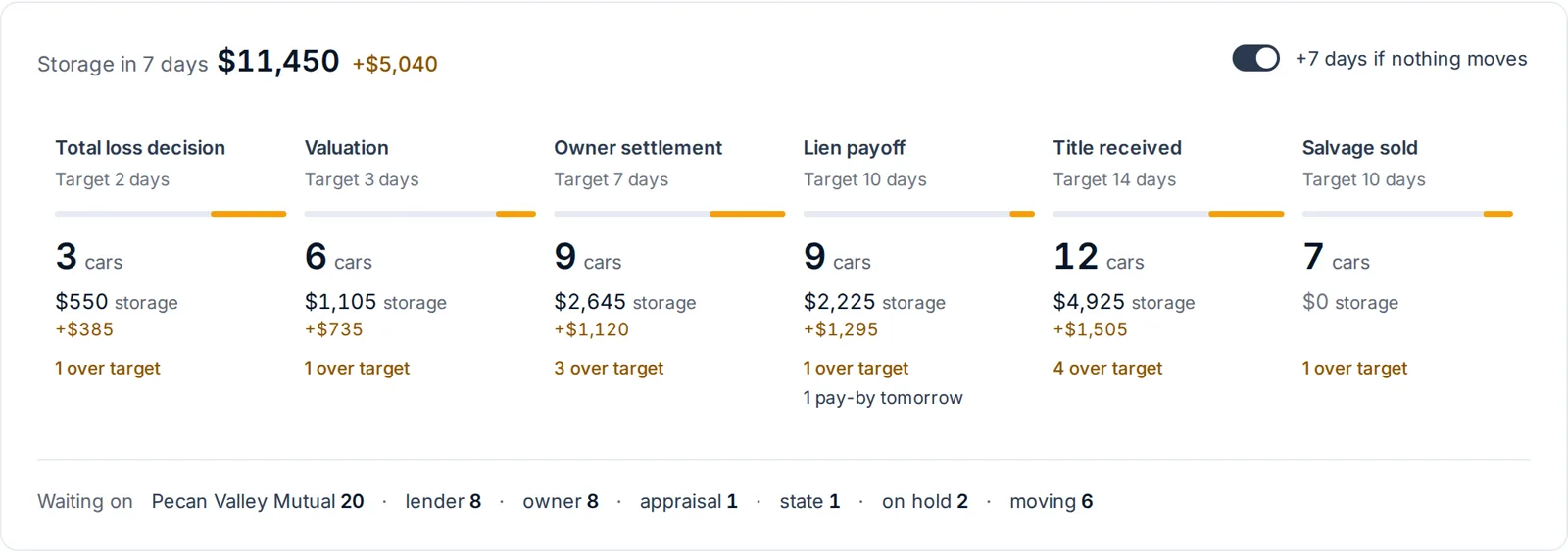
The projection turns a vague delay into a weekly figure: $5,040 if no car in this book moves.
The weekly figure divides back into a daily one for each stage, and that is where the argument for speed gets specific. A day saved at one stage is not worth the same as a day saved at another.
What one more day costs at each stage of the sample book
The pattern is general even though the numbers are not. Cars accumulate where they wait longest, and on a total loss that is usually the title: the lender's release, a title mailed to the wrong address, a co-owner who has not signed, the state. That is where the owner's clock and the carrier's clock part company: the owner is paid, and the car is still in the yard.
One car, one decision: what moving it is worth
The single largest lever on storage is where the car waits, and the decision to move it is a calculation, not a judgement call. Compare each buyer's bid net of the storage that will still run before that buyer can take the car.
In the sample book, a 2019 Honda CR-V has been at Title received for 28 days against a target of 14, at a yard charging $45 a day: $1,260 at this stage and $1,800 since it was towed in 40 days ago. The lender released the lien and mailed the title to the owner's former address. Three salvage buyers have bid.
The move, proposed with its arithmetic and its evidence
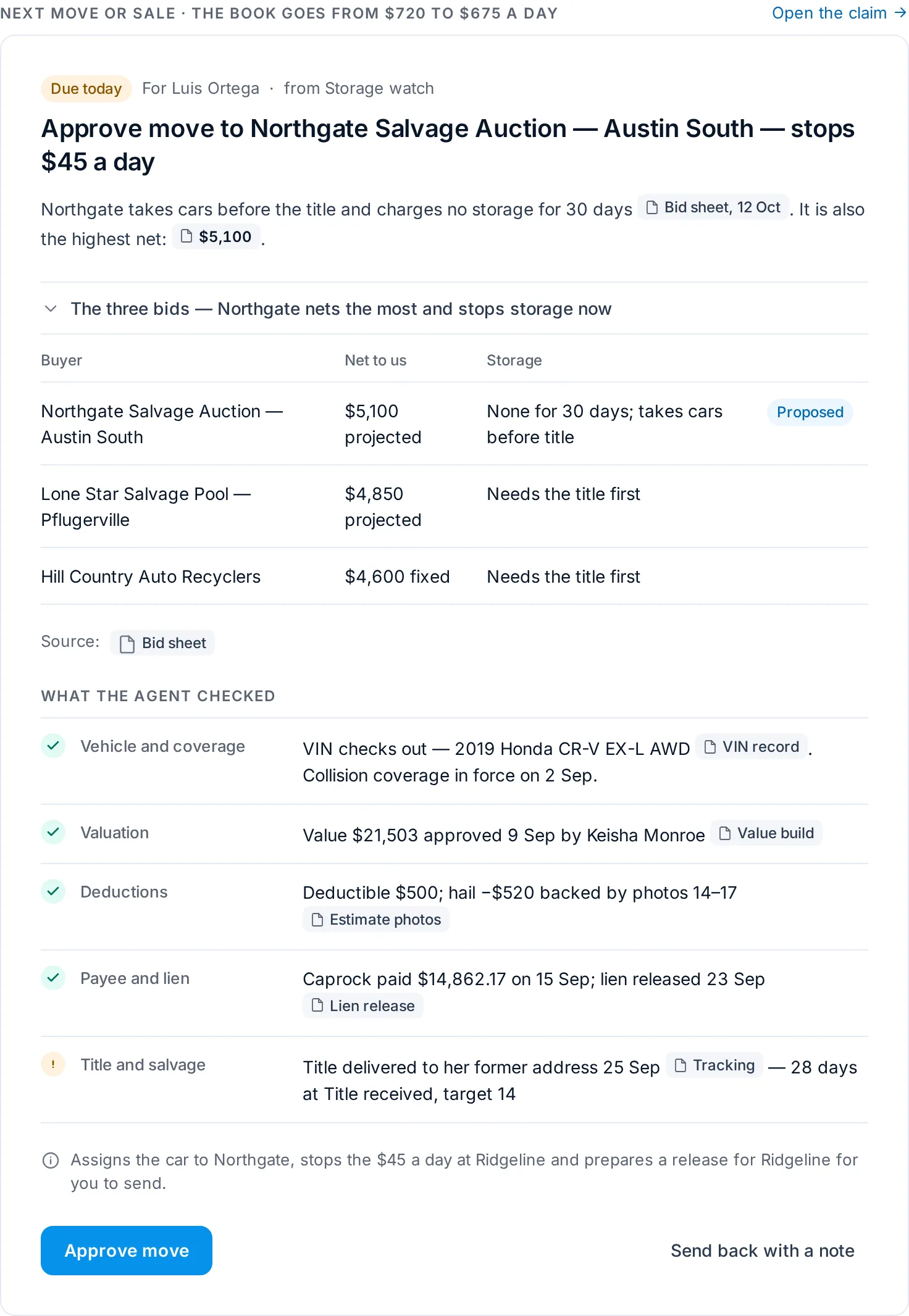
Two bids on the same car, compared the way the yard bills
Lone Star · $4,850, needs the title: $45 a day until the title is found or replaced, then until pickup.
Northgate · $5,100, takes the car now: Stops today: no storage for 30 days.
Lone Star · $4,850, needs the title: $4,850 − $630 = $4,220
Northgate · $5,100, takes the car now: $5,100
Lone Star · $4,850, needs the title: Would need to bid $45 more for every day it must wait.
Northgate · $5,100, takes the car now: Wins even at an equal bid, from the first day.
Here the highest bid and the cheapest wait point the same way, which makes the decision easy. The rule matters when they do not: a bid $200 higher that has to wait three more weeks at $45 a day loses $745 against the lower bid that takes the car today. The specialist approved the move, the meter stopped at $1,260, and the book's daily rate fell from $720 to $675. The full case study of that car follows how the address mistake was found.
The question is not "how long has this car been here?" but "what does tomorrow cost, and who can stop it today?"
Total loss KPIs: ten measures of days and dollars per file
Measure days by stage and dollars per file, from the decision to the car leaving the yard. A single "cycle time" hides the problem: the owner can be paid in weeks while the file stays open for months, and the money is spent in the second half.
There is also no credible public benchmark to compare against. The clocks that are published are legal limits, not averages. Texas gives an insurer 15 days to acknowledge a claim, 15 business days after the last item arrives to accept or reject it, and five business days after that to pay; delay past the applicable period, or 60 days, adds statutory damages. The NAIC model asks for an acknowledgment within 15 days and a decision within 21 days of proof of loss. Those say when a carrier is late, not how fast its peers are. Your own last quarter of closed files is the only baseline that will hold up.
A total loss scorecard: ten KPIs, each with its definition
- 1. Decision to offer sent
Median calendar days from the total-loss decision to the settlement letter going out.
- 2. Offer to payment
Days from the letter to the payment handed to your payment system, lender first where there is a loan.
- 3. Payment to title in hand
Days from payment to a title or its legal substitute in the file. Usually the longest stage, and the one most worth splitting by cause.
- 4. Title to car released
Days from title in hand to the car leaving the last yard that bills, by sale or move.
- 5. Billable storage days per car
Days in a yard that bills, per closed file. The unit every storage saving is counted in.
- 6. Storage dollars per closed file
Tow and storage paid, divided by files closed in the period. Split by stage of the day the cost was incurred.
- 7. Share of cars priced daily
Paying cars whose storage is known today, not reconstructed from the invoice. Below 100%, the other KPIs lag.
- 8. Payments on an expired payoff
Payoff letters paid after their good-through date, which forces a re-request and a second payment. The aim is zero.
- 9. Disputes and reissued letters per 100 files
Each one reopens a stage and restarts its clock. Count by the line disputed.
- 10. Net salvage return
Sale proceeds minus storage and tow after the decision, as a share of the vehicle’s value. Storage is netted so that a slow high bid cannot look like a win.
Two of the ten carry most of the money: billable storage days per car and payment to title in hand. KPI 7 decides whether the others can be trusted. If a car's storage is known only when the yard's statement arrives, every number built on it is weeks out of date. Valuation quality has its own measures, and the cost of a dispute is priced on its own page.
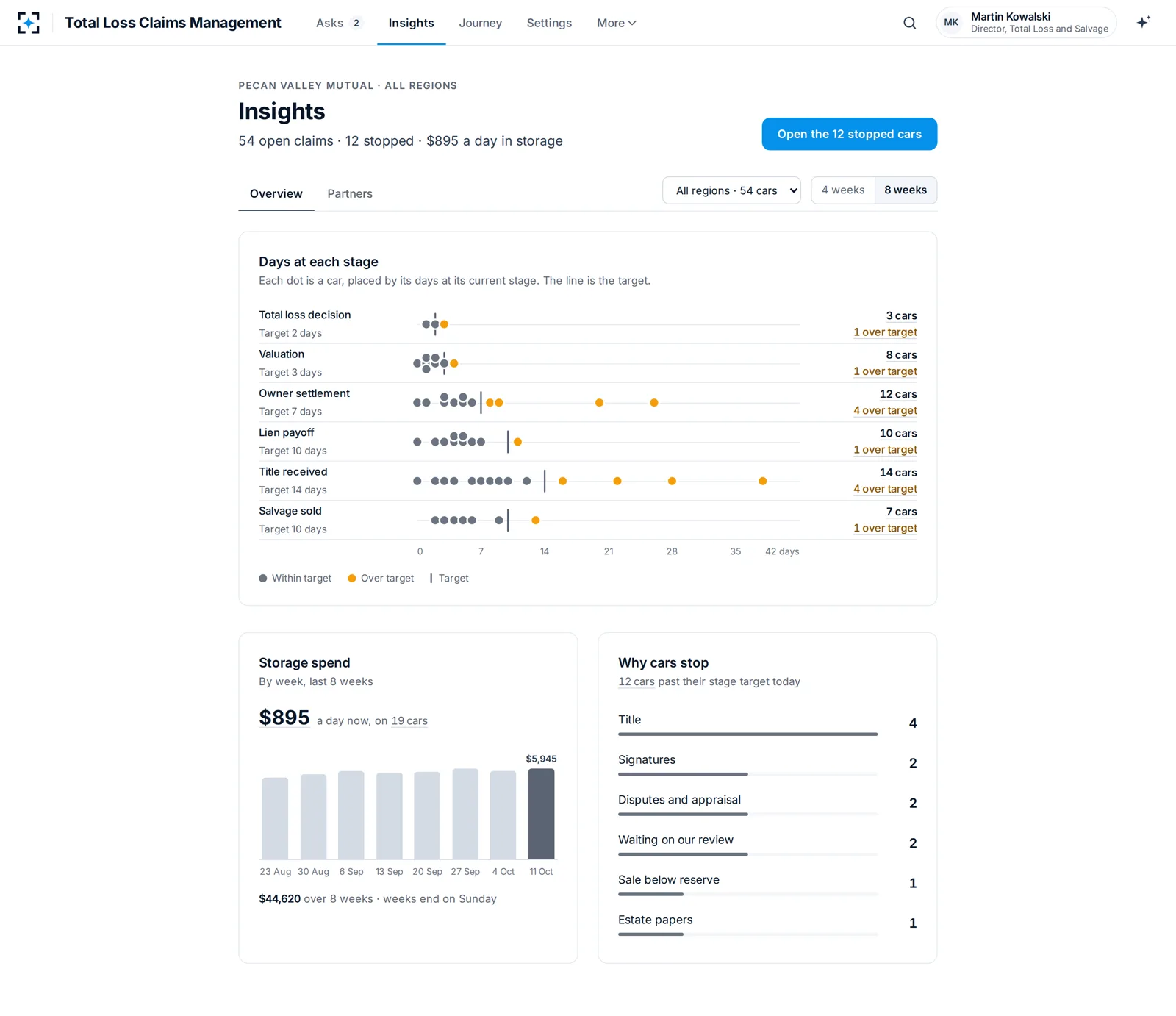
Days at each stage against target, and storage spend by week
How to calculate the ROI of total loss automation
The return is the car-days removed at each stage, priced at that stage's daily cost, plus the rework you no longer pay for, minus the cost of running the solution. Each term has an owner who should price it, and each is measured against your own baseline.
The ROI of Total Loss Claims Management, for one month of files
Car-days removed
Σ stages: (baseline days − current days) × paying cars × daily cost at that stage
Daily cost is storage plus rental where each is still open at that stage. Price title-stage days apart from offer-stage days.
Priced by: salvage and finance
Rework avoided
(events before − after) × cost per event
Expired payoffs re-requested, letters reissued, line disputes reopened: each with its hours and any second payment.
Priced by: claims operations
Handling hours
(touches before − after) × minutes × loaded rate
Calls to lenders and yards, title chasing, re-requests. Capacity, not cash, until the team takes on more files.
Priced by: finance, from timesheets
Cost to run
subscription + set-up + supervision
Including the minutes people spend approving what the agents propose, which never falls to zero.
Priced by: procurement and IT
A worked instance on the sample book shows the shape. Its five paying cars at Title received cost $215 a day. If each could move to a lot that takes cars before the title, that stage's storage would fall by up to $1,505 a week; the one move approved on 12 October took $45 a day of it. Those are figures from fictional sample data, and where a state or an auction will not take a car before the title, that lever does not exist. On a real book, the same arithmetic runs on your yards, your auctions and your rules.
Rental belongs in the first term only where it is still open. Because the rental runs while the owner waits for the offer and the payment, a day saved in valuation or settlement may also save a rental day; a day saved at the title stage, weeks after the owner was paid, usually saves only storage and handling.
What drives the return most: four inputs to test first
The largest term is days × cars × rate, so it moves in proportion to each input, and the honest way to present it is to show how it changes as each one does. Four inputs decide most of the answer.
- Which stage the days come from. In the sample book a title-stage day costs four times a decision-stage day. A tool that speeds up valuation and leaves the title queue alone saves the cheap days.
- The share of cars in billing yards. Sixteen of the sample's 46 cars pay storage. A carrier whose cars mostly go straight to an auction lot that charges nothing for the first weeks has less to save on storage and more on handling.
- The daily rate. Body shops, licensed storage facilities and police-tow yards bill differently, and caps differ by state. Use your invoice rates, not a national figure.
- The share of cars financed. Each loan adds a payoff letter, a good-through date and a lien release to wait on, which lengthens the title stage for exactly the cars that wait longest. Some loans are bigger than the car: in the CFPB's data, 11.6% of vehicle loans from 2018 to 2022 rolled in negative equity from a previous car, at an average loan-to-value of 119.3%, and a payout that does not clear the loan adds a gap to settle before the lien is released.
Run the formula at the low and high end of each input before anyone signs. If the return survives the low end of all four, it is a decision; if it needs the high end of one, that input is what the pilot must measure. A 30-day pilot on your own closed total losses sets the baseline for these KPIs before anything changes.
What not to count in a total loss ROI
Count each dollar once, and only the dollars you can trace to a changed file. Most inflated business cases break one of these rules.
An inflated case and a defensible one, line by line
Inflated: One published per-day figure, applied to every car and every day.
Defensible: Your yard and rental rates, applied only to the days and stages where each still runs.
Inflated: Storage saved, plus a higher sale price, plus “salvage decay avoided”.
Defensible: Net salvage return, with storage netted out, counted once.
Inflated: Every day saved counted as a rental day saved.
Defensible: Rental days saved only at stages where the rental is still open.
Inflated: Hours saved counted as cash.
Defensible: Hours counted as capacity, turned into money only by files taken on or overtime not paid.
Inflated: A vendor’s “X% faster”, start and end unstated.
Defensible: Median days per stage on files closed in the period, against your baseline.
Inflated: Left out.
Defensible: The approval minutes per file, which stay.
The last row is the one most often missing. In the solution no agent pays, moves a car, files with a state or writes to an owner on its own; each of those is a single request to a named person, with its evidence. That is a cost per file, small but real, and leaving it out is the easiest way to overstate a return.
Questions people ask
How much does a tow yard charge per day for a totaled car?
It depends on the state, the kind of facility and whether the tow was consented to, which is why the rate belongs in the model as each yard's invoice rate. No credible national average is published. Some states cap what licensed facilities may charge: in Texas, at most $22.85 a day for a vehicle up to 25 feet long, a cap that does not reach body shops.
How long does a total loss claim stay open?
Longer than the owner's part of it. The owner may be paid in a few weeks, but the car usually cannot be sold until the title is sorted out, and when the owner or lender does not send it, Texas makes the insurer wait at least 30 days after payment before applying for a title in its own name. The file closes after the sale, and the owner's reopen window, 35 days in states that follow the NAIC model, can run past that.
Can an insurer deduct storage fees from a total loss settlement?
Only as an itemized line it can justify, and in some states not at all as an adjustment to the value. The NAIC model requires any deduction from the settlement to be "measurable, discernible, itemized and specified as to dollar amount" and "appropriate in amount" (Model 902, §8A(3)). Washington's amended rule goes further and lists the only adjustments an insurer may make to a total loss settlement, prior damage and retained salvage among them; storage is not on the list (WAC 284-30-391(5)).
What is a reasonable daily storage fee for a totaled car?
Where a state caps licensed facilities, the cap is the yardstick: in Texas, $22.85 a day for a vehicle up to 25 feet and $39.99 above it (TDLR). Elsewhere, compare each yard with the others the desk uses. The sample book's yards bill $35 to $55 a day, all above the Texas licensed-facility cap, which is exactly the check a rate review should make before an invoice is paid.
Is there a benchmark for total loss loss-adjustment expense?
Not a credible public one for total-loss handling specifically. Build it bottom-up from your own timesheets and vendor invoices per closed file, and keep it beside storage dollars per file so that savings in one are not paid for by the other.