Total loss value is calculated as the car's actual cash value (ACV), and when an insurer declares your car a total loss that is what it owes you: what it would have cost to buy the same car, in the same condition, near you, the day before the crash. Insurers work that out from comparable vehicles, usually a handful of listings for the same year, make, model and trim, each adjusted for differences in mileage, options and drivetrain. They deduct only damage that was already on the car, add the taxes and fees your state or policy requires, subtract your deductible, and pay any loan off before you see the rest. This page walks through each line, using a fictional sample claim built in Botminds' Total Loss Claims Management, and separates what state rules require from what an insurer simply chooses.
One total loss offer, line by line
Average of 7 adjusted listingssame car, within 75 miles, listed in the last 60 days
$22,022.57
Prior hail damage, hoodappraisal photos 14–17
−$520
Actual cash valuewhat the car was worth just before the crash
$21,503
Sales tax, 6.25%to buy a similar car
+$1,343.94
Title transfer fee
+$33
Deductiblefrom the policy
−$500
Settlementthe offer
$22,379.94
Who gets paidlender first, then the owner
$14,862.17 lender
$7,517.77 owner
It matters because owners often do not accept the number. Auto total losses were one of the ten complaint topics Massachusetts' Division of Insurance heard most in 2025, with 127 complaints (Massachusetts Division of Insurance, 2025 annual report). Britain's regulator, reviewing firms that hold about 70% of its motor market, found that "some firms reported average settlement values that were lower than the available guide prices" (Financial Conduct Authority, 2024). And the arithmetic now reaches more cars: US repair prices rose 56% between January 2020 and September 2026, while used-car prices rose 36% (BLS repair price index; BLS used car index; our arithmetic). When repairs outrun values, more crashes end in a valuation rather than a repair.
Not legal advice. This is a general explanation of how valuations are built and what some state rules say. Your policy wording and your state's rules decide your claim. Your state insurance department can tell you which rules apply to you.
How do insurance companies determine actual cash value on a totaled car?
They price the car you lost by pricing cars like it that someone could buy. The template most states adapted is the NAIC's model regulation, which lets an insurer base a cash settlement on "the cost of two or more comparable automobiles in the local market area when comparable automobiles are available or were available within the last ninety (90) days" (NAIC Model Regulation 902, §8A). The same model also allows licensed dealer quotes and computerized valuation sources, provided the source covers at least 85% of makes and models for the last 15 model years.
Many insurers buy those computerized valuations from outside providers. A federal appeals court has described how one of them works: the system averages "the list prices of comparable vehicles in the area", weeds out listings far from that average, then applies "a downward adjustment" to the result (Drummond v. Progressive, 3d Cir. 2025). Whichever source is used, the result is a short chain of arithmetic, and each link in it is either set by a rule or chosen by the insurer.
In the sample claim, the agents found seven listings for the same CR-V trim near Austin, adjusted each to match the owner's car and averaged them: $22,022.57. They took off $520 for hail dents on the hood that were never repaired and that the appraiser photographed. That gave an ACV of $21,503, approved by the adjuster before any letter was written. The sections below take each line in turn.
Step 1: what counts as a comparable vehicle?
A comparable is a car of the same make and model year, with similar body style, options and mileage, offered for sale near you recently. The rules set the outer limits; inside them, the insurer chooses its own radius, time window and filters, and those choices move the number.
California requires that a comparable "must have been available for retail purchase by the general public in the local market area within ninety (90) calendar days of the final settlement offer", and that each one be identified by VIN, dealer stock number or plate, with the seller's phone number or address (10 CCR §2695.8(b)(2)). Georgia defines the local market as 50 miles from the county seat where the car was garaged, widening to 100 miles if nothing is found, and looks back 30 days (Ga. Comp. R. & Regs. 120-2-52-.06). Washington's rule, amended effective October 18, 2026, caps the search at 150 miles and widens it "in increasing circles of 25 mile increments" until two or more comparables turn up (WAC 284-30-391(2)). New York lets a vehicle count as "substantially similar" with up to 4,000 miles or 10% more mileage, whichever is greater (11 NYCRR 216.7).
What a rule fixes, and what the insurer chooses
What the rules say (examples): Washington: up to 150 miles, in 25-mile steps. Georgia: 50 miles from the county seat, then 100.
What the sample insurer chose: 75 miles from where the car was garaged. A listing 112 miles away was left out, with that reason shown.
What the rules say (examples): NAIC model and California: within 90 days. Georgia: within the last 30 days.
What the sample insurer chose: Listed in the last 60 days.
What the rules say (examples): NAIC model: two or more comparables.
What the sample insurer chose: Seven used, two left out, all nine shown to the owner.
What the rules say (examples): Not addressed in the rules quoted on this page.
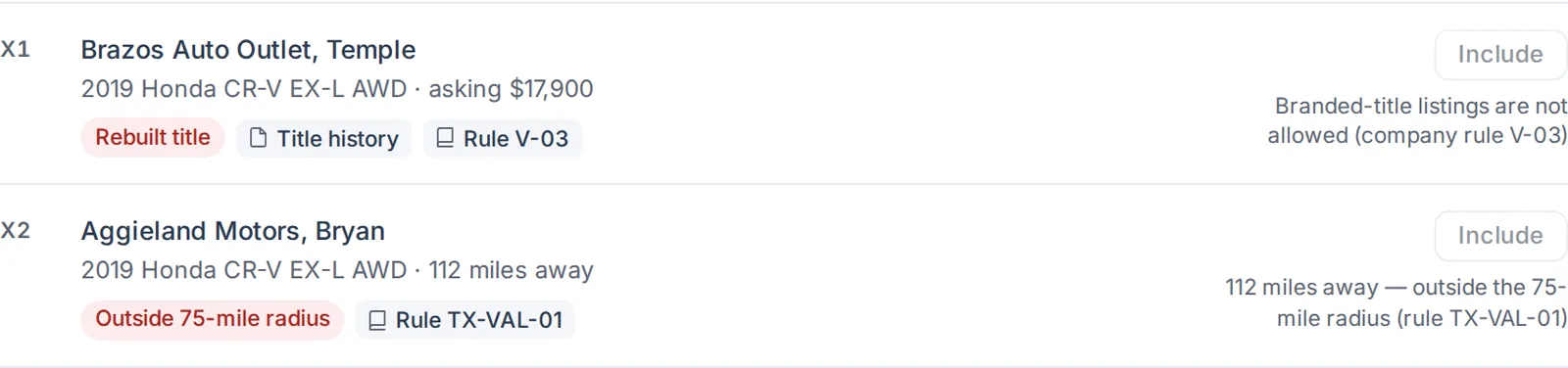
What the sample insurer chose: Never used. A rebuilt-title listing at $17,900 was left out by company rule.
What the rules say (examples): Adjust fairly and itemize (California, Washington). New York: within 4,000 miles or 10% counts as similar.
What the sample insurer chose: $0.08 a mile, the same rate for every listing.
What the rules say (examples): California: no condition deduction unless the car was documented below average. Prior damage may be deducted.
What the sample insurer chose: No general condition markdown. Only prior damage seen in the appraisal photos.
Excluding a listing is where an offer can quietly drop or rise, so an exclusion without a stated reason is the first thing to question. A rebuilt-title car sells cheaper than a clean one, which is why the sample insurer refuses it; a listing 112 miles away may be priced for a different market. Both reasons are printed beside the listing.
Every listing left out says why
Step 2: how is each comparable adjusted to match your car?
Each listing's price is moved up or down by the dollar value of every difference between it and your car: miles, trim level, drivetrain and options. The rules require those adjustments to be visible. California says any adjustment "must be discernible, measurable, itemized, and specified as well as appropriate in dollar amount and so documented in the claim file" (10 CCR §2695.8(b)(2)), and Washington requires offers "based on itemized and verifiable dollar amounts" with "appropriate deductions or additions for options, mileage or condition" (WAC 284-30-391(4)(b)).
One comparable, adjusted to the owner's car
$21,250
Asking price: 2019 CR-V EX, Lakeway Auto Plaza
+$900
Trim: EX is one level below the owner’s EX-L
−$554
Mileage: 6,930 fewer miles than the owner’s car, at $0.08 a mile
$21,596
Adjusted price that goes into the average
The other six listings in the sample work the same way. A front-wheel-drive CR-V in Georgetown gains $1,000 because the owner's is all-wheel drive. A Touring model in Bastrop, one trim above, loses $1,200. A San Marcos car with 10,710 more miles gains $857. After adjustment the seven land between $21,274 and $22,847, which is what a sound set of comparables should do: the asking prices differ by more than the adjusted ones.
Options you paid for, such as a sunroof or a tow package, should appear as credits. Washington tells insurers to "consider relevant information supplied by the claimant" when setting adjustments (WAC 284-30-391(4)(c)), so a window sticker or service record is evidence, not a complaint.
The value build the adjuster approves
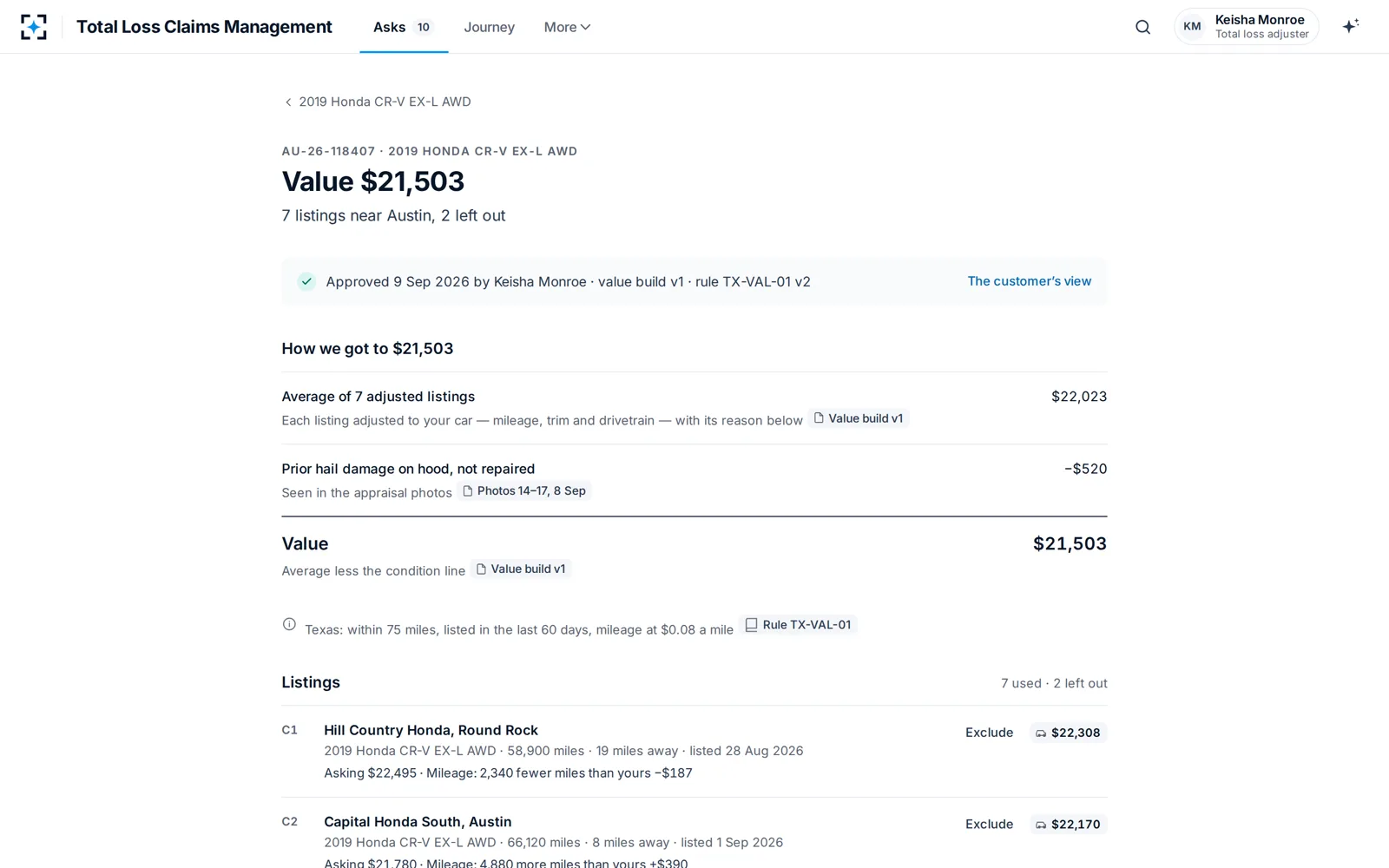
The owner's page shows the same lines in plain words, so the adjuster and the owner are reading one calculation.
Step 3: which deductions are allowed, and which are not?
Deductions for damage that was already on the car are generally allowed if they are documented and itemized. Deductions that lower every comparable by a formula, rather than for something specific about your car, are the ones regulators restrict and courts are still fighting over.
The NAIC model says deductions "must be measurable, discernible, itemized and specified as to dollar amount and shall be appropriate in amount. The basis for the settlement shall be fully explained to the first party claimant" (Model 902, §8A(3)). Washington's amended rule goes further and lists the adjustments an insurer may make, introduced with "the following methods only": a prior claim payment for unrepaired damage, other unrepaired damage "no greater than the decrease in the actual cash value due to prior damage", and salvage value if you keep the car (WAC 284-30-391(5)). California bans condition deductions "unless the documented condition of the loss vehicle is below average for that particular year, make and model" (10 CCR §2695.8(b)(2)).
Deductions: documented and itemized, or contested
Contested in court or restricted by rule: A condition markdown applied without photos or an inspection note.
Documented and itemized: Unrepaired damage the appraiser photographed, priced at what it takes off the value. In the sample, a $520 deduction for hail on the hood, photos 14–17.
Contested in court or restricted by rule: A percentage taken off listing prices on the theory that buyers negotiate. Progressive’s projected sold adjustment averaged 6.7% (Drummond, 3d Cir. 2025). The Ninth Circuit has said Washington law “explicitly prohibited the use of ‘negotiation adjustments’” (Ambrosio, 2025).
Documented and itemized: None. The sample insurer takes no negotiation-type deduction, and the setting cannot be switched on.
Contested in court or restricted by rule: The same condition grade applied to every comparable, whatever the car.
Documented and itemized: California: only if the car was documented below average for its year, make and model.
Contested in court or restricted by rule: Adjustments with no dollar figure, or different rates for different cars.
Documented and itemized: A stated rate per mile and a stated dollar figure per trim or option, on every listing.
The money in those contested lines is real. In Volino v. Progressive, New York policyholders who challenged the projected sold adjustment settled for a $48 million fund, approved in March 2025 with no objections (final approval order, S.D.N.Y.); the court found the deal recovered "69% of the total potential compensatory damages" (fee order). The Third Circuit then reversed class certification in a similar case, holding that whether each owner was underpaid is an individual question (Drummond v. Progressive, 2025), and the Ninth Circuit split over the same adjustment, its dissent noting "a conflict amongst the circuits" (Ambrosio v. Progressive, 2025). For an owner, the lesson is narrower: if a line on your report reduces every comparable by a percentage, ask what it is and what rule allows it.
How insurers can prove a value is fair file by file, and audit their own adjustments, is covered in defensible total loss valuations.
Is sales tax included in a total loss settlement?
Often, but not everywhere and not always in the same way. Some states require the insurer to pay the taxes and fees you would owe to buy a replacement; elsewhere it depends on your policy wording, and courts have read similar policies differently.
California's rule is explicit: the settlement "shall include all applicable taxes and one-time fees incident to transfer of evidence of ownership of a comparable automobile", plus the unused part of your registration fees, "whether or not a replacement automobile is purchased" (10 CCR §2695.8(b)(1)). Washington requires taxes and fees "whether or not the claimant retains or subsequently transfers ownership of the loss vehicle" (WAC 284-30-391(4)(e)). Georgia includes them but limits them to "the amount that would have been paid on the totaled, insured vehicle" (Ga. 120-2-52-.06).
Where no rule settles it, the policy and the state's own rule do, and they can point the other way. The Seventh Circuit, reading an Illinois policy, rejected the idea that tax and fees are "always part of 'replacement cost' in a total-loss claim—regardless of whether the insured incurs these costs", because the Illinois rule requires an insurer to pay them "only if the insured actually incurs and substantiates them" (Sigler v. GEICO, 7th Cir. 2020). So the same tax line can be owed outright in Washington or California, owed on proof of purchase in Illinois, and capped at the old car's amount in Georgia. An offer that leaves it out should say which of those rules it is relying on.
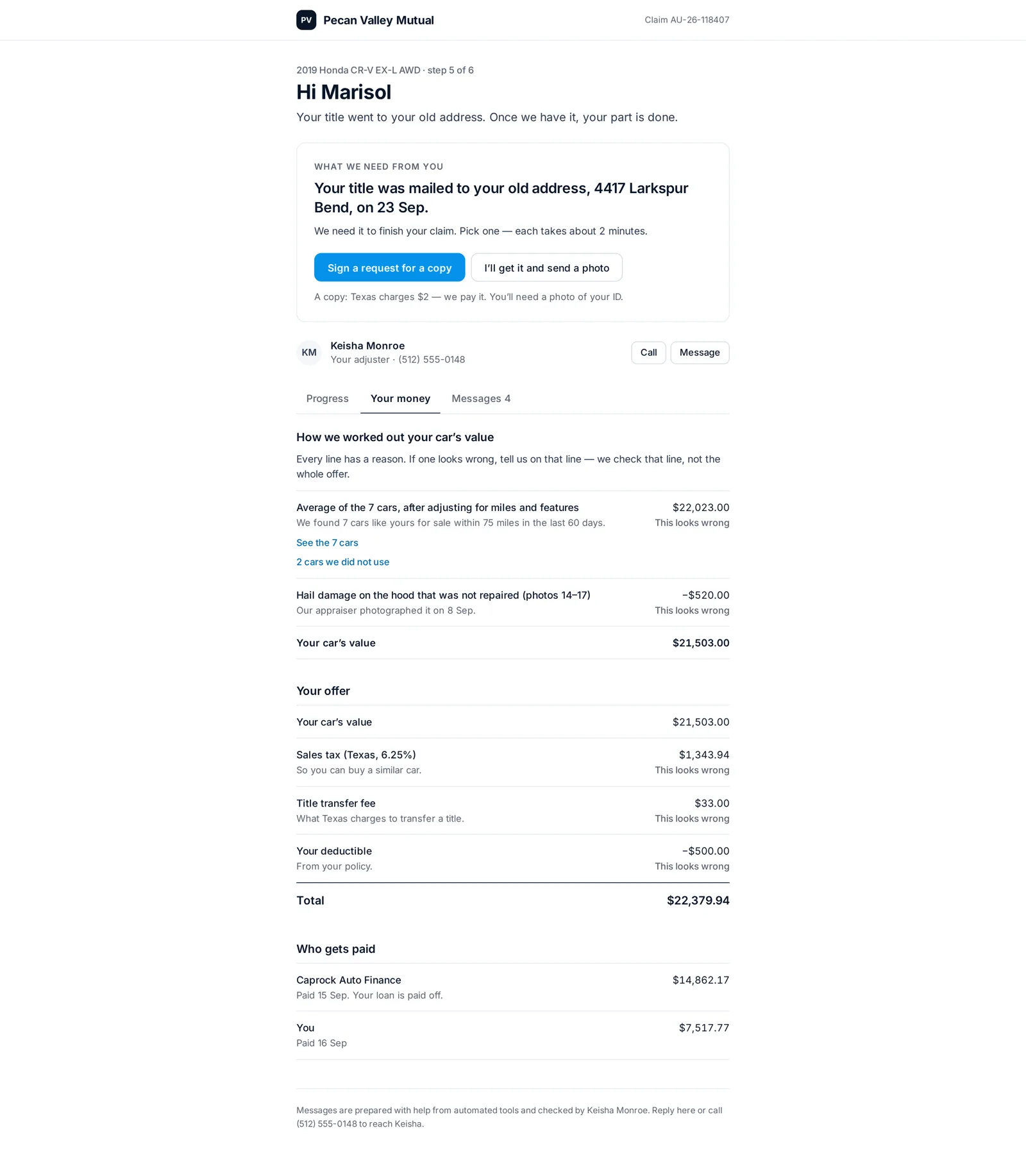
In the sample claim, the carrier adds Texas's 6.25% motor vehicle sales tax ($1,343.94) and a $33 title fee as its own policy, then subtracts the $500 deductible, for an offer of $22,379.94. The rules for every state, including registration refunds and title fees, are mapped in total loss rules by state.
The same numbers, on the owner's own page
Who gets paid first if you still owe money on the car?
The lender, or the leasing company, is paid first because it holds the title; you receive whatever is left. In the sample claim, $14,862.17 of the $22,379.94 settlement went to the lender against a payoff letter good through a set date, and $7,517.77 to the owner.
If the loan is bigger than the settlement, the difference is still yours to pay unless gap coverage or a lease's gap waiver covers it. That is not rare. In loan data the Consumer Financial Protection Bureau collected from large lenders, 11.6% of vehicle loans made between 2018 and 2022 rolled negative equity from an earlier car into the new loan, and those loans averaged a loan-to-value ratio of 119.3%; even loans with no trade-in averaged 101.6% (CFPB, 2024). A car financed above its value starts its life worth less than the loan, and a total loss settlement pays the value, not the loan.
Where the money goes when there is a loan
Financed CR-V: settlement $22,379.94
- Lender payoff, $14,862.17 · 66%
- Owner, $7,517.77 · 34%
Leased car: payoff $28,912.40
- Covered by the settlement, $24,724.25 · 86%
- Gap, $4,188.15, covered by the lease’s gap waiver · 14%
Can I keep my totaled car?
Several state rules provide for it. If you keep the car, the insurer deducts what the wreck would sell for as salvage, and the title may be branded. Rules decide how the salvage figure is set and what you must be told.
Washington lets the insurer deduct salvage value, but on request it must name a salvage buyer who will pay that amount, and the offer must stay open "for at least 30 calendar days" (WAC 284-30-391(5)(c)). California sets salvage value at what a salvage pool, licensed dealer, auction or dismantler will pay, discounts the sales tax by the tax on that salvage value, and requires the insurer to tell you in writing that keeping the car must be reported to the DMV and "may affect the loss vehicle's future resale and/or insured value" (10 CCR §2695.8(b)(1)(A)). In New York, once repairs exceed 75% of ACV and the owner keeps the car, the title goes to the insurer and comes back branded "REBUILT SALVAGE", and the insurer must withhold at least half the payment until it has the title (11 NYCRR 216.7(b)(16)).
Keeping the car changes one line
Hand the car over: $13,260.00
Keep the car: $13,260.00
Hand the car over: +$1,193.40
Keep the car: +$1,193.40 (Washington: owed whether or not you keep the car)
Hand the car over: +$85.50
Keep the car: +$85.50
Hand the car over: −$500.00
Keep the car: −$500.00
Hand the car over: None: the insurer sells the wreck
Keep the car: −$2,350.00, with a named buyer at that price for 30 days if you ask
Hand the car over: $14,038.90
Keep the car: $11,688.90, plus the car on a salvage title
Is total loss value negotiable? How to dispute one line
Yes, with evidence: the value is a calculation, so it moves when one of its inputs is shown to be wrong. Ask for the valuation report, find the one line you disagree with, and send evidence for that line. Most disputes turn on one comparable, one adjustment or one deduction, and a specific objection with a listing or a document attached is the fastest to resolve.
The rules give you tools. Washington requires the insurer to provide "a true and accurate copy of any 'valuation report'" on request (WAC 284-30-391(4)(d)). The NAIC's unfair claims practices model treats failing "to promptly provide a reasonable and accurate explanation of the basis" for an offer as an unfair practice (NAIC Model 900, §4L). If you accept and then cannot buy a comparable car for the money, the NAIC model, California, New York and Washington all keep a 35-day window to reopen the claim (Model 902, §8A(2)(e)). And if your policy has an appraisal clause, either side can invoke it: in Washington, "either the insurer or the first party claimant may invoke the appraisal provision of the policy to resolve disputes concerning the actual cash value" (WAC 284-30-391(3)). Appraisal usually means each side names an appraiser, with an umpire if they disagree; check your policy for the steps and who pays.
Before you accept, or when you push back
- Ask for the full valuation report
Every comparable, with its VIN or stock number, seller, distance, date and price.
- Check each comparable is really your car
Same year and trim, similar miles and options, clean title, within the radius.
- Check the adjustments add up
One mileage rate for all listings; a dollar figure for every trim, drivetrain or option difference.
- Question any blanket deduction
A percentage off every listing, or a condition grade with no photos, needs a stated basis.
- Check taxes, fees and registration
Whether your state or policy requires them, and that the rate is yours.
- Send listings and records for one line
Current listings within the radius, a window sticker, receipts for new tires or recent work.
- Note your deadlines
The reopen window after payment (35 days in several states) and any appraisal-clause steps in your policy.
- Ask your state insurance department
It can tell you which rules apply and how to file a complaint.
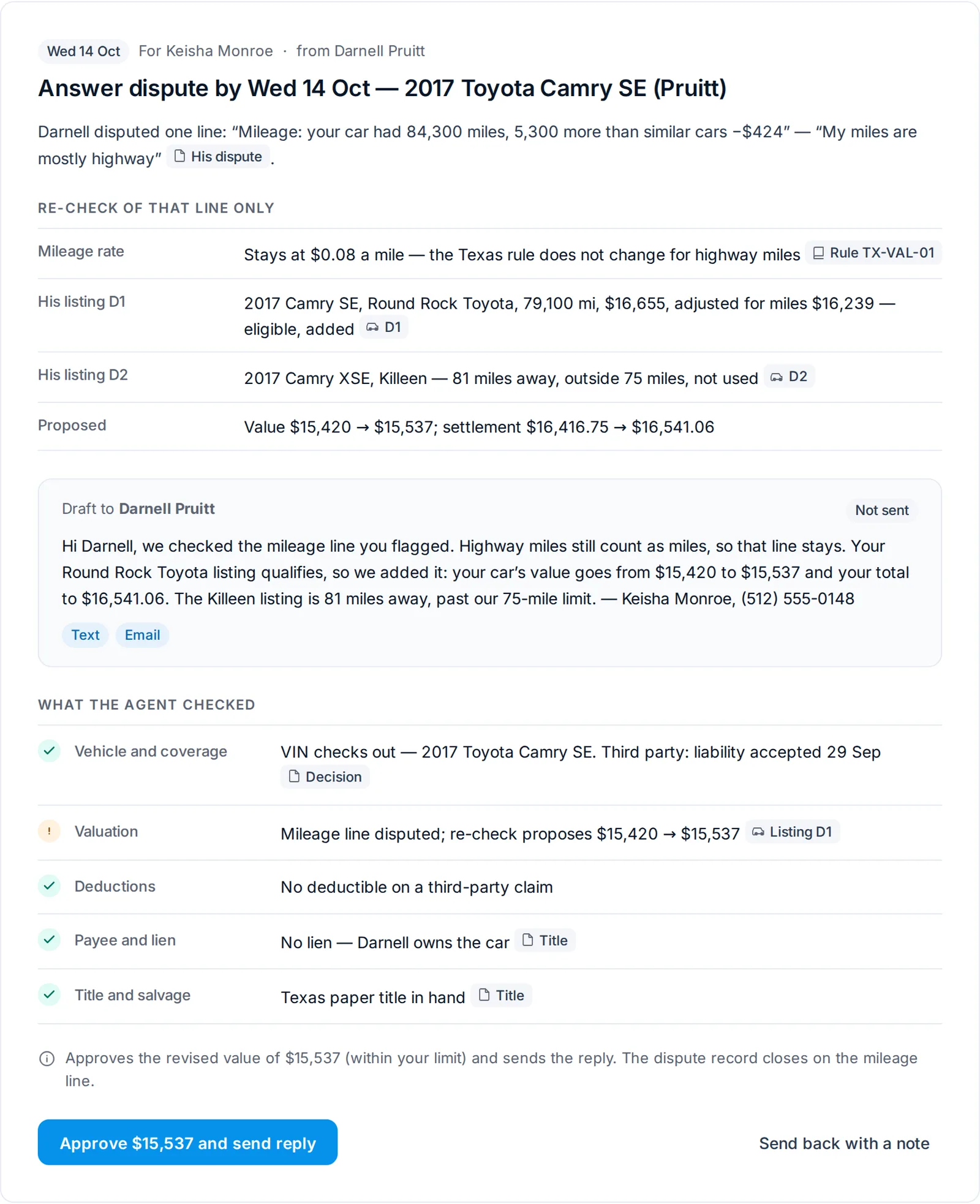
The solution is built so that a dispute stays on the line in question. On the owner's page, every line carries its own "This looks wrong" link; the adjuster re-checks that line only and answers within two business days. In a sample third-party claim on a 2017 Toyota Camry, the claimant disputed the mileage deduction and sent two listings of his own. The mileage rate stayed, one of his listings qualified and was added, and the other, 81 miles away, did not. The value moved from $15,420 to $15,537 and the settlement from $16,416.75 to $16,541.06, with the reply drafted for the adjuster to approve before anything was sent.
A dispute about one line gets an answer about that line
Showing every line to the person being paid is the design choice behind the Total Loss Claims Management solution: the agents build the value from listings that each carry their source, leave out listings only with a stated reason, write a letter the owner can follow, and check it for every required tax, fee and notice line before a person sends it. Who the owner deals with along the way, from the adjuster to the title specialist, is described in the total loss desk, seat by seat, and why so many repairable-looking cars are totaled at all in why so many cars are totaled.
Questions people ask
Why is my total loss offer lower than what dealers are asking?
Dealer asking prices are a starting point, and each is adjusted to your car's miles and trim, so a lower-mileage listing is adjusted down. Some valuation tools also cut listing prices toward expected sale prices; that kind of adjustment is restricted in some states and contested in court, so ask whether one was applied and why.
Is the deductible taken off a total loss payment?
Yes, on a claim under your own collision or comprehensive coverage. The NAIC model builds the cash settlement on the cost of a comparable car "less any deductible provided in the policy" (Model 902, §8A(2)), so it comes off after taxes and fees are added: $500 in the sample CR-V offer. A claim against the other driver's insurer carries no deductible of yours.
Can an insurer use a computer valuation report instead of dealer listings?
Yes, if the source meets a standard. The NAIC model, New York and Washington accept a computerized valuation source only if its database produces values for at least 85% of makes and models over the last 15 model years (Model 902, §8A(2)(d)). The report still has to show the comparables behind the number, and in Washington you can ask for a true copy of it.
What happens if I reject the total loss offer?
Nothing is paid until the two sides agree or a process decides it. Texas's consumer counsel lists the routes: ask how the value was set and correct any wrong option, mileage or condition, send dealer quotes, listings and receipts, ask for a claims supervisor, request appraisal under the policy, or complain to the Texas Department of Insurance (OPIC). Ask, too, who is paying the yard while you disagree, because storage keeps running on a car nobody has moved.
Does the insurer have to use sold prices or asking prices?
It depends on the state. California lets the insurer use "either the asking price or actual sale price" of a comparable (10 CCR §2695.8(b)(2)); New York recognizes approved valuation manuals and dealer quotes (11 NYCRR 216.7(c)). Whatever the source, the comparables used should be listed in the report.