The total loss valuation lawsuits are class actions claiming insurers underpaid totaled cars through the adjustments in their valuation reports. When a car is totaled, the insurer owes its actual cash value, and that number is usually built by valuation software from nearby dealer listings, then adjusted. In recent years, a run of class actions has challenged the adjustments: a "projected sold" cut to list prices, a "typical negotiation" discount, blanket condition markdowns, and sales tax and fees left out. Botminds' Total Loss Claims Management is an agentic solution that carries each totaled car from valuation to lien payoff, title and salvage, and it builds the value so that every line can be shown to the owner, a supervisor, an appraiser or an examiner. This page reads the lawsuits for what they teach a valuation team. It describes court opinions and published reports; it is not legal advice.
The short answer: the courts disagree about whether these cases can proceed as classes, and that disagreement is the useful part. Where a deduction is unlawful on its face under state law, damages can be computed for everyone by adding it back. Where it is not, several appeals courts have said underpayment must be proven owner by owner. Either way, the carrier's best defense is a file that proves its own value: comparables that can be checked, adjustments with evidence and a dollar amount, exclusions with a reason, and no markdown the state forbids.
Total loss valuation is now a litigated number
$48M
settlement fund approved in one New York class action over the projected sold adjustment
Volino v. Progressive, final approval order, 2025
3
federal appeals courts (Third, Seventh, Fourth) reversed certification of classes over that adjustment, while an Ohio appeals court upheld one
Ambrosio v. Progressive, dissent, 2025
6.7%
average cut to base market value from the projected sold adjustment, per the Third Circuit
Drummond v. Progressive, 2025
127
complaints about auto total losses to one state regulator in 2025, among its ten most common topics
Massachusetts Division of Insurance
What did the total loss valuation lawsuits decide?
They decided less about the methods than headlines suggest, and more about proof. The suits share a shape. A vendor report averages comparable listings, applies a line-item adjustment, and the plaintiffs argue that the line is categorically improper. The insurer answers that it owed actual cash value, not a particular method, and that many owners were paid at or above it anyway.
The Third Circuit accepted that answer in Drummond v. Progressive. Progressive "could have properly compensated class members while employing the PSAs", the court wrote, so whether any owner was underpaid is an individual question (Drummond opinion). An Ohio appeals court read a near-identical challenge the other way in Davenport and upheld a class. The Ninth Circuit drew the line at state law: in Jama, Washington prohibited negotiation adjustments outright, so a class could go forward; in Ambrosio, the adjustment was "not facially unlawful", so it could not. The dissent in Ambrosiolists the Third, Seventh and Fourth Circuits as having reversed certification of Progressive classes over the same adjustment, and warns of "a conflict amongst the circuits" (Ambrosio v. Progressive, 9th Cir. 2025).
Where a class survived, money followed. That is the scorecard below, in date order.
The total loss valuation lawsuits, scored
- Money paid or judgment
- Class allowed
- Insurer prevailed on this ruling
7th Cir. · 2020
Sigler v. GEICO
Taxes and fees
Dismissal affirmed
The Illinois rule requires an insurer to pay sales tax and title and tag transfer fees "only if the insured actually incurs and substantiates them", and the policy did not promise more.
9th Cir. · 2022
Lara v. First National
Condition adjustment
Denial of class certification affirmed
The insurer owed actual cash value, and a class member paid that amount or more "cannot win on the merits", so injury had to be shown person by person. "A violation of the regulation isn’t a breach."
S.D.N.Y. · 2023–2025
Volino v. Progressive
Projected sold adjustment
Classes certified, then settled
Classes certified in March 2023. A $48 million settlement fund was approved in March 2025; no class member objected and five opted out. The order is no admission of liability.
Final approval order, March 2025 · certification, as cited in Ambrosio
9th Cir. · 2024
Jama v. State Farm
Negotiation adjustment (Washington)
Class certification upheld
Washington law "explicitly prohibited" negotiation adjustments, so the class could measure its injury by adding the deduction back. The Supreme Court declined to review the case in June 2025.
3d Cir. · 2025
Drummond v. Progressive
Projected sold adjustment
Class certification reversed
Whether each member was paid less than actual cash value is "an individual issue incapable of proof on a class-wide basis".
Ohio Ct. App. · 2025
Davenport v. Progressive
Projected sold adjustment
Class certification affirmed
An Ohio appeals court affirmed a trial court’s grant of class certification in a challenge to the same adjustment, in July 2025. Progressive called it "wrongly decided".
7th Cir. · 2025
Schroeder v. Progressive
Projected sold adjustment (Indiana)
Class certification reversed
The Seventh Circuit reversed an Indiana district court’s certification, reading the Indiana policy as a duty to pay what the car would sell for between a willing buyer and seller, so each owner must show an underpayment.
4th Cir. · 2025
Freeman v. Progressive
Projected sold adjustment (South Carolina)
Class certification reversed, with a dissent
The Fourth Circuit reversed a South Carolina district court’s certification; one judge dissented.
9th Cir. · 2025
Ambrosio v. Progressive
Projected sold adjustment (Arizona)
Denial of certification affirmed, 2–1
The adjustment is "not facially unlawful", and Progressive showed at least two class members received a higher value from its report than other sources would have given, so each value is an individual question.
The wider split
Beyond these cases
The dissent in Ambrosio counts the Third, Seventh and Fourth Circuits as having reversed certification of Progressive projected-sold classes, and lists federal district courts in New York, Georgia and Tennessee that certified them or recommended it. It says courts "around the country have supported plaintiffs" on the point.
The Volino numbers are easy to misread, so read them from the court's orders. The fund is $48 million (final approval order). From it the court awarded class counsel $13,440,000 in fees, found the settlement recovered "69% of the total potential compensatory damages", and refused $10,000 service awards as "twenty-eight times the recovery of the average class member" (fee order). That puts the typical owner's recovery in the hundreds of dollars, about $360 by our arithmetic. Small per car, large per book: the same adjustment, repeated across a state's files, is what turns a few hundred dollars into a class action.
What is a projected sold adjustment? Three markdowns, and the taxes, that drew lawsuits
Each challenged line is a deduction that a claimant cannot check from the file. The projected sold adjustment cuts dealer list prices to approximate what cars actually sell for; Mitchell does not apply it to "no-haggle" or "one-price" dealers, and it averaged a 6.7% reduction in base market value in the valuations the Third Circuit reviewed (Drummond opinion). In Arizona, the Ambrosio plaintiffs alleged the report's sources had dropped cars that sold above list price as "outliers", skewing the adjustment downward. State Farm's negotiation adjustment in Washington was challenged on the same theory in Jama. In Lara, the target was a condition adjustment, and the plaintiffs argued that failing to itemize it broke Washington's rules; the court answered that "[a] violation of the regulation isn't a breach" without an injury (Ambrosio, recounting Lara and Jama).
Taxes and fees are a separate fight, and a less settled one, because the answer sits in each state's rule and each policy's wording. The Seventh Circuit held that Illinois requires a settling insurer to pay them "only if the insured actually incurs and substantiates them" (Sigler v. GEICO). Washington's amended rule settles the point for its own claims: taxes and fees "must be included in the settlement amount whether or not the claimant retains or subsequently transfers ownership" (WAC 284-30-391). The rules that differ by state are set out in the total loss rules by state.
Each challenged line, and what a defensible file shows instead
What was challenged: A downward cut to comparable list prices for assumed haggling, explained in one general sentence. Averaged 6.7% in the Mitchell valuations reviewed in Drummond.
What a defensible file shows: No cut that is not tied to this car and its market. California lets an insurer use "either the asking price or actual sale price" of an identified comparable, not a projection of it.
What was challenged: A uniform dealer-discount line (Jama). Washington law prohibited it, which is why Jama could proceed as a class.
What a defensible file shows: None. Washington’s amended rule says insurers may adjust a total loss settlement "through the following methods only", and a negotiation discount is not one of them.
What was challenged: A condition markdown applied by the valuation report (Lara). California bars a condition deduction unless the loss vehicle’s documented condition is below average.
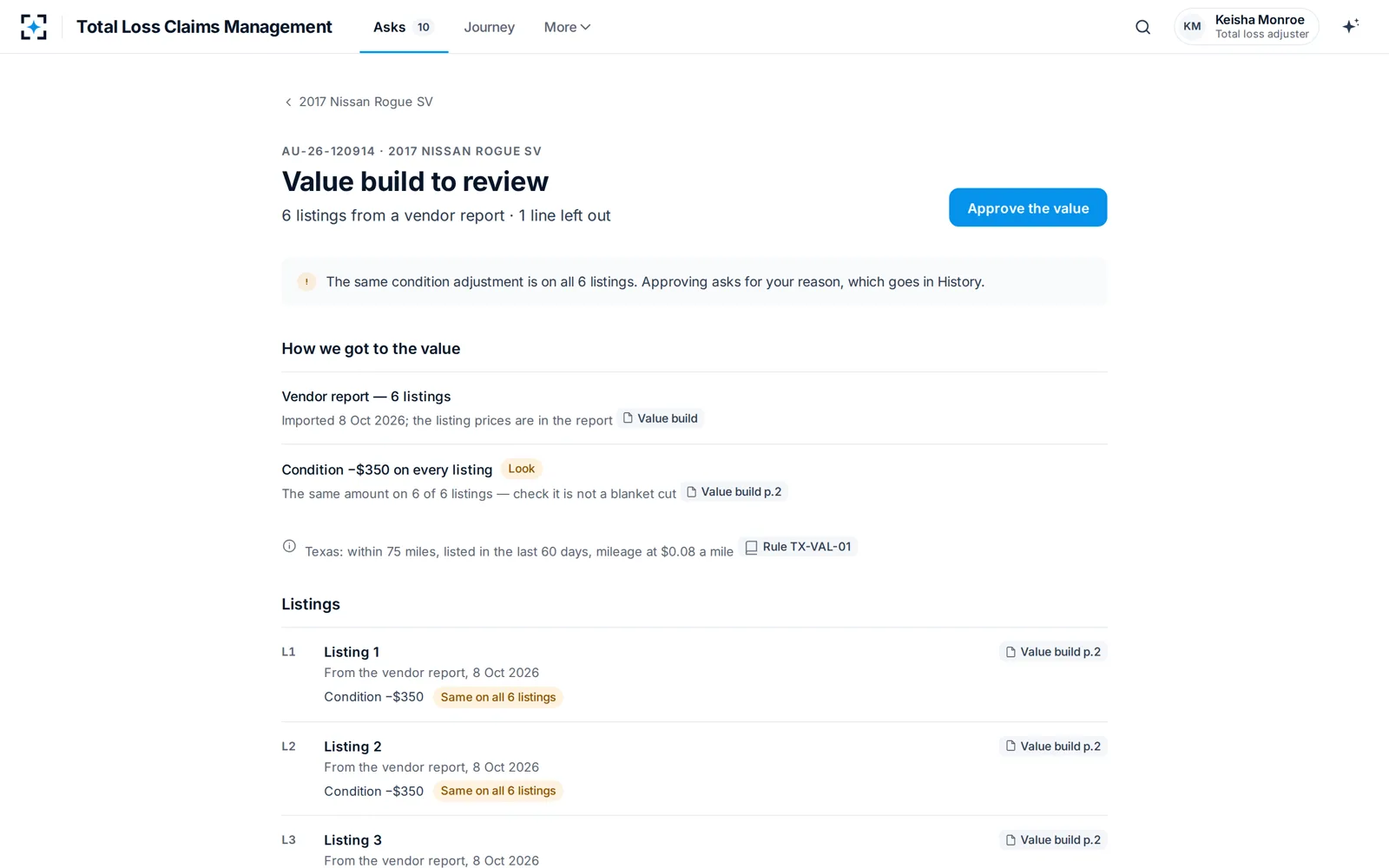
What a defensible file shows: A deduction only for damage someone saw, with the photo or inspection page and the dollar amount, and a second look when one amount appears on every listing.
What was challenged: Sales tax, title and transfer fees left out where the policy or state rule required them, or paid where it did not (Sigler turned on the Illinois rule).
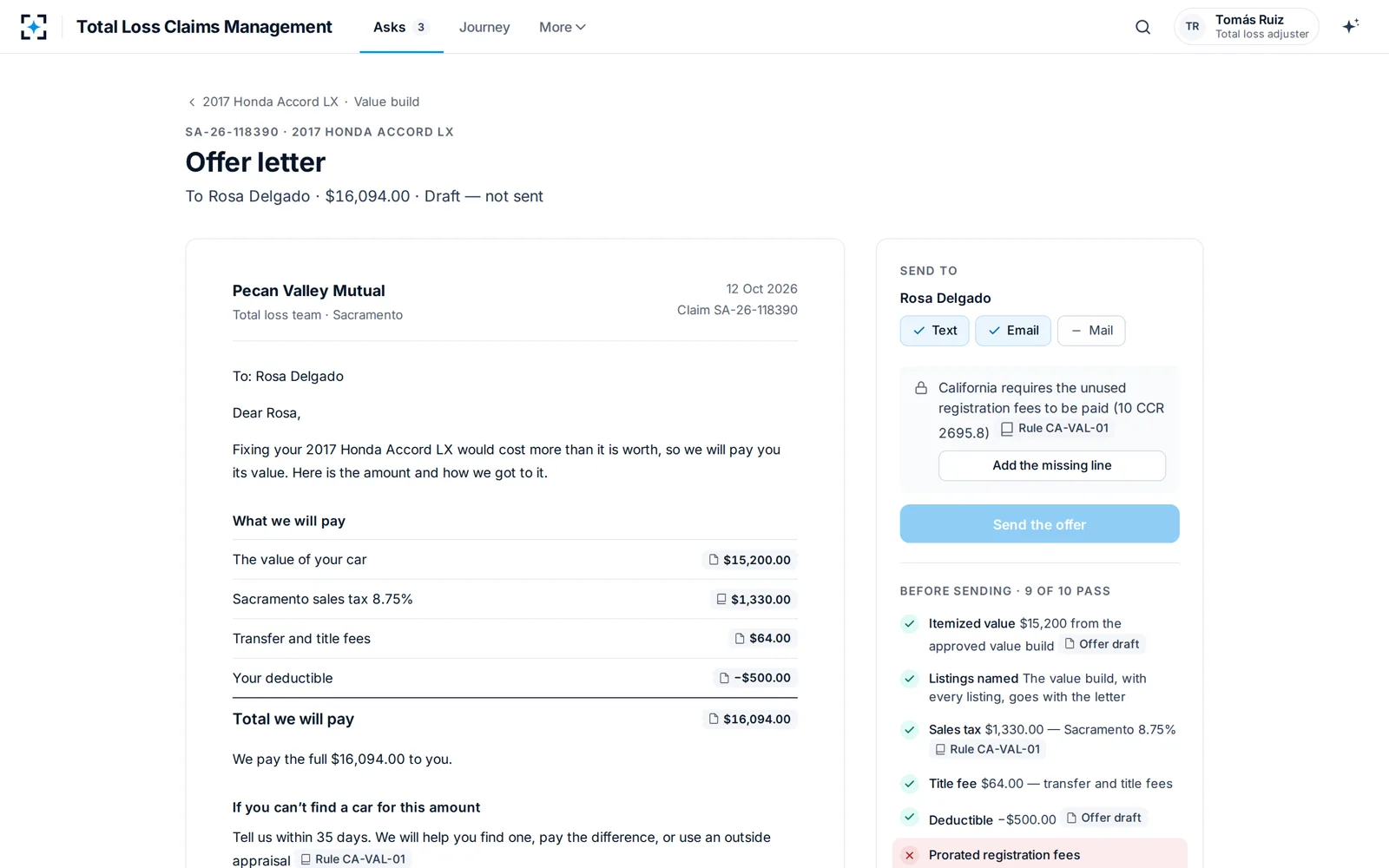
What a defensible file shows: Each tax and fee line computed under the policy and the state rule, with the rule named, including prorated registration where the state requires it.
What was challenged: Comparables "weeded out" for deviating from the average, as the Third Circuit described the method; Ambrosio plaintiffs alleged cars sold above list were dropped as outliers.
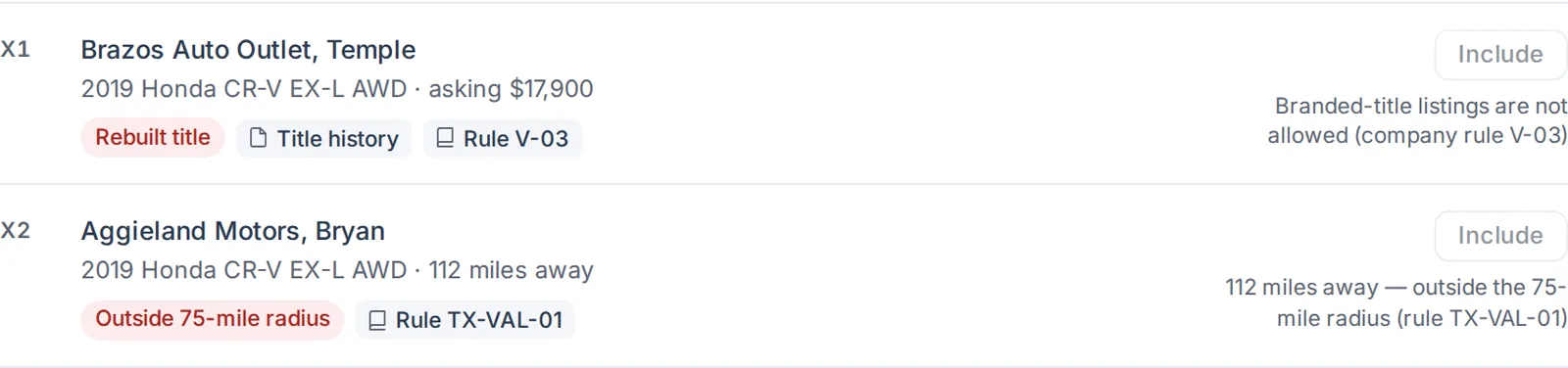
What a defensible file shows: Every excluded listing shown with its reason: a branded title, outside the radius, outside the date window.
What was challenged: An average the owner cannot reproduce.
What a defensible file shows: Each comparable identified by VIN, dealer stock number or plate, with the seller, distance and listing date, as California requires.
A uniform condition markdown, caught before approval
Why courts now ask about each file, not the method
Because the appeals courts that denied classes did so on proof, not on approval of the method. In Drummond the Third Circuit said it did "not know whether each insured whose Mitchell value was reduced by a PSA received an 'actual payout [that] was more, less, or equal to what [Progressive] could lawfully have paid'" (Drummond opinion). Defeating a class moves the fight; it does not end it. An owner can still dispute a value alone, invoke the policy's appraisal clause, or reopen the claim within the 35 days that California and Washington allow.
Regulators read the same files. The NAIC model act treats unfair claim practices as violations when committed often enough to amount to a general business practice (how the model act works), and lists "failing … to promptly provide a reasonable and accurate explanation of the basis" for an offer among them (NAIC Model 900). A markdown that software applies to every file is, by construction, a practice repeated on every file. The regulation most states adapted puts the standard in one sentence:
Any deductions from the cost, including deduction for salvage, must be measurable, discernible, itemized and specified as to dollar amount and shall be appropriate in amount.
NAIC Model Regulation 902, §8A(3)
The newer rules go further. California requires each comparable to be identified and says "deductions taken from the cost of a comparable automobile that cannot be supported shall not be used" (10 CCR §2695.8). Washington, from October 18, 2026, lists the only adjustments allowed, caps the search at 150 miles, and requires a computerized source to list the comparables it used (WAC 284-30-391). Britain's motor regulator reached the same standard from the other side. Reviewing firms that hold about 70% of its market, it found some made low first offers expecting to raise them only if the customer pushed back, with no new information: "We therefore consider this can be unfair." It also wants condition deductions evidenced for the specific vehicle, not applied as blanket amounts or percentages (Financial Conduct Authority, 2024). And where software or AI builds the number, the NAIC's AI bulletin, adopted in 29 jurisdictions as of October 8, 2026, says the claim-settlement standards apply "regardless of the methods the Insurer used" (NAIC bulletin; adoption map).
How do you audit total loss valuations? Eight measures
Audit each valuation line by line, and turn the lines into rates. Cycle time and severity are the usual claims measures; valuation quality is harder to count because its evidence sits inside vendor reports. The eight measures below can be counted on any sample of closed files, by a valuation QA analyst or by software, and each one maps to a line the lawsuits or the regulations care about.
The defensible-valuation scorecard
100%
comparables identified by VIN, stock number or plate, with seller, distance and date
100%
adjustments that cite their evidence (listing, photo or rule) and state a dollar amount
100%
excluded listings shown with a reason
0
branded-title comparables (rebuilt, salvage, flood)
0
negotiation-type deductions, under any name
100%
uniform adjustments (same amount on every listing) reviewed, with a written reason
0
letters that differ from the approved value, or miss a required tax, fee or notice line
By line
disputes counted by the line disputed, with the re-check result and its turnaround
Three of these deserve a note. The negotiation measure must count the line by what it does, not what it is called: deductions with the same purpose have been called "projected sold" and "typical negotiation". The uniform-adjustment measure is a proxy for the blanket markdown, a single line that can be challenged for a whole class at once. And the dispute measure is the one that tells you which line to fix next: a value that draws disputes on the mileage line has a different problem from one that draws them on condition. Owners' side of the same number is set out in how a total loss value is calculated.
What must a total loss settlement letter include?
It must state the value and how it was reached, every addition and deduction in dollars, and the notices the state requires, starting with the right to reopen. California requires the comparable cost to be "fully itemized and explained in writing for the claimant at the time the settlement offer is made" and a notice of the 35-day reopen right (10 CCR §2695.8). Washington requires any addition or deduction to be "itemized showing specific dollar amounts" (WAC 284-30-391). New York sets its own valuation methods and a 25-mile, three-day rule for a dealer quote (11 NYCRR 216.7). A letter that passes these checks before it is sent is a letter that can be defended later.
Twelve checks before a total loss offer letter is sent
- The value matches the approved build
Same number, same version, approved by a named person within their dollar limit.
- Every comparable is named
VIN, stock number or plate, seller and listing date travel with the letter.
- Every adjustment is in dollars
Mileage, trim, options and condition, each with its amount and its evidence.
- No unsupported deduction
No line that cannot be supported for this car, which rules out a blanket negotiation or projected-sale cut.
- Exclusions are explained
Branded titles, distance and age, each with its reason.
- Sales tax as the policy and state require
With the rate and the rule that applies to this owner.
- Title, transfer and registration fees
Including prorated unused registration where the state requires it, as California does.
- The deductible, once
Shown as its own line, not folded into the value.
- Who is paid what
Lender payoff first, then the owner, adding up to the total.
- The reopen notice
The 35-day right where California, Washington or the NAIC model applies.
- The appraisal right
Where the policy has an appraisal clause or the state requires the notice.
- The current address and a named contact
Sent to where the owner lives now, with one person to call.
A California offer letter that cannot be sent with a line missing
How Total Loss Claims Management builds a value that can be defended
The solution's agents assemble the value; people approve and send it. Arithmetic, eligibility filters and rule lookups run as fixed code, not as model output, so the same inputs give the same value. The valuation agent never uses a branded-title listing, and the negotiation deduction is fixed at never: it is not a setting a carrier can change. The agents themselves are covered in what each agent does and may not do.
In Total Loss Claims Management, where each line of the value comes from
Agent
Read and find listingsDecodes the VIN build, reads the appraisal and photos, and finds same-year listings inside the carrier’s radius and date window. Listings left out keep their reason.
Never: uses a branded-title listing
Agent
Adjust with evidenceMileage, trim, drivetrain and documented condition, each line citing its listing, photo or rule.
Never: takes a negotiation-type deduction
A person decides
Approve the valueThe adjuster approves within her dollar limit, or leaves a listing out with a reason and the value recomputes. Larger values go to the supervisor.
Agent
Draft and check the letterWrites the offer in plain words and runs the pre-send checks for the state.
Never: sends anything without a person
A person decides
Send, and re-check one lineThe adjuster sends. If the owner disputes a line, that line alone is re-checked and the answer drafted for approval.
Take a sample claim from the solution's fictional book, a 2019 Honda CR-V EX-L AWD in Austin, to see what the file holds. Seven comparable listings average $22,023 after adjustment, each with its dealer, mileage, distance and listing date, and each mileage difference priced at the carrier's $0.08 a mile. One deduction follows: $520 for unrepaired hail damage on the hood, cited to appraisal photos 14 to 17. The value is $21,503, approved by the adjuster with the rule version recorded beside her name.
The value build: every line has a source
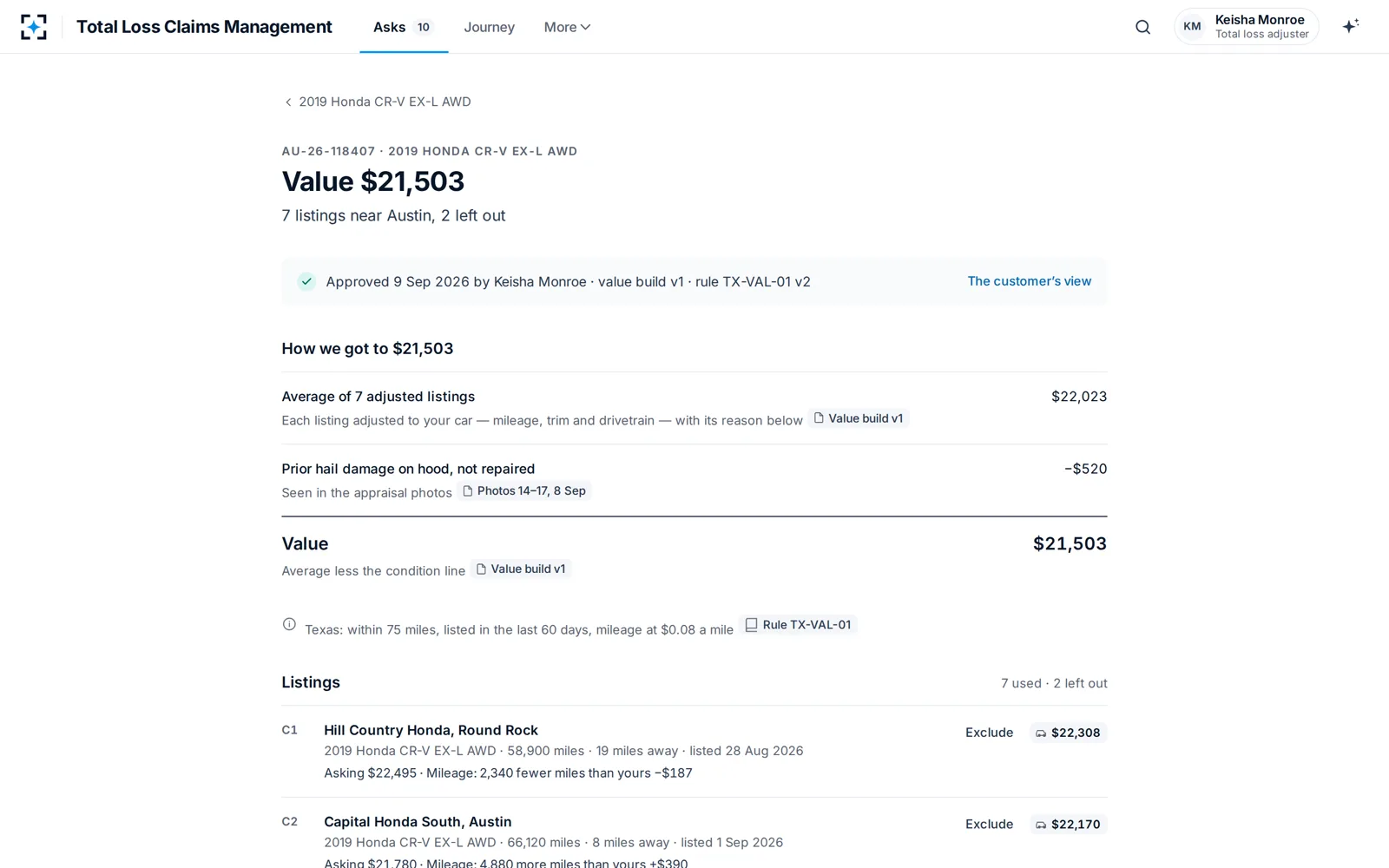
Two listings were left out, and the file says why. If the adjuster unticks another listing, she must give a reason, and the value recomputes from the remaining six to $21,485, showing what it was before. A third-party claimant in the same sample book disputed his mileage line and sent two listings of his own; one was eligible, and the line-only re-check moved his value from $15,420 to $15,537. Those are the files a court, an appraiser or an examiner can read without calling anyone.
Listings left out, each with its reason
Testing a valuation process on your own closed files
The fastest way to know where a valuation process stands is to score it before anyone changes it. Draw a sample of closed total losses across your states, including some that were disputed or went to appraisal, and run the eight measures on the files as they were paid. Then rebuild the same claims with an evidence-first method and compare the lines, not only the totals: which deductions had no evidence, which exclusions had no reason, which letters missed a line. The disputed files show whether the rebuilt value would have answered the dispute.
Be clear about what such a test proves. In the current version of the solution, the connections to listing, VIN-decode and other outside services are simulated, so a pilot connects your own sources first. The plan for that is in a 30-day pilot on your own closed total losses, and the solution itself is described on the Total Loss Claims Management page.
Questions people ask
Is the projected sold adjustment illegal?
None of the decisions above held it unlawful in itself. Courts have split on whether challenges to it can proceed as classes, the New York case settled for a $48 million fund under an order that is no admission of liability, and the Ninth Circuit tied the answer to whether state law forbids the deduction on its face, as Washington's does for negotiation adjustments.
Can a carrier deduct for the condition of a totaled car?
Under the NAIC model, deductions must be measurable, itemized and appropriate in amount. California allows a condition deduction only when the loss vehicle's documented condition is below average, and still allows deductions for prior or unrelated damage. Washington's amended rule permits deductions for unrepaired prior damage no greater than the loss in value it causes.
Am I part of a total loss class action?
Only if your claim falls inside a class a court has certified or a settlement defines, which turns on the insurer, the state, the claim dates and the adjustment challenged. Members are sent notice and can opt out; in the New York projected sold case, five did and no member objected (final approval order). Where certification was refused, as in the Third Circuit, there is no class to join, and an owner's route is an individual dispute or the policy's appraisal clause.
Should a carrier re-review total loss valuations it has already paid?
It should at least measure them. The NAIC model act reaches practices repeated often enough to be a general business practice (Model 900, §3), so the useful look-back counts lines across files: identical adjustments on every listing, deductions without evidence, letters missing a tax or notice line. Washington's amended rule applies from October 18, 2026, so files settled before it and after it should be scored against the rule in force on the day.
Do I have to pay sales tax if the owner does not buy a replacement?
It depends on the state and the policy. California and Washington require taxes and fees whether or not a replacement is bought; the Seventh Circuit found that Illinois law and GEICO's policy did not require them when none were incurred. Check the rule for each state before the letter goes out.