The Unfair Claims Settlement Practices Act is a model law the NAIC adopted in 1990. It lists fourteen claims practices, from misrepresenting policy provisions to failing to acknowledge a claimant's letters promptly, and lets a state insurance commissioner sanction an insurer that commits them flagrantly or often enough to amount to a general business practice. It is a template, not a law. Each state enacts its own version, and many add a regulation, often modeled on the NAIC's Model 902, that turns the act's duties into day counts. For anyone auditing claims, the first question on every file is therefore which state's text governs this claim, and it is not always the obvious one. Botminds' Claims Compliance Audit tests every closed claim against the rule set of the state that governs it, so that question is answered and recorded before a single date is tested.
The rules are quoted from the NAIC models and the states' own codes, linked where they appear. Examples from the solution use a fictional sample insurer and are sample data.
The NAIC's claims models in four numbers
14practices
listed as unfair claims practices in the model act, Section 4
1990
the year the NAIC split claims out of its Unfair Trade Practices Act
23jurisdictions
shown as adopting the model claims regulation on the NAIC’s 2023 chart
$1,000per violation
the model penalty, capped at $100,000 unless flagrant
What is the unfair claims settlement practices act?
The unfair claims settlement practices act is the NAIC's Model 900, a model statute that sets "standards for the investigation and disposition of claims arising under policies or certificates of insurance issued to residents of [insert state]" (Model 900 §1). The bracket is the point: every state fills in its own name and its own text. The model excludes workers' compensation, fidelity, suretyship and boiler and machinery insurance, and it says plainly that it creates no private lawsuit: "Nothing herein shall be construed to create or imply a private cause of action for violation of this Act."
The model makes a practice unlawful in two ways. It is improper if committed "flagrantly and in conscious disregard" of the act, or if it "has been committed with such frequency to indicate a general business practice to engage in that type of conduct" (§3). The commissioner may then order the insurer to stop and impose a penalty of up to $1,000 a violation and $100,000 in all, rising to $25,000 a violation and $250,000 in all where the conduct was flagrant, or suspend or revoke the insurer's license if it knew or should have known it was breaking the act (§6).
The model has a history worth knowing. The NAIC's prefatory note records that "By adopting this model act in June 1990, the NAIC separated issues regarding unfair claims settlement practices into a free-standing act apart from the NAIC Model Unfair Trade Practices Act." It did not ask states to repeal their older laws, so some states still keep claims practices inside a general unfair trade practices statute, as Florida does.
What are unfair claims settlement practices? The fourteen acts
Unfair claims settlement practices are the specific acts listed in Section 4 of the model, and they fall into three groups: being slow, being unfair on the merits, and being unclear. The table pairs each with what a claims audit can actually test in a closed file. Several can be tested only on patterns across files, not on one file alone.
The fourteen unfair claims practices in NAIC Model 900, and what a file audit can test
| Model 900 §4 | The practice, in short | What a closed-file audit can test |
|---|---|---|
| A | Knowingly misrepresenting facts or policy provisions to claimants | Letters and notes against the policy wording |
| B | Not acknowledging pertinent communications with reasonable promptness | Acknowledgment and reply dates against the state clock |
| C | No reasonable standards for prompt investigation and settlement | The claims manual itself, and whether files follow it |
| D | Not trying in good faith to settle when liability is reasonably clear | Time from clear liability to offer; pattern only |
| E | Forcing suits by offering substantially less than later recovered | Litigated files: offer against outcome; pattern only |
| F | Refusing to pay without a reasonable investigation | Investigation steps before a denial |
| G | Not affirming or denying coverage within a reasonable time after investigating | Decision date against the end of the investigation |
| H | Settling for less than advertising led the insured to expect | Marketing material against the settlement; rarely testable in a claim file |
| I | Settling on an application altered without the insured’s knowledge | Application in the file against the one signed |
| J | Paying without saying which coverage each payment is under | Payment records and letters |
| K | Delaying by demanding a proof of loss and then duplicate verification | Requests for information after proof of loss |
| L | No prompt, reasonable explanation of a denial or compromise offer | The denial letter: reason, provision and timing |
| M | Not providing claim forms within 15 calendar days of a request | Date of request and date forms were sent |
| N | No reasonable standards for repairs by insurer-owned or required repairers | Repair-shop program standards; pattern only |
The NAIC unfair property casualty claims settlement practices model regulation
The NAIC's Unfair Property/Casualty Claims Settlement Practices Model Regulation, Model 902, turns the act's general duties into deadlines. Every insurer must acknowledge a claim within 15 days, answer the insurance department within 21 days, reply to other claimant communications within 15 days, and tell a first-party claimant within 21 days of proofs of loss whether the claim is accepted or denied. If it needs more time, it must say why within those 21 days and then write every 45 days. It must pay within 30 days once liability is affirmed and the amount is not in dispute (Model 902 §§6–7).
Two details matter in an audit. The model defines "Days" as calendar days (§3D), and it reaches both first- and third-party claimants. And it puts a notice duty on a rejection: if the claimant objects, the insurer must tell the claimant in writing that the state's insurance department can review the matter (§7H).
Adoption is uneven. The NAIC's own state chart, last updated in fall 2023, lists 23 jurisdictions in its Model Adoption column, 12 with related activity only, including California, Texas, Illinois and Georgia, and 21 with no current activity on the model (NAIC state page). The chart warns that states may not share the NAIC's reading of their laws (how to read the state adoption charts), and it tracks only this regulation, not every claims rule a state has. New York's Regulation 64 sits in the adoption column even though it counts business days where the model counts calendar days.
Which state's unfair claims act applies to a claim?
The governing state is usually the state whose residents the policy was issued to, but an audit has to establish it claim by claim, because the states define their own reach differently. The model act covers claims under policies issued to residents of the enacting state. New York's Regulation 64 applies to every insurer licensed in the state, with exclusions by line (216.2). California's regulations apply to claims subject to the unfair practices article of its Insurance Code, with their own exclusions (2695.1(b)). Texas's prompt payment subchapter covers only first-party claims paid directly to the insured or beneficiary (§542.051).
How Claims Compliance Audit settles which state's rule governs a claim
Agent
Is the line in scope?Workers’ compensation, fidelity, surety and marine are outside many claims rules; title and credit are outside New York’s. The approved rule table lists each state’s exclusions.
Never: tests a claim against a rule that excludes its line
Agent
First party or third party?New York and the NAIC model reach both; Texas’s prompt payment damages reach first-party claims only.
Never: prices a third-party Texas claim at 18%
Agent
Which state’s policy and claimant?Reads the policy state and the risk and claimant addresses from the file, and applies the rule table’s governing-state test.
Agent
Which version, on which date?Tests each step against the text in force on the day it happened; Florida’s 2023 changes apply to steps after them, not before.
A person decides
Compliance decides the hard casesMulti-state commercial policies, insureds who moved, risks in one state and claimants in another: a compliance officer or counsel decides, and the decision is written into the rule table for the next file.
The last step is the one that protects the audit. A rule table that silently picks a state for an ambiguous file will produce results nobody can defend. A table that sends the ambiguous file to a person, and records the answer, turns a judgment into a precedent the next reviewer can follow.
Unfair claims settlement practices act Texas: three routes, not one
Texas spreads its claims rules across two chapters and three enforcement routes. Subchapter A of chapter 542 "may be cited as the Unfair Claim Settlement Practices Act" (§542.001). It lists seven unfair claim settlement practices, including failing to acknowledge pertinent communications promptly and failing to keep the complaint record the next section requires, and the Department enforces it through complaint analysis, hearings and cease-and-desist orders. Its text lists the acts without the model's "general business practice" qualifier, and adds that an insurer may not be found in violation "solely because of the number and type of complaints or claims against the insurer" (§542.009(g)).
Subchapter B, the prompt payment subchapter, sets the deadlines and makes a non-compliant insurer pay the claimant 18% a year on the claim plus attorney's fees (§542.060). Chapter 541 lists unfair settlement practices, such as failing to explain promptly the basis for a denial, and gives a person who suffers actual damages a private action, with up to three times actual damages for knowing conduct (§§541.060, 541.151, 541.152). For an audit the practical result is that a late Texas step can carry a price even when no regulator is involved. That price is worked through in Texas Insurance Code 542.060.
Unfair claims settlement practices act California: one knowing act is enough
California's act is Insurance Code §790.03(h), which, in the words of the regulations built on it, enumerates sixteen claims settlement practices. Its trigger is lower than the model's. The regulations reach practices "knowingly committed on a single occasion" as well as those frequent enough to be a general business practice (10 CCR 2695.1(a)), and "knowingly committed" includes knowledge "implied by operation of law" (2695.2(l)).
The penalty is counted per act. The Department of Insurance described the ceiling in May 2026: under Insurance Code §790.035, "penalties may reach $5,000 per violation, or $10,000 for willful violations" (CDI). In deciding the amount, the Commissioner weighs factors that include the relative number of claims affected against those handled and reviewed, any remedial measures, prior violations and the degree of harm (2695.12(a)). A California audit therefore cannot treat a low error rate as a safe harbour. Each confirmed exception is potentially its own violation.
One act or a general business practice? How the trigger differs by state
The states disagree about what turns a late step into a violation, and the disagreement decides how an audit should report its results. Where a state keeps the model's general-business-practice standard, the error rate matters most. Where a state counts each instance, every confirmed exception does.
What makes a claims practice unlawful, and how penalties count, in five rulebooks
| Rulebook | What makes it unlawful | How penalties count |
|---|---|---|
| NAIC Model 900 | Flagrant and in conscious disregard, or a general business practice | Up to $1,000 a violation, $100,000 in all; flagrant $25,000 and $250,000 |
| New York, Ins. Law §2601 | Committed without just cause and often enough to be a general business practice | Each instance may be treated as a separate violation for a monetary penalty |
| California, Ins. Code §790.03(h) | Knowingly committed once, or a general business practice | Up to $5,000 a violation, $10,000 if willful, as the Department describes §790.035 |
| Florida, §626.9541(1)(i) | Some acts outright; most of the list when frequent enough to be a general business practice | Nonwillful: up to $12,500 a violation ($25,000 for declared-emergency claims), with aggregate caps |
| Texas, §542.003 | The listed acts, without a frequency qualifier in the text | Department orders under subchapter A; damages to the claimant under subchapter B |
The examiners' handbook connects the two approaches with a benchmark. For states with the general-business-practice standard, it keeps a long-standing benchmark of 7% for claim practices and 10% for other trade practices, and presumes that error rates above them show a general business practice (Handbook, chapter 14, 2017 edition; the wording and its two meanings are set out in the NAIC error tolerance chart). For states that count each act, it notes, the sample's error rate is instead an estimate of how many violations the population holds. An audit that reports both numbers, the rate and the confirmed count, serves either kind of state.
What is the difference between an unfair claim practice and an unfair trade practice?
An unfair claim practice concerns how a claim is investigated, decided, paid and explained; an unfair trade practice is the wider category that covers how insurance is sold, priced and administered. The NAIC's Unfair Trade Practices Act, Model 880, covers misrepresentation and false advertising, unfair discrimination, record-keeping and the complaint register, among others (Model 880 §4). Its own prefatory note explains that in June 1990 the NAIC moved claims settlement into the separate Model 900 to focus attention on claims as a subject of market conduct regulation.
The distinction has three practical consequences. Claims and non-claims practices carry different benchmarks in the handbook, 7% against 10%. Some states keep both in one statute: Florida lists unfair claim settlement practices as one paragraph of its unfair insurance trade practices section (§626.9541(1)(i)). And the complaint register an examiner reconciles against the department's complaints sits in the trade practices act (Model 880 §4.L), not in the claims act.
What a claims audit records before it tests a single date
Before testing any deadline, a claims audit should record the facts that decide which rule applies and how its results will be judged. Each is cheap to capture at the start and expensive to reconstruct when an examiner asks.
Six things to record on every file before the clocks are tested
- The governing state, and why
Policy state, risk location and claimant residence, and the rule-table test that chose among them.
- The line, and any exclusion
Workers’ compensation, surety, marine, title and credit drop out of some states’ claims rules.
- First party or third party
It changes the clocks in some states and the damages in Texas.
- The rule version on each step’s date
A 2022 Florida claim is tested against 2022 law; a 2024 one against the 2023 amendments.
- The state’s trigger
Single knowing act, general business practice, or each instance, so the report states the right number.
- Any private-action exposure
In Texas, a late first-party step carries statutory damages whether or not the Department acts.
How Claims Compliance Audit applies the governing state's rules
Claims Compliance Audit keeps one approved rule set per state, versioned, and shows the rule beside every exception. Open any late step and the panel gives the requirement in plain words, the citation, the three dates that matter and the exposure with its basis. In the sample below, a California claim's decision went out nine days after the 40-day limit with no written notice of the need for more time.
A late step opened in place: the governing rule, the dates and the exposure
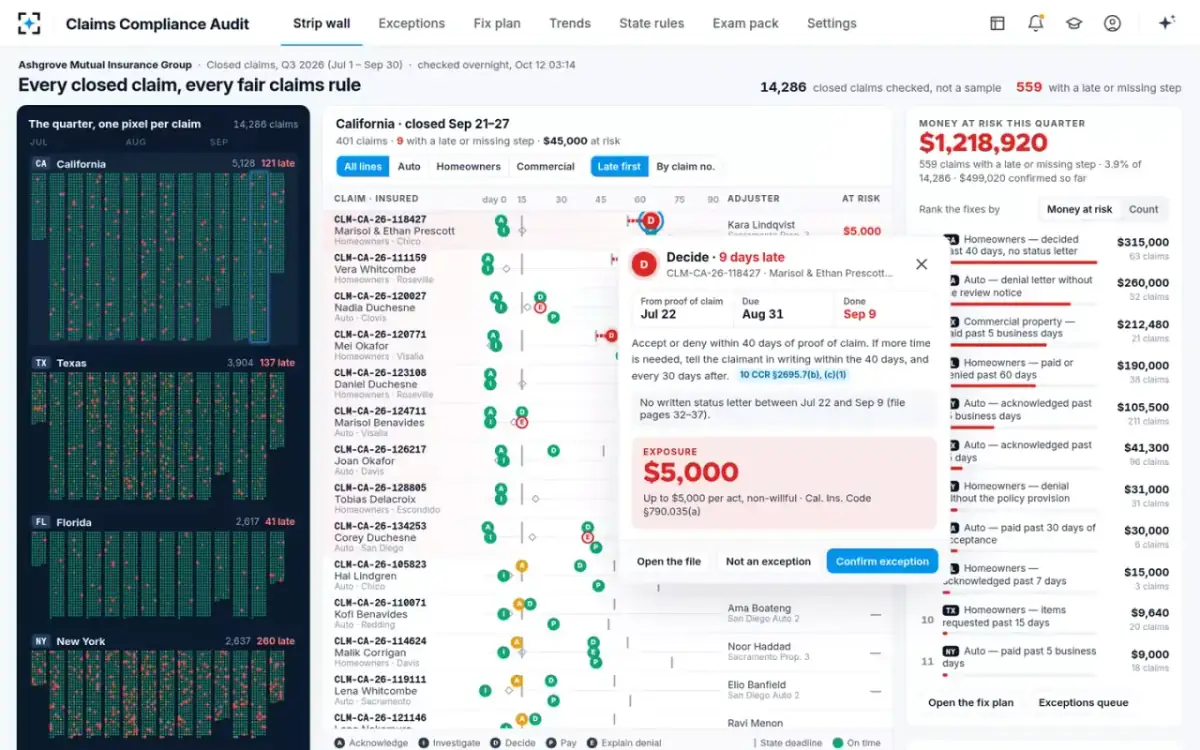
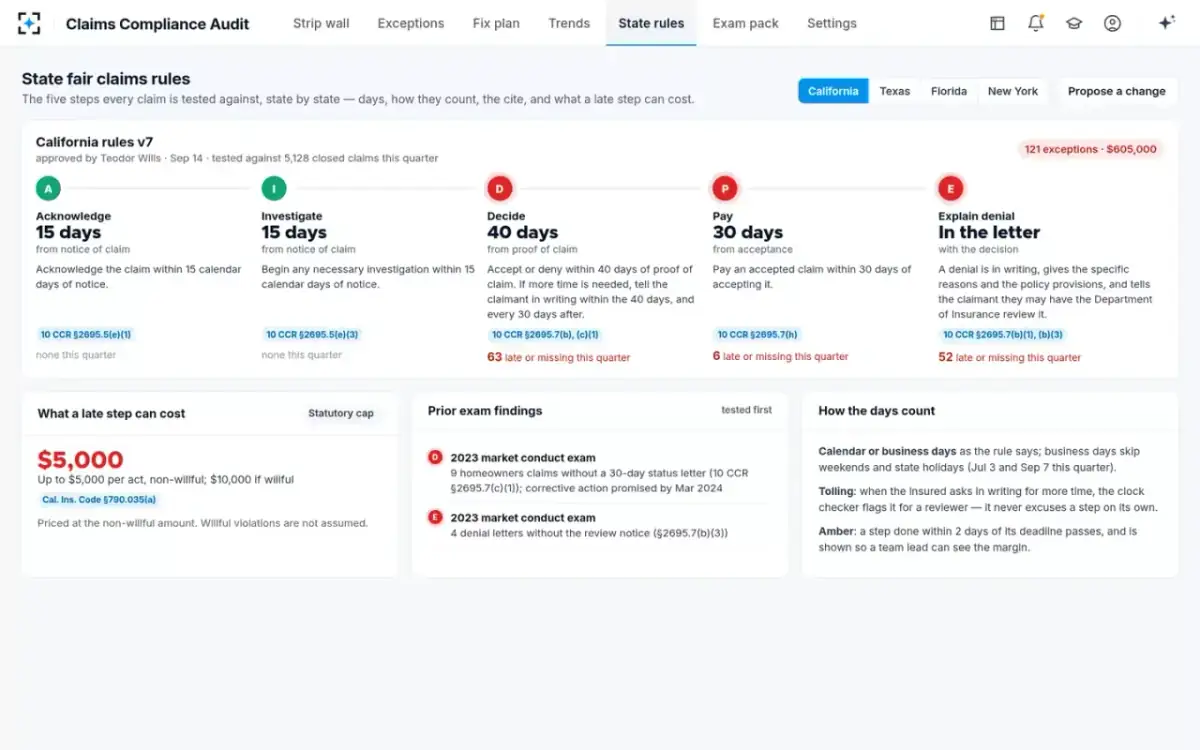
The rule sets themselves are a screen of their own: each state's five steps with their days, how the days count, the citation and what a late step can cost, plus any prior exam findings, which are tested first. Changing a rule takes a proposal and the approval of the VP, Compliance. The five steps those rules cover, and the evidence each needs, are laid out in the claim file audit checklist; New York's business-day version of them is in Regulation 64 New York.
One state's fair claims rules: five steps, how the days count, and prior exam findings tested first
Questions people ask
Is there a private right of action under the unfair claims settlement practices act?
Not under the NAIC model, which says it creates no private cause of action; enforcement is by the insurance commissioner. States differ. Texas gives a person with actual damages a private action for listed unfair settlement practices in Insurance Code chapter 541, while Florida says a breach of its 60-day pay-or-deny rule cannot be the sole basis for a private suit.
What does "general business practice" mean in claims law?
That a practice happened often enough to be the insurer's way of doing business rather than a one-off error. Examiners measure it as an error rate on a random sample; the NAIC handbook's long-standing benchmark for claims is 7% (2017 edition). California and New York both allow single instances to count in some circumstances.
Does the unfair claims settlement practices act apply to workers' compensation?
The NAIC model excludes it, as it excludes fidelity, suretyship and boiler and machinery insurance. Texas's prompt payment subchapter excludes workers' compensation too, and New York's Regulation 64 does not apply to workers' compensation policies.
Who enforces unfair claims settlement practices laws?
The state insurance regulator, usually through market conduct examinations, consumer complaints and administrative orders. In Florida that is the Office of Insurance Regulation; in New York the Department of Financial Services; in California and Texas the Department of Insurance.
Does the act cover third-party claims?
The NAIC model regulation defines a claimant as a first-party claimant, a third-party claimant or both, and New York's Regulation 64 covers first- and third-party claims. Texas's prompt payment damages are limited to first-party claims. An audit should record which kind each claim is before testing it.
How many states have adopted the NAIC unfair claims model regulation?
The NAIC's own chart, updated in fall 2023, lists 23 jurisdictions as having adopted Model 902 and 12 more with related rules, including California and Texas. The chart reflects the NAIC's reading of each state's law as of that date; check each state's current text before relying on it.