An AI claims audit tool reads closed claim files the way a claims compliance analyst does, through the notes, letters, estimates and payments, puts a date and a page on every step, and tests each step against the fair claims rules of the state that governs the claim. The useful version does this on every closed claim rather than a sample, and it is strict about what it leaves to people: whether an exception is a violation, whether a written request for more time stopped the clock, whether a violation was willful, and what goes to a regulator. Botminds' Claims Compliance Audit splits the reading among six specialist agents, each with written limits. A claims compliance reviewer confirms every exception, and the VP, Compliance signs anything sent to a department.
The figures below come from the solution's sample quarter for a fictional insurer, Ashgrove Mutual Insurance Group: 14,286 claims closed in California, Texas, Florida and New York. They show how the tool behaves, not a customer's results. Regulators' findings are quoted from their own publications.
Nothing is an exception until a reviewer says so.
The review rule in Claims Compliance Audit
What does an AI claims audit tool actually do?
An AI claims audit tool does three different kinds of work, and the design question is which of them a model should touch. The first is reading: finding the acknowledgment letter on page 3, the proof of claim on pages 19 to 31, the partial denial on page 38. That is volume work with judgment at the edges, and it is where language models earn their place. The second is counting: adding 40 calendar days to a proof-of-claim date, or 15 New York business days to a notice date. That is arithmetic under a written rule. The third is judging: deciding that a late step is a violation, that a letter from the insured tolled the clock, or that the pattern is willful. That belongs to people. This is a compliance audit of claim files against state rules; auditing what adjusters bill for their work is a different job, covered in claims auditing tools for adjuster bills.
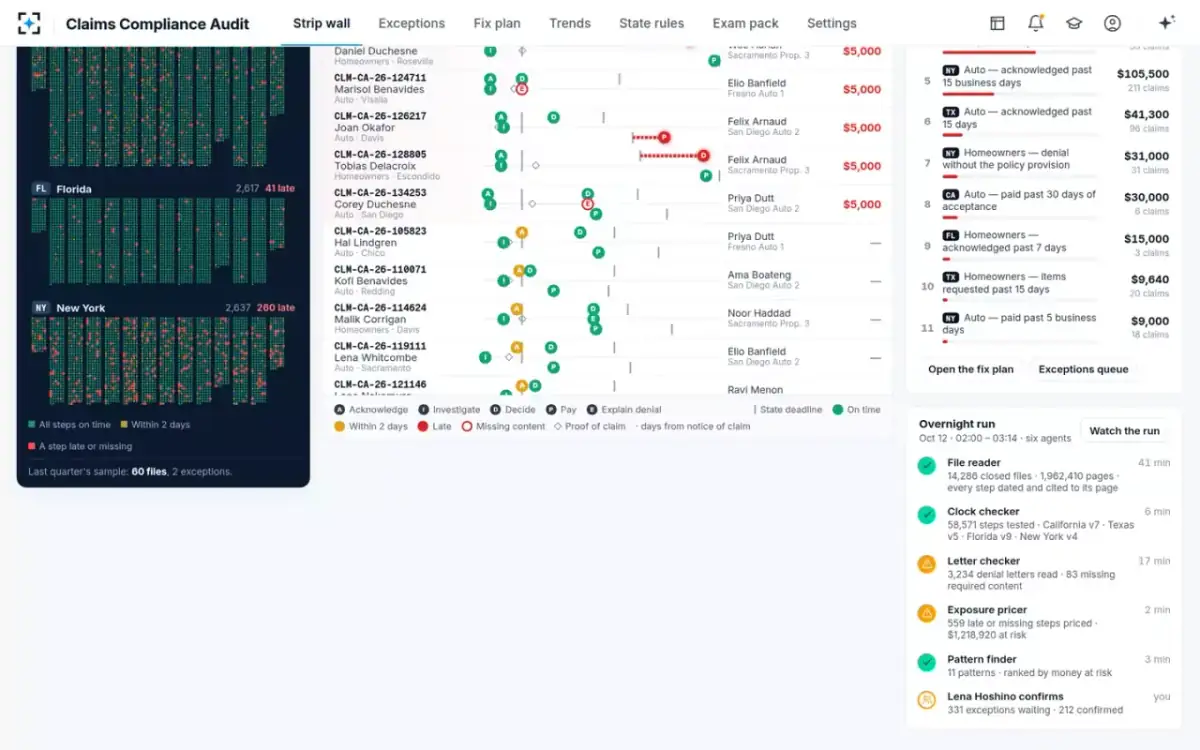
In the sample quarter the reading was the bulk of the job. Between 02:00 and 03:14 one night the agents read 14,286 closed files totaling 1,962,410 pages, tested 58,571 dated steps against each state's rule version and read 3,234 denial letters, 83 of which were missing content the state requires. They priced 559 late or missing steps and grouped them into 11 patterns. What they did not do is decide anything: the run ended with 331 exceptions waiting for a reviewer.
Six agents in Claims Compliance Audit, and the line each may not cross
Each agent in Claims Compliance Audit has one job, a short list of things it may do and a "never" line that is enforced in the product, not just written in a policy. The limits follow a simple principle: an agent may produce evidence and arithmetic, and a person makes every decision that changes what the insurer says to a claimant, a team or a regulator.
Six agents, what each may do, and what none may decide
File reader
DoesReads every note, letter, estimate and payment in a closed file and dates each event: notice, acknowledgment, investigation, proof of claim, decision, payment.
MayCite the page each date came from; record both dates when two documents disagree, and flag them.
NeverInfer a date the file does not show.
Clock checker
DoesApplies the state’s approved rule to the dated events: calendar or business days, holidays, the status-letter extension.
MayMark each step on time, within the margin, late or not applicable; send a written request for more time to a reviewer as possible tolling.
NeverExcuse a late step. No model decides a deadline.
Letter checker
DoesReads denial and status letters for what the state requires: the reason, the policy provision, the regulator’s review notice.
MayQuote the passage that passes or fails, and look for status letters between proof of claim and the decision.
NeverWrite to an insured, or paraphrase a letter as proof.
Exposure pricer
DoesPrices each late or missing step from the approved exposure schedule: per-act caps, statutory interest, a fee allowance.
MayShow the arithmetic and the source on every amount.
NeverCall an estimate a fine, or price a willful amount unless a reviewer marks the file willful.
Pattern finder
DoesGroups exceptions into root causes by state, line, team, step and letter template, and reads the notes for why the step slipped.
MayRank fixes by money at risk with the count rank beside it, and propose a fix.
NeverAssign the fix, or name an adjuster outside their own team.
Exam pack builder
DoesAssembles the market conduct evidence pack in the regulator’s data call layout: population, results, exceptions, corrective actions, reviewer log, cover memo.
MayDraft the cover memo from confirmed numbers only.
NeverSend anything to a regulator. The VP, Compliance signs.
Two limits do most of the work. The file reader never infers a date the file does not show, because an inferred date is exactly what an examiner cannot reproduce. If a file has no acknowledgment, the right output is "missing", and a missing step is an exception in its own right. The exposure pricer never calls an estimate a fine, because a fine is something only a regulator can impose, after a process. What an audit can honestly say is what the step could cost under the statute or the company's own schedule.
Why the deadline is computed by fixed rules, not a model
A deadline is arithmetic on dates under a written rule, so it should be computed by fixed code that gives the same answer every time and can be shown line by line. A model that is right 99 times out of 100 on deadlines is wrong on 143 of the sample quarter's 14,286 claims, and nobody can say in advance which. The rules are also full of small, exact instructions that a general model has no reason to know.
California counts calendar days but moves a deadline that lands on a weekend or holiday to the next working day (10 CCR 2695.2(b)). New York counts business days and excludes "a New York State legal holiday" (11 NYCRR 216.1(d)), and the state's public holidays include Lincoln's Birthday on 12 February and "each general election day," which a federal holiday calendar leaves out (General Construction Law §24). Florida suspends its clocks while a policyholder has not answered a request for material information for more than 10 days, but only for requests sent at least 15 days before the deadline (§627.70131(8)(b)). Each of those is a line of code with a citation, approved by compliance and versioned. In the sample, every result names the version it was tested against: California v7, Texas v5, Florida v9, New York v4.
Regulators expect this kind of discipline from AI used in insurance. The NAIC's model bulletin on insurers' use of AI asks for a written program whose controls are scaled to the risk, and one of the factors it names is how far people take part in the final decision (NAIC model bulletin). It had been adopted in 29 jurisdictions as of 8 October 2026 (NAIC map), with California, Colorado, New York and Texas following their own insurance-specific rules. A tool that reads with a model, counts with rules and leaves every decision to a named person is straightforward to describe in that program.
Which decisions stay with people?
Four decisions stay with people in any AI claims audit tool worth buying: whether an exception is real, whether something stopped the clock, which fix comes first, and what the insurer tells its regulator. The flow below shows where each falls in Claims Compliance Audit. The green steps are people.
One quarter through Claims Compliance Audit: where the agents stop and people decide
Agent
File readerDates every event in every closed file and cites each date to its page.
Never: infers a date the file does not show
Agent
Clock checker and letter checkerTest each step against the approved state rule; read every denial and status letter for required content.
Never: excuse a late step or paraphrase a letter as proof
Agent
Exposure pricerPrices each late or missing step from the approved schedule, showing basis and arithmetic.
Never: calls an estimate a fine
A person decides
Claims compliance reviewerConfirms each exception or overturns it with a reason: tolled, wrong date read, or out of scope.
Agent
Pattern finderGroups confirmed exceptions into root causes and ranks fixes by money at risk beside the count.
Never: assigns a fix
A person decides
Claims quality managerAssigns each fix to a team lead, with a due date.
Agent
Exam pack builderBuilds the data call response in the regulator’s layout from confirmed numbers.
Never: sends anything to a regulator
A person decides
VP, ComplianceApproves rule versions and the exposure schedule, and signs the exam pack.
Tolling is the decision most often handed to software by accident. A note that reads "insured to send photos" does not stop a California or New York clock; in Florida a request can toll the clock, but only on the statute's conditions. The clock checker therefore never applies tolling itself. It sends any written request for more time to a reviewer, who decides and gives a reason that stays with the file.
What examiners find when they look at a whole population
Examiners find the steps an AI claims audit tool should be testing, at rates a quarterly sample rarely shows. In May 2026 the California Department of Insurance said its examiners had reviewed a sample of 220 wildfire claims at one insurer and found 398 violations in 114 of them, among them failures to begin investigating within 15 days, to accept or deny within 40 days, and to send required status letters (CDI). Those are the Department's allegations in an accusation that had yet to be heard. The Department noted that penalties under Insurance Code §790.035 "may reach $5,000 per violation, or $10,000 for willful violations."
Florida's regulator fined eight insurers a combined $2,075,000 in September 2025 after examinations of Hurricane Ian and Idalia claims, for findings that included late acknowledgments, missing disclosure statements and unpaid interest (Florida OIR). Each finding was a step with a date and a rule, which is to say the kind of thing an audit tool can test on every closed claim before the examiner samples it. The Florida reports are laid out finding by finding in the Florida OIR market conduct exam casebook.
A quarterly sample against an AI claims audit tool, row by row
The difference is less about speed than about what the result can claim. A sample estimates an error rate. An automated claims audit system that reads every file can list every late step, price it and show the page, and that changes what the compliance desk can promise the claims leaders and the regulator.
The same quarter, sampled by hand or read in full by Claims Compliance Audit
Quarterly hand sample: 60 files from 14,286 in the sample quarter.
AI claims audit tool, every closed claim: All 14,286, each step tested against its state’s rule version.
Quarterly hand sample: 2 exceptions.
AI claims audit tool, every closed claim: 559 claims with a late or missing step, grouped into 11 root causes.
Quarterly hand sample: An analyst’s spreadsheet, usually without a page reference.
AI claims audit tool, every closed claim: The file page the date was read from, one click away.
Quarterly hand sample: Read when the file is sampled.
AI claims audit tool, every closed claim: 3,234 denial letters read; 83 missing required content.
Quarterly hand sample: The most frequent error first.
AI claims audit tool, every closed claim: Ranked by money at risk, with the count rank beside it.
Quarterly hand sample: The analyst, then a meeting.
AI claims audit tool, every closed claim: A reviewer per exception, with a reason kept for each overturn.
The fix list is where the difference turns into money. Ranked by count, the sample's first fix was New York auto acknowledgments: 211 claims, priced at $105,500 on the company's own schedule. Ranked by money, the first was California homeowners claims decided after 40 days with no status letter: 63 claims, $315,000, third by count. How the Texas line on that list is priced is worked through in Texas Insurance Code 542.060.
Claims compliance software for insurance companies: ten questions to ask
Ask any vendor of claims compliance software to show, on one of your own closed files, where each date came from, which rule version it was tested against and who decided the result. A demo on its own data proves only that its data is clean. The questions below separate a tool that will stand up in an exam from one that produces a dashboard.
Questions for any AI claims audit tool, and what a good answer looks like
- Where does each date come from?
A page in the file, cited, not a field in the claim system that someone may have keyed late.
- What happens when two documents disagree on a date?
Both are kept and flagged for a person. The tool should never pick one silently.
- Are deadlines computed by fixed rules, with a version and an approver?
You should be able to read the rule, see who approved it and when it took effect.
- Which calendar does it use in each state?
Business or calendar days, the state’s own holiday list, and what happens when a deadline lands on a weekend.
- Does it test the law in force on the day of the step?
Florida cut its 14-day acknowledgment to 7 in 2023; a 2022 claim is tested against 2022 law.
- Does it read letter content, or only check that a letter exists?
A denial without the provision or the regulator notice fails, however timely it is.
- Can a reviewer overturn a result, and is the reason kept?
Reasons should be fixed choices with a note, logged with who and when.
- How is exposure priced, and is the basis shown?
Statutory cap, statutory interest or your own schedule, labeled as an estimate, never as a fine.
- Can it produce the regulator’s data call layout?
Population, result per claim, exceptions with evidence, corrective actions and the reviewer log.
- Can anything leave without a signature?
The right answer is no.
What an AI claims auditor cannot do
An AI claims auditor cannot see what was never written down, and in claims compliance that is a finding rather than a gap. California forbids denying a claim on information from a phone call or interview unless the conversation is documented in the file (2695.7(l)). If the adjuster called the insured on day 12 and wrote nothing, the tool will report the acknowledgment as missing, and it will be right.
It cannot decide which state's rule governs a claim with a multi-state policy, a mailing address that moved, or a risk located somewhere other than where the insured lives. It can apply the answer once compliance has written it into the rule table. It cannot decide willfulness, which in California doubles the per-violation ceiling the Department described. It cannot replace the examiners' handbook's first instruction for each claims standard, which is to check the company's own written standards against the law before testing files (Handbook, 2017 edition, chapter 16). And in a pilot the claims system export and the document store are connected by the insurer's team, which is usually the first week of work. How that pilot runs is set out in the closed claim file review process.
It is also not a claims system. Claims Compliance Audit tests closed claims; it does not handle open ones or send anything to claimants. The one forward-looking feature is a day-30 alert to team leads on undecided California claims, ahead of the 40-day line.
What the agents' work looks like on one file
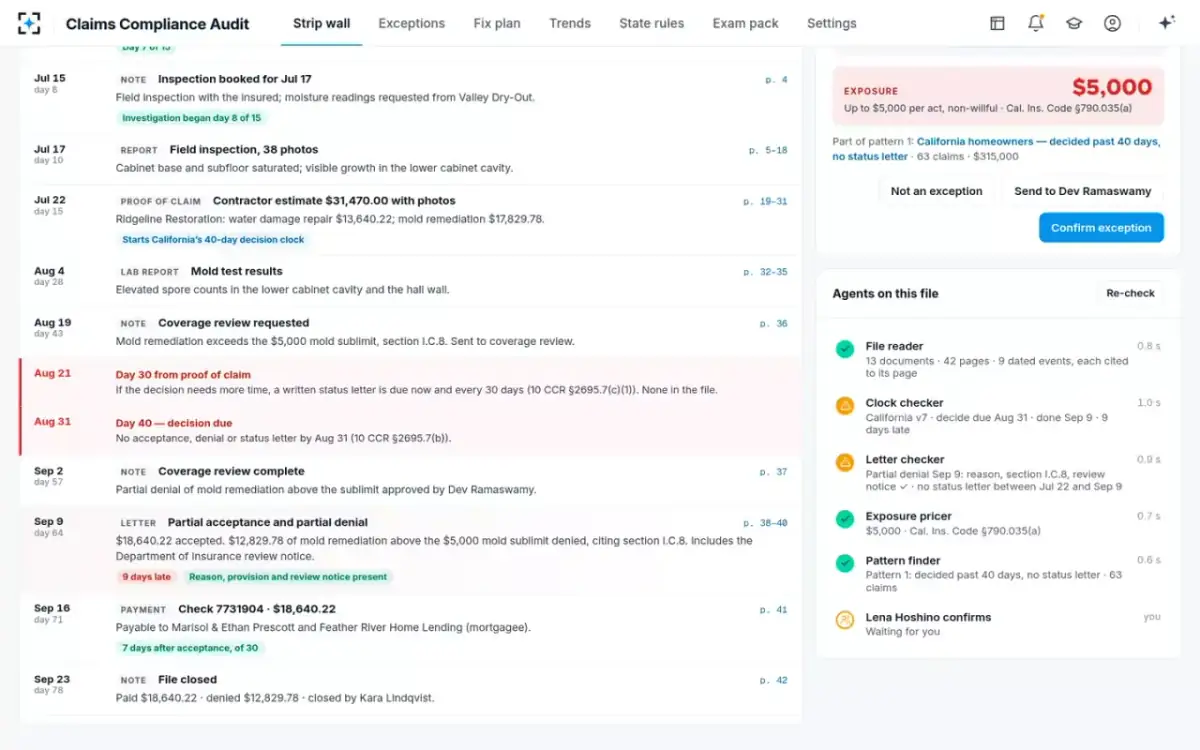
On a single file the agents' work is a list of what each one did and found, beside the file itself. The sample claim below is a California homeowners water claim, CLM-CA-26-118427, decided nine days after the 40-day deadline with no status letter in between. The letter checker confirmed the partial denial itself was complete, so only the decision is an exception.
Margin notes where the clock passed, and each agent's step on the file
The overnight run: what each agent did, and what waits for a person
Questions people ask
Can AI audit insurance claims?
It can do the reading and the arithmetic of a claims compliance audit on every closed claim: dating each step from the file, applying each state's rule and checking letter content. Deciding whether an exception is a violation should stay with a person. In the sample quarter, the agents read 14,286 files overnight and left 331 exceptions for reviewers.
Is an automated claims audit system covered by the NAIC AI bulletin?
The bulletin covers AI systems that make or support decisions related to regulated insurance practices, and claims handling is one. Where a state has adopted it, the safe course is to list the audit tool in the insurer's AI program inventory with its controls. As of 8 October 2026 the NAIC counted 29 adopting jurisdictions, with four states following their own insurance-specific rules.
How accurate is an AI claims auditor?
Measure it the way an examiner would: on your own closed files, against a reviewer. Deadlines computed by fixed rules are exact once the dates are right; the error sits in reading. In the sample quarter reviewers overturned 16 of the 228 exceptions they had decided, about 7%, each with a recorded reason.
How long does an automated claims audit take?
In the sample, one overnight run of 74 minutes read 14,286 closed files and tested 58,571 steps. The time that remains is people's: confirming exceptions, assigning fixes and signing. Botminds estimates a quarter's testing and one data call at about 7 working days with the agents, against 32 by hand.
Does an AI claims audit tool replace claims compliance analysts?
No. It removes the file reading and date-keeping that fill most of their quarter and leaves the judgment: which event starts a clock on an ambiguous file, whether a request tolled it, and whether a pattern is real. The four seats on the desk are described in the guide to the claims compliance analyst role.
What should claims compliance monitoring software never do?
Send anything to a claimant or a regulator, excuse a late step on its own, or call an estimate a fine. California's Department of Insurance described penalties of up to $5,000 per violation, and $10,000 for willful ones, under Insurance Code §790.035; deciding willfulness is a legal judgment for people.