A Florida OIR market conduct exam is an examination by the Florida Office of Insurance Regulation, under section 624.3161 of the Florida Statutes, of whether an insurer's practices comply with the Insurance Code, the insurer's own procedures and its policies. After Hurricane Ian, the Office examined claims handling at a series of residential property insurers, and its 2025 reports state every finding as an error rate on a random sample: adjusters not properly appointed, acknowledgments sent late, required disclosure statements missing, claims not paid or denied within 90 days, interest not paid. In September 2025 the Office announced $2,075,000 in penalties against eight insurers. Each finding is a dated step in a claim file, which means each is something a claims audit can test on every closed claim before the examiner samples it. Botminds' Claims Compliance Audit does that test, cites the file page for each date, and leaves every exception for a reviewer to confirm.
The findings below are quoted or summarized from the Office's published reports, consent order and press release, each linked. The companies are named as the regulator names them. Examples from the solution use a fictional sample insurer and are sample data.
Examination results with a 95% confidence level permit those results to be extrapolated to the population identified in each of the areas examined.
Florida OIR, 2025 Hurricane Ian examination reports, Examination Procedures
What is a Florida OIR market conduct exam?
A Florida OIR market conduct exam tests whether an insurer complies with the Insurance Code chapters the Office administers, and the Office may examine each authorized insurer "As often as it deems necessary" (§624.3161(1)). The Office may use contracted professional examiners, whom the examined insurer pays directly, and the insurer bears the reasonable cost of the examination (§624.3161(3) and (4)). Each Hurricane Ian report describes the purpose as reviewing the insurer's operating practices against the Florida Insurance Code, the insurance rules, the company's own procedures, its policy contracts and the Office's orders.
The Hurricane Ian examinations were targeted: they covered claims adjudicated between 28 September 2022 and 31 December 2023, and several ran from spring 2024 to spring 2025. The targeted reports close the same way, noting that they do not record what regulatory or administrative action may follow. That came separately, in consent orders and the September 2025 announcement.
Which department oversees market conduct examinations in Florida?
The Florida Office of Insurance Regulation oversees and conducts market conduct examinations of insurers in Florida. The Department of Financial Services plays two supporting parts that show up in the reports. Its Division of Consumer Services takes consumer inquiries and complaints and reports apparent violations by licensees to the Office (§624.307(10)(a)). And it licenses claims adjusters: a recurring finding was that insurers used adjusters "who were properly licensed as Florida claims adjusters by the Department of Financial Services, but were not appointed" by the insurer (American Mobile report).
The two agencies' data also decide where the Office looks. Its exam selection rule must prioritize insurers with a disproportionate number of claims-handling complaints to either agency, among them failure to communicate or pay on time, untimely payments that give rise to statutory interest, failure to use licensed and appointed adjusters, failure to keep reasonable claims records and failure to follow the company's own claims-handling manual (§624.3161(8)(b)). Being a negative outlier on the NAIC's Market Conduct Annual Statement is another listed trigger.
Market conduct examinations in Florida after a hurricane: when they are required
Market conduct examinations in Florida after a hurricane are required, not optional, for some insurers. Under §624.3161(7)(b), a residential property insurer must be examined if, more than 90 days after the storm, it is in the top 20% of insurers by the ratio of hurricane claim complaints to the Department to its hurricane claims, or by the ratio of hurricane claims closed without payment to its hurricane claims on wind policies, or if it has made significant payments to its managing general agent since the storm. An insurer in the top 20% by hurricane claims filed per policy in force may be examined (§624.3161(7)(a)).
The examination must start within 18 months of the landfall of a hurricane that prompts an executive order or state of emergency, and it must cover the insurer's managing general agent as if it were the insurer. Three of those triggers, complaints, closed-without-payment ratios and agent payments, are numbers an insurer can compute about itself the week after a storm. So is the closed-without-payment folder, which every Ian report sampled separately.
Eight Hurricane Ian reports, one method
Every Hurricane Ian report followed the same method, which makes them comparable. The Office asked each insurer for its universe of Ian claims with Florida exposure, split it into claims closed with payment, claims closed without payment, and reopened or supplemental claims, drew a random sample from each at the size the NAIC handbook's acceptance table recommends, and tested every sampled file. The table summarizes the eight reports read for this guide.
Eight 2025 Florida OIR reports on Hurricane Ian claims: population and sample
| Insurer, as named in the report | Report issued | Ian claims in the three populations | Claims reviewed |
|---|---|---|---|
| Citizens Property Insurance Corporation | 24 Jan 2025 | 63,037 | 323 |
| Truck Insurance Exchange | 24 Feb 2025 | 8,753 | 322 |
| Centauri Specialty Insurance Company | 22 Apr 2025 | 3,289 | 272 |
| Clear Blue Insurance Company | 22 May 2025 | 604 | 228 |
| TypTap Insurance Company | 23 May 2025 | 7,429 | 319 |
| American Mobile Insurance Exchange | 11 Jul 2025 | 1,690 | 241 |
| American Coastal Insurance Company | 18 Jul 2025 | 516 | 167 |
| Tower Hill Prime Insurance Company | 21 Jul 2025 | 5,720 | 295 |
The sample sizes explain the precision of the findings. Two hundred to three hundred files per insurer is enough to state an error rate per finding with the confidence the reports claim, and nowhere near enough to list every affected policyholder. Where the reports led to restitution, the insurer did the full count itself: Tower Hill "issued $46,320.09 in restitution to Florida policyholders after completing an audit of the sampled claims" (Tower Hill report).
Hurricane Ian findings by error rate
The findings fell into a short list of steps, and the same steps failed at many insurers. The bars show the highest error rate each kind of finding reached in any of the eight Ian reports. Two are paperwork about the adjuster, three are content the statute requires on letters and payments, and the rest are clocks.
The highest error rate each kind of finding reached in the 2025 Hurricane Ian reports
The spread between insurers is as telling as the peaks. On appointment of adjusters, the same finding ran from 0.3% at Truck and 0.9% at Citizens to 61.8% at Centauri. On the 90-day pay-or-deny clock it ran from under 1% at American Mobile and Citizens to 20.4% at American Coastal. Every insurer worked the same storm under the same statute, so the difference is in the claims operation, which is the part an insurer controls.
Several findings were about the content of documents rather than their timing. The statute requires a specific disclosure statement, in at least 12-point bold uppercase type, with any preliminary or partial estimate and with any payment that is not full and final (§627.70131(6)); TypTap was cited both for leaving it out and for printing it in the wrong type. The Homeowner Claims Bill of Rights, a separate notice due within 14 days of the first claim communication, is explained in the Florida homeowners claims bill of rights guide.
Your own claims manual is the examiner's yardstick too
Florida's examiners test insurers against their own written standards as well as the statute, and some of the highest error rates came from there. Centauri missed its own 72-hour field inspection standard on 47.8% of sampled Ian claims and its one-working-day contact standard on 7.7% (Centauri report). American Mobile did not send its own claim acknowledgment letter within 24 hours on 16.2% (American Mobile report). TypTap's independent adjusters missed its five-day report standard on 22.9% (TypTap report). Citizens did not upload estimates, photos and sketches within its own five calendar days on 19.8% (Citizens report).
The law behind this is recent. Since 2023, every authorized residential property insurer must keep a claims-handling manual covering each stage from acknowledgment to closing, and attest each year, by 1 May, that it complies with the code and that the insurer has the resources to follow it at all times, catastrophes included (§627.4108). The reports also reviewed the manuals themselves and noted no exceptions at Tower Hill. A manual that passes on paper and is missed in half the files is the combination examiners now report.
The fines: $2,075,000 across eight insurers
On 2 September 2025 the Office announced penalties totaling $2,075,000 against eight insurers for claims-handling practices found in market conduct examinations of Hurricanes Ian and Idalia (Florida OIR). Six of the eight fined insurers' reports are among those read for this guide; Citizens and Truck, whose reports are also summarized above, were not on the list. The Office added that in fiscal year 2023–24 its Market Conduct Unit secured more than $8 million in restitution and issued more than $2.8 million in fines.
The September 2025 penalties, beside the largest findings in each insurer's Ian report
American Coastal
$400,000
Adjuster license number missing on later letters, 22.2%; adjusters not appointed, 21.6%; not paid or denied within 90 days, 20.4%
American Mobile Insurance Exchange
$400,000
Disclosure statement with estimates not compliant, 61.4%; adjusters not appointed, 22.4%
Clear Blue
$400,000
Adjusters not appointed, 37.7%; late acknowledgments, 18.9%
Monarch National
$325,000
Report not reviewed for this guide
Tower Hill Prime
$250,000
Late acknowledgments, 12.2%; adjuster name and license missing, 9.8%
TypTap
$150,000
Disclosure statement with estimates, 47.6%; field reports past the insurer’s 5-day standard, 22.9%
Centauri Specialty
$100,000
Adjusters not appointed, 61.8%; disclosure with partial payments, 51.8%
Sutton National
$50,000
Report not reviewed for this guide
The fines do not track the error rates, and the consent orders show why the arithmetic is not simple. Centauri's order recites 168 instances of unappointed adjusters and 141 payments without the disclosure statement, and sets an administrative fine of $100,000 plus $2,000 in costs (consent order 25-55). That is the statute's aggregate ceiling for nonwillful violations arising from the same action on claims from a declared emergency, where each violation can carry up to $25,000 (§624.4211(2)(a)). The order also says future violations of the same statutes may be treated as willful, where the ceilings are $200,000 a violation and $1 million in all for emergency claims.
Restitution runs alongside. An insurer that discovers a nonwillful violation must correct it and, where restitution is due, pay every affected person with interest at 12% a year (§624.4211(2)(b)). That duty applies to violations the insurer finds itself, which is the strongest argument for finding them first.
What changed in 2023, and why the reports tested 2022 law
The Hurricane Ian reports tested the clocks that were in force when the claims were handled, and each carries the same footnote: section 627.70131 as amended in 2023 "has reduced 14-day timeframes to 7 days, 45-day timeframes to 30 days, and 90-day timeframes to 60 days" (Tower Hill report). The Idalia sections of the same reports apply the new clocks: Truck was cited for not acknowledging Idalia communications "within seven calendar days", and Citizens for Idalia claims not paid or denied "within 60 days" (Truck, Citizens).
That is the lesson for any audit that spans a rule change: test each step against the law in force on the day the step happened, and record which version was used. An audit that applies today's 7-day acknowledgment to a 2022 file reports violations that were not violations; one that applies the old 14 days to a 2024 file misses real ones.
Each Florida finding as a step a claims audit can test first
Every finding in the reports maps to a step with a date or a document, so each can be tested on closed files before an examination. The checklist below turns the 2025 findings into tests against the current statute.
Florida hurricane claim findings, turned into tests an audit can run on every closed file
- Adjuster licensed and appointed on the day of assignment
Check the appointment, not just the license, for staff, independent and emergency adjusters.
- Acknowledgment within 7 calendar days of any claim communication
And responsive: a claim notice gets claim forms, instructions and a telephone number (§627.70131(1), (2)).
- Adjuster name and license number on every later communication
Each letter and email after inspection, not only the first (§627.70131(3)(c)).
- Detailed estimate sent within 7 days of being generated
Dated from the estimate itself (§627.70131(3)(e)).
- The statutory disclosure statement, in 12-point bold uppercase
With every preliminary or partial estimate and every payment that is not full and final (§627.70131(6)).
- Homeowner Claims Bill of Rights within 14 days
Of the first communication about the claim.
- Paid or denied within 60 days of notice, with a written explanation
Initial, reopened and supplemental claims alike, net of any lawful tolling (§627.70131(7), (8)).
- Interest paid on any payment made after the deadline
At the statutory rate, from the date of notice (§627.70131(7)(a)).
- Your manual’s own deadlines
Inspection, contact, reporting and estimate upload, each tested like a statute.
How Claims Compliance Audit tests Florida's steps
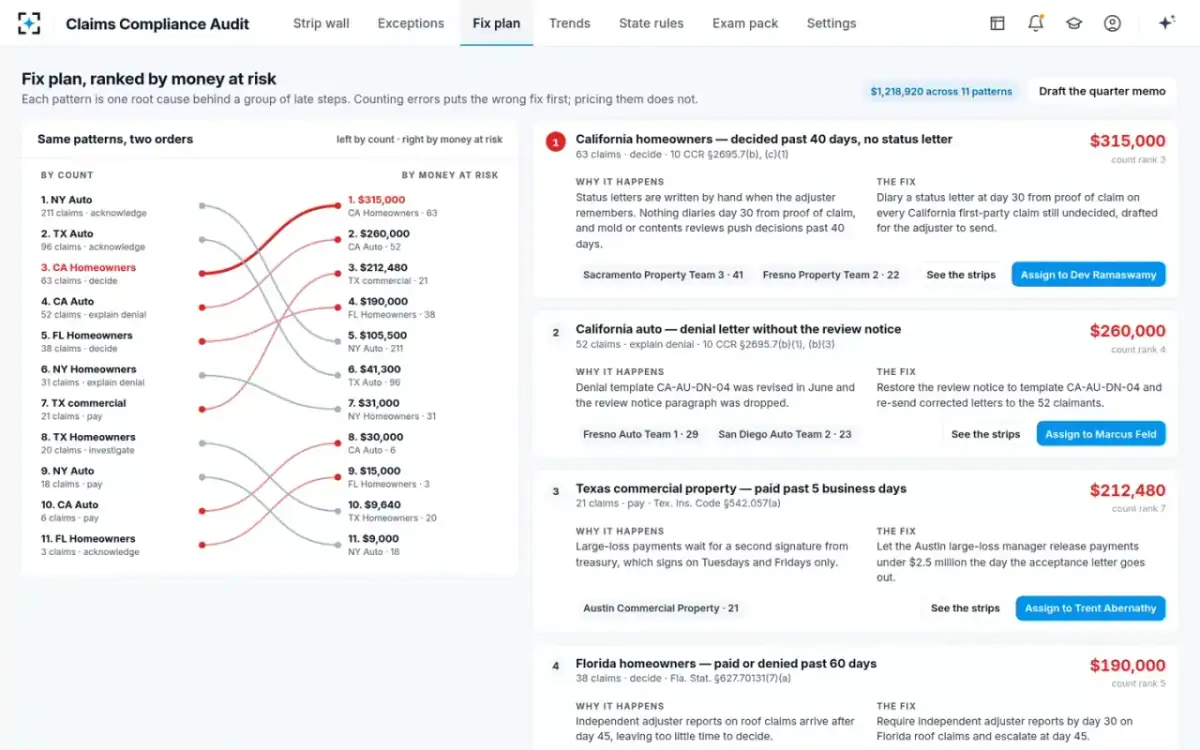
Claims Compliance Audit holds a Florida rule set, approved and versioned, that applies the 2023 clocks to steps taken after the amendments and the earlier ones to steps before them. In the sample quarter, Florida produced 41 of the 559 claims with a late or missing step, from 2,617 Florida claims closed. The largest Florida pattern was 38 homeowners claims paid or denied after 60 days, which the pattern finder traced to independent adjusters' roof reports arriving after day 45.
The Florida pattern on the fix plan: paid or denied after 60 days
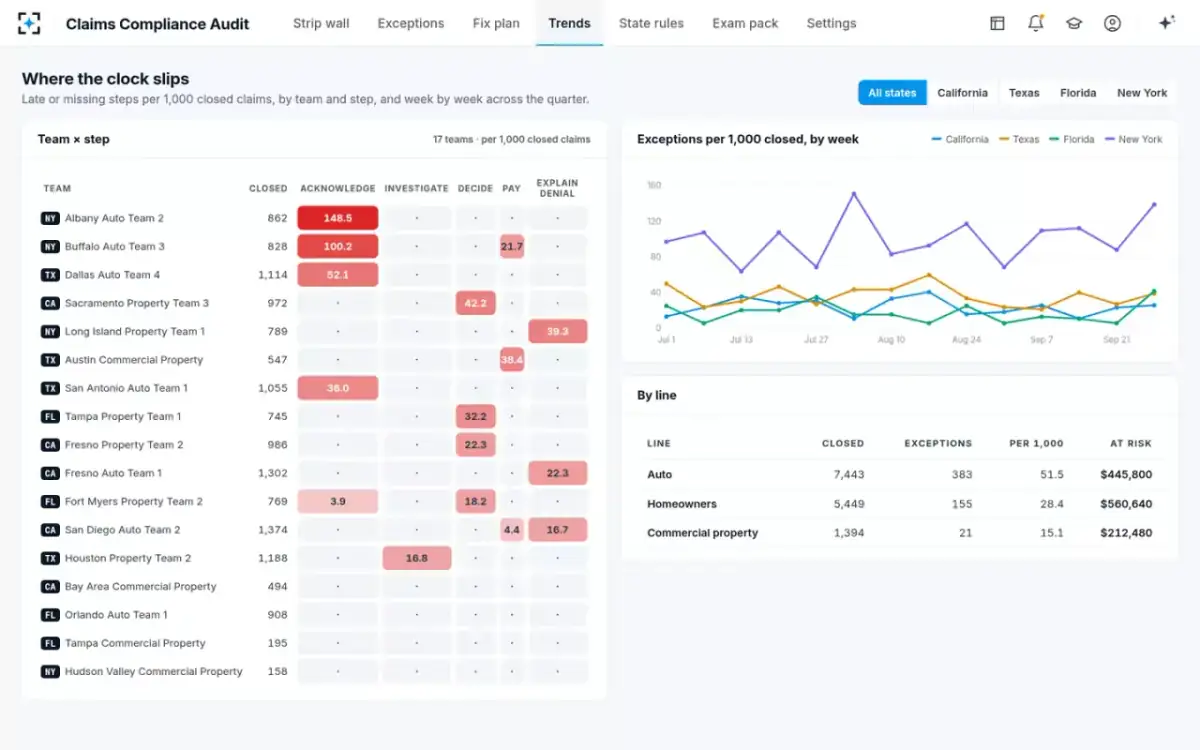
The trends screen shows where in the organization each Florida step slips, per 1,000 closed claims by team. In the sample, the Tampa and Fort Myers property teams carried the late decisions, the same step the examiners found failing across the Ian reports. Because each result names its rule version, an examiner can see which text every Florida claim was tested against.
Late steps per 1,000 closed claims, by team and step, with the Florida teams in view
The audit's evidence pack is built in the regulator's data call layout and goes to the VP, Compliance to sign; nothing is sent to the Office by the agents. How a desk can pilot this on a quarter it has already sampled is set out in the closed claim file review process, and the sample-size arithmetic behind the reports' 95% claim in the claims audit sample size calculator.
Questions people ask
How often does Florida OIR conduct market conduct exams?
As often as it deems necessary, under §624.3161(1), using a selection method that prioritizes complaints, outlier results on the NAIC's annual statement and evidence of unfair practices. After a hurricane, some residential property insurers must be examined, and the examination has to start within 18 months of landfall.
Are Florida market conduct exam reports public?
Yes. The Office of Insurance Regulation publishes final reports on its website, by year, along with consent orders that set fines. The eight Hurricane Ian reports summarized in this guide were all issued between January and July 2025.
What is a targeted market conduct examination in Florida?
An examination limited to one area of an insurer's operations rather than all of them. Seven of the eight 2025 Hurricane Ian reports read for this guide are titled targeted examinations and covered claims handling for that storm, and in several cases Hurricane Idalia, adjudicated between September 2022 and the end of 2023.
What happens after a Florida market conduct exam?
The Office issues a final report, then may take action separately, usually by consent order with a fine, corrective actions and sometimes the right to re-examine at the insurer's cost. Centauri's 2025 order set a $100,000 fine plus $2,000 in costs and allowed future violations of the same statutes to be treated as willful.
What were the most common findings in Florida's Hurricane Ian exams?
Adjusters who were licensed but not appointed by the insurer, late acknowledgments of claim communications, missing or non-compliant disclosure statements with estimates and partial payments, adjuster license numbers missing from letters, claims not paid or denied within 90 days and interest not paid on late payments. Each was stated as an error rate on a random sample, and each is a step an audit can test from the file.
Does a Florida exam test the insurer's own claims manual?
Yes. The Ian reports cite insurers for missing deadlines in their own manuals, such as a 72-hour inspection standard missed on 47.8% of sampled claims, and they review whether the manual itself meets the statute. Since 2023, residential property insurers must attest to their manuals every year by 1 May.