The Florida homeowners claims bill of rights is a one-page notice, required by section 627.7142 of the Florida Statutes, that every insurer writing personal residential property insurance in Florida must give a policyholder within 14 days of first hearing about a claim. It promises an acknowledgment of the claim within 7 days, a written answer on request within 30 days of a complete proof of loss saying whether the claim is covered in full, in part or denied, or that it is still being investigated, a copy of the adjuster's detailed estimate within 7 days, and payment or denial within 60 days, with interest if the insurer is late. It also offers free state mediation and a helpline. Read together, those promises describe what a good claim status page shows. Botminds' Claim Status Self-Service is a policyholder self-service solution that answers "where is my claim?" from the live claim file and counts the response clocks a carrier sets for its states; on a Florida claim those are the bill of rights' clocks.
The statute text below is the 2026 Florida Statutes as published by the Legislature. Examples from the solution use a fictional sample claim, Alicia Brennan's kitchen water claim with an invented insurer, Halverton Mutual. That claim is in California, so its screens show California's clocks; the settings that would carry Florida's are the same ones. Sample figures are not a customer's result, and none of this is legal advice.
The four promises a Florida status page has to keep
7days
to acknowledge the claim, and any later communication about it
30days
after a complete proof of loss, a written answer on request
7days
to send a copy of the adjuster’s detailed estimate
60days
from notice to pay or deny, with interest from the date of notice if late
What is the Florida Homeowner Claims Bill of Rights?
It is a summary, set out word for word in the statute, of rights Florida law already gives a homeowner with a claim. The statute says so itself: the purpose is "to summarize, in simple, nontechnical terms, existing Florida law regarding the rights of a personal lines residential property insurance policyholder who files a claim of loss." It covers the claims process only, not every right under the policy, and it warns that the timelines have exceptions when conditions are beyond the insurer's control.
The insurer must deliver it within 14 days of the first communication about a claim. Failing to deliver it can bring administrative enforcement by the Office of Insurance Regulation, but the statute is careful about the courtroom: the bill of rights does not create a civil cause of action, and a failure to deliver it is not admissible as evidence in a lawsuit against the insurer. The rights in it are real because other statutes create them, mostly section 627.70131; the bill of rights is how the homeowner hears about them.
“YOU HAVE THE RIGHT TO:”
Fla. Stat. §627.7142, the heading of the rights the insurer must list
Eight rights follow, then seven pieces of advice. The rights are about time, information and help; the advice is about protecting the property, documenting the damage and being careful with contractors. A status page that shows only a stage name delivers none of it.
How long does my insurer have to acknowledge my claim in Florida?
Seven days. The first right reads: "Receive from your insurance company an acknowledgment of your reported claim within 7 days after the time you communicated the claim." The statute behind it goes further than the first notice: an insurer must review and acknowledge any communication about a claim within 7 calendar days, unless it pays within that time, and an acknowledgment of a new claim must include the claim forms, instructions and a telephone number, unless it tells the claimant the claim appears not to be covered.
That second part is what turns the 7-day rule into a status rule. Every message a homeowner sends, an email, an upload, a question on the claim page, starts its own 7-day clock. The insurer's representatives count too: a communication made to or by someone the insurer has authorised to handle claim communications is treated as made to or by the insurer.
A Florida residential claim against its statutory clocks
- Acknowledgeby day 7
- Bill of rights sentby day 14
- Investigate, inspect, estimatepay or deny by day 60
- Investigation beginsby day 7
- Any physical inspectionby day 30
- Copy to the policyholderby day 7
The 30-day answer you can ask for in writing
The second right is the closest thing in Florida law to a guaranteed status update, and it only works if the homeowner asks. It reads: "Upon written request, receive from your insurance company within 30 days after you have submitted a complete proof-of-loss statement to your insurance company, confirmation that your claim is covered in full, partially covered, or denied, or receive a written statement that your claim is being investigated."
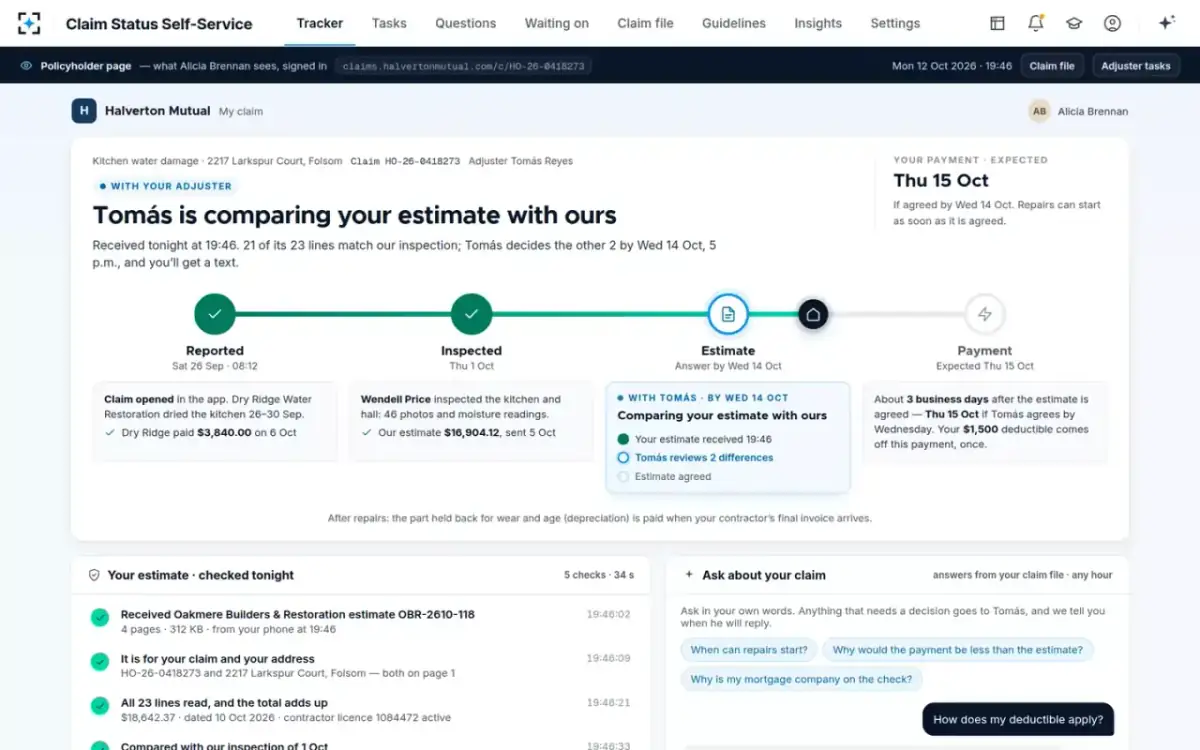
Three conditions sit in that sentence: a written request, a complete proof of loss, and 30 days. A homeowner who does not know the right exists will not make the request, and a claim that stalls before the proof of loss is complete never starts the 30 days. A status page can close both gaps: show whether the proof of loss is complete, and offer the written request as a button with the date the answer is due. In the sample settings, a signed proof of loss is one of the waiting items a customer sees, with "Sign on the page" as the action.
A stage that says who has the claim and when the answer is due
Can I get a copy of the adjuster's estimate in Florida?
Yes, within 7 days of the adjuster generating it, and the insurer must send it without being asked. The third right restates a rule in section 627.70131: the insurer must send the policyholder a copy of any detailed estimate of the loss within 7 days after the adjuster generates it. The same section does not require a detailed estimate where one is not reasonably necessary to investigate the claim, so a small claim paid quickly may never have one.
Florida also tells the homeowner, in capitals, that an early estimate may change. A preliminary or partial estimate must carry the statement "THIS ESTIMATE REPRESENTS OUR CURRENT EVALUATION OF THE COVERED DAMAGES TO YOUR INSURED PROPERTY AND MAY BE REVISED AS WE CONTINUE TO EVALUATE YOUR CLAIM." On a status page, that sentence is the honest label for an estimate stage that is not finished, and it is a better one than "In progress".
How long does an insurance company have to pay a claim in Florida?
Sixty days from notice of the claim to pay or deny it, in whole or in part, for residential policies and small commercial ones. The fourth right promises, within 60 days, full settlement or payment of the undisputed part of the claim, or a denial, subject to any interest a mortgage lender holds in the policy, which is why the lender's name can be on the check (the guide to an insurance check made out to your mortgage company explains what follows). The fifth right adds interest: if the insurer misses the 60 days, interest runs from the date the claim was filed and is paid with the claim.
The statute behind those rights has three refinements a status page should reflect. A payment below the insurer's own detailed estimate must come with a written explanation of the difference. The 60-day clock pauses during mediation, and when the policyholder has not supplied requested material information within 10 days, but only for requests sent at least 15 days before the deadline. And after a declared emergency, the Office of Insurance Regulation can give insurers extra time, capped at 30 additional days for payment or denial.
The payment itself follows Florida's replacement cost rule for dwellings: the insurer must "initially pay at least the actual cash value of the insured loss, less any applicable deductible", and pays the rest as the repair work is done. The difference between the deductible and the depreciation held back is set out in the guide to the recoverable depreciation holdback.
Mediation, the helpline, and what the bill of rights does not do
The last three rights are routes to help. The sixth offers free mediation of a disputed claim by the Florida Department of Financial Services, Division of Consumer Services, under most circumstances. The seventh offers neutral evaluation of a covered sinkhole claim. The eighth points to the Division of Consumer Services' toll-free helpline for help with any claim or question about how it is being handled, with the insurer filling in the number and web address.
The advice section is just as practical: file directly with the insurer; check managed-repair terms before signing a repair contract; make emergency repairs, keep receipts and photograph the damage before and after; read carefully any contract that takes a percentage of the insurance proceeds; confirm a contractor's Florida licence; require proof of insurance; and, if you have to leave the home, secure it and give the insurer a number where you can be reached.
Each right, the claim stage it belongs to, and what a status page shows
| Right | Stage | What the claim page should show |
|---|---|---|
| 1. Acknowledgment within 7 days | Reported | The date the claim was acknowledged, and for every later message, the date it was received and the date it was answered |
| 2. On written request, a coverage answer within 30 days of a complete proof of loss | Inspected or Estimate | Whether the proof of loss is complete; a button to make the written request; the date the answer is due |
| 3. Copy of the detailed estimate within 7 days | Estimate | The estimate itself, on the page, with the date it was sent and the statement that it may be revised |
| 4. Payment or denial within 60 days | Payment | The pay-or-deny date, counted from notice; any pause and why; who is named on the check |
| 5. Interest if late | Payment | Whether interest applies and that it is paid with the claim |
| 6–8. Mediation, sinkhole evaluation, the helpline | Any stage | How to request mediation, and the Division of Consumer Services number and website |
The bill of rights as a status page
Put the rights against the stages and the argument makes itself: Florida has already decided what a homeowner should be told about a claim and when. An insurer that delivers the notice on day 14 and then shows "In review" for six weeks has met the letter of section 627.7142 and missed its purpose. One that shows each clock on the claim, counted from the events the statute names, has turned a legal notice into the page homeowners actually check.
It also changes the conversation with the regulator. Section 627.70131 requires insurers to keep dated records of every claim communication, proof of loss, information request, inspection, detailed estimate, tolling period and payment or denial. A status page built on those same dates is the regulator's checklist and the homeowner's view of one claim at once, so the two can never disagree.
What a Florida claim status page should show
- The acknowledgment date, and a reply date for every message
7 calendar days each, counted from receipt, including messages to independent adjusters and other representatives.
- Whether the proof of loss is complete
Several clocks start there; a missing signature or document is the waiting item.
- The written-request button for the 30-day coverage answer
With the due date once the request is made.
- The adjuster’s estimate, within 7 days
Labelled as a current evaluation that may be revised if it is preliminary.
- The 60-day pay-or-deny date
With any pause shown and explained: mediation, information requested and not yet received, an emergency extension.
- The adjuster’s name and licence number
Required on every communication after the inspection.
- Mediation and the helpline
Always one click away, not only after a dispute.
Setting Florida’s clocks in Claim Status Self-Service
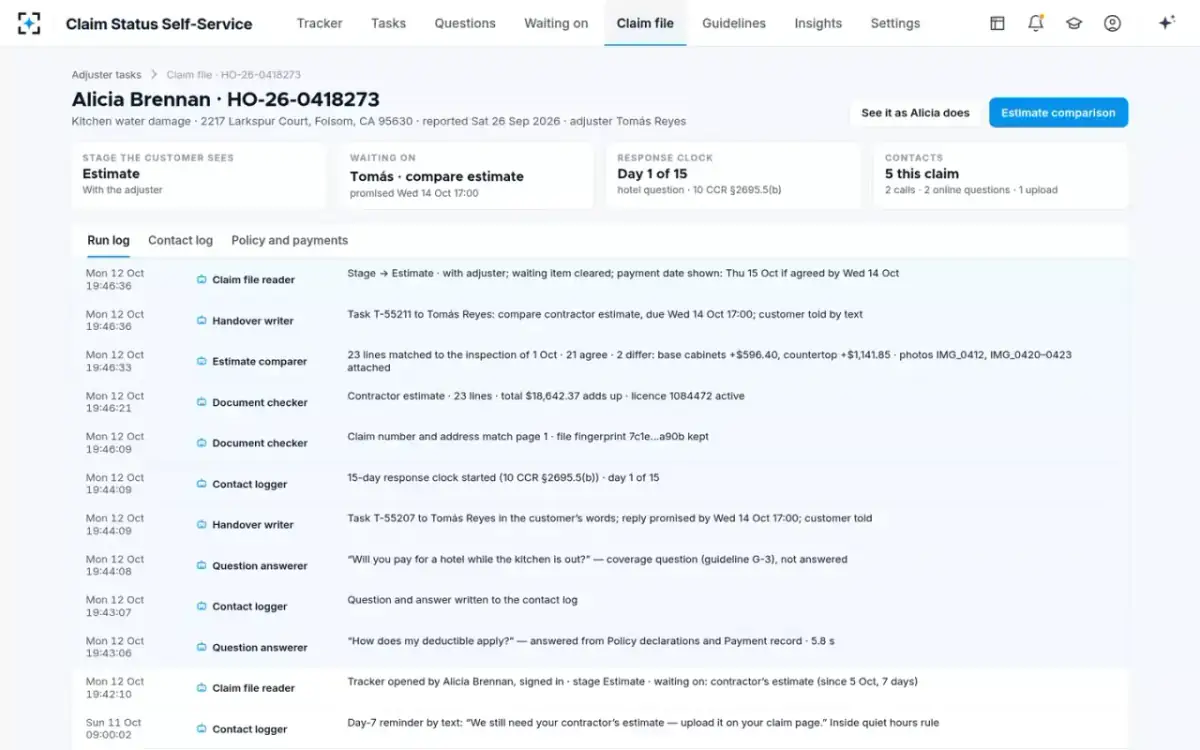
The solution counts whatever clocks a carrier sets, per question and per claim, and logs each against the claim. On the sample California claim, the settings carry California's: a complete answer to any question within 15 calendar days and written status every 30 days while a claim is undecided, each citing its regulation. A Florida carrier would set the 7-day acknowledgment, the 30-day coverage answer and the 60-day pay-or-deny clock, and the claim page and the adjuster's task list would show them the same way.
Each clock is counted on the claim and cites the rule it comes from
The supervisor's view counts the same clocks across every open claim, so a claim nearing day 60 is visible days before it gets there. In the sample week all three of the carrier's clocks stood at 100 percent: 3,358 questions answered within 15 days, 209 of 212 handed questions answered by the promised time with the rest still inside it, and 118 undecided claims sent their 30-day status on time. What a well-written status line says on any given day, so the clocks are never the only thing a homeowner sees, is the subject of the guide to an insurance claim under review. To see the sample claim screen by screen, start from Claim Status Self-Service.
Questions people ask
Does the Florida bill of rights apply to every homeowners claim?
It applies to insurers issuing personal lines residential property policies in Florida, and the 60-day payment rule behind it also covers commercial structures and tenants' contents of 10,000 square feet or less. It does not apply to commercial policies covering structures or contents in more than one state.
Can I sue my insurer for not giving me the bill of rights?
No. The statute says the bill of rights does not create a civil cause of action and that a failure to deliver it is not admissible as evidence against the insurer; the Office of Insurance Regulation enforces delivery administratively. The rights it summarises come from other statutes, which have their own remedies.
How long does a Florida insurer have to inspect my home?
Within 30 days after it receives the proof-of-loss statements, if the investigation involves a physical inspection, and the investigation itself must begin within 7 days of those statements. The adjuster must give you a document with their name and state licence number.
What does the dual interest in Florida's bill of rights mean?
It means someone else, usually your mortgage lender, may have an interest in the payment, so the check can name both of you. The 60-day promise still applies; the lender's endorsement and release follow its own rules.
Who do I call in Florida if my insurer is not responding?
The Department of Financial Services' Division of Consumer Services, whose toll-free helpline the bill of rights must list. It also runs the free mediation program for disputed residential claims.