The homeowners insurance claim process has four stages a policyholder can see: the claim is reported, the damage is inspected, an estimate of the repair is written and agreed, and the payment is made, often in more than one part. Each stage has a deadline in state law, and each spends most of its time waiting on someone: the insurer, the policyholder, a contractor or a lender. The difficulty is that insurers do not run claims in four stages; their claim systems hold dozens of status codes written for adjusters, and a policyholder shown "In progress" or a code has no idea what is happening or what to do. Botminds' Claim Status Self-Service is a policyholder self-service solution that shows each claim as those four stages, drawn live from the claim file, and names the one item the current stage is waiting on and who has it.
The example claim is fictional sample data, as it runs through the solution: a burst supply line under Alicia Brennan's kitchen sink in Folsom, California, insured by an invented carrier, Halverton Mutual. Its dates and amounts are not a customer's result. The deadlines are California's and Florida's, quoted as published on 27 October 2026.
How often a homeowners claim happens, and what it is worth
5.8%
average annual homeowners claim frequency, 2018–2022
$18,206
average severity per homeowners claim over the same years
330+
private homeowners insurers in the data the figures come from
What is the homeowners insurance claim process?
It is the sequence from reporting damage to being paid for it, and regulators describe it in similar steps. The NAIC's consumer guide lays it out as reporting the claim, the adjuster estimating the damage, determining coverage and what the insurer will pay, then rebuilding, repairing and replacing. It also warns that payment is not one event: "The settlement process is not a single transaction." Living-expense payments usually come first, then payments for belongings, then for the repairs to the house.
Those steps describe what the insurer does. A policyholder needs a shorter list that answers a different question: where is my claim now, and what is it waiting for? Four stages do that for a typical water or storm claim on a house, and the sample carrier adds a fifth, Contents, for fire, wind and hail claims, where belongings become a separate piece of work.
The regulator’s steps and the four stages a policyholder sees
| Stage the policyholder sees | What happens | The NAIC’s step | Who usually has it |
|---|---|---|---|
| Reported | The claim is opened and acknowledged; emergency work such as drying is arranged; an adjuster is assigned | Report a claim | The insurer |
| Inspected | The adjuster or an inspector sees the damage, takes photos and measurements | Estimate damage | The insurer, and the policyholder for access |
| Estimate | The insurer’s estimate is written; the policyholder’s contractor prices the work; differences are decided; coverage is confirmed | Estimate damage; determine coverage | Often the policyholder or the contractor, then the adjuster |
| Payment | Payments are issued, often in parts; depreciation held back is paid after repairs | Rebuild, repair and replace | The insurer, then the lender if one is named |
Stage 1, Reported: what happens after you file a homeowners claim
The insurer acknowledges the claim, sends any forms and instructions, assigns an adjuster and, for water, often sends a drying company the same day. State law sets the pace of the first step. California requires an insurer, immediately and within 15 calendar days of notice, to acknowledge the claim, provide the necessary forms and instructions, and begin any necessary investigation (10 CCR 2695.5(e)). Florida allows 7 calendar days to acknowledge a claim communication, and its acknowledgment must include the forms, instructions and a telephone number (§627.70131).
On the sample claim, Alicia reported the burst pipe in the insurer's app at 08:12 on Saturday 26 September. A drying company was drying the kitchen that day, through to 30 September, and was later paid $3,840.00 directly. Her adjuster called her on Monday 28 September, and on 30 September the loss was confirmed as covered, a sudden discharge of water under dwelling coverage. Everything a policyholder needs to know at this stage fits on one line: who the adjuster is, what is being done, and what happens next.
Stage 2, Inspected: the adjuster’s visit and the scope of the damage
Someone from the insurer sees the damage, in person or through photos and video, measures it and records what must be repaired. Florida allows electronic inspection methods, from photographs to drones, and requires any physical inspection within 30 days of receiving the proof of loss. On the sample claim an inspector visited on Thursday 1 October and took 46 photos and moisture readings of the kitchen and hall.
The inspection is where the policyholder's own job begins, and it is often missed. If belongings were damaged, the NAIC guide says, the adjuster will ask for a home inventory; for structural repairs, the insurer may ask for the policyholder's own contractor's estimate. A status page that ticks Inspected without saying what the insurer now needs from the policyholder has left out the most useful sentence.
Stage 3, Estimate: the stage that waits on the most people
The insurer writes its estimate of the repair, the policyholder's contractor writes theirs, and the adjuster decides the differences. It is the stage with the most parties and the most waiting. The sample claim shows why.
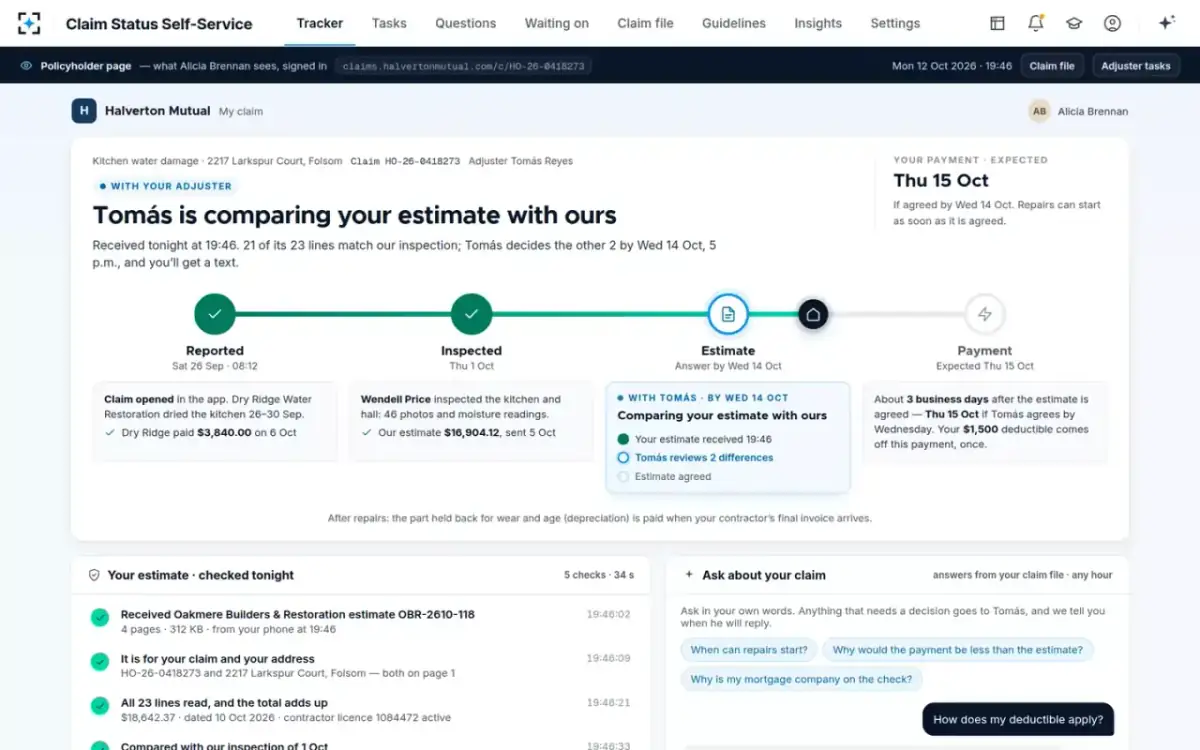
The insurer's estimate, $16,904.12, was sent on Monday 5 October with a request for Alicia's contractor's estimate. For the next seven days the claim waited on her, and two calls in that week did not tell her so. When she opened her claim page on the evening of 12 October, the Estimate stage named the item, with an upload button. She uploaded her contractor's estimate from her phone at 19:46; it was checked against her claim and address and compared with the inspection within 34 seconds: 21 of 23 lines matched and 2 differed. The adjuster decided both the next morning and agreed $17,500.52.
The Estimate stage, minutes after the upload: who has it and by when
Who had the sample claim, day by day, from report to check
Alicia Brennan’s claim, 26 Sep to 15 Oct (19 days)
- Insurer: report, drying, inspection, estimate · 47%
- Policyholder: contractor’s estimate · 37%
- Adjuster: deciding 2 lines · 5%
- Payments: check to the mail · 11%
Over a third of the claim's life was the policyholder's own wait, and she did not know it. That is not unusual in kind: on the same evening, across the sample region's 2,192 open property claims, 611 were waiting on the policyholder and 388 on a contractor. A stage that names its waiting item turns those days into something the policyholder can act on.
Stage 4, Payment: why it comes in parts
Because the policy pays different coverages at different times, and replacement cost policies pay depreciation only after the repair. On the sample claim the first dwelling payment was the agreed $17,500.52, less $2,214.60 of depreciation held back until the repairs are done and the $1,500 deductible: $13,785.92, by check to Alicia and her mortgage lender, mailed on Thursday 15 October. The rest comes when the contractor's final invoice arrives.
The Payment stage: the amount, what is held back, and who is on the check
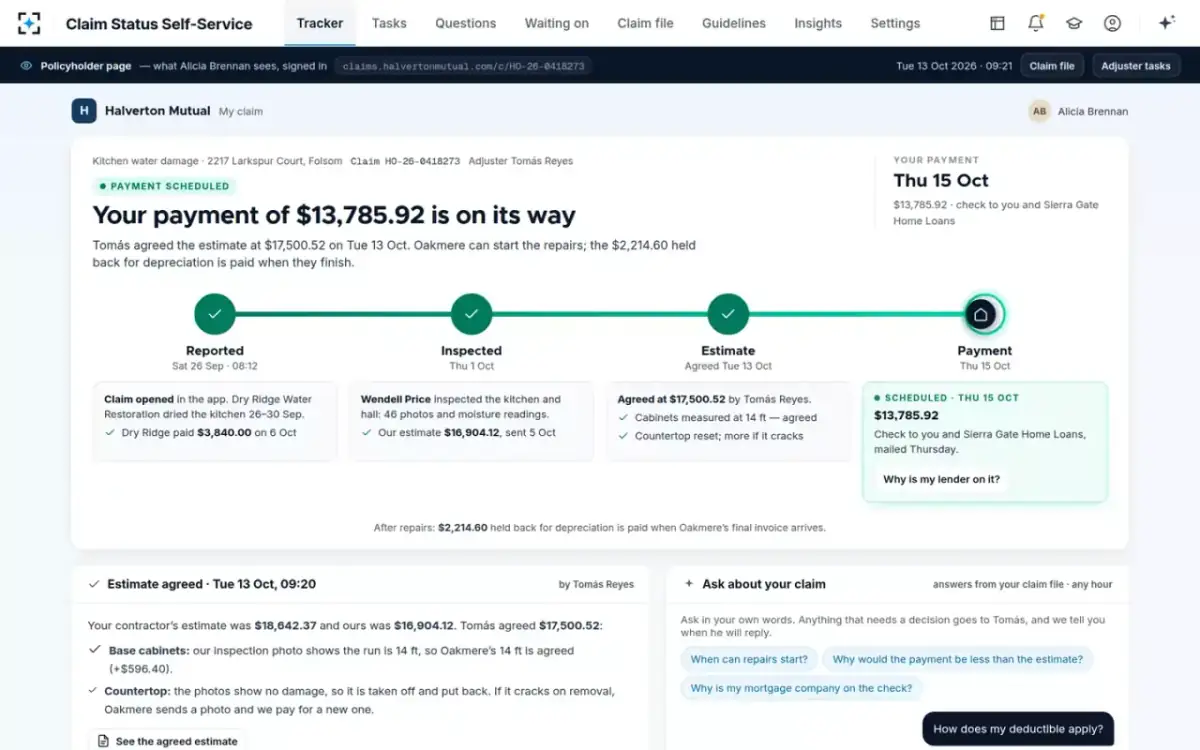
Two payment questions generate more calls than any other at this stage, and each has its own guide: why the check is smaller than the estimate, answered in the guide to the recoverable depreciation holdback, and why the lender is named on it, in the guide to an insurance check made out to your mortgage company.
How long does a homeowners insurance claim take?
As long as its slowest wait, within outer limits set by state law. California requires an insurer to accept or deny a claim, in whole or in part, within 40 calendar days of receiving proof of claim, and to write every 30 days while it cannot (10 CCR 2695.7). Florida requires payment or denial of a residential claim within 60 days of notice. Neither sets how long the repair takes, and a claim with depreciation held back stays open until the work is finished.
The sample claim, stage by stage: 19 days from report to check
- Reported26 Sep–1 Oct
- Inspected1–5 Oct
- Estimate5–13 Oct
- Payment13–15 Oct
The sample claim's 19 days are short for a homeowners claim because it was a contained water loss with a quick inspection. A wildfire or hurricane claim, or one with a dispute, runs for months, and much of that time is waiting on contractors, lenders, permits and adjusters stretched across a catastrophe. The stage names stay the same; the waiting items change.
Why four stages, and not the claim system’s codes
Because a status a customer cannot understand produces a call, and a status a customer can see moving produces trust. The sample claim's code during its seven-day wait was "Est. pending — PH", which tells an adjuster the estimate is pending on the policyholder and tells the policyholder nothing. Research on service design supports showing the work: in experiments on online services, Ryan Buell and Michael Norton of Harvard Business School found that when websites signal the effort being made on a customer's behalf, "people can actually prefer websites with longer waits to those that return instantaneous results—even when those results are identical."
“due to what we term the labor illusion, when websites engage in operational transparency by signaling that they are exerting effort”
Buell and Norton, The Labor Illusion, Management Science, 2011
A claim is not a website search, and nobody prefers a longer claim. But the finding explains why a tracker that shows stages ticking off, the item being waited on and the next date reduces calls even before it speeds anything up: the wait stops being a black box.
Designing the stages: the rules behind the translation
Mapping codes to stages is a design decision with rules, and getting them written down before launch avoids the awkward cases. The sample carrier's settings define the stages per claim type and the wording of every waiting item, and its approved message rules govern what the page may say.
Rules for turning claim codes into stages a policyholder can see
- Every code maps to exactly one stage
A code that could mean two stages is split in the claim system or resolved by a rule, never shown raw.
- Each stage names its one waiting item and who has it
The policyholder, a contractor, the adjuster, payments or someone else such as a lender or a city permit office.
- A stage can move back
A supplement for hidden damage returns the claim to Estimate; say so rather than hide it.
- Dates come only from the file
A promised reply time, a payment date, a request date; never an estimate the adjuster has not made.
- Partial payments leave the stage open
Say what is still to come, such as depreciation after repairs.
- Each claim type gets its own stages
Fire, wind and hail add Contents; auto claims follow the repair shop.
Four stages, each with what happened and what is next
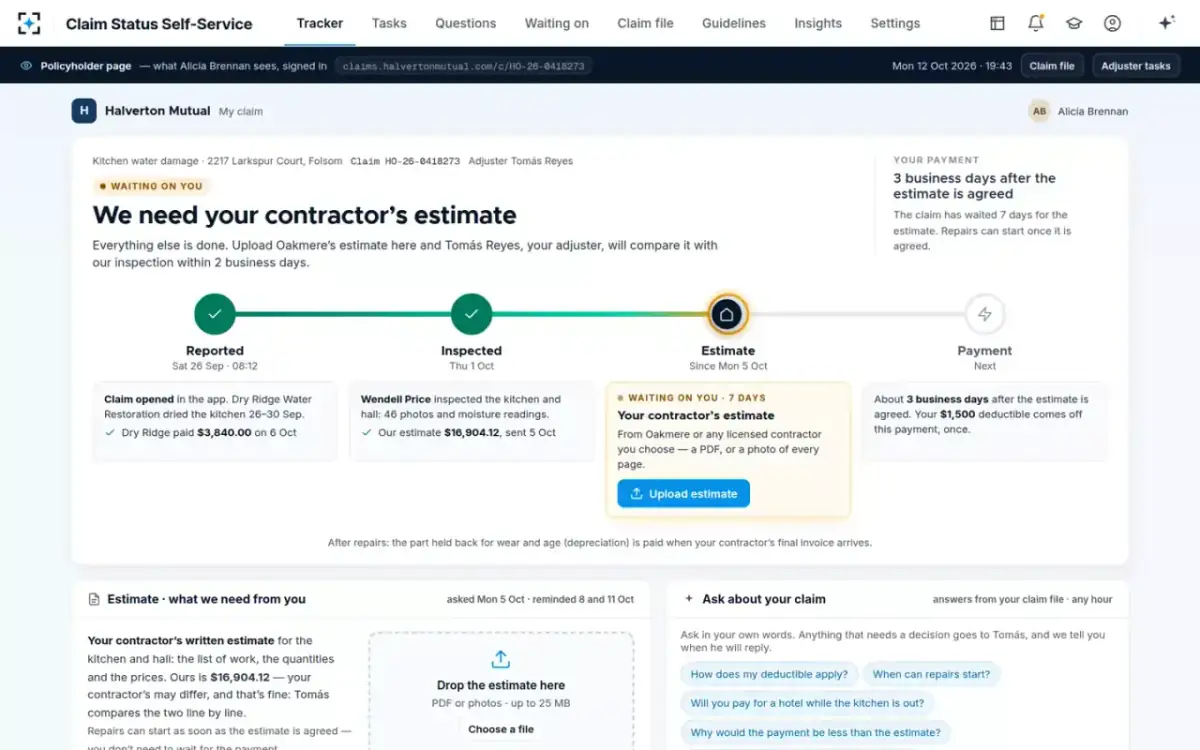
The stages also carry the wording. What a stage should say while a decision is pending, so that "under review" never stands alone, is set out in the guide to an insurance claim under review. To see the sample claim screen by screen, start from Claim Status Self-Service.
Questions people ask
What are the steps to file a homeowners claim?
Make the home safe and prevent further damage, photograph everything, report the claim to your insurer as soon as you can, keep receipts for emergency repairs and any hotel stay, and be ready for the adjuster's inspection with a list of damaged belongings.
What happens after the adjuster inspects my home?
The insurer writes its estimate of the repair, and may ask for your contractor's estimate or a home inventory. In Florida you must receive a copy of any detailed estimate within 7 days of the adjuster generating it; differences between estimates are decided by the adjuster, and payment follows once the amount is agreed.
How long does it take for a home insurance claim to be approved?
State law sets outer limits: in California, acceptance or denial within 40 days of proof of claim; in Florida, payment or denial within 60 days of notice for residential claims. Many claims are decided sooner; ones waiting on documents, contractors or disputes take longer.
Why does my homeowners claim payment come in several checks?
Because coverages are paid separately and replacement cost policies hold back depreciation until repairs are done. The NAIC's guide says living-expense payments usually come first, then personal property, then the repairs to the house.
Does filing a homeowners claim always mean an inspection?
Usually, but not always in person. Florida explicitly allows insurers to investigate with photographs, video calls and drones, and a small claim may be handled from photos and invoices.