AI chatbot disclosure laws require a business to tell people when they are dealing with an AI rather than a person, and in the United States they are state laws with different triggers. Utah requires a business using generative AI in a consumer transaction to disclose it when the person clearly asks, and requires licensed professionals to disclose it up front when the AI gives advice someone could rely on for a significant personal decision. California makes it unlawful to use a bot online to mislead a person about its artificial identity in order to sell something, unless the bot is disclosed. Both states also make a further point that matters more to an insurer: the company answers for what its AI says. Botminds' Claim Status Self-Service is a claim status assistant for policyholders: it answers from the live claim file and the policy with a source on each answer, and hands every question that needs judgment, such as coverage, to the adjuster.
This guide reads the two state laws as published on 27 October 2026, the clearest court-like ruling on a chatbot's wrong answer, and the claims rules that apply whoever answers. Examples come from a fictional sample: an invented insurer, Halverton Mutual, and its policyholder Alicia Brennan, whose kitchen flooded in Folsom, California, as her claim runs through the solution. Those details are sample data, not a customer's result. Nothing here is legal advice; a carrier's counsel decides how each law applies to its business.
Two state chatbot disclosure laws, read side by side
| Utah Code Title 13, Chapter 77 | California Bus. & Prof. Code §17941 | |
|---|---|---|
| Who it covers | A supplier using generative AI to interact with an individual in a consumer transaction; and people in occupations licensed by Utah’s Department of Commerce | Any person using a bot to communicate or interact with someone in California online |
| What triggers it | A clear, unambiguous question about whether the person is talking to AI; or, for licensed occupations, a high-risk interaction | Intent to mislead about the bot’s artificial identity, to encourage a purchase or sale or to influence a vote |
| What must be said | That the person is interacting with generative AI and not a human; for high-risk interactions, a prominent disclosure | That it is a bot, clearly and conspicuously |
| When | On request; for high-risk interactions, at the start of a spoken one and in writing before a written one | A disclosure removes liability; the law sets no single moment |
| Safe harbor or defence | No enforcement action if the AI discloses at the outset and throughout that it is AI, not human, or an AI assistant | Disclosure itself is the defence |
| What it adds on liability | It is not a defence to a consumer protection violation that generative AI made the statement | Applies only to misleading use for sales or elections |
What do AI chatbot disclosure laws require?
At their simplest, an honest answer to the question "am I talking to a person?". At their strictest, a statement at the start of the conversation, repeated through it, that the other party is an AI. The difference between those two is the difference between Utah's general rule and its safe harbor, and it is where most businesses settle: say it up front and keep saying it, and the question of when disclosure was required never arises.
The laws do not forbid chatbots, and they do not define what a chatbot may say about an insurance claim. Those limits come from elsewhere: from the unfair claims practices laws that govern every claims statement, and from the ordinary rule that a company is answerable for what it tells customers. A claims assistant that discloses perfectly and answers wrongly has satisfied the disclosure law and failed everything else.
Utah's rule: disclose when asked, and up front for high-risk advice
Utah's general rule turns on the customer's question. A supplier using generative AI in a consumer transaction "shall disclose to the individual that the individual is interacting with generative artificial intelligence and not a human, if the individual asks or otherwise prompts the supplier about whether artificial intelligence is being used." The question must be clear and unambiguous. Licensed professionals carry a heavier duty: they must "prominently disclose when an individual receiving services is interacting with generative artificial intelligence" where the use is a high-risk interaction.
The definition of high risk is the part a claims leader should read twice. It includes an interaction involving the collection of sensitive personal information, among it financial data, and the provision of personalized recommendations, advice, or information that could reasonably be relied upon to make significant personal decisions, with financial and legal advice named as examples. A conversation about whether a hotel stay is covered, or whether to accept an estimate, comes close to that description whatever the statute's scope turns out to be.
The safe harbor is how a carrier stops worrying about the edge cases. No enforcement action follows if the AI clearly and conspicuously discloses, "at the outset of any interaction" and throughout it, that it is generative AI, that it is not human, or that it is an AI assistant. A claim status page that says so in its header and on every answer is inside it.
California's bot disclosure law
California's law, enacted in 2018 as SB 1001, is narrower and older. As the state Assembly's privacy committee summarised existing law in 2025, it prohibits using a bot to communicate with a person in California online "with the intent to mislead the other person about its artificial identity" in order to knowingly deceive them about the content of the communication, to encourage a purchase or sale or to influence a vote. A person who discloses the bot is not liable, and the disclosure must be clear, conspicuous and reasonably designed to inform the people the bot talks to.
A claim status assistant is not selling anything, so the law's commercial trigger may not reach it at all. That is not a reason to skip disclosure. The same committee analysis records a 2025 proposal, AB 410, to require every bot to disclose its identity before interacting and to answer truthfully when asked; whatever becomes of that bill, the direction is plain, and a carrier that already discloses at the outset has nothing to change.
Is the company liable for what its chatbot says?
Both of the authorities below say yes. Utah's law says so in terms; as amended in 2026, it "is not a defense to the violation of any statute administered and enforced by the division under Section 13-2-102 that generative artificial intelligence: (1) made the violative statement", undertook the violative act, or was used in furtherance of the violation.
The best-known ruling came from British Columbia's Civil Resolution Tribunal in February 2024. Air Canada's website chatbot told a grieving passenger he could apply for a bereavement fare retroactively; the airline's policy did not allow it, and the chatbot's answer even linked to the page that said so. The airline argued it could not be held liable for information provided by its chatbot. The tribunal found that the airline did not take reasonable care to ensure its chatbot was accurate, and ordered it to pay $812.02.
“It should be obvious to Air Canada that it is responsible for all the information on its website. It makes no difference whether the information comes from a static page or a chatbot.”
Moffatt v. Air Canada, 2024 BCCRT 149
Two lessons transfer directly to claims. First, a link to the right policy does not cure a wrong sentence above it: the tribunal asked why the customer should have to check one part of the website against another. Second, the claims laws already apply. The NAIC's model unfair claims act, which many state statutes follow, lists among unfair practices misrepresenting relevant facts or policy provisions to claimants and failing to acknowledge their communications with reasonable promptness. Neither cares whether a person or a program said it.
Can a chatbot tell me if my claim is covered?
It can tell you what the adjuster has already decided, and it should not decide anything itself. Whether a loss, an item or a cost is covered is a judgment about the policy and the facts, made by a licensed adjuster who answers for it, and a wrong coverage answer from an assistant is the company's misstatement. A good claims assistant therefore separates two kinds of question: those whose answer is already on the file, such as "has my claim been accepted?" once the adjuster has accepted it, and those that ask for a new decision, such as "will you pay for a hotel?".
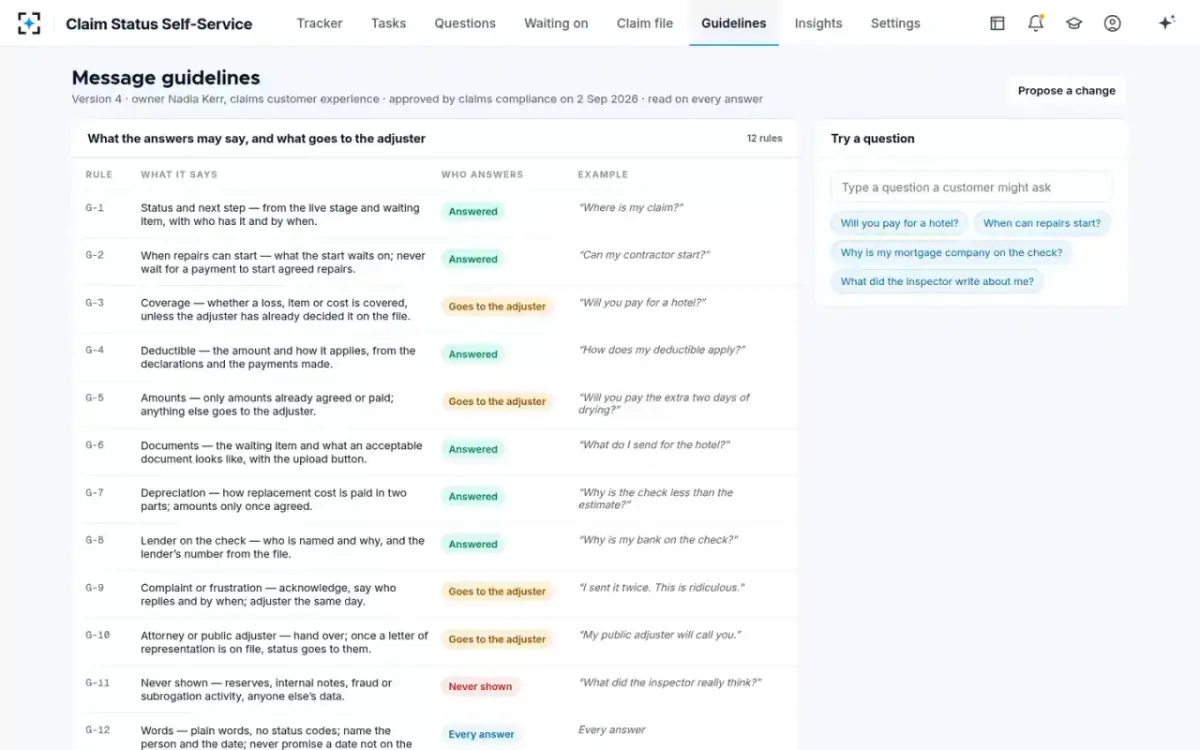
That is how the sample carrier's message guidelines draw it. Rule G-3 sends coverage questions to the adjuster unless the adjuster has already decided the point on the file. When Alicia Brennan asked whether Halverton would pay for a hotel while her kitchen was out, the answer did not guess:
“That’s a decision for Tomás Reyes, your adjuster: whether living costs are covered depends on whether the house can be lived in during the repairs. I’ve sent him your question in your words, with your claim details. He’ll reply by Wed 14 Oct, 5 p.m., here and by text. Keep receipts for any extra costs from today.”
The sample claim's answer, handed to the adjuster under guideline G-3
That answer still teaches the policyholder something true, what the decision turns on and what to keep, without making the decision. How loss-of-use coverage is actually worked out is a separate subject, set out in the guide to how loss of use is calculated for homes.
Where the line sits in a claims assistant
The line is a written rule, not the model's judgment. Every question is either answerable from the claim file, the policy and an approved guideline, in which case it is answered with a source on each detail, or it is not, in which case it goes to a named person with a reply-by time the customer sees.
One question through Claim Status Self-Service
Agent
Question answererReads the question against the live claim file, the policy and the approved message guidelines.
Never: Guesses when a guideline says the adjuster decides.
Agent
Question answererAnswerable from the file: replies in plain words, with the claim document, policy clause or guideline behind each detail.
Never: Promises coverage, an amount not agreed or a date not on the file.
Agent
Handover writerNeeds judgment: turns the question into an adjuster task with the customer’s own words, the file context and a reply-by time, and tells the customer who and when.
Never: Answers the judgment question itself.
A person decides
AdjusterDecides: coverage, amounts not yet agreed, exceptions, complaints, anything after an attorney or public adjuster is mentioned.
Agent
Contact loggerWrites the question, the answer or the handover, and the response clock, to the claim’s contact log.
Never: Edits or deletes a logged contact.
Twelve written rules decide what is answered and what is handed over
Disclosure is the easy part; the handover is the test
Writing "you are chatting with an AI assistant" takes a minute. Building an assistant that knows when to stop takes the rest of the project, and it is where consumer regulators have looked hardest. The CFPB's 2023 study of chatbots in banking found customers stuck in loops with no route to a person, and warned that "These systems may simply be offloading the burden of a human having to explain such policies or the responsibility of knowledgeable customer service agents to a cheaper automated process." The study concerned banks, not insurers, but the failure it describes is the same on a claims line.
Why 212 questions went to an adjuster in one sample week
The bars show the line working. Nearly two in five handovers were coverage questions; another quarter asked about amounts nobody had agreed. Every one of them is a question a less careful assistant could have answered plausibly and wrongly. And the handover is fast because the work of understanding the question is already done: the adjuster receives the customer's words, the file context and the time promised.
Two ways to put AI on a claims line
A chatbot with a disclosure banner: Whatever the model can phrase, from public pages and FAQs.
A claims assistant built on handover: Only what the claim file, the policy and an approved guideline support.
A chatbot with a disclosure banner: Answered in general terms, often with a caveat.
A claims assistant built on handover: Handed to the adjuster unless already decided on the file.
A chatbot with a disclosure banner: A link, if any, which may not match the sentence.
A claims assistant built on handover: The document behind each detail, which the customer can open.
A chatbot with a disclosure banner: A phone number at the end of a loop.
A claims assistant built on handover: A named person and a reply-by time, inside the conversation.
A chatbot with a disclosure banner: Chat transcripts held apart from the claim.
A claims assistant built on handover: Every question, answer and handover on the claim’s contact log, never edited.
Questions to put to any claims assistant before it goes live
Buyers can test all of this before a single policyholder sees it. The questions below come from the laws above and from the failures they describe; the testing method itself is set out in the guide to AI insurance chatbot accuracy.
Disclosure and handover questions for a claims assistant
- Where does it say it is AI?
At the outset and throughout, in words like those in Utah’s safe harbor, on the page, in texts and on the phone line.
- What does it say when asked “am I talking to a person?”
A plain yes or no, never a deflection.
- Which questions does it refuse to answer, and who wrote that list?
A written rule set owned by a named person and approved by compliance, not the model’s judgment.
- What happens to a coverage question?
It should go to the adjuster with the customer’s words and a reply-by time the customer can see.
- Does every detail carry its source, and does the sentence match it?
A link to the right page under a wrong sentence did not help Air Canada.
- Is every conversation kept on the claim?
Unedited, with the channel, the sources and the outcome, for the regulator and for the next adjuster.
- Who changes the rules, and how?
Changes should need compliance approval and leave a version history.
Regulators' wider expectations for AI in insurance, set out in the NAIC's model bulletin and adopted by many states, are covered in the guide to insurance companies using AI to deny claims. To see how the sample claim's questions were answered and handed over, screen by screen, start from Claim Status Self-Service.
Questions people ask
What is the California bot disclosure law?
Business and Professions Code §17941, enacted as SB 1001 in 2018. It makes it unlawful to use a bot online to mislead a person in California about its artificial identity in order to encourage a purchase or sale or to influence a vote, and a clear, conspicuous disclosure that it is a bot removes the liability.
What does Utah's AI disclosure law require?
A supplier using generative AI in a consumer transaction must tell an individual they are dealing with AI and not a human if the individual clearly asks. People in licensed occupations must disclose it prominently, at the start of the interaction, when the AI is used for high-risk interactions such as financial or legal advice. Disclosing at the outset and throughout gives a safe harbor.
Do I have to be told I am talking to AI on an insurance claim?
It depends on the state and on how its law treats an insurance claim conversation; in Utah, a clear question about whether you are talking to AI must get a truthful answer in a consumer transaction. Disclosing up front, on every channel, is the simplest way to stay within every state's rule.
Can I talk to a human about my claim instead of a chatbot?
You should always be able to. On a well-built claims assistant, a question that needs judgment, a complaint or a mention of an attorney goes to the adjuster with a reply-by time; in the sample week 212 of 3,358 questions were handed over that way.
Can an insurer blame its chatbot for a wrong answer?
Not successfully, so far. Utah's law says AI making the statement is no defence to a consumer protection violation, and British Columbia's tribunal held Air Canada responsible for its chatbot's wrong answer, finding it made no difference whether the information came from a static page or a chatbot.