Insurance virtual assistant cost only makes sense next to the cost of the work it replaces, and on the claims side that work is mostly status calls: "where is my claim?", "when will I be paid?", "why is the check smaller?". A status call answered by a claims adjuster costs the adjuster's loaded wage for every minute of the call, plus the estimate or decision that waited while the call went on. Federal data put the median claims adjuster's pay at $37.51 an hour and wages at 70 percent of employer compensation cost, which makes an adjuster's hour cost about $53.59 before overheads. Botminds' Claim Status Self-Service is an AI claim status assistant for property policyholders that answers those questions from the live claim file, at any hour, and hands judgment questions to the adjuster; its value is measured in calls that no longer reach the adjuster and answers that are right the first time.
The worked example uses a fictional sample: a six-adjuster property team at Halverton Mutual, an invented insurer, before and after self-service went live on its claims. Those figures are sample data, not a customer's result. The wage figures are the Bureau of Labor Statistics'; the arithmetic is ours, and every input is one a carrier can replace with its own.
What an hour of the people who answer status calls costs
$37.51
median hourly pay of claims adjusters, appraisers, examiners and investigators, 2025
$22.47
median hourly wage of customer service representatives in insurance carriers and related activities, May 2025
70%
share of private employers’ compensation cost paid as wages, June 2026
How much does an insurance virtual assistant cost?
It depends on which kind you mean, and the honest comparison is with the in-house hour, not with another vendor's quote. A human virtual assistant is priced by the hour or the month by the firm that supplies them, and rates vary with country, hours and skills. An AI assistant is usually priced by licence, by volume or by the claims it covers. Neither price means anything until it is set against what the same work costs today, and that cost is knowable from public data and your own call logs.
The in-house hour is the benchmark because it is the hour the assistant frees. The BLS puts the median wage of customer service representatives in insurance carriers and related activities at $22.47 an hour in May 2025, and of claims adjusters, appraisers, examiners and investigators at $37.51. Wages are about 70 percent of what a private employer pays for an hour of work, according to the June 2026 employer cost survey, which says "Wages and salaries averaged $32.82 and accounted for 70.0 percent of employer costs," so the loaded hour is roughly the wage divided by 0.7.
Two meanings of "insurance virtual assistant"
People who search for an insurance virtual assistant are often looking for a person: a remote assistant who handles an agency's or a claims team's calls, emails and paperwork. Others mean software: a chatbot or AI assistant on the website, on text or on the phone. Both are bought to take routine contacts off skilled staff, and both can be measured the same way. They differ in what they can know. A remote assistant without access to the claim file can take a message but cannot say what the claim is waiting on; one with full access is a contact centre agent by another name. An AI assistant reading the claim file can say what it is waiting on at three in the morning, and must be held to rules about what it may not say.
The sample carrier's own contact centre agent put the problem with the human route in one line: he could read the status code but could not tell the customer what it meant. A virtual assistant, human or AI, that only relays codes moves the call rather than ending it.
What does a status call cost an insurer?
The minutes of the person who answers it, at their loaded rate, plus the cost of whatever they were not doing. For an adjuster that second part is the larger one: a desk adjuster's day is estimates, comparisons and decisions, and every check-in call interrupts one of them. No government or academic source we could find publishes how long a claims status call takes or how many calls a claim generates, so the honest method is to price one minute and let a carrier multiply by its own figures.
The annual cost of status calls, term by term
Adjuster time on status calls
calls a week × minutes a call ÷ 60 × loaded hourly cost × 52
Calls from your phone system; minutes from a sample of recorded calls; cost from your payroll or the BLS figures above.
Claims operations and finance
Contact centre time on status calls
calls a week × minutes a call ÷ 60 × loaded hourly cost × 52
The same arithmetic for the agents who answer first, at their own rate.
Contact centre lead
Repeat contacts from wrong or partial answers
calls about the same question within 7 days × the costs above
A call that did not end the question comes back, often as a complaint.
Quality and complaints
Cost of the assistant
licence or volume price + set-up + the time to keep its rules current
The part every vendor quote shows; the other three are the part it should be compared with.
Procurement
A worked example: one minute of a status call, priced
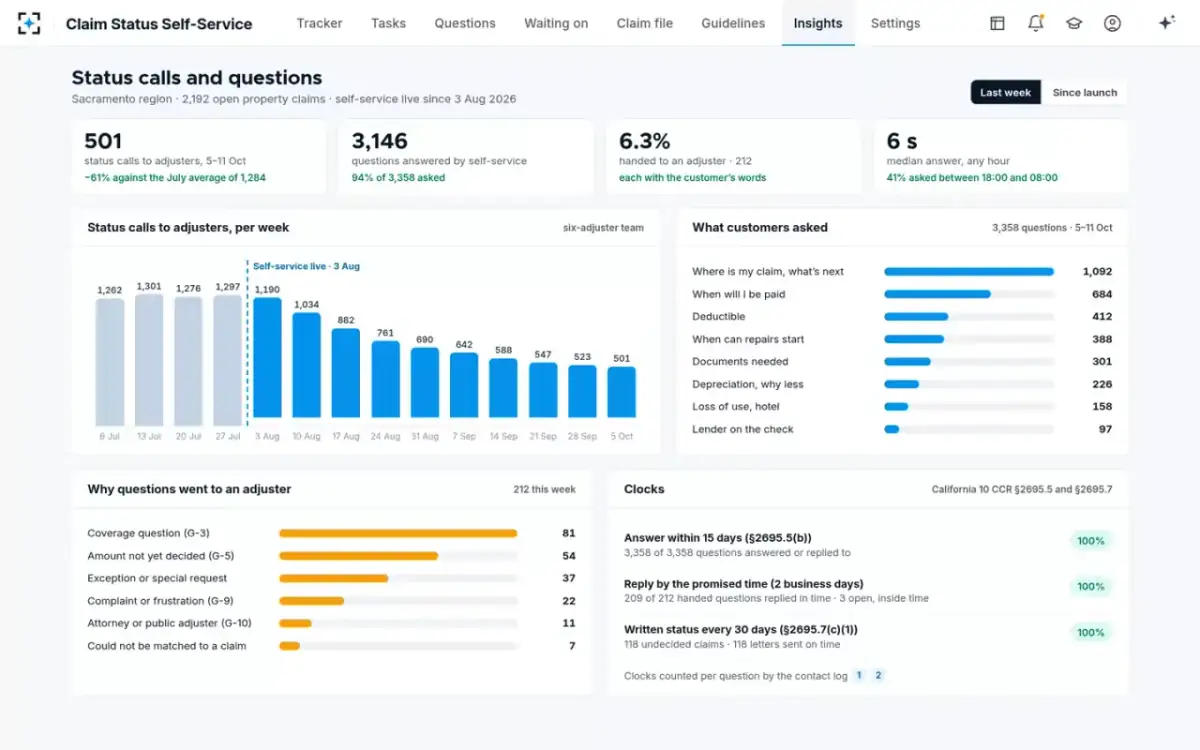
Take the sample team's numbers as they run through the solution. In four weeks of July, before self-service, its six adjusters took an average of 1,284 status calls a week. Ten weeks after self-service went live on 3 August, they took 501. That is 783 fewer calls a week, or about 40,700 a year, a fall of 61 percent (our arithmetic on sample data).
Status calls reaching one sample team’s adjusters, week by week
Now price a single minute. If each of those 783 avoided calls took one minute of an adjuster's time, the saving at a loaded $53.59 an hour would be about $36,400 a year. Every further minute a call really takes adds the same again. A carrier that times a sample of its own status calls can read its saving off that line: a call that takes m minutes is worth m times $36,400 a year on this team's numbers (our arithmetic).
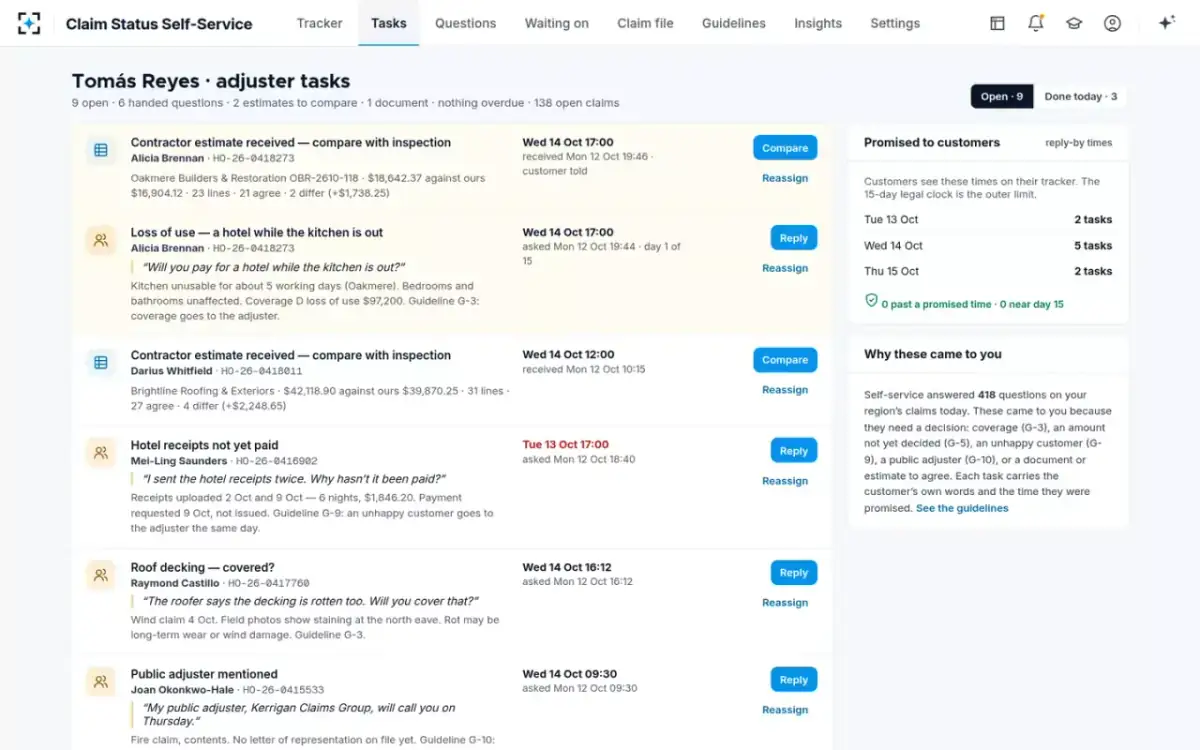
That is the direct cost only. The time does not vanish from the payroll; it moves to estimates and decisions, which is where the value lies. In the sample, the questions that still reached the adjuster were the ones that needed him: a coverage question about a hotel, a contractor's estimate to compare, a complaint about receipts sent twice, each with the customer's words and the time promised.
What reaches the adjuster once status questions do not
The cost a price list leaves out: wrong answers and repeat calls
A cheap assistant that answers wrongly is the most expensive option, because the customer calls back, and the second call is angrier. The CFPB's 2023 review of chatbots in banking counted wasted time, frustration, inaccurate information and junk fees among the costs that poorly designed bots pass to customers. On an insurance claim the equivalent is a wrong promise about money or coverage, which becomes a complaint and sometimes a regulator's inquiry.
So the third term in the formula, repeat contacts, deserves real measurement: how many questions come back within a week, from the same customer, on the same topic. It is also the cleanest test of a human virtual assistant service. If the remote assistant takes a message and the customer calls again the next day, the cost has doubled, not halved.
Three ways to answer "where is my claim?", compared
Carriers answer status questions in one of three ways, and most mix them. Each has a place; their costs and limits differ in ways a buyer can set out on one page.
Adjuster, agent or self-service: what each costs and what each can say
| The adjuster answers | An agent or virtual assistant answers | Self-service answers from the file | |
|---|---|---|---|
| Cost per hour of answering | About $53.59 loaded at the BLS median (our arithmetic) | About $32.10 loaded at the BLS median for insurance carriers; outsourced rates vary | A licence or volume price; no cost per call |
| Hours | Office hours, between other work | The service’s hours | Any hour; 41% of the sample week’s questions came between 18:00 and 08:00 |
| What it can say | Everything, including coverage and amounts | What the screen shows; often a status code without its meaning | What the file, the policy and approved wording support, each with its source |
| What it must not say | Nothing it cannot stand behind | Anything that needs judgment | Coverage, unagreed amounts, exceptions, complaints: handed to the adjuster with a reply-by time |
| Consistency | Varies with who picks up | Varies with the script and the agent | One rule set for every answer |
How to measure the return on claim self-service
Count the same things before and after, on the same claims, for long enough to see the trend settle: in the sample, calls fell steeply for five weeks and more slowly after that. Volume matters to the scale of the return. The Treasury's Federal Insurance Office found that, across more than 330 homeowners insurers from 2018 to 2022, the national "average claim frequency of 5.8 percent" held roughly steady, so a book of 100,000 homeowners policies produces around 5,800 claims a year (our arithmetic), each with its own run of questions.
The numbers to collect before and after
- Status calls to adjusters, per week
From the phone system, tagged by the reason the agent records; four weeks before launch at least.
- Minutes per status call
From a timed sample of recorded calls, not an estimate.
- Questions by topic and by hour
What customers ask, and how many ask outside office hours.
- Repeat contacts within seven days
Same customer, same topic: the measure of a wrong or partial answer.
- Response clocks met
Questions answered inside the state deadline, and handed questions answered by the promised time.
- Complaints mentioning communication
The slowest number to move and the one regulators read.
The sample team's weekly screen shows the shape of the result: 3,146 of 3,358 questions answered by self-service in the week of 5 October, 212 handed to adjusters, and all three response clocks at 100 percent. The accuracy side of the same measurement, testing answers against the team's, is set out in the guide to AI insurance chatbot accuracy.
The before-and-after a finance team can read in one screen
Where Claim Status Self-Service fits in the budget
It sits in the line where status calls cost adjuster and agent time today. It reads the claim system, policy administration, inspection estimates and payments; answers on a policyholder page, by two-way text and on a phone status line, in English and Spanish; checks uploaded documents; lines up contractors' estimates with the inspection; and logs every contact on the claim. It does not replace the adjuster or the contact centre. Coverage, amounts, exceptions and complaints still go to people, and the contact centre sees the same tracker and answers as the customer, so a phone call that still happens is shorter.
What it costs is a question for a conversation on your own claims, and the right comparison is the formula above with your inputs, not a list price. To see the sample team's week screen by screen, start from Claim Status Self-Service; the rollout itself is set out in the guide to a claim status portal go-live plan.
Questions people ask
What does an insurance virtual assistant earn?
There is no official wage series for virtual assistants as such. The closest BLS benchmark is customer service representatives in insurance carriers and related activities, whose median wage was $22.47 an hour in May 2025; outsourced and overseas assistants are priced by their firms.
What does a claims adjuster earn per hour?
The BLS puts the 2025 median pay for claims adjusters, appraisers, examiners and investigators at $37.51 an hour, or $78,020 a year. With wages at about 70 percent of employer compensation cost, the loaded hour is roughly $53.59 (our arithmetic).
How many status calls does a claim generate?
We found no government or academic source that publishes it, and vendor figures vary. Count your own: status calls a week from the phone system, against open claims the same week.
Is an AI assistant cheaper than hiring a virtual assistant?
Per answer, usually, because it has no cost per call and works any hour; in the sample week 41 percent of questions came between 18:00 and 08:00. Whether it is cheaper overall depends on how many calls it really ends, which only your own before-and-after numbers show.
Does self-service reduce adjuster workload or just move it?
Both: routine status calls go, and the questions that remain are the ones that need a decision. In the sample, adjusters took 501 status calls in a week against a July average of 1,284, and the 212 questions handed to them arrived with the customer's words and a reply-by time.