A recoverable depreciation holdback is the part of a replacement cost claim the insurer keeps back until the repairs are finished: it pays the actual cash value first, the replacement cost minus an allowance for age and wear, and pays the depreciation when the policyholder shows the work is done. The deductible is a different deduction. It is the share of the loss the policyholder agreed to carry, it comes off once, and it does not come back. Both make the first check smaller than the estimate, and homeowners routinely confuse them, which is why "why is my check less than the estimate?" is one of the questions claims phone lines hear most. Botminds' Claim Status Self-Service answers policyholders' claim questions from the live claim file and the policy, with a source on each answer; on the payment stage it separates the two deductions line by line, and it explains them the same way at two in the afternoon and two in the morning.
The example below is a fictional sample claim as it runs through the solution: a burst supply line in Alicia Brennan's kitchen in Folsom, California, insured by an invented carrier, Halverton Mutual, under a replacement cost homeowners policy. Every figure on her claim is sample data, not a customer's result. The rules come from the National Association of Insurance Commissioners, California, Florida and the federal flood policy.
One payment, annotated: from the contractor’s estimate to the check
Contractor’s estimate
$18,642.37
Oakmere Builders & Restoration, 23 lines, uploaded by the policyholder.
Price the adjuster did not agree
− $1,141.85
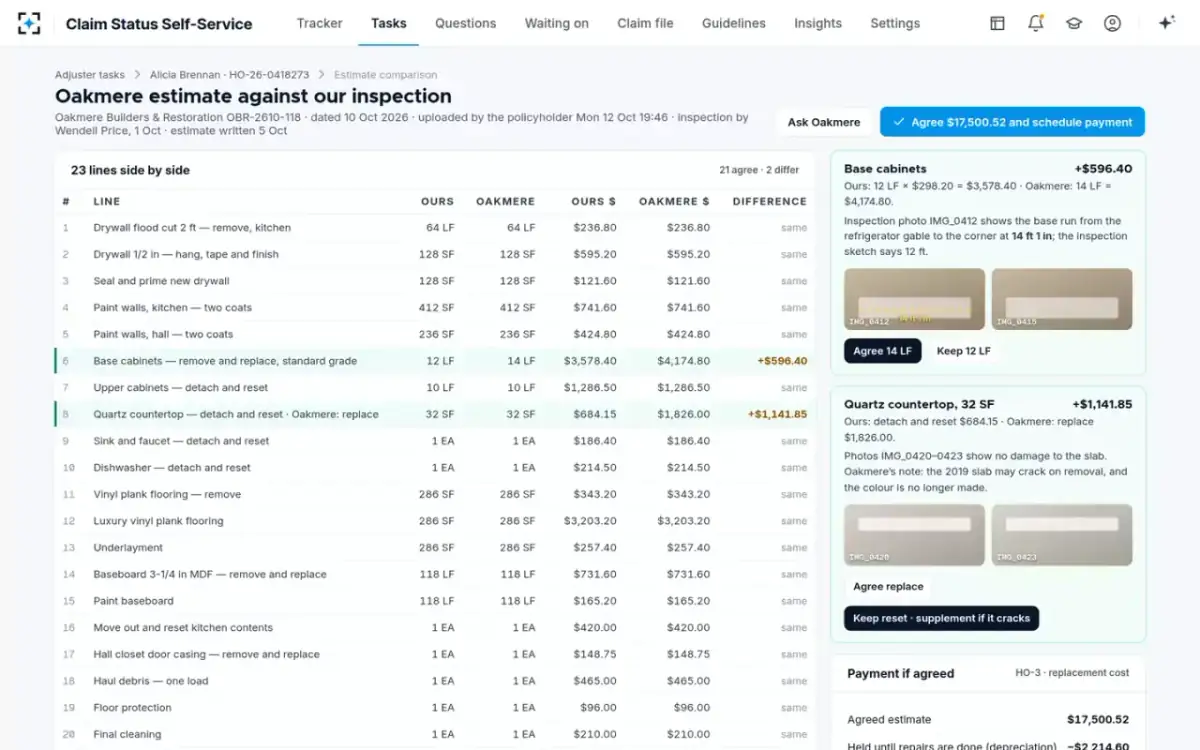
Countertop: the contractor priced a replacement; photos showed no damage, so it is taken off and reset, with a supplement if it cracks.
Agreed estimate
$17,500.52
The replacement cost the claim is settled on, before the deductible.
Depreciation held back
− $2,214.60
Age and wear of what is being replaced. Paid when the repairs are finished and the final invoice arrives.
Deductible
− $1,500.00
Taken once for this claim, from the repair payment. Not paid back.
Paid now
$13,785.92
By check, mailed Thursday 15 October.
What is recoverable depreciation?
Recoverable depreciation is the amount between what it costs to replace damaged property and what that property was worth given its age and condition, and it is "recoverable" because a replacement cost policy pays it once the property is actually repaired or replaced. The NAIC's consumer guide defines it in one line: "Recoverable depreciation is calculated as the difference between an item’s replacement cost and ACV." It also sets out the two-step payment that creates the holdback: on a replacement cost policy "the insurer at first may pay only the ACV for the damage to your home or personal property", and pays the difference, up to the replacement cost, when the policyholder shows the repair or replacement has been made.
The size of the holdback depends on what was damaged. A ten-year-old kitchen floor carries more depreciation than last year's paint. The NAIC's example is a roof near the end of its life: an actual cash value policy "may pay as little as 20% of the cost to replace the roof", while a replacement cost policy pays the whole cost, part of it later. That is the gap a holdback bridges, and why it can be large on an old roof and small on a recent remodel.
California adds a limit worth knowing: its Insurance Code allows depreciation only on parts of a structure that are normally repaired and replaced during its useful life, as the Department of Insurance's 2026 notice summarises it, and its claims regulations require every deduction to be itemized and explained to the claimant in writing. The guide to like kind and quality rules works through how depreciation is set on contents; this page stays on the dwelling check.
The holdback and the deductible: two deductions, two outcomes
The holdback is a timing difference and the deductible is a permanent one. Treating them as the same thing is the most common error in explaining a claim payment, from either side of the phone: a homeowner who thinks the deductible will come back after repairs is disappointed, and one who thinks the depreciation is gone for good may never claim it.
Depreciation holdback and deductible, side by side
Recoverable depreciation holdback: The value lost to age and wear on what is being replaced.
Deductible: The part of each loss the policyholder agreed to pay, set on the declarations page.
Recoverable depreciation holdback: Yes, on a replacement cost policy, once the repairs or replacement are done.
Deductible: No. It is the policyholder’s share for good.
Recoverable depreciation holdback: Line by line, on each item that is depreciated.
Deductible: Once per claim, from the payment, not from each bill.
Recoverable depreciation holdback: Repairs, then sends the final invoice or proof of replacement before the deadline.
Deductible: Pays that amount to the contractor as part of the repair bill.
Recoverable depreciation holdback: $2,214.60, paid when the contractor’s final invoice arrives.
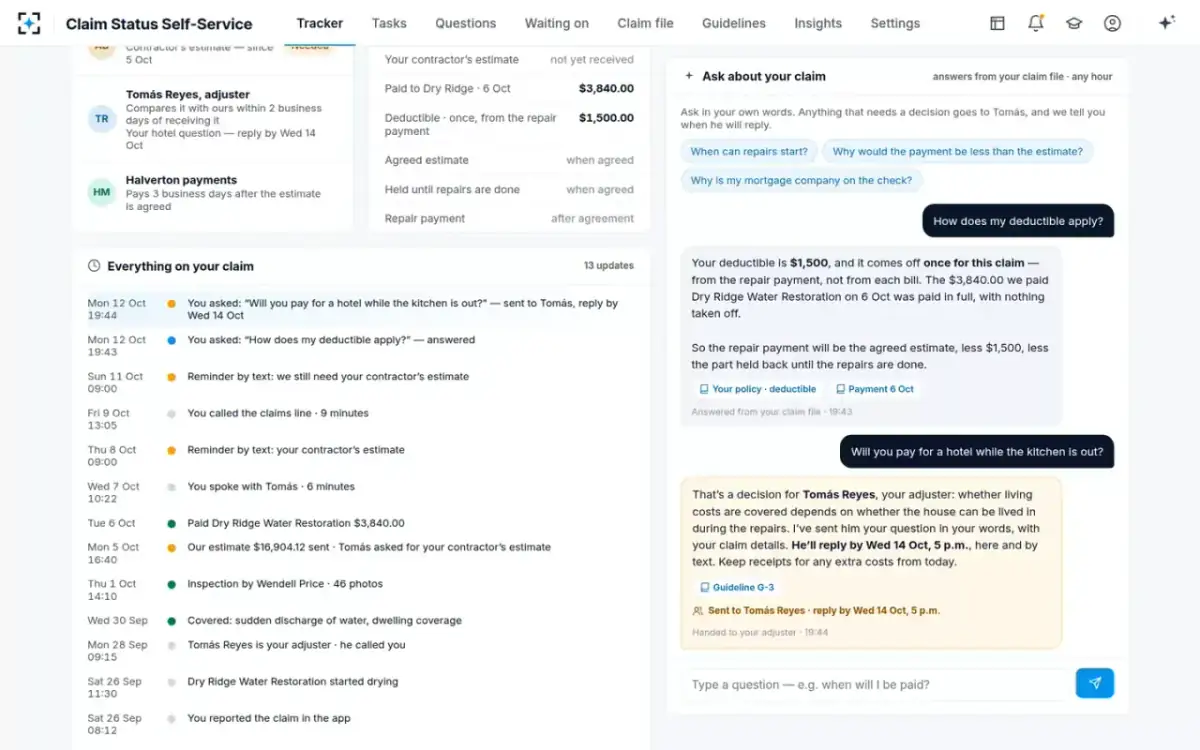
Deductible: $1,500, taken from the repair payment; a $3,840.00 drying bill was paid in full.
The deductible's mechanics catch people too. In the sample claim the policyholder asked how hers applied, and the answer came from her declarations and the payment history: $1,500, once for this claim, taken from the repair payment, while the $3,840.00 already paid to the drying company went out in full with nothing taken off. Another sample policyholder asked whether she paid her $1,000 deductible to the insurer or to the contractor; the answer was to the contractor, because the insurer had already taken it off its payment.
The deductible answered from the declarations and the payments
How does recoverable depreciation work on a home repair claim?
On a replacement cost dwelling claim it works in two payments. First the insurer pays the agreed repair cost less depreciation and less the deductible. Then, when the repair is done and the policyholder sends proof, usually the contractor's final invoice, it pays the depreciation it held back, up to the agreed replacement cost and the policy limit. If the final repair cost is less than the agreed estimate, the second payment is smaller; if hidden damage turns up, a supplement adds to both.
The federal flood policy writes the rule into a regulation, which makes it a useful reference. For a principal residence insured to at least 80 percent of its replacement cost, the insurer pays repairs "without deduction for depreciation", but where the cost is more than $1,000 or more than 5 percent of the insurance on the dwelling, it "will not be liable for any loss under R.2.a above or R.4.a.2 below unless and until actual repair or replacement is completed." A flood policyholder can claim actual cash value first and the rest later, provided they give notice of that intent within 180 days of the loss.
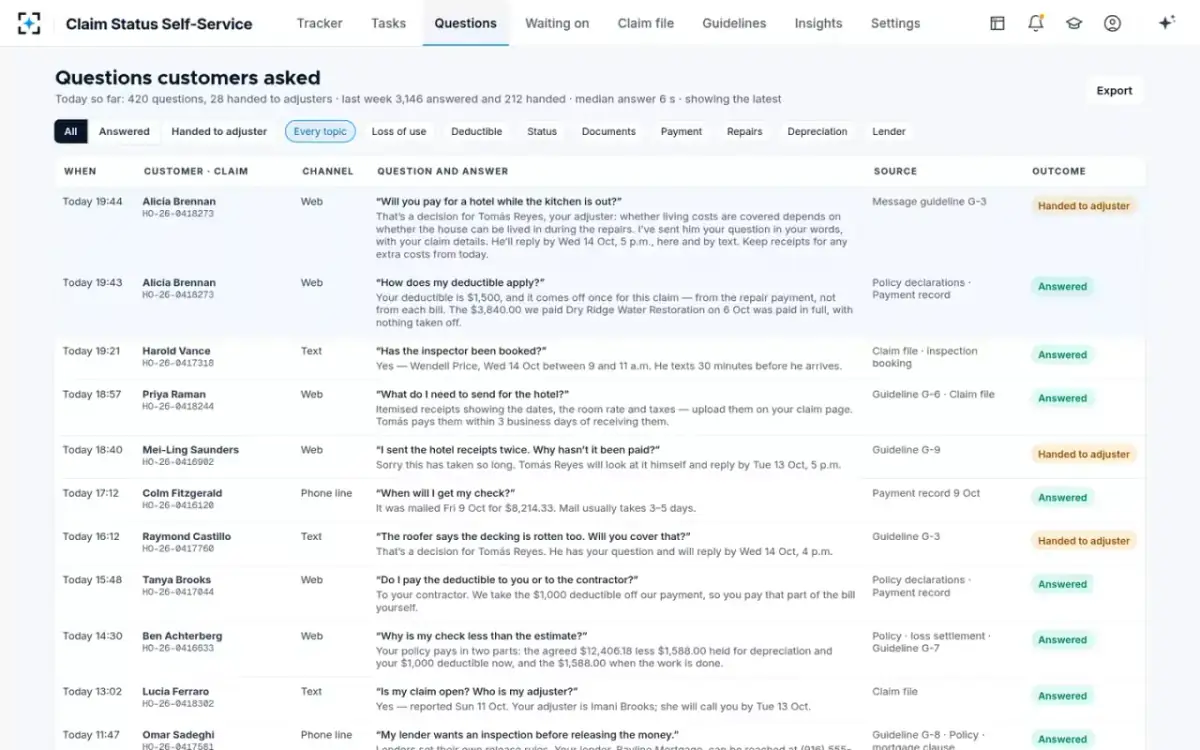
Private homeowners policies follow the same pattern with their own wording and deadlines. On the sample claim the arithmetic is plain: an agreed estimate of $17,500.52, depreciation of $2,214.60 held back, a $1,500 deductible, so $13,785.92 now. The holdback is about 12.7 percent of the agreed estimate (our arithmetic). A second sample policyholder, asking why his check was less than the estimate, got the same structure with his own numbers: $12,406.18 agreed, $1,588.00 held for depreciation and his $1,000 deductible now, and the $1,588.00 when the work is done.
Two policyholders, one explanation of the smaller check
Why is my insurance check less than the contractor’s estimate?
Usually for three reasons at once, and only one of them is depreciation. The insurer pays its own agreed estimate, which may be lower than the contractor's where the adjuster did not agree a line; it holds back depreciation; and it takes off the deductible. On the sample claim the contractor's estimate was $18,642.37 and the check $13,785.92. Of the $4,856.45 difference, $1,141.85 is a countertop the contractor priced as a replacement and the adjuster agreed only to remove and reset, with a supplement if it cracks; $2,214.60 is the holdback; $1,500 is the deductible.
Florida makes the first of those reasons the insurer's to explain in writing. Its claims statute says: "If the insurer’s claim payment is less than specified in any insurer’s detailed estimate of the amount of the loss, the insurer must provide a reasonable explanation in writing of the difference to the policyholder." The same section requires every partial estimate to warn, in capitals, that it may be revised. A status answer that breaks the check into its parts does in the moment what those rules require on paper.
Where the agreed estimate comes from: two differences, each decided by the adjuster
How long do you have to claim recoverable depreciation?
As long as the policy and the state allow, which is often a year and sometimes much longer after a declared disaster. The NAIC tells consumers "That time limit can range from 6 months to up to one year, depending on your state’s laws and your policy." State law can set a floor above that. California gives the policyholder at least 12 months from the first actual cash value payment to collect the full replacement cost, and at least 36 months for a loss tied to a declared state of emergency, with six-month extensions for good cause.
Deadlines for the held-back money vary by rulebook
The deadline is a status item in its own right. A claim with depreciation held back is not finished when the first check clears, and a homeowner who hears nothing for eleven months may lose money by not knowing. Putting the date on the claim page, with what must be sent, turns an obligation buried in the policy into a line the policyholder can act on.
Florida pays the rest of a dwelling claim as the work is done
Florida does not let a dwelling holdback wait for the very end of a job. Its homeowners statute requires the insurer, for a dwelling insured at replacement cost, to pay at least the actual cash value first: "For a dwelling, the insurer must initially pay at least the actual cash value of the insured loss, less any applicable deductible." The remainder follows the repairs: "The insurer shall pay any remaining amounts necessary to perform such repairs as work is performed and expenses are incurred."
Two more Florida rules change the explanation. A total loss of a dwelling is paid at replacement cost with no holdback. And for personal property, insurers must offer a policy that pays replacement cost without any holdback, whether or not the item is replaced, and may also offer a cheaper version that pays actual cash value first and the rest against receipts. A Florida status answer about the holdback therefore depends on which contents option the policyholder bought, which is exactly the kind of detail an answer drawn from the declarations page gets right and a script read by a busy agent may not.
In one sample week, the two deductions drove 638 questions
412
questions about the deductible
226
asking why the payment is less, or about depreciation
19%
of the 3,358 questions asked that week
How to claim recoverable depreciation: what to send
Send proof that the repair or replacement was done, at the cost claimed, before the deadline. For a dwelling that usually means the contractor's final invoice, sometimes with photos of the completed work or a signed completion form; for contents, receipts for what was replaced. The insurer then pays the difference between what it paid and the lower of the agreed replacement cost and what was actually spent, up to the limit.
Collecting the held-back depreciation, step by step
- Find the amount held back
It should be on the payment letter or the claim page as its own line, separate from the deductible.
- Find the deadline
In the policy’s loss settlement condition, and in state law where it sets a minimum: at least 12 months from the first payment in California, 36 after a declared emergency.
- Get a final invoice that matches the agreed scope
Line for line with the agreed estimate, so the insurer can see the same work was done. Extra work belongs in a supplement, not the final invoice.
- Add proof the work is finished
Photos of the completed rooms, or the insurer’s completion form if it uses one.
- Send it the way the insurer accepts
An upload on the claim page, email or post; keep a copy and the date sent.
- Expect the lender on the check
The held-back money is dwelling money, so a mortgage lender named on the first check can be on this one too.
That last point links two of the most-asked payment questions. The guide to an insurance check made out to your mortgage company explains why the lender is named and how it releases the money.
Explaining the smaller check the same way every time
A smaller-than-expected check is a moment where the answer depends on who picks up. One adjuster explains depreciation as money paid later; another as the age of the cabinets; a contact centre agent reading a status code may not mention it at all. Each version is defensible and together they are a complaint waiting to happen, because the policyholder hears three different stories about the same money.
Claim Status Self-Service handles it with one approved rule and the claim's own numbers. Guideline G-7 in the sample carrier's message guidelines says depreciation questions are answered, explaining how replacement cost is paid in two parts, and that amounts are quoted only once agreed. Before the adjuster agrees the estimate, the answer explains the structure and the deductible, without amounts nobody has agreed; after, it gives the three lines and the date. Questions that go beyond the file, such as whether an upgrade will be paid for, are not answered: they go to the adjuster with the policyholder's own words and a time for the reply.
The consistency is measurable. A carrier can ask its team and its assistant the same depreciation question in ten forms and compare the answers line by line, which is the test set out in the guide to AI insurance chatbot accuracy. To see the sample claim screen by screen, start from Claim Status Self-Service.
Questions people ask
What is a recoverable depreciation holdback?
It is the depreciation a replacement cost policy holds back from the first payment and pays once the repairs or replacement are done. On the sample claim it was $2,214.60 of a $17,500.52 agreed estimate, payable when the contractor's final invoice arrives.
Do I get my deductible back with the recoverable depreciation?
No. The deductible is your share of the loss and stays with you; only the depreciation is paid later. On the sample claim the $1,500 deductible came off the repair payment once and does not return, while the $2,214.60 holdback does.
What if the final repair costs less than the agreed estimate?
The insurer pays the depreciation only up to what was actually spent, so a cheaper repair means a smaller second payment. The flood policy, for example, pays no more than the least of the limit, the replacement cost and "the necessary amount actually spent" on the repair.
Is depreciation taken on labour?
It depends on the state and the policy. California's regulations say the labour needed to repair or replace covered property is not a component of physical depreciation, so a California holdback should apply only to materials that wear out; other states and policies differ, and the adjuster should be able to show which lines were depreciated.
Can the insurer pay the depreciation in stages?
Yes, and in Florida it must pay the rest of a replacement cost dwelling claim as the work is performed and expenses are incurred. Elsewhere, ask whether the insurer will release depreciation against progress invoices on a large job rather than waiting for the last one.