Like kind and quality is the insurance rule that a lost or damaged item is replaced with one of the same kind and the same quality, not a better one and not a worse one, and that the price is what such an item costs to replace. The phrase comes from the fire policy, and California's claims regulation still uses it: where the insurer must pay for "replacing the property destroyed or damaged with other of like kind and quality", the measure of recovery is actual cash value, the replacement cost less a "fair and reasonable deduction for physical depreciation" (10 CCR §2695.9(f)(1); Ins. Code §2051(b)). Applied to a family's contents list, the rule produces hundreds of small decisions, one per line, which is the work Contents & ALE Claims Management takes on.
Each of those decisions is a model, a grade, a price, an age and a deduction, and each can be argued. Contents & ALE Claims Management is Botminds' software for pricing and checking contents claims: agents match each line to a product, find the like-kind item, take quotes from the carrier's approved retailers and apply the carrier's depreciation table, with the family's own words kept beside the result and the contents specialist deciding. This guide follows one line through it, on fictional sample data: a television the family remembered only as "TV, big one".
One line priced at like kind and quality in Contents & ALE Claims Management, from the family's words to the amount paid
- 1
The family wrote
“TV, big one in the living room — $1,500, Black Friday 2024”
No receipt. The only picture is frame 0:41 of a Christmas-morning video.
- 2
Matched model
Lumora LM65-OC4, 65-inch OLED, 2024
96% match after measuring the screen against an 80-inch door: 64.6 inches, a 65-inch class.
- 3
Like kind and quality
Lumora LM65-OC6, 2026
The OC4 was discontinued in March 2026; the successor has the same size, panel and grade.
- 4
Replacement cost
$1,849.99
Median of three approved retailers: $1,829.00, $1,849.99 and $1,899.00.
- 5
Depreciation
− $416.25 (22.5%)
1.8 years of an 8-year life for televisions, from the carrier’s own table.
- 6
Actual cash value
$1,433.74
Paid now. The $416.25 is held back and paid when the family buys the replacement.
What is like kind and quality?
Like kind and quality is a test of equivalence: the replacement must do the same job at the same standard as the thing lost. The NAIC's model claims regulation gives the clearest wording of the test, in its rule on replacement car parts, which must be "at least equal in kind and quality to the original part in terms of fit, quality and performance" (NAIC Model 902, §8). For contents the same three ideas apply. Fit is size and type: a 65-inch television, not a 55-inch one. Quality is grade: an OLED panel, not an entry-level LED. Performance is what the item does.
What the test is not is just as important. It is not the original price, not a brand guarantee and not an upgrade. A sofa bought for $3,200 is replaced with a sofa of the same construction and fabric grade at today's price, which may be higher or lower. And under a policy that pays actual cash value, like kind and quality is only the starting point: the replacement cost is then reduced for the age and condition of the lost item.
The like kind and quality insurance rules a contents price has to satisfy
No single national rule governs contents pricing; state law and the policy do. Four texts set the standards most contents teams work to, and they agree more than they differ: price the equivalent item, deduct depreciation only for real age and wear, itemize every deduction, and be able to show the claimant how each number was reached.
Four texts behind a like-kind price, and what each requires of a priced line
| Rule | What it says | What the priced line has to show |
|---|---|---|
| Cal. Ins. Code §2051(b) | Actual cash value is the cost to replace "less a fair and reasonable deduction for physical depreciation based upon its condition at the time of the injury". | A replacement cost, an age and a condition, not a flat percentage. |
| 10 CCR §2695.9(f), California | Adjustments must be "discernable, measurable, itemized, and specified as to dollar amount", and the basis "fully explained to the claimant in writing". | The dollar amount of depreciation on each line, and the reason in words. |
| NAIC Model 902, §9B | Actual cash value is "replacement cost of property at time of loss less depreciation, if any", with worksheets on request. | A worksheet the insured can ask for, showing every deduction. |
| FEMA NFIP Claims Manual | The inventory should note "quality, make, model, serial number (when applicable), quantity, age, special limit item, and cost to replace with like kind and quality at current pricing". | Make, model, quantity, age and a current like-kind price on every line. |
Two details in those texts trip up practitioners. The first is timing. California's statute computes the measure of indemnity "as of the time of the commencement of the fire", and the NAIC model says "at time of loss", while FEMA asks for "current pricing". On a claim priced a few weeks after the loss the difference is usually small, but on a contents claim reopened a year later it is not, and the file should say which date the price reflects.
The second is matching. For replacement-cost policies California's regulation says: "When a loss requires replacement of items and the replaced items do not match in quality, color or size, the insurer shall replace all items in the damaged area so as to conform to a reasonably uniform appearance." (§2695.9(a)(2)) The sentence speaks of items in a damaged area; applied to contents, it is the logic that makes a specialist price a three-piece sectional as a set rather than replacing one surviving seat.
What if my item is discontinued? The successor rule
When the exact model is no longer sold, like kind and quality points to its current successor of the same grade and size. Technology is where this bites first: a television or laptop bought three years ago is often no longer sold, so a team that only prices exact models leaves those lines unpriced. The successor has to be chosen by a rule the carrier can state, not by whatever the cheapest search result happens to be.
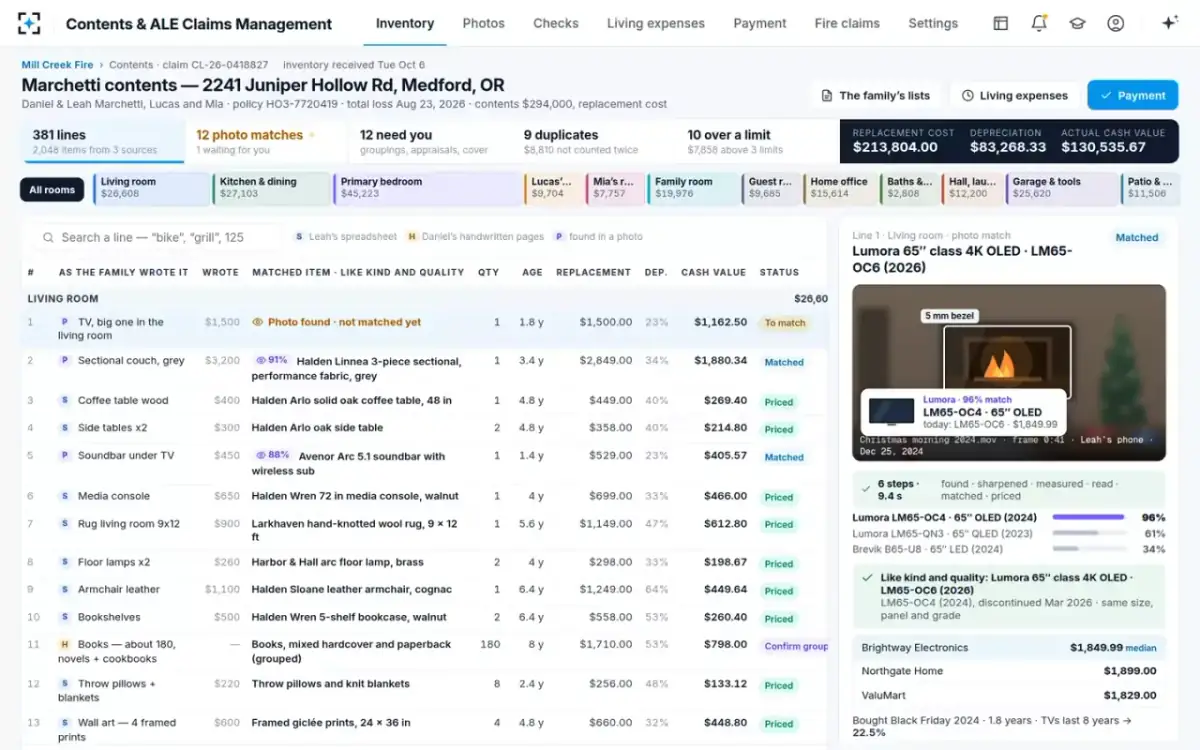
In the sample claim the family's television was matched to a Lumora LM65-OC4, a 2024 65-inch OLED that was discontinued in March 2026, five months before the fire. The pricing agent applied the carrier's rule, "current successor, same grade and size", and priced the LM65-OC6, a 2026 model with the same screen size, panel type and grade. A cheaper 65-inch LED from the same maker would fail the quality test; a larger 77-inch OLED would fail the fit test. Both are exclusions the rule makes automatic.
The photo match, the successor and three quotes, side by side
How do insurance companies value personal property?
They price a replacement, then subtract depreciation if the policy pays actual cash value first. In California's words, actual cash value for a total or partial loss "to the structure or its contents" is "the amount it would cost the insured to repair, rebuild, or replace the thing lost or injured less a fair and reasonable deduction for physical depreciation based upon its condition at the time of the injury or the policy limit, whichever is less" (§2051(b)). A replacement-cost policy pays that actual cash value first and the withheld depreciation once the item is replaced.
The deduction is where most disputes start, and the rules narrow it. California requires that depreciation "reflect a measurable difference in market value attributable to the condition and age of the property" and apply only to property "normally subject to repair and replacement during the useful life of the property" (§2695.9(f)). That is why carriers keep life tables by category. The sample carrier's table gives televisions 8 years, furniture 12, adult clothing 5 and children's clothing 2, caps any deduction at 80%, and does not depreciate jewelry or art at all.
Can the insurer price below my receipt?
The receipt proves what was bought and when, but it does not set the price. Like kind and quality is measured at the replacement's price, so an item bought on sale years ago can be priced above the receipt, and an item whose price has fallen can be priced below it. Neither California's regulation nor the NAIC model mentions the purchase price at all. What they require is that the price and the deduction be shown and explained.
Some carriers write their own floor. The sample carrier's rule is "never below the family's own receipt for the item", and its pricing agent applies it on every line. In the television's case the floor did not bite: the family wrote $1,500, what they paid on Black Friday 2024, and the like-kind price came to $1,849.99, $349.99 more, because the policy owes today's price for the same set rather than last year's sale price. The rule cuts both ways: the family's grey sectional, which they remembered at $3,200, was priced at $2,849.00 for its like-kind three-piece set.
The family's figure against three like-kind quotes for the same television
One line priced, from "TV, big one" to $1,433.74
The waterfall at the top of this page is the whole calculation, and each step is a separate claim the file has to support. The match rests on the frame and the measurement. The successor rests on the carrier's rule and the discontinuation date. The price rests on three dated quotes from named retailers. The age rests on the family's own words, "Black Friday 2024", because there was no receipt; the sample carrier's order is receipt first, then the photo's date, then what the family wrote.
The deduction is straightforward once those are fixed. 1.8 years of an 8-year life is 22.5%, so $416.25 comes off the $1,849.99 and $1,433.74 is paid now. Because the policy pays replacement cost, the $416.25 is not lost: it is held and paid when the family buys the replacement. California, in a declared emergency, gives a policyholder at least 36 months from the first actual-cash-value payment to claim it. How the same steps work across a whole schedule, including duplicates and limits, is in contents valuation, one line from memory to payment.
Depreciation has to be itemized and explained in writing
A contents payment that shows only a total depreciation figure does not meet California's rule, and would not survive a request for worksheets under the NAIC model. §2695.9(f) requires each adjustment to be "discernable, measurable, itemized, and specified as to dollar amount", and adds: "The basis for any adjustment shall be fully explained to the claimant in writing." The NAIC model adds: "Upon the insured’s request, the insurer shall provide a copy of the claim file worksheets detailing any and all deductions for depreciation" (Model 902, §9B).
For a 381-line schedule that means 381 explanations, which is where the temptation to use one percentage per room comes from. FEMA's flood manual names that shortcut as unacceptable for flood claims. The explanation the sample carrier sends is short and specific: the age, where the age came from, the life for the category and the dollar amount. The family's letter then says, in plain words, how much more is theirs as they replace things.
Where the price came from: retailers, dates and the median
A like-kind price is only as defensible as its sources, and regulators are starting to ask for them. Washington's claims rule, amended with effect from 18 October 2026, says that an insurer using "a database, survey, estimating software, or benchmarks" to price materials or labor must, on the claimant's request, give "the date the data was collected, where the data was collected from, and which businesses provided the cost data" (WAC 284-30-380(8), WSR 26-17-089). A contents price drawn from an unnamed database fails that test; three named retailers with dated quotes pass it.
What a defensible like-kind line shows
- The family’s own words
Exactly as written, with the row, page and line or photo it came from, so nobody has to argue later about what was claimed.
- The matched item and the evidence for the match
Make and model, with the receipt, photo or description it rests on and, for a photo, the match score.
- The like-kind item and the rule that chose it
Same model, or the current successor of the same grade and size, with the discontinuation date when it applies.
- Dated quotes from named sellers
Who, when and how much, and the rule for choosing among them, such as the median of three.
- The age and where it came from
Receipt, photo date or the family’s words, in that order of preference.
- The deduction in dollars, with its basis
Life for the category, years used, percentage and amount, and the cap if one applies.
- What happens to the held depreciation
Paid on replacement, with the deadline the policy or state law allows.
How Contents & ALE Claims Management prices a line
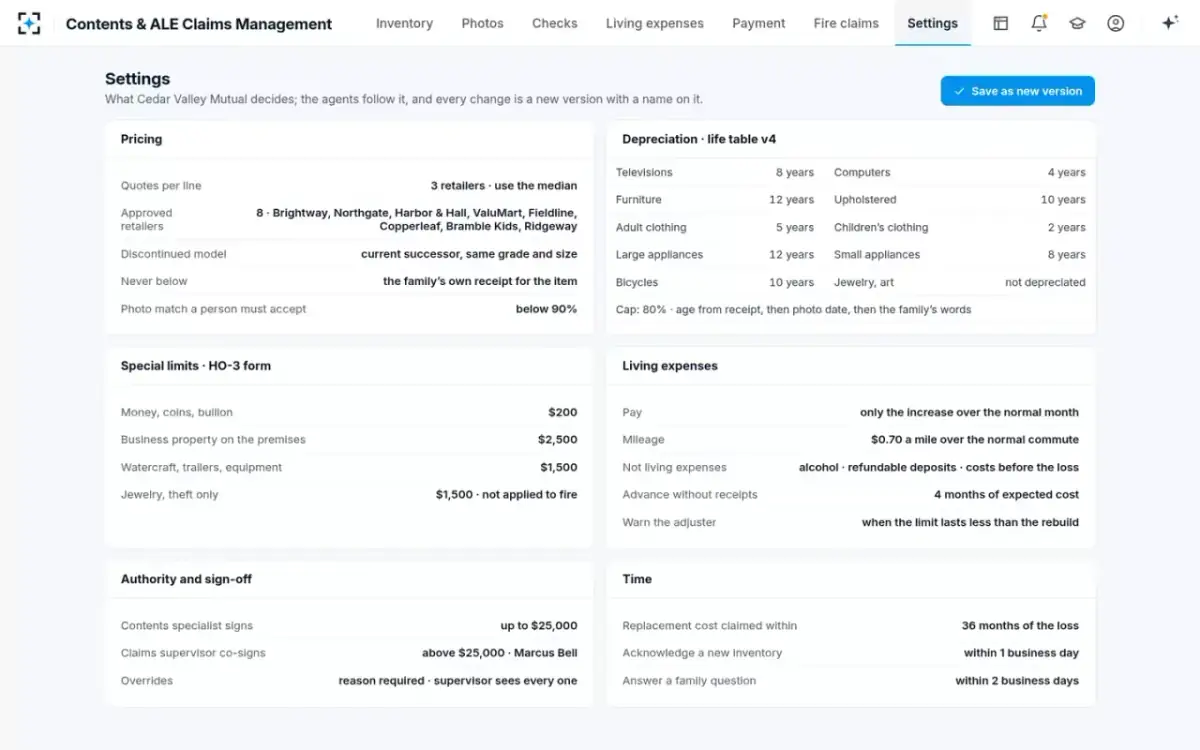
In the solution, pricing is three agents working in sequence, each with limits it cannot cross. The photo matcher finds the item and proposes a make and model, measuring it against objects of known size such as a door, a counter or an outlet; below a 90% match a person accepts the match. The pricing agent finds the like-kind item and takes three quotes from the carrier's approved retailers; it never prices below the family's own receipt for the same item and never steps down a grade. The depreciation agent applies the carrier's life table by category and age, and the same inputs always give the same answer.
None of those rules belongs to Botminds. The number of quotes, the approved retailers, the successor rule, the receipt floor, the match threshold, the life table and its cap are the carrier's settings, and each change is saved as a new version with a name on it, so a line priced in October can be explained in March under the rules that applied at the time.
The carrier's pricing and depreciation rules, as the agents read them
What the solution does not do is decide a disputed price. If the family says their sofa was a higher grade than the photo suggests, the specialist sees the family's words, the match and the quotes together and decides, and an override needs a reason the supervisor can see. How the agents handle a match they are unsure of is covered in contents inventory software that asks instead of guessing.
Questions people ask
What does like kind and quality mean in insurance?
It means a replacement of the same kind and the same quality as the item lost: same type and size, same grade, same function. The NAIC's model regulation states the test for car parts as "fit, quality and performance", and contents are priced the same way. Under an actual-cash-value settlement, depreciation for age and condition is then deducted.
Do insurers have to replace an item with the same brand?
Not necessarily. The rules require equivalence in kind and quality, not the same label, so an equivalent product from another maker may qualify, depending on the policy wording. What a carrier cannot do is price a lower grade; a defensible file says why the replacement is equivalent.
Can my insurer use a flat depreciation percentage for everything?
In California, no: depreciation must reflect a measurable difference in market value due to the item's condition and age, and be itemized in dollars. FEMA's flood manual also calls applying the same rate to all items an unacceptable practice for flood claims.
What happens to the depreciation the insurer holds back?
On a replacement-cost policy it is paid when you replace the item, up to the policy limit. In California, after a declared-emergency loss, you have at least 36 months from the first actual-cash-value payment to collect it, with six-month extensions for good cause.
Can I ask how my insurer priced my contents?
Yes. California requires the basis of every depreciation adjustment to be explained in writing, and the NAIC model gives the insured a right to the depreciation worksheets on request. In Washington, since 18 October 2026, a claimant can also ask for the date, source and businesses behind any pricing database the insurer used.