Contents valuation for insurance is the process of putting a dollar value on each item of personal property in a claim, as the policy defines value: usually the cost to replace it with like kind and quality, less depreciation for age and condition, and subject to the policy's limits. On a whole-house loss it is done line by line, hundreds of times, from a list the family wrote after the fact. Each line passes through six steps before it reaches a payment, and an error at any step flows through every total after it; Contents & ALE Claims Management puts a check on each step.
That chain is why contents valuation is slow and why it is argued over. A contents specialist has to show, for every line, where it came from, what product it became, what that product costs, how old the lost one was and why the deduction is what it is. Contents & ALE Claims Management is Botminds' software for that chain: specialist agents carry each step and cite their evidence, and the contents specialist decides wherever the evidence runs out. This guide follows one line, a television, through the fictional sample claim the solution uses, then widens out to the whole 381-line schedule.
Six steps of one contents line in Contents & ALE Claims Management, each with an owner and a limit
Agent
1 · The wordsThe inventory reader takes “TV, big one in the living room — $1,500, Black Friday 2024” as written, with its source.
Never: Never rewrites the family’s words
Agent
2 · The matchThe photo matcher finds it in a video frame and matches a 65-inch OLED at 96%.
Never: Below 90%, a person accepts the match
Agent
3 · The priceThe pricing agent prices the current successor at three approved retailers; the median, $1,849.99, wins.
Never: Never a lower grade than the family owned
Agent
4 · The ageThe depreciation agent applies 1.8 years of an 8-year life: 22.5%, cash value $1,433.74.
Never: Same inputs always give the same depreciation
Agent
5 · The duplicateThe coverage checker finds “Big TV” on the spreadsheet and pairs it with this line.
Never: Flags only; a person decides every duplicate
A person decides
6 · Limits, holds and paymentThe contents specialist reviews the waterfall and signs; above her authority the supervisor co-signs.
How contents valuation for insurance works, in six steps
Every line is valued the same way: identify it, price its like-kind replacement, depreciate it, make sure it is not counted twice, and apply the policy's limits before anything is paid. The order matters. Pricing a line that turns out to be a duplicate wastes the work; depreciating before the right product is chosen gets the life wrong; applying limits last, after hours of pricing, can mean a carefully priced coin collection pays $200. A guide to Coverage C's special limits covers that last step in depth.
The sample claim shows the scale. The family's inventory arrived as 381 lines from three sources covering 2,048 items, and the agents read and priced it overnight. The specialist's work began from a schedule in which every line already carried its source, its match, its price and its deduction, and the decisions left for her were marked.
One family's contents claim, valued line by line
381
lines from a spreadsheet, three handwritten pages and a photo album
2,048
items behind those lines, counting each book and toy
$8,810
that the family listed twice, found in nine pairs and counted once
$214,153.99
replacement cost of the 369 lines priced for payment
Step 1, the family's words: how to prove ownership for an insurance claim
Ownership is proved with whatever the family has, and after a fire that is rarely a receipt. Bank and card statements, photos and videos from phones and social media, manuals, warranty registrations and the family's own description can all serve as evidence, and the flood policy lets an insurer examine "all books of accounts, bills, invoices and other vouchers, or certified copies pertaining to the damaged property if the originals are lost" (SFIP Dwelling Form, VII.H.1). FEMA tells examiners that photographs "should document contents items of exceptional value and quality" (NFIP Claims Manual).
The first check is that the line keeps the family's words. "TV, big one in the living room — $1,500, Black Friday 2024" carries three clues: a size class, a room and a purchase date. A specialist who retypes it as "Television" throws two of them away. In the sample every line keeps the family's wording beside the matched product and cites the row, page and line, or photo it came from, so the evidence for ownership and the claim are the same object.
Step 2, the match: from a description to a make and model
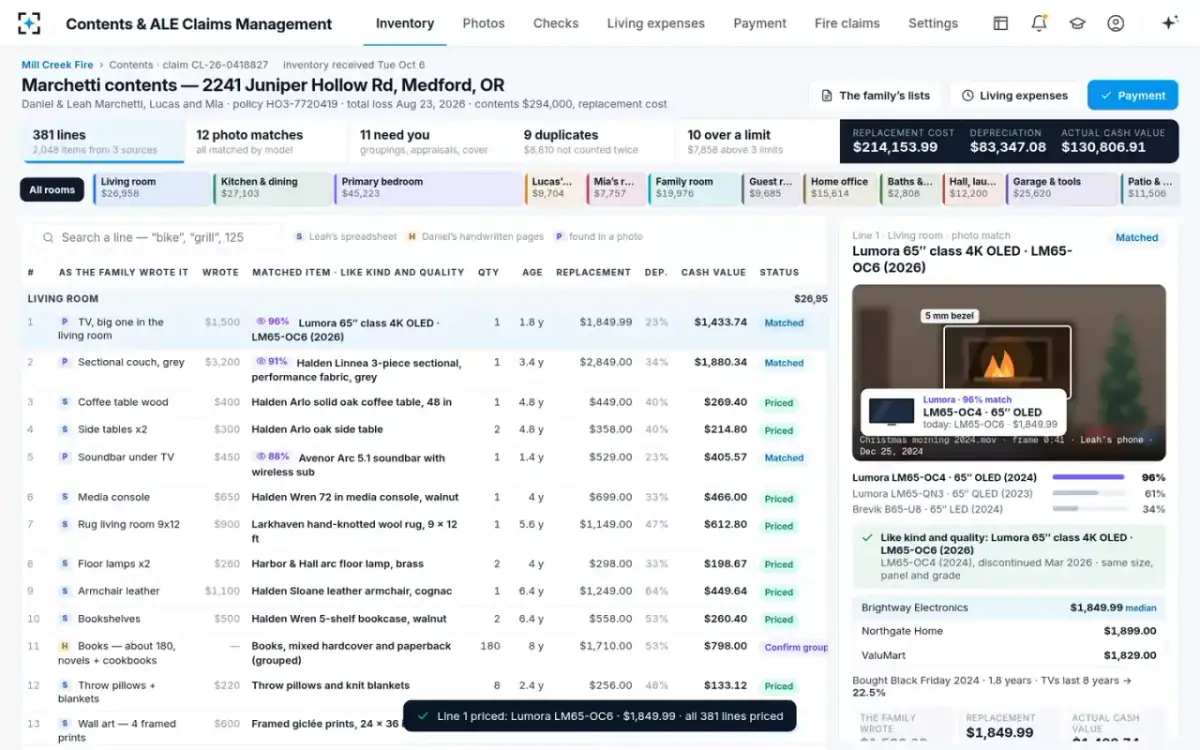
Without a model there is no like-kind price, so the second step finds one, from a receipt where there is one and otherwise from a photo or the description. The television had no receipt. Its only picture was frame 0:41 of a Christmas-morning video. The photo matcher sharpened the crop from four neighbouring frames, measured the screen against an 80-inch door at 64.6 inches, a 65-inch class, read the design and matched it among 412 sets sold from 2022 to 2025: a Lumora LM65-OC4 at 96%, ahead of two others at 61% and 34%.
The risk at this step is a confident wrong match, and the check is a threshold. The sample carrier sends any match below 90% to the specialist, with the candidates and the evidence. Antiques are a special case worth knowing: the flood policy says "We will pay only for the functional value of antiques", and FEMA's example values a restored 400-year-old chair, appraised at $25,000, at the cost of a functionally similar new chair, $3,500, less 10% depreciation: $3,150 (NFIP Claims Manual). A homeowners policy has its own wording, which is why the match has to know which policy it is valuing for.
Step 3, the price: replacement cost contents coverage today
Replacement cost is what it costs now to buy an item of like kind and quality, and on a replacement-cost policy it is the basis for contents. The OC4 had been discontinued in March 2026, so the like-kind item was its successor, the LM65-OC6, priced at three approved retailers: $1,829.00, $1,849.99 and $1,899.00. The median, $1,849.99, was used. That is $349.99 more than the family wrote, because they had bought on sale and the policy owes the price of the same set today.
The checks here are the successor rule and the sources. Is the replacement the same size, panel and grade? Are the retailers on the carrier's approved list, and are the quotes dated? The full rules behind a like-kind price, including what to do when an item is discontinued, are set out in like kind and quality insurance rules.
The schedule after the match was accepted: the TV repriced, every total updated
Step 4, the age: depreciation by category, itemized
Depreciation is the replacement cost multiplied by the share of the item's useful life already used, and every rule on it asks for the same thing: a real age, a stated life and a dollar amount per line. The television was bought on Black Friday 2024, 1.8 years before the fire. The carrier's life table gives televisions 8 years. 1.8 divided by 8 is 22.5%, so $416.25 comes off and the actual cash value is $1,433.74. The sample carrier caps any deduction at 80% and does not depreciate jewelry or art.
Two rules show how much the details matter. FEMA's flood manual rejects the shortcut: "The application of the same rate of depreciation (lump-sum) to all building and personal property items is not an acceptable practice" (NFIP Claims Manual). And the two rulebooks a contents team is most likely to meet disagree about labor. California says the expense of labor to replace covered property "is not a component of physical depreciation and shall not be subject to depreciation or betterment", except labor built into manufactured goods (10 CCR §2695.9(f)(1)). FEMA tells flood adjusters to "apply depreciation to the material, labor, and equipment usage, including overhead, profit and sales tax, on all claimed replacement items of property".
Two rulebooks, two answers on depreciating the labor in a contents line
California homeowners claims: Not depreciated (10 CCR §2695.9(f)(1))
Federal flood claims (NFIP): Depreciated with the item (NFIP Claims Manual)
California homeowners claims: Depreciated as part of the item
Federal flood claims (NFIP): Depreciated as part of the item
California homeowners claims: Not addressed in §2695.9
Federal flood claims (NFIP): Depreciated with the item
California homeowners claims: Not allowed: deductions must be itemized per line
Federal flood claims (NFIP): Not acceptable practice
Step 5: how do insurers check a contents list for duplicates?
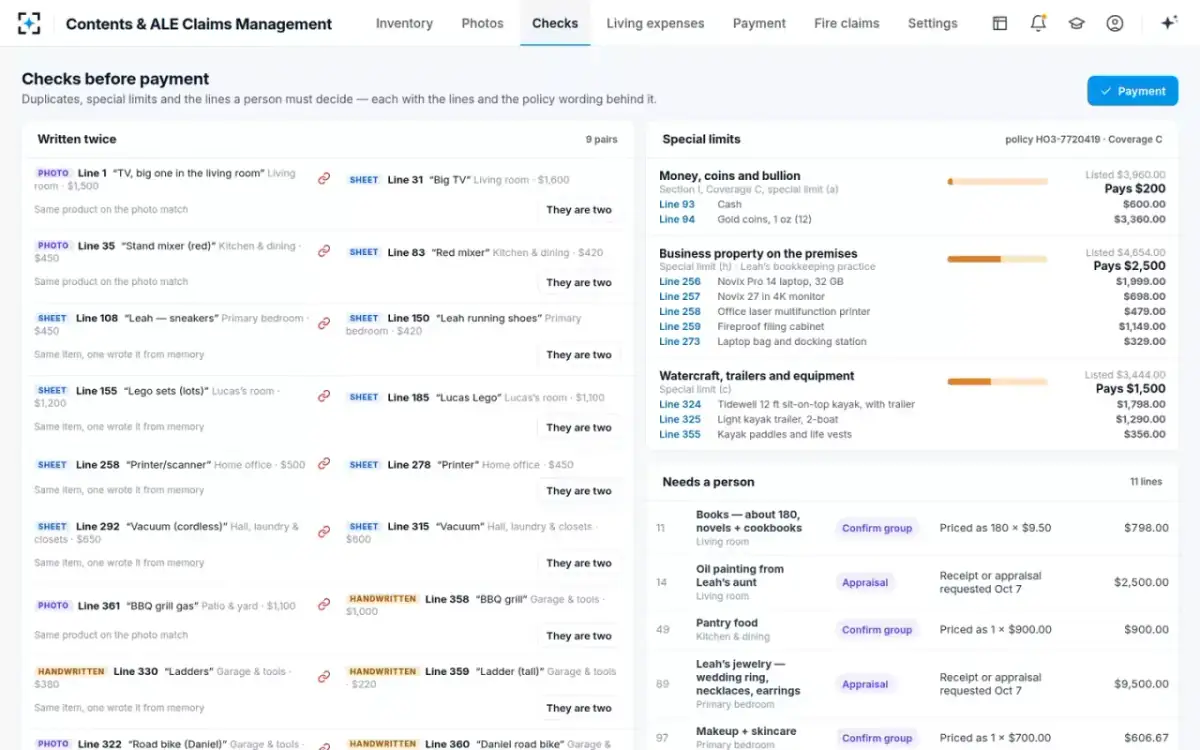
They compare every line with every other, across the family's sources and across rooms, looking for the same product, the same photo match or the same thing described in different words. Duplicates are the normal result of honest memory: when two people each write a list, both remember the grill. In the sample, nine items had been written twice, $8,810 in the family's own figures, including the grill on Leah's spreadsheet and on Daniel's handwritten pages, and "Big TV" on the spreadsheet against "TV, big one" from the photo.
The check is that a duplicate is flagged and counted once, never deleted. Each pair is shown side by side with a "They are two" button, because sometimes there really were two: the sample's flagged pairs include Leah's "sneakers" and her "running shoes", which may or may not be one pair. The coverage checker flags; only a person decides, and only a person takes a line out.
Duplicate pairs, special limits and the lines a person decides
Step 6, limits and holds: how much will insurance pay for contents?
On a replacement-cost policy, insurance pays the actual cash value first, then the held-back depreciation as items are replaced, up to the contents limit and after any special limits and holds. California's statute describes the sequence: the insurer "shall pay the actual cash value of the damaged property, as defined in Section 2051, until the damaged property is repaired, rebuilt, or replaced. Once the property is repaired, rebuilt, or replaced, the insurer shall pay the difference between the actual cash value payment made and the full replacement cost reasonably paid to replace the damaged property, up to the limits stated in the policy" (Ins. Code §2051.5(a)(2)).
From a priced schedule to the amount paid today: the whole claim's waterfall
| Step | Amount |
|---|---|
| Replacement cost of 369 priced lines | $214,153.99 |
| Less depreciation (most of it paid back as items are replaced) | − $83,347.08 |
| Actual cash value | $130,806.91 |
| Less amounts above three special limits: money, business property, watercraft | − $5,011.32 |
| Less three lines held for an appraisal: a painting, jewelry, quilts | − $13,350.00 |
| Contents actual cash value owed | $112,445.59 |
| Less the contents advance paid on 2 September, without an inventory | − $40,000.00 |
| Paid now | $72,445.59 |
| Held, paid as items are replaced | $80,500.40 |
The time the family has to collect the held depreciation is part of the value. California sets at least 12 months from the first actual-cash-value payment, and, for a loss relating to a state of emergency, at least 36 months, with six-month extensions for good cause (§2051.5(b)(1)). The sample carrier's setting is 36 months, and the family's statement tells them in plain words: "$80,500.40 more is yours as you replace things".
A contents valuation worksheet that survives review
A contents valuation worksheet survives review when each step above leaves its evidence on the line. That is a stricter standard than most hand-built spreadsheets meet, because a spreadsheet stores the result of each step, not the reason for it. The table below lists the six places a value can go wrong and the check that catches each.
Six places a contents value goes wrong, and the check Contents & ALE Claims Management runs for each
| Step | What goes wrong | The check |
|---|---|---|
| 1 · Words | Description retyped, detail lost, item invented | Family’s words kept verbatim with the source cited |
| 2 · Match | Confident wrong model, wrong size class | Match score with candidates; a person below the threshold |
| 3 · Price | Lower grade, wrong successor, undated or unnamed source | Successor rule; named retailers; dated quotes; median |
| 4 · Age | One rate for everything; labor depreciated where it may not be | Life table by category; age source stated; dollars per line |
| 5 · Duplicate | Counted twice, or a real second item deleted | Pairs flagged side by side; a person decides |
| 6 · Limits and holds | Caps applied late or not at all; advance forgotten | Caps named per line; advance netted once; holds listed |
In the solution, each of those checks belongs to an agent with a written limit, and every human decision, accepting a match, confirming a group, keeping two lines apart, overriding a price, is on the claim's activity trail with the person and the reason. The same discipline applies to the living-expense side of the claim, where every cut names its rule; that part is in how loss of use is calculated for homes.
Questions people ask
How much will insurance pay for contents after a total loss?
On a replacement-cost policy, the actual cash value of each item first, then the depreciation held back as you replace things, up to the contents limit and after special limits. In a California declared emergency the insurer must also offer at least 60% of the contents limit, up to $350,000, without an itemized list. In the sample claim, $112,445.59 of actual cash value was owed, with $80,500.40 more payable on replacement.
What is a home contents valuation?
It is an estimate of what it would cost to replace everything in a home, used to set the contents limit when buying insurance, or, after a loss, the line-by-line valuation of what was lost. The first is done room by room before any loss; the second is done by the insurer's contents specialist from the family's inventory.
Do I need receipts for a contents claim?
Not for everything. Receipts help prove the model and age, but statements, photos, videos and your own description are also evidence, and California's insurers must accept grouped categories after a declared emergency. Expect the insurer to ask for receipts or an appraisal for high-value items such as jewelry or art.
Is replacement cost contents coverage worth having?
It pays the depreciation that an actual-cash-value policy keeps, once items are replaced. On the sample claim that was $80,500.40, more than a third of the replacement cost. Whether it is worth the premium depends on what you own and how much of it you would replace.
Why is my contents settlement lower than my list?
Usually for one of four reasons: depreciation for age, special limits on categories such as cash or business property, items counted twice, or a lower like-kind price than the figure you remembered. Each should be shown on its own line with a reason; in California the basis for every depreciation adjustment must be explained in writing.