A home inventory list for an insurance claim is the itemized list of the personal property lost, with enough detail for the insurer to price each item: what it was, how many, roughly how old, and what it cost or would cost now. Before a loss it can be made calmly, room by room, with photos. After a total loss it has to be rebuilt from memory, and that is a different job: a family that has lost a house has to remember several hundred belongings, often while living in a hotel, and write them down in a form an adjuster can use. Contents & ALE Claims Management is built to read that list as the family wrote it.
The method that works is the one people use to remember anything: walk the house in your head, room by room, and use every outside trace you can find to fill the gaps, phone photos, card statements, online orders. The insurer's job is to take the family's words as they wrote them and turn them into priced lines without making them rewrite anything. Contents & ALE Claims Management is Botminds' software for that second part: agents read a family's spreadsheets, handwritten pages and photo albums into one numbered schedule, keep the family's words beside every line, and price and check each one for the contents specialist to decide. The example on this page is the solution's fictional sample family, whose home burned on 23 August 2026.
What one family's rebuilt list held, by writer and by room
Who wrote the lines (371 written lines)
- Leah’s spreadsheet, 319 rows · 86%
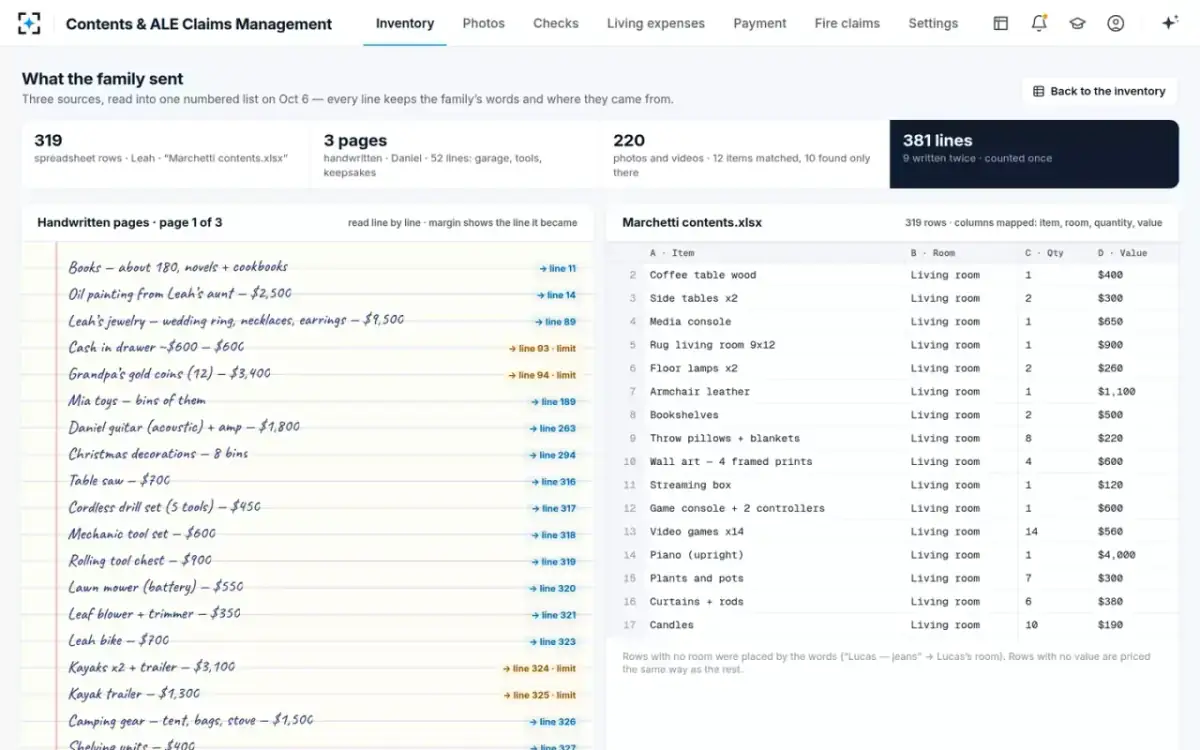
- Daniel’s pages, 52 lines · 14%
Replacement cost by room ($214,154 priced)
- Primary bedroom · 21%
- Kitchen and dining · 13%
- Living room · 13%
- Garage and tools · 12%
- Hall, laundry, patio · 11%
- Family room · 9%
- Children’s rooms · 8%
- Office, guest, baths · 13%
What a home inventory list for an insurance claim must contain
Each line needs a description, a quantity, and something that lets the insurer place a value on it: an age, a price paid or an estimate, and any receipt or photo you have. The federal flood policy states the requirement in one sentence: "Prepare an inventory of damaged property showing the quantity, description, actual cash value, and amount of loss. Attach all bills, receipts, and related documents" (Standard Flood Insurance Policy, VII.G.3). Homeowners policies carry their own wording. In California the insurer must, within 15 calendar days of notice of a claim, provide "necessary forms, instructions, and reasonable assistance" (10 CCR §2695.5(e)(2)), but after a declared-emergency total loss it may not insist on its own inventory form if yours carries substantially the same information.
In practice a family cannot know the actual cash value; that is the insurer's calculation of replacement cost less depreciation. What helps most is description. "TV" is a line the insurer has to guess at; "TV, big one in the living room — $1,500, Black Friday 2024" tells it a size class, a room, a price and a date. That line, from the sample family, became a specific 65-inch OLED priced at today's like-kind cost, and the date set its depreciation. How that happens is the subject of contents valuation, one line from memory to payment.
How to list contents after a fire: room by room, from memory
Walk the house in your head in the order you used it, one room at a time, and write what you see: walls, shelves, drawers, closets, under the bed. Then do the same for spaces people forget, the garage, the attic, the shed, the car trunk, the patio. Two people writing separately tend to cover different ground, because each remembers the rooms they use. In the sample family, Leah's spreadsheet covered most of the house; Daniel's three handwritten pages covered the garage, his tools and the keepsakes, and the garage and tools came to about 12% of the replacement cost.
Memory prompts for rebuilding a house of belongings
- Your phone and cloud photos, by room and by event
Birthdays, holidays and “before we moved in” photos show furniture, televisions and shelves in the background. The sample family’s best evidence for its TV was a Christmas-morning video.
- Card and bank statements
Big purchases leave a date and a seller; three years of statements will place most appliances and electronics.
- Online order histories and email receipts
Marketplaces and retailers keep years of orders, with model numbers.
- Warranty registrations and manuals saved online
They carry exact models for appliances, tools and electronics.
- Friends’ and relatives’ photos
Gatherings at your home show rooms you never photographed yourself.
- Each family member, separately
Children remember toys and games; whoever uses the garage remembers the tools. Duplicates between lists are expected, and the insurer should find them.
- The places nobody lists
Pantry, bathroom cabinets, linen closet, garage shelves, holiday decorations, the patio.
Write in your own words and do not worry about the insurer's format. Put the room, what it was, how many, the brand or size if you know it, about when you bought it and about what it cost. Where you cannot remember a model, say what you can: "big", "leather", "the good one". Those words are evidence, and good software keeps them.
Can you group items instead of listing each one?
Yes, for things too many to count, and in California after a declared emergency the insurer must accept it. The statute says that after a total loss of a primary residence the insurer "shall accept an inventory that includes groupings of categories of personal property, including clothing, shoes, books, food items, CDs, DVDs, or other categories of items for which it would be impractical to separately list each individual item claimed" (Ins. Code §2061(a)(3)). FEMA's flood manual asks for the same thing in photographs: "Photographs should also include groups of items such as clothing, kitchen items, furniture, etc." (NFIP Claims Manual).
A grouping still needs a count or an estimate and a description of quality. The sample family wrote "Books — about 180, novels + cookbooks", which the schedule priced as 180 mixed hardcover and paperback books at $9.50 each, $1,710 before depreciation, and flagged for the specialist to confirm the count. "Mia toys — bins of them" is harder to price and will draw a question; "Mia toys — 4 bins, mostly building sets and dolls" will draw fewer.
How one family's memory added up
381
lines in the schedule, after reading three sources
2,048
items behind those lines, once groups such as books were counted
9
items written twice by two family members, found and counted once
214photos
and 6 videos read from the family’s album to find and match named items
Do I need a contents inventory after a wildfire in California?
Not for the first part of the money. After a covered total loss of a furnished primary home in a declared state of emergency, the insurer must offer at least 60% of the contents limit, up to $350,000, without an itemized claim (Ins. Code §10103.7). To recover more, up to the contents limit, you file an itemized claim. The law also gives you time: the insurer may not require proof of loss less than 100 days after the loss, and must grant three-month extensions for good cause.
One of the statute's examples of good cause speaks directly to the list: "For personal property coverage, the fact that a personal property inventory is premature if the primary structure has not yet commenced construction" (Ins. Code §2051.5(b)(3)(B)(ii)). The Legislature wrote into law that a family may not be ready for a full inventory while the house is still a lot. The full rule, and what carriers must build for it, is in the Eliminate the List Act guide.
Home inventory app or printable list: which helps after a total loss?
Before a loss, either works, and the best one is the one you finish. After a loss, an app's value is whatever it captured beforehand; if it was never filled in, a printable list or a spreadsheet is as good, because the insurer should accept any form with substantially the same information. What matters more than the tool is where the list lives: an inventory stored only on a computer in the house burns with the house.
A home inventory made before the loss against one rebuilt after it
Made before a loss: Walking each room with a phone, photographing shelves and labels
Rebuilt after a total loss: Memory, phone and cloud photos, statements, order histories
Made before a loss: Models and serial numbers where you take the time
Rebuilt after a total loss: Descriptions in the family’s words, often “big”, “leather”, “about 180”
Made before a loss: Photos and receipts saved alongside
Rebuilt after a total loss: Whatever survived off-site; a photo in the background of a family event
Made before a loss: Off-site: cloud storage or with a relative
Rebuilt after a total loss: Not applicable: it is made after the fact
Made before a loss: Price it
Rebuilt after a total loss: Read it as written, match it, price it, find duplicates, ask about gaps
In Contents & ALE Claims Management, the family's own words sit beside the line each became
How long do you have to send the inventory?
As long as the policy and your state allow, which ranges from weeks to years, so read the deadline before you start. The federal flood policy asks for a signed proof of loss, including the inventory, "Within 60 days after the loss" unless the deadline is extended (SFIP, VII.G.4). California, after a declared emergency, bars any proof-of-loss deadline earlier than 100 days after the loss and requires three-month extensions for good cause. Florida sets the outer limit for telling the insurer at all: a residential property claim is barred unless notice was given "within 1 year after the date of loss", and a supplemental claim "within 18 months after the date of loss" (Fla. Stat. §627.70132).
Those are deadlines for the claim and its proof, not for remembering everything. Families remember more after the first list, and the rules expect it: Florida's statute provides for supplemental claims, and California's lets a family file a full itemized claim after the advance. On a replacement-cost policy the depreciation held back on each line is paid as items are replaced, over months or years. A list that is good enough to price the first payment, and honest about what is still missing, is better than a perfect list that arrives after the deadline.
What happens to your list after you send it
The insurer reads it, matches each line to a product, prices a like-kind replacement, deducts depreciation for age, looks for items listed twice and applies the policy's special limits, then pays the actual cash value and holds the rest until you replace things. Each of those steps can raise a question back to you, and a good insurer asks only the questions it needs. On the sample family's 381-line list, the specialist's questions came down to a handful: confirm the count on a few groups, such as the books; send a receipt, photo or appraisal for the painting, Leah's jewelry and the quilts; and say whether nine pairs of lines were really one item each.
The caps are the step families least expect. A list that values Grandpa's gold coins at $3,360 will see them paid with the cash under a $200 money limit on a typical homeowners form; business equipment kept at home and a pair of kayaks have caps of their own. Knowing that before you finish the list saves you time on items whose value cannot change the payment. The full list of typical caps is in special limits of liability under Coverage C.
What the carrier owes the family's words
It owes them a reading, not a rewrite. A family that has spent a month rebuilding its house on paper should not be asked to retype it into a portal, convert it to the carrier's template or split "Christmas decorations — 8 bins" into a hundred lines. California already bars insurers from insisting on their own inventory form after an emergency total loss when the family's form carries substantially the same information. FEMA expects the flood adjuster to start the inventory and help the policyholder document the rest.
Reading well means three things. Keep every line's original words beside the product it becomes, so the family can recognise their own list in the insurer's schedule. Cite where each line came from, the row, the page and line or the photo, so nothing is lost or invented. And ask specific questions where the words are not enough: "about how many bins?", "was the painting appraised?", rather than sending the whole list back.
The rebuilt list as a priced schedule in Contents & ALE Claims Management: the family's words beside the like-kind item
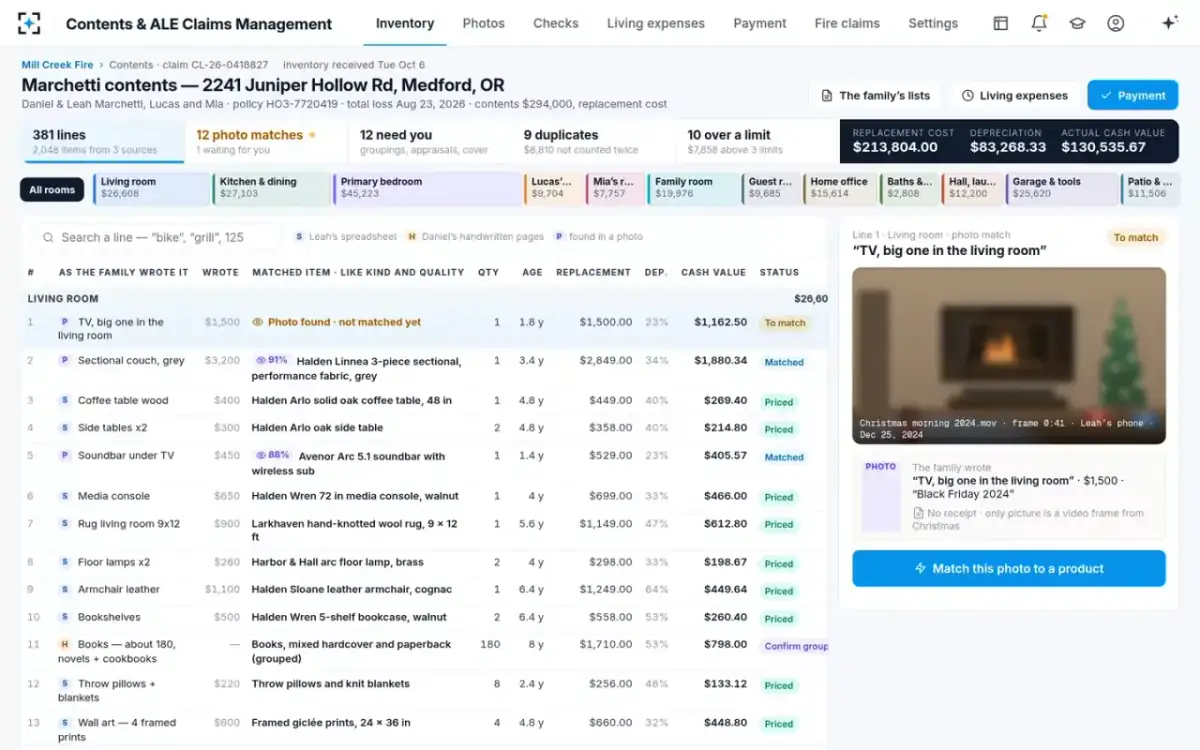
In the solution, the inventory reader does that reading under two limits: it keeps the family's own words beside every line and cites the source of each. The coverage checker flags duplicates between family members' lists and asks a person to decide, with a "They are two" button for the times there really were two. The statement the family receives at the end tells them in plain words what was paid, what comes back as they replace things, and which few items need a receipt, a photo or an appraisal.
Questions people ask
How detailed does a home inventory list for insurance need to be?
Detailed enough to identify a like-kind replacement: what the item was, how many, brand or size if known, rough age and rough price. Group items that are impractical to list one by one, such as clothing or books, with a count and a quality. The more specific a line, the fewer questions it draws and the faster it is priced.
What is an insurance claim personal property inventory?
It is the list of belongings you submit to claim under the personal property, or contents, part of your policy. It supports your proof of loss and is what the insurer prices, depreciates and checks against the policy's special limits.
Is there a printable home inventory list for insurance?
Printable room-by-room worksheets are easy to find, and any spreadsheet or printed list with room, item, quantity, age and price will do. After a disaster in California, an insurer may not require its own form if yours carries substantially the same information.
How do I prove I owned something that burned?
With whatever you have: photos and videos in which it appears, card or bank statements, order histories, warranty registrations, manuals saved online, and your own description. Expect the insurer to ask for more for high-value items such as jewelry, art or collections, often a receipt or an appraisal.
What if we listed the same thing twice?
It is normal when two people write lists, and the insurer should find the pairs and count each item once, telling you which. In the sample family's claim nine items appeared twice. If there really were two, say so and the line is restored.