An additional living expenses calculator works out how much loss-of-use coverage a displaced household is using each month, and how long its advance and its limit will last. The core is one subtraction: what the family now spends on housing, food, travel and services, minus what it would normally have spent on the same things. Multiply that monthly increase forward, compare it with what is left of the limit, and set the result against the date the home will be fit to live in again. The useful answer is not a total; it is a date, and the gap between that date and the end of the rebuild, which Contents & ALE Claims Management projects on every claim.
Most ALE calculators stop at the subtraction, and most carriers run the projection only when a limit is nearly gone. Contents & ALE Claims Management is Botminds' software for contents and living-expense claims: an agent builds the family's normal month, checks each receipt against it and the carrier's guidelines, tracks the advance and projects when the advance and the limit run out, while the contents specialist decides and signs. This guide runs the calculation on the solution's fictional sample family, the Marchettis, whose home burned on 23 August 2026.
Contents & ALE Claims Management's run rate for one family in a rental: $5,907 above their normal month
What an additional living expenses calculator has to compute
It has to compute four things, in order: the normal month, the monthly increase, the balance left of the advance and the limit, and the run-out date. The normal month comes from the household's spending before the loss; the sample family's was built from three months of card statements. The monthly increase is everything the family spends because it cannot live at home, minus what it would have spent anyway. The IRS uses the same arithmetic when it decides how much of an ALE payment is taxable: actual living expenses while the home cannot be used, minus normal living expenses for the same period (IRS Publication 547).
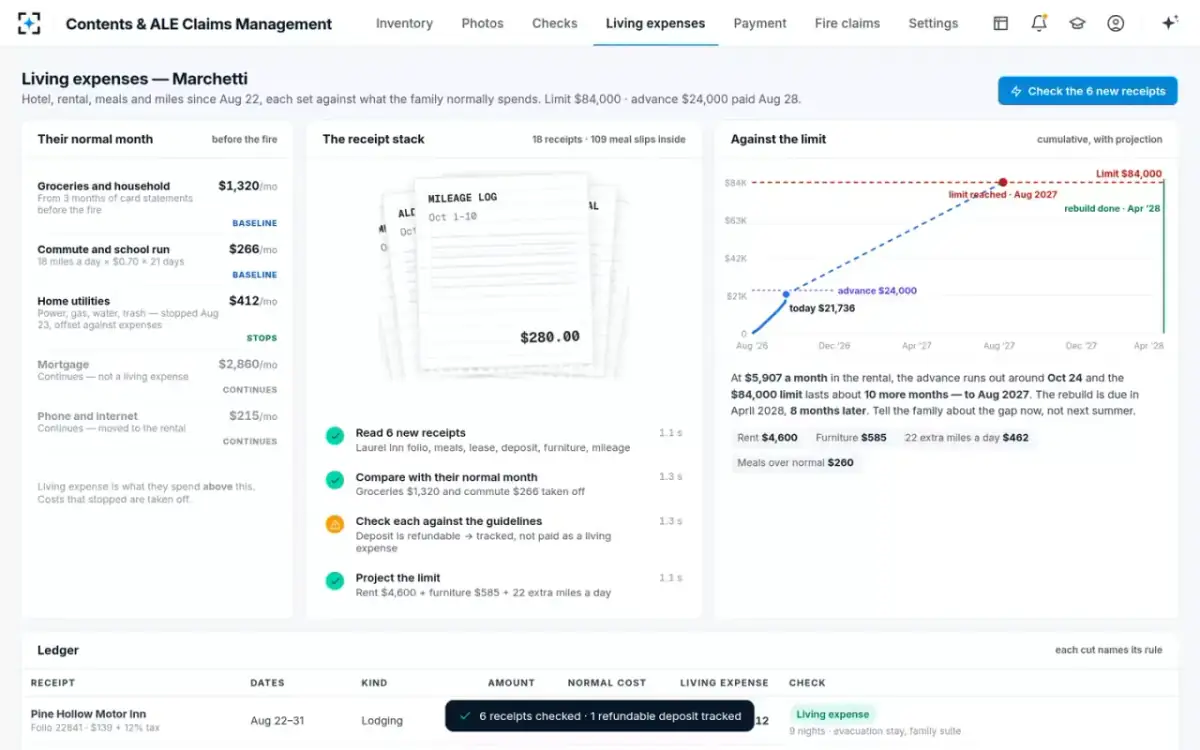
The balance and the date are where most spreadsheets stop working, because they need the payments to date, the advance and the policy limit in one place, and a forecast of next month's costs. The sample's figures make the point. By mid-October the family had spent $21,735.50 above their normal month, inside a $24,000 advance paid on 28 August, so $2,264.50 of the advance was left. At $5,907 a month in the rental, the advance would run out around 24 October. The full calculation of what counts and what does not is in how loss of use is calculated for homes.
The calculator on one family's month, run forward
Run forward, the family's $84,000 limit lasts about ten more months, to around August 2027. The arithmetic is short: $84,000 less the $21,735.50 already used leaves $62,264.50, and $62,264.50 divided by $5,907 is 10.5 months from mid-October. The field adjuster's rebuild estimate has the house finished in April 2028. That leaves about eight months in which the family would be paying rent with no living-expense cover, while still paying the mortgage on the house being rebuilt.
The money runs out before the house is ready: eight months uncovered
- Advance$24,000
- Rest of the limit, Oct 2026 to Aug 2027$60,000
- No cover, Aug 2027 to Apr 20288 months
- Rebuild, from the fire to the estimated finish20 months
Nothing in that projection is exotic, and nothing in it is visible on a receipt-by-receipt payment screen. A desk that pays each week's receipts correctly can still let a family walk into the gap, because nobody multiplied forward. The sample carrier's rule makes the projection an alert: warn the adjuster when the limit lasts less than the rebuild. The family's statement then says, in plain words, how long the limit lasts at today's costs and offers to talk early about the rebuild timeline.
How long does ALE last in California?
After a declared state of emergency, at least 24 months from the loss, extendable by up to 12 months for delays beyond the family's control and by further six-month periods for good cause, under Insurance Code §2060(b)(1), but still subject to the policy's other terms, including its dollar limit (§2060). The Department of Insurance warns families about exactly the sample's situation: "However, some policies may have a dollar limit that could be exhausted prior to these time limits ending" (CDI consumer alert).
So a California family can have two years of cover in time and ten months of cover in money. The time rule protects a family whose limit is generous; it does nothing for one whose limit is thin. Outside California, and outside declared emergencies, the period is whatever the policy says. In every case the calculator has to model both clocks and report the one that ends first. The sample family lives in Oregon, so California's minimums do not apply to them; their limit is the binding clock.
The family's living-expense position in mid-October
$21,735.50
spent above their normal month since 22 August
$2,264.50
left of the $24,000 advance
Aug 2027
when the $84,000 limit runs out at $5,907 a month
Apr 2028
when the field adjuster’s estimate has the rebuild finished
Is additional living expenses paid in advance?
Often, after a disaster, and in California it is a right on request. After a total loss relating to a state of emergency, an insurer must, "upon request by an insured, render an advance payment of no less than four months of living expenses" (Ins. Code §2061(a)(1)). After the 2025 Los Angeles fires the Commissioner ordered insurers by bulletin, on 23 January, to provide that advance alongside the contents advance (CDI wildfire claims tracker).
The sample carrier's rule is to advance four months of expected cost without receipts, and it paid the family $24,000 on 28 August, five days after the fire. The advance ran short in about two months because the first weeks were the most expensive, with nights at a motel and an inn before the family moved into the rental. An advance sized on a steady-state month is fine on average and short at the start, which is one more reason to track it against receipts rather than assume it lasts the four months its name suggests.
What happens when the ALE limit runs out?
The household pays its own extra costs from then on, unless the policy, an endorsement or a state rule provides more. For a homeowner that usually means rent and a mortgage at the same time. The cost of finding out late is real: research on four U.S. hurricanes found that "insured households are less likely to experience high financial burdens in both the short and longer-run post-disaster and are less likely to have unmet funding needs" (You and Kousky, Environmental Defense Fund, a discussion paper that has not been peer reviewed). Cover that ends early takes away exactly that protection, at the point in the rebuild when the family is most stretched.
Knowing eight months ahead changes what a family can do. They can choose a cheaper rental before signing a renewal, ask whether the rebuild can be phased, plan the move back, or set money aside. Knowing in the month the cover stops leaves none of those options. The carrier gains too: a projected gap raised early is a conversation; a gap discovered after payments stop is a complaint.
What a slow contents payment adds to living expenses
Contents and ALE are separate coverages, but they meet in the rental. The sample family rents furniture for $585 a month because theirs burned. Until their contents claim is paid and they can buy furniture again, that cost keeps drawing on the living-expense limit: about $135 a week of the limit, on the sample's figures. A contents schedule that takes three weeks longer to price costs the family roughly $400 of living-expense cover on that line alone, and delays the money they need to stop renting.
That is the customer value of speed that is easiest to show. In the sample, the family's 381-line inventory arrived on Tuesday 6 October, was read and priced overnight, and was signed and co-signed on Monday 12 October, with $72,445.59 paid by direct deposit. Whether a family uses that money to buy furniture is their choice; what the carrier controls is how long they wait for it.
The living-expense screen in Contents & ALE Claims Management: normal month, receipts checked, limit projected
An ALE calculator spreadsheet, or a receipt-by-receipt check?
A spreadsheet is a calculator; a living-expense file needs a calculator and an audit. The spreadsheet answers "how much per month"; the file also has to answer, for every receipt, whether it is owed, why, and against which baseline, and has to keep the projection current as receipts arrive. The comparison below is how the two differ on the sample family's claim.
An ALE calculator spreadsheet against a checked living-expense file
Calculator spreadsheet: Typed in once, often from memory
Receipt-by-receipt check with a projection: Built from statements, category by category, with stopped costs offset
Calculator spreadsheet: Added to a total
Receipt-by-receipt check with a projection: Sorted as owed, above baseline, tracked or not owed, with the rule named
Calculator spreadsheet: Easy to pay by mistake
Receipt-by-receipt check with a projection: Refundable deposit tracked; a folio sent twice paid once
Calculator spreadsheet: A note in a cell
Receipt-by-receipt check with a projection: Netted against spending; the date it runs out shown
Calculator spreadsheet: Checked when someone remembers
Receipt-by-receipt check with a projection: Projected every time; an alert when the limit ends before the rebuild
What to look for in ALE software
Look for software that keeps the family's normal month as evidence, names a rule for every cut and projects the limit against the rebuild date, and leaves the decisions to people. Speed of reading receipts matters less than those three; a fast tool that pays gross receipts overpays, and one that cuts without saying why produces complaints.
Questions to ask of any ALE calculator or living-expense software
- Where does the normal month come from?
Statements, a stated budget or published averages, kept on the claim and visible to the family.
- Does every cut name its rule?
Before the loss, duplicate, alcohol, refundable deposit, or whatever the carrier’s guidelines say, shown on the line.
- Does it track advances and deposits separately?
An advance is netted; a refundable deposit is tracked, not paid as a living expense.
- Does it project the run-out date against the rebuild?
Using the field adjuster’s estimate, with an alert when the limit ends first.
- Does it model both clocks?
A time limit (by policy or by state law after an emergency) and a dollar limit; report whichever ends first.
- Whose guidelines does it follow?
The carrier’s, versioned: mileage rate, excluded items, advance size, warning rules.
- Does it ever pay?
It should recommend; a person with authority signs.
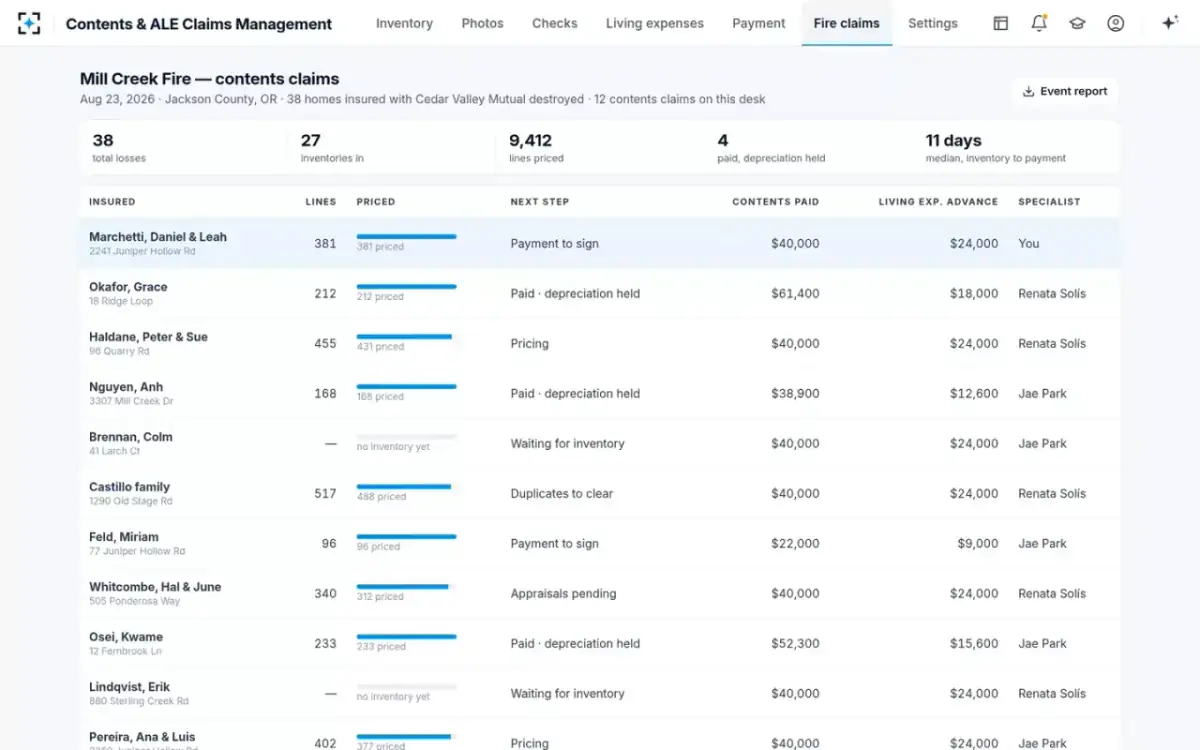
Where the solution fits is the checking and the projecting, inside the same claim as the contents schedule. It does not set the carrier's guidelines, decide coverage disputes or pay. The receipts come from the family and the advances from the carrier's claim system; the solution brings them together, so a catastrophe lead can see every family from one fire with the living-expense advance paid beside the contents payment.
Every family from one fire, with contents paid and the living-expense advance
For buyers comparing tools, the go-live questions, what the carrier has to supply and how to rehearse before a fire season, are in a go-live plan for contents claim software.
Questions people ask
How do I calculate additional living expenses?
Add up what you spend while you cannot live at home on housing, food, transportation, utilities and services, then subtract what you normally spent on the same things; the difference is the additional living expense. Keep statements from before the loss to show your normal month, and every receipt since. The IRS uses the same method to decide whether any of an ALE payment is taxable.
How much ALE will I get per month?
There is no fixed monthly amount: it is your actual increase in costs, up to the policy's limit and time period. On many homeowners forms the limit is a share of the dwelling limit; New York's regulator gives 20% as a typical general limit. Your declarations page shows yours.
Does ALE cover a security deposit on a rental?
Usually not as a living expense if it is refundable, because it is not a cost you lose. In the sample claim the $4,600 rental deposit was tracked but not paid as a living expense. Policies and insurers differ, so ask how yours treats deposits before you sign a lease.
Can I get ALE paid up front?
In California, after a total loss in a declared emergency, yes: the insurer must advance at least four months of living expenses if you ask, and pays further amounts on proof after that. Elsewhere it depends on the policy and the insurer. Either way, track your spending against the advance, because the first weeks of a displacement are often the most expensive.
What if my rebuild takes longer than my ALE?
Ask early whether the policy, an endorsement or your state's law extends the period; in California, delays beyond your control can extend the time limit after a declared emergency, though not a dollar limit. If the dollar limit will run out first, plan for the gap now: housing cost, the mortgage and the move back.