The Eliminate the List Act is the name California's Department of Insurance gave to Senate Bill 495 while it was moving; the law it became, Chapter 542 of the Statutes of 2025, took effect on 1 January 2026. It does three things for a home lost in a declared state of emergency. A furnished primary home that is a covered total loss must be offered at least 60% of its contents limit, capped at $350,000, without an itemized claim. The insurer may not demand a proof of loss sooner than 100 days after the loss. And it must grant three-month extensions for good cause. The list survives for any amount above the advance, and pricing that list is the work Contents & ALE Claims Management takes on.
That matters because contents is the slowest part of a total loss. A family that has lost everything is asked to rebuild, from memory, hundreds of lines in their own words, and a contents specialist has to price each one at today's like-kind cost, depreciate it and check it against the policy's special limits. Contents & ALE Claims Management is Botminds' software for that work: agents read the family's spreadsheets, handwritten pages and photos into one priced schedule, check living-expense receipts against the family's normal month, and leave every decision and signature to the specialist. The new law changes when that schedule is needed and what it has to subtract.
SB 495 in five numbers
60%
of the contents limit, the least an insurer must offer without an itemized claim
$350,000
the cap on that offer, up from $250,000 under the 2020 rule
100days
the earliest an insurer may require a proof of loss, counted from the date of loss
3months
each good-cause extension of that deadline, as many as the delay justifies
What is the Eliminate the List Act?
It is SB 495 (Allen), signed on 10 October 2025, which amended two sections of the California Insurance Code: §10103.7, the contents advance, and §2051.5, the replacement-cost and proof-of-loss rules. It also added a reinsurance reporting duty that has nothing to do with claims. The short title never appears in the statute. It comes from the Commissioner's office, which in March 2025 described "SB 495, the Eliminate the List Act" as a bill that, "once amended, will require insurance companies to pay wildfire survivors 100 percent of their contents coverage without needing a detailed inventory" (CDI, 6 March 2025). The final law does not do that, which is why carriers should work from the code section and not the slogan.
The operative sentence is §10103.7(b)(1). In a covered total loss of a primary dwelling "resulting from a state of emergency", and "if the residence was furnished at the time of the loss", the insurer "shall offer a payment under the contents (personal property) coverage in an amount no less than 60 percent of the policy limit applicable to the personal property covered under the policy, up to a maximum of three hundred fifty thousand dollars ($350,000), without requiring the insured to file an itemized claim" (§10103.7). Every word in that sentence is a condition a claim file has to show was met.
From 30% of the dwelling to 60% of contents: what changed from the 2020 rule
The old rule, added by AB 3012 in 2020, measured the advance against the wrong coverage. It required a payment of at least 30% of the dwelling limit, up to $250,000, without an itemized claim. The Department's own sponsor argument called that formula "confusing for policyholders given it is based on primary structure coverage", because a family's contents limit and its dwelling limit are different numbers (Assembly Insurance Committee analysis). SB 495 ties the advance to Coverage C, the limit that actually insures the belongings.
The 2020 contents advance against SB 495, line by line
2020 rule (AB 3012): The dwelling (Coverage A) limit
SB 495, from 1 January 2026: The personal property (Coverage C) limit
2020 rule (AB 3012): No less than 30% of the dwelling limit
SB 495, from 1 January 2026: No less than 60% of the contents limit
2020 rule (AB 3012): $250,000
SB 495, from 1 January 2026: $350,000
2020 rule (AB 3012): Covered total loss of a furnished primary dwelling from a state of emergency
SB 495, from 1 January 2026: Unchanged
2020 rule (AB 3012): Not addressed
SB 495, from 1 January 2026: Insurer may require one: the home was furnished and the contents were worth at least the advance
2020 rule (AB 3012): 60 days, from the standard fire policy
SB 495, from 1 January 2026: Not less than 100 days after the loss; three-month extensions for good cause
The change is smaller than the headline numbers suggest for many households, and larger for some. The Assembly analysis notes that Coverage C "is usually capped based on Coverage A limit", so the contents limit is often a fixed share of the dwelling limit. Where that share is one half, 60% of contents is exactly 30% of the dwelling, so the floor does not move until the old $250,000 cap starts to bite. The table below runs the arithmetic on four illustrative policies.
The floor rises where the cap bit or contents limits are high, and falls where they are low
| Illustrative policy | Dwelling limit | Contents limit | 2020 floor | SB 495 floor |
|---|---|---|---|---|
| Contents at half the dwelling | $500,000 | $250,000 | $150,000 | $150,000 |
| A larger home, same ratio | $1,000,000 | $500,000 | $250,000 (capped) | $300,000 |
| Contents at 70% of the dwelling | $500,000 | $350,000 | $150,000 | $210,000 |
| Contents at a quarter of the dwelling | $800,000 | $200,000 | $240,000 | $120,000 |
The last row is the one compliance teams miss. A policy whose contents limit is low against its dwelling limit now has a lower statutory floor than it had in 2025, because the 30%-of-dwelling formula is gone from §10103.7. The Assembly analysis flagged the shift for a different reason, warning that moving to Coverage C "could provide an inequity among neighbors with similar homes" and adding that "The formula change is likely to spur greater standardization of Coverage C." (analysis, comments 5 and 10) A carrier that wants no family worse off than under the old rule has to choose to pay the greater of the two.
How the bill went from 100% to 60% in the Assembly
The 60% figure is a committee compromise. As amended in the Senate on 26 March 2025, SB 495 would have required insurers "to offer 100 percent of the personal property policy coverage limit without an itemized claim" and pushed the proof-of-loss deadline to 180 days. The Assembly Insurance Committee's staff recommended cutting the advance to 60% with a $350,000 cap, the proof-of-loss deadline to 100 days, and the extensions from six months to three, and adding the attestation form (analysis, comment 10). The bill was amended in the Assembly on 10 and 17 July, passed both houses on 13 September and was signed on 10 October.
SB 495, from introduction to the forms deadline
- Introduced 19 Feb35 d
- 100% and 180 days, from 26 Mar106 d
- 60%, $350k, 100 days, from 10 Jul92 d
- Signed 10 Oct, waiting83 d
- In force 1 Jan; forms catching up181 d
- Forms must comply from 1 Julfrom 1 Jul
The cost argument behind the cut is in the analysis. It quotes figures the committee received: "At 30% of Cov A, the insurer would have paid $254,332 per claim for contents. Instead, the insurer paid 75% of C, which ended up being $422,615." The 75% reflects the Commissioner's February 2025 notice, which asked insurers to pay 100% of contents limits, and no less than 75%, without a list after the Los Angeles fires; by March, the Department reported that "The majority of homeowners insurance companies agreed to provide at least 75 percent of contents coverage without a detailed inventory" (CDI, March 2025). The law now fixes a floor below what most of those carriers volunteered.
Does the 60 percent rule apply to partial losses?
No. The advance applies only to "a covered total loss of a primary dwelling", from a state of emergency as defined in Government Code §8558, where the home was furnished. A kitchen fire, a smoke-damaged house that still stands, a vacation home, or a total loss outside a declared emergency all fall outside it. The Assembly analysis said so plainly: "insureds who lose their homes in a standard residential fire will not benefit but may pay higher premiums" (analysis, comment 3).
Three more limits are written into §10103.7(b). Paragraph (4) says the subdivision "does not affect payment under the policy for scheduled personal property", so a scheduled ring or painting is settled under its schedule, not swept into the 60%. Paragraph (6) keeps the insurer's right to restrict payment "in cases of suspected fraud". And paragraph (5) allows an attestation form in which the insured acknowledges the home was furnished and that the lost property was worth at least the advance; the form "shall not contain any misleading or inaccurate information", and the Commissioner may set its parameters by bulletin or regulation.
The 100 days are a proof-of-loss rule, not an inventory holiday
The 100 days in the press coverage come from a different section. The Department's announcement said insurers must pay the 60% "without requiring policyholders to submit a detailed inventory for at least 100 days" (CDI, 10 October 2025). The statute splits that into two rules. The advance needs no itemized claim at any point (§10103.7). Separately, §2051.5(b)(3)(A) says "an insurer shall not require the insured to provide proof of loss less than 100 days after the loss" (§2051.5).
The Department has already had to correct how carriers count it. Bulletin 2026-5 says the 100-day period "begins to run on the date of loss rather than the declaration of the state of emergency", and warns that some insurers were "using ambiguous or confusing language that undercuts the minimum 100-day proof of loss deadline" or counting from the declaration (Bulletin 2026-5). The extensions are mandatory: three months at a time, for good cause, where the insured acting in good faith meets a delay beyond their control. The statute lists examples, including the insurer's own delay in providing forms and instructions, a property the insured cannot reach because of government action or hazardous materials, and, for contents, an inventory that would be premature because rebuilding has not yet started.
When does the California contents law take effect?
The law took effect on 1 January 2026, and policy forms issued or renewed on and after 1 July 2026 must comply with both amended sections in full (§10103.7(c), §2051.5(e)). The gap between the two dates is not a grace period for claims. Bulletin 2026-5 tells insurers that the law binds them before their forms are rewritten, and that one which fails to comply "may be subject to administrative action" (Bulletin 2026-5).
For a claims department the practical date is the next declared emergency. A loss on any day of 2026 is handled under the new sections, whatever the policy jacket still says. A carrier whose first SB 495 claim arrives during a fire season will be applying, for the first time and at volume, an offer letter, an attestation, a 100-day clock counted from the right date and an advance that has to be netted out of every later contents payment.
What a carrier has to build before the next declared emergency
Most of the work is operational, not legal: the obligations are clear, but each one lands on a different team. The checklist below follows a single total-loss file from first notice to final contents payment, and each line maps to a sentence of the statute or the bulletin. Rehearse it on a closed file before a fire, not during one.
An SB 495 readiness rehearsal, one total-loss file at a time
- Flag the claim as emergency-related on day one
The advance, the 100-day clock and the extensions all hang on a state of emergency under Government Code §8558. The flag has to exist before anything else can run.
- Confirm the three facts the advance needs
Covered total loss, primary dwelling, furnished at the time of loss. Keep the evidence for each in the file.
- Send the notice of both options
§10103.7(b)(3): the insured must be told of the advance and of the right to file a full itemized claim later.
- Compute the offer from Coverage C, not Coverage A
60% of the contents limit, capped at $350,000. Scheduled personal property is settled separately.
- Check the attestation form against the statute
Only the two acknowledgments the law describes, with nothing misleading. Watch for a Commissioner bulletin setting its parameters.
- Count the proof-of-loss date from the date of loss
Day 100 at the earliest, then three-month extensions for good cause. Bulletin 2026-5 names counting from the declaration as an error.
- Carry the advance into every later contents payment
An itemized claim above the advance is paid net of it. A payment that forgets the advance overpays; one that nets it twice underpays.
- Measure the rehearsal
Time from notice to advance, share of offers sent with both options, and errors found in the netting. Then fix the slowest step.
Where the list still matters: recovering above the advance
The list is not eliminated for anyone whose belongings were worth more than the advance. §10103.7(b)(2) says that after the advance "the insured may recover additional amounts up to the policy limit for contents coverage by filing a claim pursuant to the terms of the policy". On a $500,000 contents limit, the advance is $300,000 and the remaining $200,000 is claimed the old way, line by line. Above the $350,000 cap, a family with a $900,000 limit has $550,000 that only an itemized claim can reach.
Two other rules shape that remaining claim. Under §2051.5(b)(1)(B), in a state-of-emergency loss, a policyholder has no less than 36 months from the first actual-cash-value payment to collect full replacement cost, so the depreciation held back on each line stays open for years. And the statute's own example of good cause, an inventory that is premature before construction starts, tells carriers the itemized claim will often arrive late and in pieces. How a family rebuilds that list from memory is the subject of the home inventory guide.
The scale is not hypothetical. The Department's tracker counted 41,727 claims filed after the January 2025 Los Angeles fires and $25.2 billion paid by its update of 6 July 2026; those claims "include home, business, living expenses, auto damage, and other disaster-related claims", and the count has been revised over time (CDI wildfire claims tracker). Those fires were handled under the 2020 rule and the Commissioner's voluntary request. The next one will be the first large test of SB 495.
How Contents & ALE Claims Management handles a claim with an advance
The solution treats the advance as a line in the payment, not a note in the file. In the sample claim the screens below use, a fictional carrier, Cedar Valley Mutual, paid the Marchetti family a $40,000 contents advance without an inventory on 2 September, ten days after a wildfire destroyed their home. The family is in Oregon, so California's statute does not govern their file; the mechanics are what carry over. When their 381-line inventory was priced, the payment recommendation deducted the advance before arriving at the amount due.
In Contents & ALE Claims Management, the advance is netted out of the contents payment
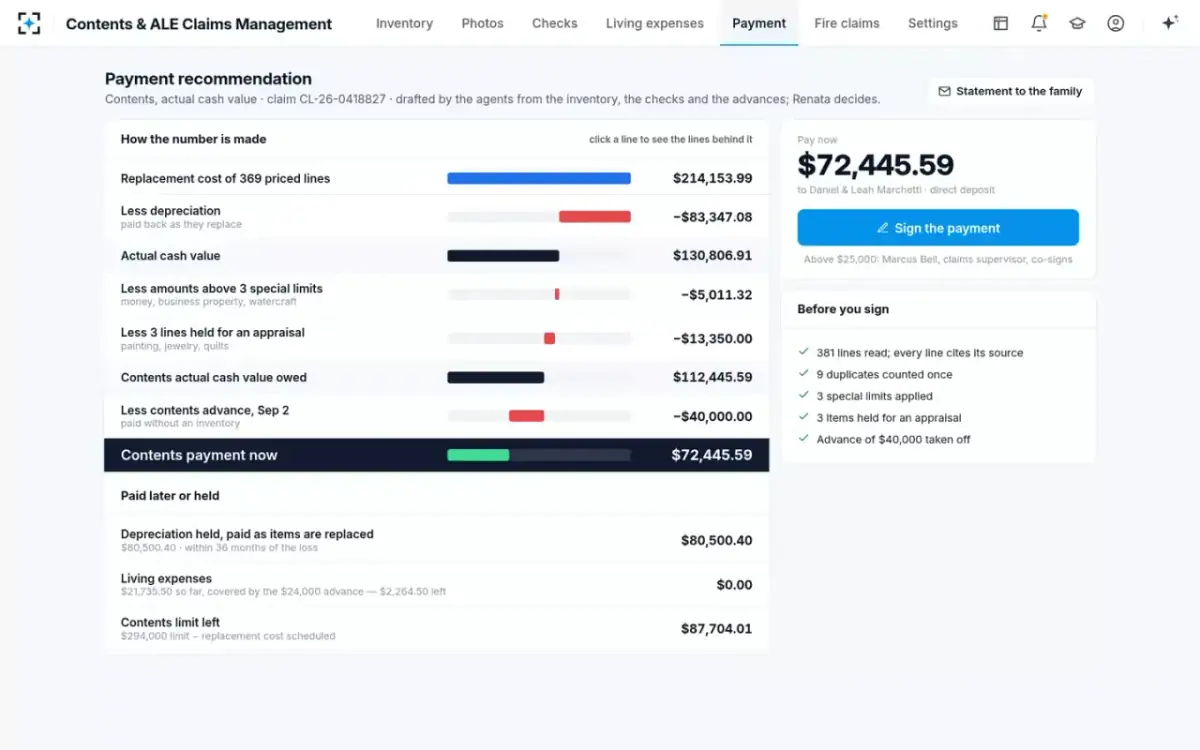
The same logic holds for an SB 495 file. The specialist sees the offer that was made, the advance that was paid and the itemized claim above it, each with its source. The agents keep the family's own words beside every line and accept grouped entries such as "Books — about 180" for a person to confirm, which is what California's 2020 law (§2061(a)(3)) already requires carriers to accept. They never approve or pay: the contents specialist signs within authority, and a supervisor co-signs above it.
One fire, every contents claim on the desk, and what each has been paid
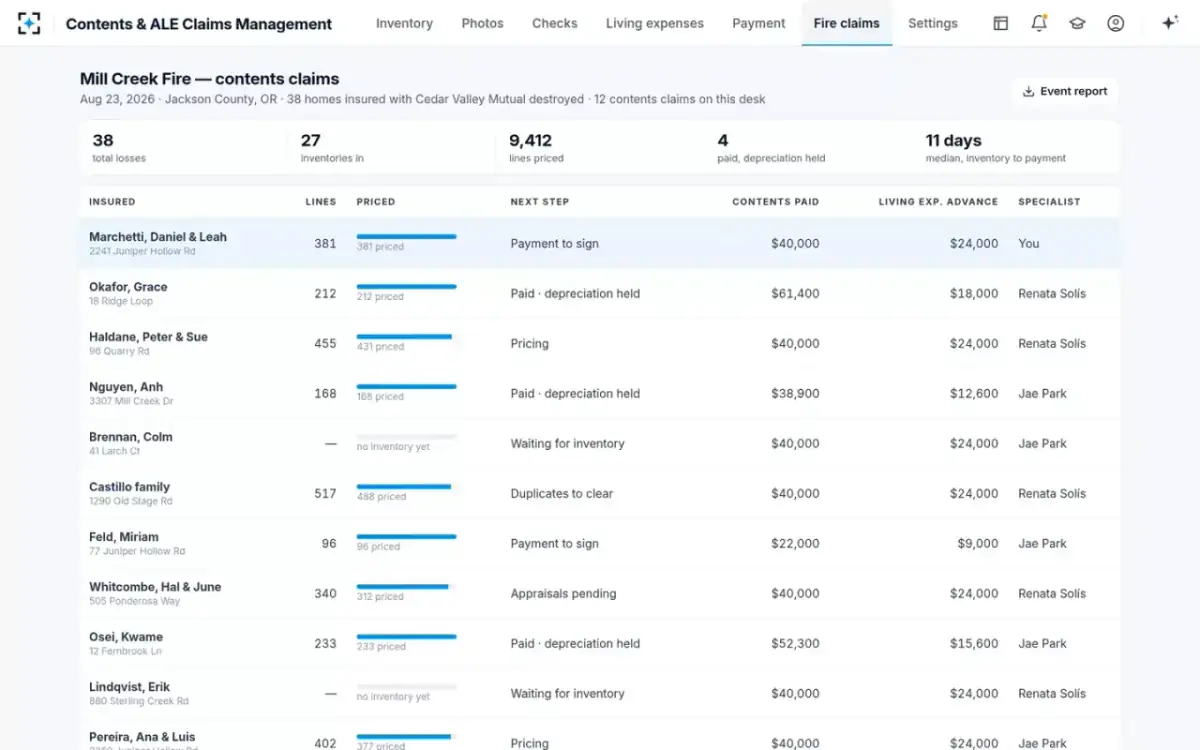
What the solution does not do is decide the legal questions. Whether a loss is a covered total loss, whether the home was furnished and whether a delay is good cause are judgments for the carrier's people, written into the file. The agents make the arithmetic and the evidence fast enough that those people decide on day 10 rather than day 60. The like-kind pricing behind each line is explained in how one contents line is priced, and the living-expense side of the same claim in how loss of use is calculated.
Questions people ask
What is SB 495 in California?
SB 495 (Allen), Chapter 542 of the Statutes of 2025, is the law the insurance commissioner promoted as the Eliminate the List Act. For a covered total loss of a furnished primary home in a declared emergency, it requires an offer of at least 60% of the contents limit, up to $350,000, without an itemized claim, and bars proof-of-loss deadlines earlier than 100 days after the loss. It took effect on 1 January 2026.
How much contents can I get without an inventory in California?
At least 60% of your policy's personal property limit, up to $350,000, if your furnished primary home was a covered total loss in a declared state of emergency. Your insurer may pay more; most homeowners insurers agreed to pay at least 75% without a list after the 2025 Los Angeles fires. Anything above the advance, up to your limit, is claimed with an itemized list.
Does the Eliminate the List Act apply to a house fire that was not a declared emergency?
No. The advance and the 100-day proof-of-loss rule apply only to losses relating to a state of emergency as defined in Government Code §8558. A single house fire is handled under the policy and California's general claims regulations, including the requirement that depreciation be itemized and explained in writing.
Can my insurer make me sign something to get the 60% advance?
It may require an attestation form, limited by statute to acknowledging that the home was furnished and that you reasonably believe your lost property was worth at least the advance. The form may not contain misleading or inaccurate information, and the Commissioner may set its parameters by bulletin or regulation.
When does the 100-day proof of loss deadline start?
On the date of loss, not the date the emergency was declared, according to the Department's Bulletin 2026-5. Insurers must also grant extensions of three months for good cause, such as being unable to reach the property because of government action or hazardous materials.
Is the 60 percent advance the most I can recover for contents?
No. §10103.7(b)(2) lets you recover more, up to the contents limit, by filing an itemized claim under the policy after receiving the advance. Replacement-cost policies then pay held-back depreciation as you replace items, with at least 36 months from the first payment to do so after an emergency loss.