Loss of use for a home is calculated as the difference between what a displaced household actually spends to keep living as it did and what it would normally have spent in the same period. Insurers call the coverage additional living expense, or ALE, and on many homeowners forms it is Coverage D. New York's regulator puts it in one sentence: "you are only covered for the difference between your normal living expenses and any additional living expenses" (NY DFS). Hotel bills, a rental, extra miles and restaurant meals count only by the amount they exceed the family's usual month, and costs that stopped, such as utilities at a burned house, come off. Contents & ALE Claims Management applies that rule receipt by receipt.
The calculation is simple to state and slow to do, because the inputs arrive as a weekly stack of folios, meal slips, mileage logs and leases, and each has to be set against a baseline nobody wrote down before the loss. Contents & ALE Claims Management is Botminds' software for that work and for the contents claim that runs beside it: an agent builds the family's normal month, checks each receipt against it and the carrier's guidelines, names the rule behind every cut, and projects when the limit runs out, while a person decides. This guide uses its fictional sample family, the Marchettis, displaced by a wildfire on 23 August 2026.
One family's normal month, and what happened to each part of it
$1,320
groceries and household a month, the baseline food spending
from 3 months of card statements
$266
commute and school run a month, the baseline for mileage
$412
home utilities a month, stopped on the day of the fire
offset against expenses
$2,860
mortgage a month, still paid
continues, so not a living expense
How is loss of use calculated? The increase over the normal month
Take what the household spends while displaced, subtract what it would have spent anyway, and pay the difference, for as long as the policy and the law allow and up to the limit. The IRS uses the same arithmetic to decide what part of an ALE payment is taxable, and its definition is the cleanest one in print: "A temporary increase in your living expenses is the difference between the actual living expenses you and your family incurred during the period you couldn’t use your home and your normal living expenses for that period" (IRS Publication 547).
The IRS also lists what goes into both sides: renting suitable housing, transportation, food, utilities and miscellaneous services. "Normal living expenses consist of these same expenses that you would have incurred but didn’t because of the casualty or the threat of one." That last clause matters. A mortgage the family keeps paying is not a normal expense they avoided, so it neither adds to nor reduces ALE; a utility bill that stopped is one they avoided, so it comes off.
The IRS's worked example of the normal-month method
| Line | Item | Amount |
|---|---|---|
| 1 | Insurance payment for living expenses | $2,200 |
| 2 | Actual expenses for the month away: motel $3,000, food $850 | $3,850 |
| 3 | Normal living expenses: rent $1,400 (not charged that month), food $500 | $1,900 |
| 4 | Temporary increase in living expenses (line 2 minus line 3) | $1,950 |
| 5 | Part of the payment that is taxable (line 1 minus line 4) | $250 |
What are additional living expenses, and what is ALE in insurance claims?
Additional living expenses are the extra costs of living somewhere else, or living differently, because a covered peril made the home unfit to live in. California's Department of Insurance defines the coverage this way: "Also known as Loss of Use or Fair Rental Value, ALE covers the additional costs when your property is not safe to live in due to a covered peril, like a wildfire" (CDI consumer alert). The Department lists food and housing costs, telephone or utility installation at a temporary residence, extra transportation to work or school, relocation and storage, and furniture rental as eligible.
Two details in that definition are easy to miss. The home does not have to be destroyed: the Department notes that if a home has no water, sewer or electricity because of a covered peril, ALE can apply even to an undamaged house.
Building the normal month: what is a baseline, what stops, what continues
The normal month is built from what the family spent before the loss, category by category, and every category ends up in one of three states. Some keep running at the same level and are the baseline: the family still eats and still drives to work, so only spending above the usual amount counts. Some stop: a burned house has no power bill, so that saving is offset against the new costs. Some continue unchanged, like a mortgage, and play no part in the calculation at all.
The sample family's baseline came from three months of card statements: $1,320 a month on groceries and household goods and $266 on the commute and school run. Their utilities, $412 a month, stopped on 23 August and are offset. Their $2,860 mortgage and $215 phone and internet continue. The method matters more than the source. Where a family has no statements, a carrier can rebuild the month from bank statements, a budget the family states, or published local averages, but it has to say which, because every receipt is measured against it.
Do additional living expenses cover meals?
Yes, but only the part above what the family normally spends on food. A household that spent $1,320 a month on groceries and now eats every meal from a motel or a restaurant is owed the difference, not the restaurant bill. That is the IRS's example in miniature: food of $850 in the month away against $500 normally adds $350 to the increase. New York's regulator lists "restaurant bills" among covered expenses on the same basis.
The sample auditor treats meals the same way: after the family moved into their rental, its projection carries "meals over normal" at $260 a month, not the full food bill. Alcohol is a guideline cut in the sample carrier's rules, which is why $64 of bar items on a hotel folio was taken off with that rule named on the line.
One week of receipts, sorted: owed, offset, not owed
Every receipt in a living-expense file ends up as one of four things: owed in full, owed above the baseline, tracked but not paid, or not owed with a named rule. The table below sorts receipts and bills from the sample family's first weeks out of their home. None of the decisions is exotic; what makes the work slow is doing it for every slip, every week, for months.
Receipts from one displaced family, each sorted with the rule that applies
| Receipt or bill | What it is | Sorted as | Why |
|---|---|---|---|
| Pine Hollow Motor Inn, 22–31 Aug | 9 nights at $139 plus 12% tax | Owed in full | Evacuation lodging; they normally pay no rent |
| Rental lease, from October | $4,600 a month | Owed in full | Housing; the mortgage continues and offsets nothing |
| Rental deposit | $4,600, refundable | Tracked, not paid as a living expense | A refundable deposit is not a cost |
| Furniture rental | $585 a month | Owed in full | Named as eligible by California’s regulator |
| Mileage log | 22 extra miles a day at $0.70 a mile | Owed above the commute baseline | Only miles beyond the normal commute |
| Restaurant and grocery receipts | Food while displaced | Owed above the $1,320 baseline | Only the increase over normal food spending |
| Home utilities | $412 a month that stopped | Offset | A cost the family no longer pays |
| Grocery receipt dated before the fire | A normal pre-loss shop | Not owed | Incurred before the loss |
| Laurel Inn folio, received twice | The same stay sent twice | Paid once | Duplicate |
| Bar items on a folio | $64 | Not owed | Alcohol, a guideline exclusion in the sample carrier’s rules |
What receipts do I need for ALE?
Keep a receipt or bill for every cost that is higher, or new, because you cannot live at home, and keep the evidence of your normal month. The California Department of Insurance tells policyholders to "keep all of your bills and receipts associated with your relocation, such as emergency shelter (i.e. hotel bills), clothing, and food" (CDI). California law also requires an insurer, when a homeowner claims ALE, to "provide the insured with a list of items that the insurer believes may be covered under the policy as additional living expenses" (Ins. Code §2060(a)), so in California the carrier's list is the place to start.
The paper a loss-of-use claim runs on
- Three months of statements from before the loss
The normal month is built from them. Without a baseline, every receipt is an argument.
- Every lodging folio and the lease
Hotel, motel, short-term rental, then the longer lease, with the dates of each stay.
- Deposits, separately
A refundable deposit is tracked, not paid as a living expense, and comes back to whoever paid it.
- A mileage log
Date, trip and miles, so extra miles can be set against the normal commute.
- Food receipts, kept by week
Only the increase over normal food spending is owed, so the total by week is what counts.
- Bills that stopped
Utilities, trash, services at the damaged home: they reduce the claim, and showing them speeds it.
- Furniture rental, storage and moving
Named as eligible by California’s regulator, with the dates each began and ended.
Is additional living expenses limited by time?
Yes, by the policy, and in some states by law in the policyholder's favour. Policies set the period, often tied to the time reasonably needed to repair the home, and a dollar limit. California sets a statutory minimum after a declared state of emergency: ALE lasts "no less than 24 months from the inception of the loss", with an extension of up to 12 more months for delays beyond the insured's control and further six-month extensions for good cause (§2060(b)(1)). The same section adds "but shall be subject to other policy provisions", which is why a dollar limit can still run out first.
The time limit and the dollar limit are separate clocks, and the family needs to know which one ends first. In the sample, the family's $84,000 limit lasts to about August 2027 at their current spending, while the rebuild is due in April 2028. That gap, and what a carrier should do about it, is the subject of the additional living expenses calculator.
Coverage D loss of use percentage: how the limit is set
On many homeowners policies the loss-of-use limit is a percentage of the dwelling limit. New York's regulator gives 20% as the general limit for additional living expenses on the most widely used homeowners form, alongside 50% for personal property on the premises (NY DFS). Other forms cap ALE by time instead of, or as well as, by amount. The declarations page says which.
A percentage limit can be generous for a short displacement and thin for a long one. The arithmetic of the limit is easy; the forecast is not. A carrier that projects the run-out date from the family's actual monthly spend can tell them months ahead, rather than in the month the money stops.
Is additional living expenses taxable?
Usually not, to the extent it covers the temporary increase in living costs. The IRS says that if ALE payments "are more than the temporary increase in your living expenses, you must include the excess in your income", but adds: "However, if the casualty occurs in a federally declared disaster area, none of the insurance payments are taxable" (IRS Publication 547). In the IRS's worked example above, $250 of a $2,200 payment was taxable because the payment exceeded the increase.
This is one more reason to calculate ALE from the normal month rather than paying gross receipts. A payment built on the increase is, by construction, close to what the IRS treats as non-taxable; a payment built on the total hotel and food bills can overpay, and outside a federally declared disaster the excess becomes the family's tax problem. Households with a tax question should ask a tax adviser; this is not tax advice.
How Contents & ALE Claims Management checks each receipt
In the solution, one agent, the living-expense auditor, does the checking, and it may not pay or cut without naming a rule. It reads each new receipt, compares it with the family's normal month, checks it against the carrier's guidelines and updates the projection of the limit. Anything it cuts carries the rule on the line: before the loss, a duplicate folio, alcohol, a refundable deposit. It recommends; the contents specialist decides, and payments above the specialist's authority need a supervisor's co-signature.
How six new receipts are checked against the normal month
Agent
Read the receiptsSix new receipts from 9 to 11 October: Laurel Inn folio, meals, lease, deposit, furniture, mileage.
Agent
Compare with the normal monthGroceries ($1,320) and commute ($266) taken off; stopped utilities offset.
Never: Never cuts a receipt without naming the rule
Agent
Check each against the guidelinesThe $4,600 deposit is refundable: tracked, not paid as a living expense.
Agent
Project the limitRent $4,600, furniture $585 and 22 extra miles a day set the monthly run rate.
A person decides
Decide and signThe contents specialist accepts or overrides each line; an override needs a reason the supervisor sees.
Never: Agents never pay; they recommend
Contents & ALE Claims Management puts the normal month, the receipt stack and the limit on one screen
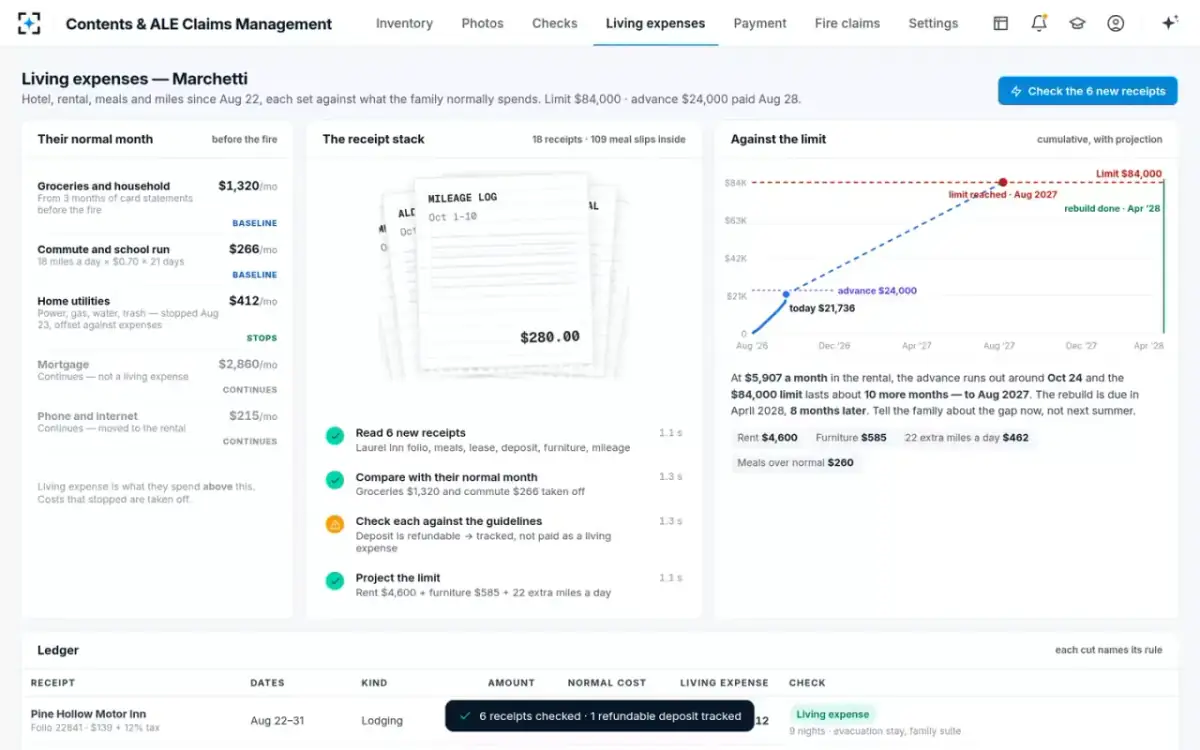
The family sees the result in plain words. Their statement says what the receipts so far come to above their normal spending, how much of the advance is left and how long the limit lasts at today's costs, and it asks them to keep sending rent and mileage each month.
“Living expenses: your receipts so far come to $21,735.50 above what you normally spend, and the advance covers it, with $2,264.50 left.”
From the sample family's statement
The statement to the family, with the living-expense paragraph
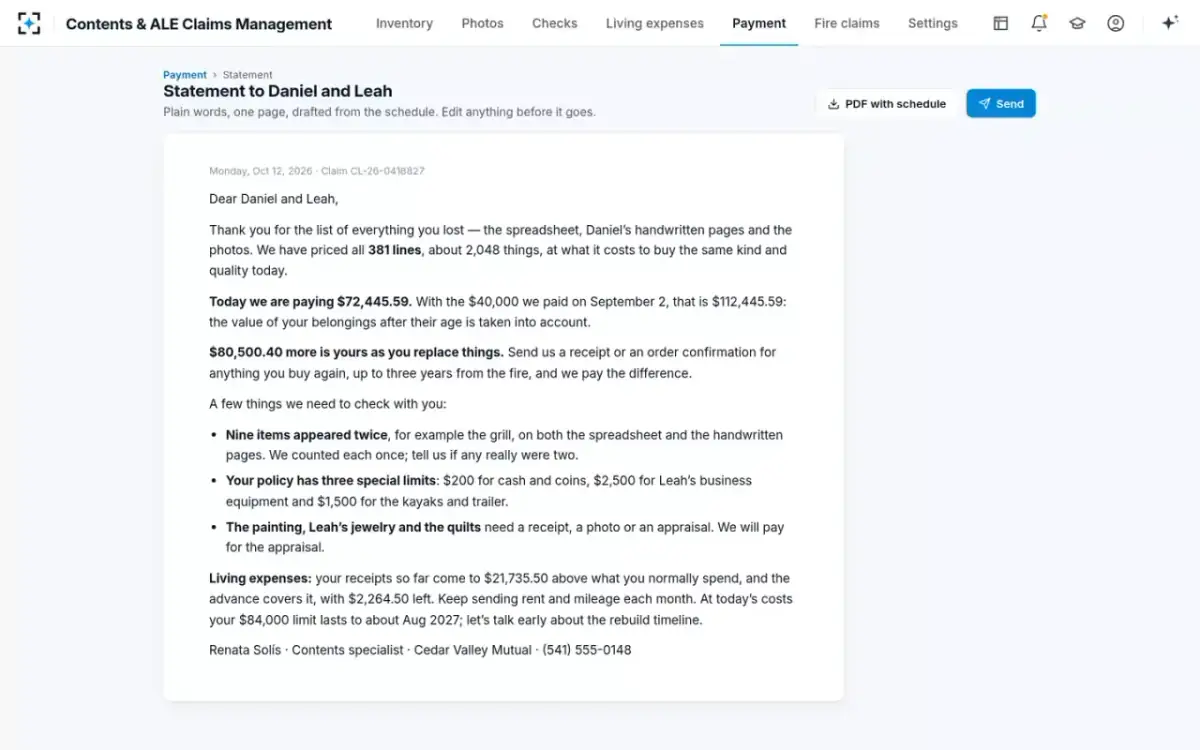
The contents side of the same claim, and why a faster contents payment can shorten the furniture-rental line above, is set out in contents valuation for insurance.
Questions people ask
What is normal living expenses per month for an ALE claim?
It is what your household spent in a typical month before the loss on the same things you now spend on while displaced: housing, food, transportation, utilities and services. Insurers and the IRS subtract it from your actual costs while you are out of your home; only the difference is additional living expense. Card or bank statements from the months before the loss are the usual evidence.
Does ALE pay my mortgage?
No. A mortgage you keep paying is not an additional cost of living elsewhere, and it is not a normal cost you avoided, so it plays no part in the calculation. ALE pays for your temporary housing in full when you normally pay no rent, which is how it helps a homeowner who is still paying the mortgage.
Can I get ALE if my house was not damaged but I could not live in it?
Often, yes, if a covered peril made it unsafe or unlivable. California's regulator says ALE can apply when a home has no water, sewer or electricity because of a covered peril, though an insurer may instead fix the condition, for example with a generator. California also guarantees at least two weeks of ALE after a declared emergency when an order of civil authority bars access to a home because of a covered peril.
Do I have to repay ALE if I spent less than I was advanced?
An advance is paid against expenses you are expected to incur, and later payments depend on proof. California's law requires the insurer to pay further ALE "upon proper proof following the advance period". If your actual increase in costs ends up below what was paid, how the difference is handled depends on the policy and the insurer.
Is ALE paid for a renter?
Renters policies usually include loss of use too, calculated the same way: the increase over normal costs. California's regulator notes that most renters policies pay ALE only until the renter can move back or for a reasonable time to find another rental, whichever is less, so the period can be much shorter than for a homeowner.