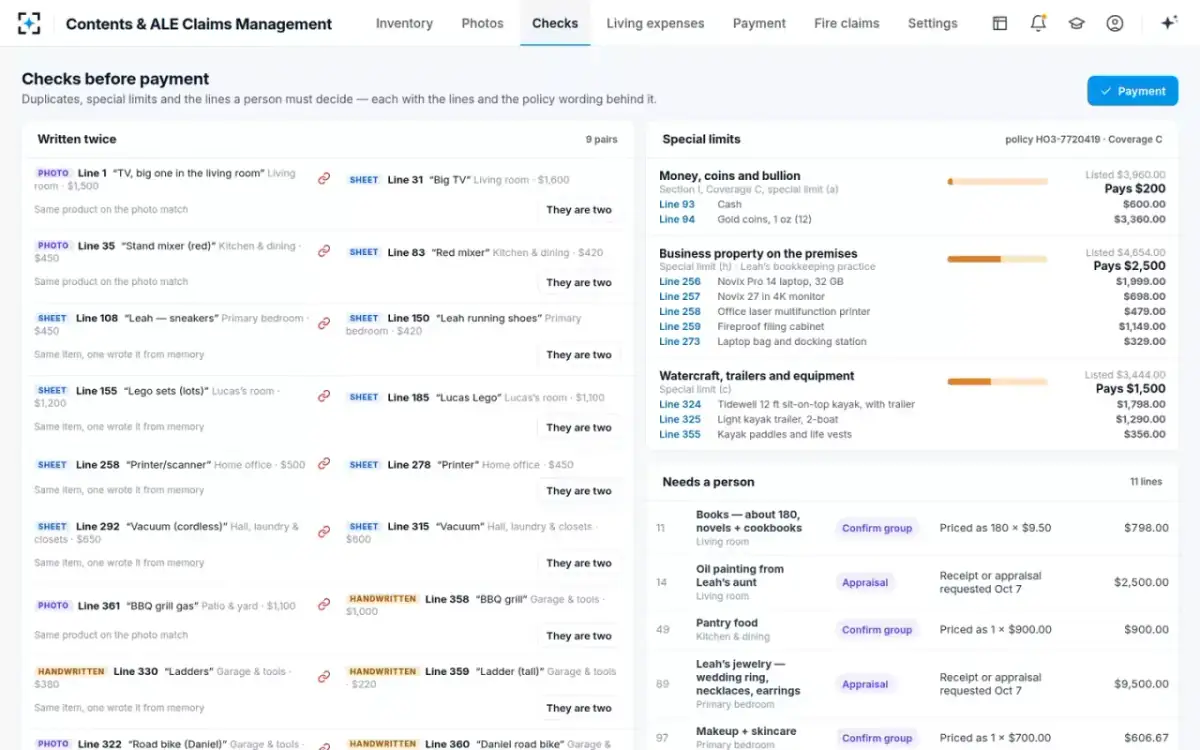
Special limits of liability under Coverage C are dollar caps on particular kinds of personal property that apply inside the overall contents limit, whatever the property was worth. A typical homeowners policy pays no more than $200 for money, $1,500 for watercraft including trailers, $2,500 for business property at home, and, for loss by theft only, $1,500 for jewelry, watches and furs and $2,500 for firearms or silverware. New York's regulator explains that these limits "represent the total amount that a company will typically pay for a loss of property in the specified category" (NY DFS). A family's cash and gold coins, listed at $3,960, pay $200 under the money limit, and Contents & ALE Claims Management shows that cap beside the coins before a specialist spends time on them.
The caps matter twice in a contents claim: once in the amount paid and once in the work done. A specialist who prices each gold coin to the dollar before noticing the money limit has spent an hour to arrive at $200. Contents & ALE Claims Management is Botminds' software for pricing and checking contents claims: a coverage checker finds every line that falls under a special limit, groups it with the others under the same cap, and shows listed against paid with the policy wording, so the specialist decides with the cap in view. The examples come from its fictional sample claim, a family whose home burned in August 2026, insured on an HO-3 form.
Three special limits on one family's claim: what they listed against what the caps pay
What is special limits of liability?
It is a sublimit: a maximum the policy will pay for one category of property, however high the overall contents limit is. Special limits tend to fall on property that is small, valuable, easy to steal or hard to value, and on property that belongs to a different risk, such as a business or a boat. The overall limit still applies on top. New York's regulator adds the consequence most people miss: "An insured’s overall personal property limit per loss would usually be reduced by any recoveries received that are subject to these special limits" (NY DFS).
Special limits are not exclusions. A family with $10,000 of cash in a drawer is covered for that cash, up to the money limit. And they are not the overall contents limit, which on the most widely used homeowners form is commonly set at 50% of the dwelling limit for property on the premises, according to the same regulator's guide. The special limit is the inner box; Coverage C is the outer one.
The Coverage C special limits on a typical homeowners policy
The list is short and stable, though amounts vary by form and insurer and can be raised by endorsement. The New York regulator's list of typical limits is below; your declarations and policy wording are what count. Read the first word of each line: "on" means the cap applies to any covered loss; "for loss by theft" means it applies only to theft.
Typical special limits under Coverage C, and when each applies
| Category | Typical limit | Applies to |
|---|---|---|
| Money, bank notes, bullion, gold and silver | $200 | Any covered loss |
| Securities, accounts, deeds, letters of credit | $1,500 | Any covered loss |
| Watercraft, including trailers | $1,500 | Any covered loss |
| Trailers not used with watercraft | $1,500 | Any covered loss |
| Jewelry, watches, furs, precious and semi-precious stones | $1,500 | Theft only |
| Silverware, goldware and pewterware | $2,500 | Theft only |
| Guns | $2,500 | Theft only |
| Property used for business, at the residence | $2,500 | Any covered loss |
| Property used for business, away from the residence | $500 | Any covered loss |
| Electronic apparatus in or on a motor vehicle | $1,500 | Any covered loss |
Theft-only limits and all-peril limits: why the jewelry was not capped in the fire
The jewelry, watch, fur, gun and silverware limits are typically written for "loss by theft", so a fire, a flood or a windstorm does not trigger them. That single word changes a claim. In the sample family's claim, Leah's jewelry, a wedding ring, necklaces and earrings listed at $9,500, burned with the house. The sample carrier's settings show the jewelry limit as "$1,500 · not applied to fire", so the line was held for a receipt or an appraisal instead of being capped, and $9,500 of value stayed open rather than collapsing to $1,500.
The same ring under two different losses
Stolen from the house: Theft limit for jewelry applies, $1,500 on the typical form
Destroyed in the house fire: Theft limit does not apply
Stolen from the house: The special limit, unless the ring is scheduled
Destroyed in the house fire: The overall contents limit, unless the ring is scheduled
Stolen from the house: Proof of ownership and of the theft
Destroyed in the house fire: Proof of ownership and value, such as a receipt or appraisal
Stolen from the house: Not applicable
Destroyed in the house fire: $9,500 held for an appraisal, not capped
The money limit is the opposite case. It is written "on" money, so it applies to any covered loss, fire included. The sample family's $600 of cash in a drawer and Grandpa's twelve gold coins, which they valued at $3,360, both fall under it: $3,960 listed, $200 paid. A specialist who reads the theft-only limits as all-peril underpays the jewelry; one who reads the money limit as theft-only overpays the coins.
Are jewelry and cash limited on homeowners insurance?
Yes, both, but differently. Cash is capped for any covered loss, at $200 on the typical form; jewelry is typically capped only for theft, at $1,500 for jewelry, watches and furs together. Neither cap is a valuation: the insurer still has to establish what the items were worth, and pays the lower of that value and the cap. For jewelry lost in a fire, the question is proof, not the cap, which is why appraisals are requested.
Gold and silver coins are a trap. The New York guide lists "money, bank notes, bullion, gold & silver" together under the $200 limit, so a coin collection valued for its gold can pay as cash. Collectors who want full cover for coins, stamps or cards should insure them separately, and the regulator says so in as many words.
“Therefore, if you have expensive jewelry, furs, cameras, or a coin, stamp, or sports card collection, or valuable antiques, you should consider insuring them separately by endorsement with a higher limit of coverage, or by purchasing a separate policy, called a personal articles ‘floater.’”
New York Department of Financial Services
Increased special limits of liability: endorsements and floaters
Increased special limits are bought, not assumed: an endorsement raises a category's cap, and a scheduled-property endorsement or a personal articles floater lists named items at agreed values. A scheduled item is settled under the terms of its schedule or floater rather than the category cap. Disaster rules treat it separately too: California's contents advance law leaves payment for scheduled personal property untouched (Ins. Code §10103.7(b)(4)).
For a contents specialist, the first question on any high-value line is therefore whether it is scheduled. If it is, it leaves the Coverage C schedule entirely. If it is not, the next question is whether a special limit applies and for which perils. Only then is it worth pricing precisely.
Apply the caps before the pricing: what the order saves
The caps should be applied before pricing effort is spent, because a capped group needs only enough pricing to show it exceeds the cap. The sample's money group shows why: whether the gold coins are worth $3,360 or $4,100 changes nothing once the cap is $200. The same holds for business property. Leah's bookkeeping laptop, monitors, printer, filing cabinet and dock, listed at $4,654, pay $2,500 under the on-premises business limit; pricing them line by line to the cent is work the payment never sees.
The basis of the cap also matters. The sample claim's summary band shows the family's listed figures $7,858 above the three limits, while the payment waterfall deducts $5,011.32. Both are right: the band measures the family's own numbers against the caps, while the waterfall applies the caps after pricing and depreciation, where the payment is calculated. A specialist should report the second and keep the first as context. How the full waterfall runs is in contents valuation, from memory to payment.
Special limits in Contents & ALE Claims Management: each group, its lines, listed against paid
Flood policies cap differently: one $2,500 limit
The federal flood policy has a single special limit for several categories at once. It says: "We will pay no more than $2,500 for any one loss to one or more of the following kinds of personal property", and lists artwork, photographs, collectibles and memorabilia; rare books or autographed items; jewelry, watches, precious stones and articles of gold, silver or platinum; furs; and personal property used in any business (SFIP Dwelling Form, III.B.8). Unlike the homeowners jewelry cap, this one is not limited to theft.
FEMA's manual adds how it is applied: "The adjuster must apply the $2,500 special limit to the aggregate ACV of all applicable contents", and "any excess loss to items subject to the $2,500 special limits cannot be applied to the contents deductible" (NFIP Claims Manual). A family with both a homeowners policy and a flood policy can therefore see the same necklace capped under one and not the other, depending on what destroyed it.
Every capped line should say which cap
A payment that reduces a line for a special limit should name the limit and show the amount above it. The NAIC's model act lists as an unfair practice "Making claims payments to an insured or beneficiary without indicating the coverage under which each payment is being made" (NAIC Model 900, §4.J), and a reduction is part of a payment. A family that sees "Gold coins, $3,360, paid $200" with no reason will assume an error; one that sees "money limit, $200, Section I, Coverage C, special limit (a)" has the policy wording to check.
Before any contents payment: the special-limit checks
- Is the item scheduled?
If so, it is settled under its schedule and leaves the Coverage C limits.
- Which category, if any, does it fall into?
Money, securities, watercraft, trailers, jewelry and furs, silverware, guns, business property, vehicle electronics.
- Is the limit all-peril or theft-only?
Read the first words of the provision. A fire does not trigger a theft-only cap.
- Is the business property at home or away?
The typical caps differ: $2,500 on the premises, $500 away.
- Group the lines under each cap
Caps apply to the category in one loss, not to each line.
- Price only as far as the cap needs
Enough to show the group exceeds the cap; no further.
- Name the cap on the payment and the statement
The limit, its section letter and the amount above it, for every capped line.
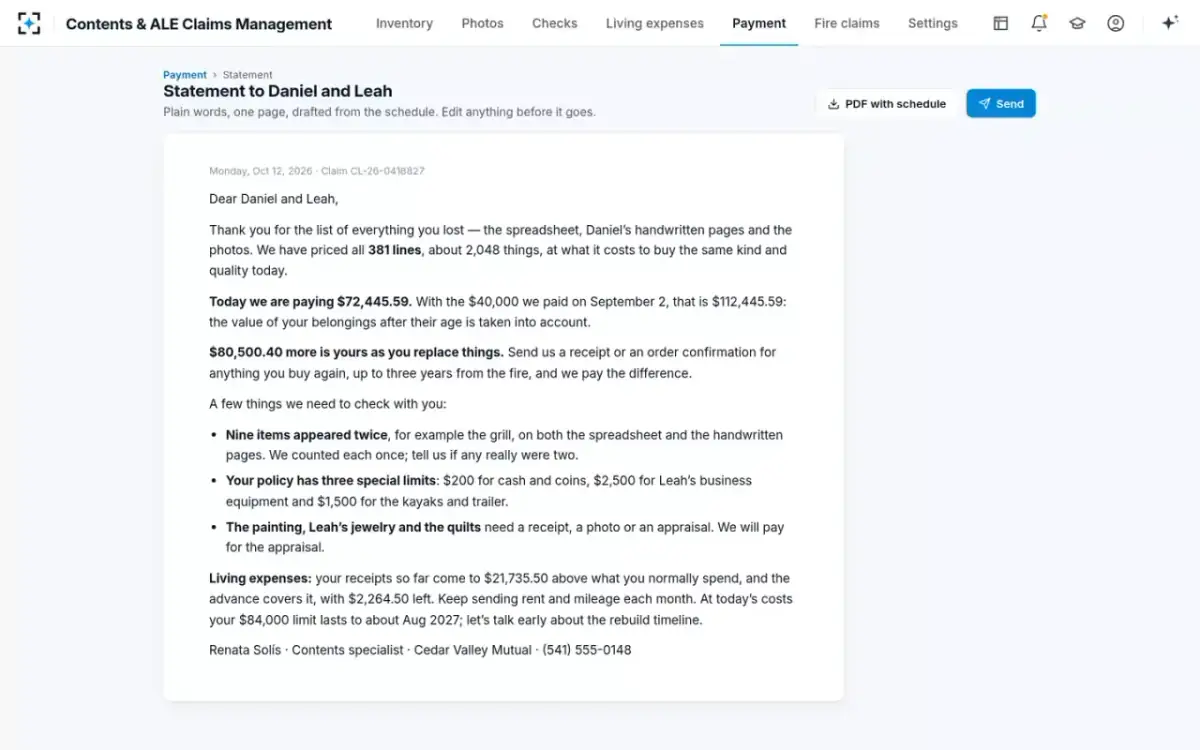
In the solution, the coverage checker does the grouping and flags; it never removes a line, and a person decides. The family's statement then names the three limits in plain words, "$200 for cash and coins, $2,500 for Leah's business equipment and $1,500 for the kayaks and trailer", so the reason for each reduction arrives with the money.
The family's statement from Contents & ALE Claims Management names each limit in plain words
Caps are one of the reasons a contents settlement differs from a family's list; the others, depreciation and like-kind pricing, are in like kind and quality, line by line.
Questions people ask
What are the Coverage C special limits on an HO-3 policy?
Typically $200 for money, $1,500 for securities, $1,500 for watercraft including trailers, $1,500 for other trailers, $1,500 for theft of jewelry, watches and furs, $2,500 for theft of silverware and of guns, $2,500 for business property at home and $500 away, and $1,500 for electronics in a vehicle. Insurers' forms vary, so check your own policy.
What are homeowners insurance personal property limits?
There are two layers: the overall Coverage C limit, often set as a share of the dwelling limit (New York's regulator gives 50% for property on the premises as typical), and the special limits inside it for particular categories. Both appear in your declarations and policy wording.
Does the special limit for business property cover my home office computer?
If the computer is used for business, typically only up to the business property limit: New York's regulator gives $2,500 at home and $500 away. A computer used only personally falls under the ordinary personal property limit. For more cover, the regulator points to an endorsement or a separate policy.
Do special limits apply to the California 60% contents advance?
The advance is paid without an itemized claim, so there are no lines for a special limit to apply to. The limits come into play if the family files an itemized claim for more, which is settled under the policy's terms. Scheduled personal property is outside the advance altogether.
How do I increase special limits of liability?
Ask your insurer for an endorsement raising the limit for a category, or schedule individual items, such as a ring or a collection, at an appraised value on a scheduled-property endorsement or a separate personal articles floater. Scheduled items are settled under the schedule's own terms rather than the category cap.