Contents inventory software, on the claims side, is software that turns a policyholder's list of lost belongings into a priced, checked schedule an adjuster can pay from. It has to read lists in any form, a spreadsheet, a template, handwritten pages, a photo album, match each line to a product, price it and check it against the policy. The part that separates good software from risky software is what it does when it is not sure. A tool that fills every gap looks complete and is wrong in ways nobody can see; a tool that asks leaves fewer, clearly marked decisions for a person. Contents & ALE Claims Management is built to ask.
The search term covers two different markets. Home inventory apps help a household list what it owns before anything happens. Claims-side contents software works after the loss, for the carrier, on whatever the family managed to put together. Contents & ALE Claims Management is Botminds' software of the second kind: agents read the family's sources into one numbered schedule, match and price each line at like kind and quality, catch duplicates and special limits, and check living-expense receipts, while the contents specialist decides and signs. The examples below come from its fictional sample claim, a family whose house burned in August 2026.
In Contents & ALE Claims Management every line meets six questions, and each uncertain answer goes to a person
1Is the item in something the family sent?
YesMake it a line, citing the row, the page and line, or the photo.
NoNo line. The software does not add belongings from outside the family’s own material.
2Can it be matched to a make and model?
YesFrom the receipt, the description or a photo, with a match score.
NoA person decides how to price it. No price from a guess without a candidate.
3Is the photo match 90% or better?
YesProposed with the candidates it beat, for the specialist to see.
NoWaits for a person to accept or reject the match.
4Is it a grouping, such as “Books — about 180”?
YesPriced per unit and flagged for a person to confirm the count.
NoPriced as a single item.
5Does it appear twice, across sources or rooms?
YesBoth lines shown side by side; counted once until a person says “they are two”.
NoCounted once.
6Does a special limit, an exclusion or an appraisal apply?
YesFlagged with the policy wording. Never removed: only a person takes a line out.
NoReady for payment.
What contents inventory software has to do
It has to do five jobs in order, and be honest at each one: read every source, match each line to a product, price it at like kind and quality, depreciate it, and check it against duplicates and the policy's limits. Most of the time on a manual contents file goes into the first three, which are typing and searching, not judgment. Most of the risk sits in the last two, which change the amount paid.
What it should not do is decide. The NAIC's model bulletin on insurers' use of AI, which the NAIC's map lists as adopted in 29 jurisdictions (NAIC, October 2026), is plain that tools do not change the standard: "Decisions subject to regulatory oversight that are made by Insurers using AI Systems must comply with the legal and regulatory standards that apply to those decisions, including unfair trade practice laws" (NAIC Model Bulletin, Section 3). A contents payment is such a decision. Software that prices a schedule is an input to it, and the insurer answers for the result.
Can software read a handwritten inventory?
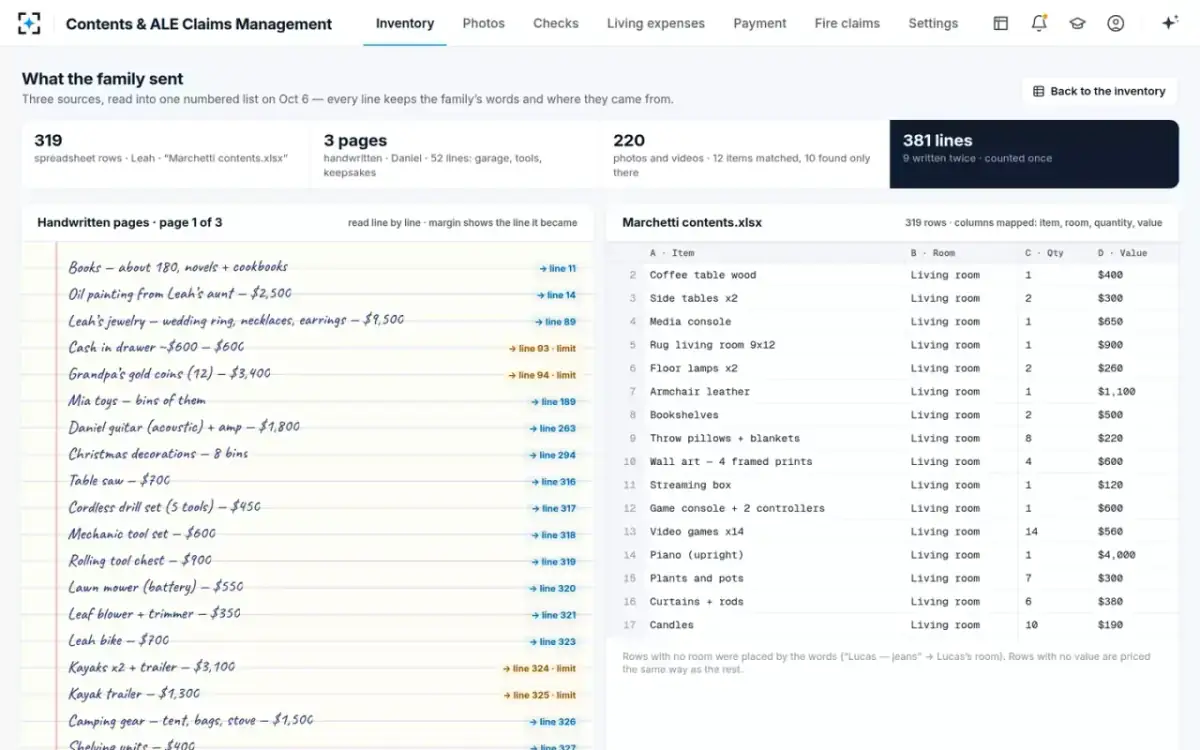
Yes, and it has to, because a family that has lost a house writes its list wherever it can. In the sample claim the inventory came from three sources: Leah's spreadsheet of 319 rows, Daniel's three handwritten pages with 52 lines covering the garage, tools and keepsakes, and a shared album of 214 photos and 6 videos. The inventory reader turned them into one numbered list of 381 lines, and every handwritten line shows in the margin the line it became and whether it is a duplicate or falls under a limit.
Reading the words is the easy part. The harder part is placing them: a spreadsheet row with no room was put in a room from its own words, "Lucas — jeans" going to Lucas's room. And the reader keeps the family's wording exactly, so "Kayaks x2 + trailer — $3,100" stays visible beside line 324, the line it became, under the watercraft limit. If the family later disputes a line, the specialist can show them their own words and the product chosen for them in the same row.
Three sources, one numbered list: each handwritten line shows the line it became
Does contents software invent items?
It can, and that is the risk to design against. Language models produce fluent text whether or not a source supports it. Researchers at Stanford and Yale tested commercial AI legal research tools built to answer from real sources, and found that they "each hallucinate between 17% and 33% of the time" (Magesh et al.). That study is about legal research, not contents, but the lesson carries: grounding a tool in documents reduces invention, it does not remove it.
For a contents schedule the defence is structural, not a promise. Every line must cite the row, the page and line, or the photo frame it came from, and must keep the family's own words beside the product chosen. A line with no citation cannot exist, so an invented television has nowhere to come from. The sample solution's inventory reader works under exactly those two limits. The remaining risk is a wrong match on a real line, which is what the next question handles.
What happens when a photo match is uncertain?
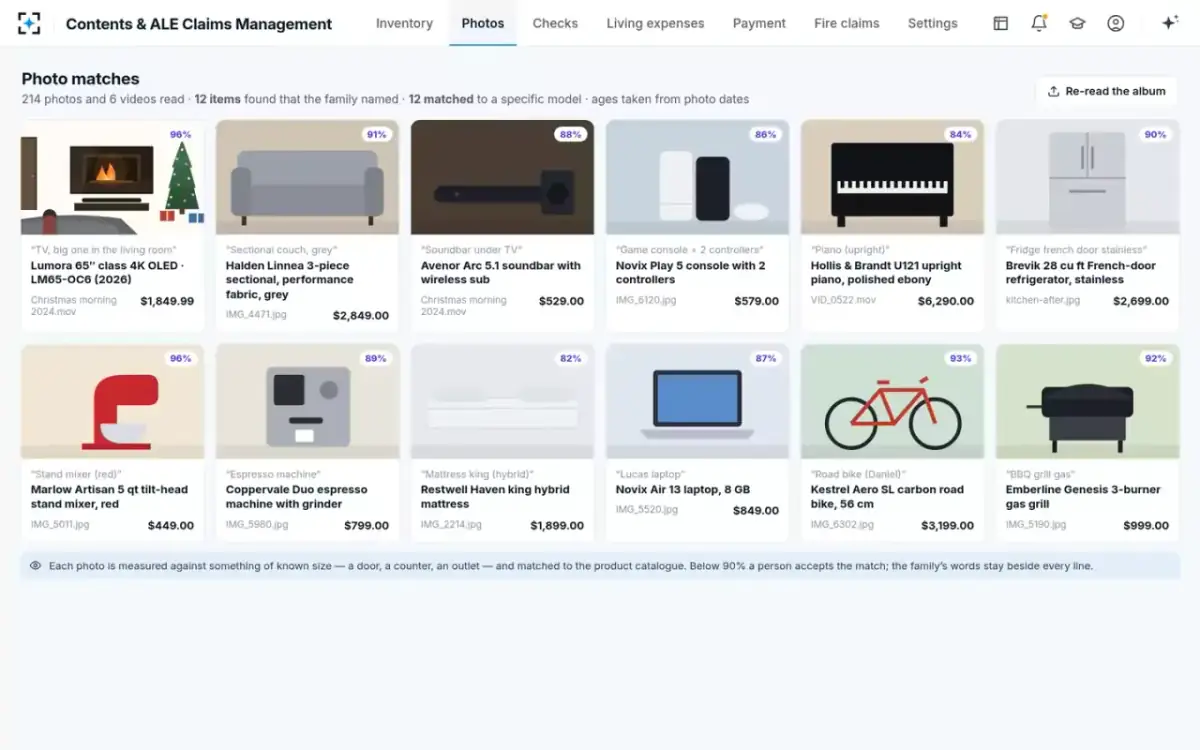
A person accepts it or not, and the software says why it is unsure. In the sample, the photo matcher found the family's television in frame 0:41 of a Christmas-morning video, sharpened the crop from four neighbouring frames, measured the screen against an 80-inch door at 64.6 inches, and matched it to a Lumora LM65-OC4 at 96%, with the runners-up at 61% and 34% shown beside it. That is above the carrier's 90% threshold, so the match was proposed directly and the specialist accepted it in one click.
Below 90% the match waits. The agent still shows its best candidate and the evidence, but nothing is priced from it until the specialist agrees. Without any candidate, the agent does not price at all. The threshold is the carrier's setting, not the vendor's, and it is the single most important number to agree before go-live: set it too low and wrong matches are priced silently; set it too high and the specialist is asked about everything.
Twelve named items found in the family's photos, each with its match score
The questions a good contents agent asks, and who answers them
Every uncertain answer in the decision path above becomes a question for a named person, and the questions are specific. Is "Books — about 180" really 180 books? The specialist confirms the grouping or asks the family. Is the grill on Leah's spreadsheet the same grill as on Daniel's pages? The specialist sees both lines and clicks "They are two" only if it was two grills. Is Leah's jewelry, listed at $9,500, worth that? The line is held and a receipt or appraisal is requested.
California's law already requires carriers to accept some of these answers in the family's favour. After a declared emergency, an insurer "shall not require that the insured use a company-specific inventory form if the insured can provide an inventory using a form that contains substantially the same information" (Ins. Code §2061(a)(2)), and it must accept grouped categories such as clothing and books. Software that can only read the carrier's own template, or that rejects a grouping because it wants item-level detail, puts the carrier on the wrong side of that rule.
Contents inventory list, worksheet or template: what the software must accept
Anything the family can produce. Families search for a "contents inventory list", a "contents inventory worksheet" or a "home contents inventory list template excel", and they will send whichever they found, often more than one. A spreadsheet with columns in an unfamiliar order, a phone photo of a printed worksheet, a typed list in an email and a bundle of receipts are all inventories. Mapping their columns, item, room, quantity, value, is the software's job, not the family's.
The practical test for a buyer is to send a vendor the messiest real inventory in your closed files, not their sample. Count how many lines come back with a citation, how many were merged or split, and how many questions the software raised. A clean result on a clean template proves nothing about the night after a wildfire. The rebuild-from-memory side of that problem, from the family's chair, is in how to write a home inventory list for an insurance claim.
Why the refusal rate is a quality measure
The share of lines a tool sends to a person is not a defect to be driven to zero; it is a measure of whether the tool knows the limits of its evidence. On the sample's 381-line claim, the band at the top of the schedule summed it up: one photo waiting for the specialist, 12 lines needing a person for groupings, appraisals or cover, 9 duplicate pairs and 10 lines over a special limit. Each is a decision the specialist would have had to make anyway, now presented with the evidence beside it.
What one 381-line inventory sent to a person, by reason
Track the rate over time and by reason. A rising share of uncertain photo matches may mean the threshold is too strict or the photos are poorer after a particular event. A falling share of duplicate flags on claims with several family members' lists should make you suspicious, not pleased. And compare the specialist's overrides with the agents' proposals: an override rate near zero can mean the agents are right, or that nobody is looking.
What to ask before you buy contents inventory software
Ask about evidence, thresholds and accountability before you ask about speed. Washington's claims rule, in force since 18 October 2026, says "A reasonable investigation may not rely solely on the use of a database, which includes, but is not limited to, estimating software and benchmarks gathered from one or multiple databases" (WAC 284-30-330(4)). A contents tool whose output is treated as the investigation, rather than an input to it, is a regulatory problem in that state and a weak defence everywhere else.
Questions to put to any contents inventory software
- Does every line cite where it came from?
Row, page and line, or photo frame, visible on the line, not in a log. Ask what happens to a line it cannot cite.
- Are the family’s own words kept?
Exactly as written, beside the product chosen, on every line.
- Who sets the match threshold, and what happens below it?
It should be your setting, and below it a person accepts. Ask for the share of matches below it on your own files.
- Does it accept groupings and any inventory format?
California requires both after a declared emergency. Send your messiest closed file as the test.
- Does it flag, or does it remove?
Duplicates, limits and exclusions should be flagged with the policy wording; only a person should take a line out.
- Can you see the sources behind each price?
Named sellers and dates, so you can answer a claimant who asks where a price came from.
- Whose rules does it follow, and are they versioned?
Your retailers, successor rule, life table and limits, with each change saved under a name and date.
- Does it ever approve or pay?
It should not. Recommendations go to a person with authority.
Where Contents & ALE Claims Management fits, and where it does not
It fits after the loss, on the carrier's side, between the family's inventory and the signed payment. It reads spreadsheets, handwritten pages and photo albums; matches items to makes and models; prices them at like kind and quality from the carrier's approved retailers; applies the carrier's life table; flags duplicates, special limits, exclusions and appraisals; checks living-expense receipts against the family's normal month; and drafts the payment recommendation and the family's statement. Every rule it follows is the carrier's setting.
It is not a home inventory app for households, and it does not replace the contents specialist. It does not decide coverage, approve payments or remove lines. And it does not replace a carrier's claim system: advances already paid come from that system and payments go back to it. The BLS already observes that "computer software can evaluate photographs of damaged property and calculate an estimated claim amount" (BLS); the design question is what that software is allowed to conclude on its own, and here the answer is nothing that changes a payment without a person.
Two kinds of contents inventory software, and which one this is
Home inventory app: A household, before any loss
Claims-side contents software: A carrier’s contents specialist, after a loss
Home inventory app: Photos and receipts taken room by room in advance
Claims-side contents software: Whatever the family can produce afterwards, often from memory
Home inventory app: A list of belongings
Claims-side contents software: A priced, depreciated, checked schedule and a payment recommendation
Home inventory app: Nobody needs to
Claims-side contents software: A person with authority, on every uncertain line and every payment
Home inventory app: Not this
Claims-side contents software: This, plus the living-expense side of the same claim
The specialist's side of the same work, seat by seat, is in what a contents adjuster does, and what a carrier has to bring to go live is in the go-live plan for contents claim software.
Questions people ask
What is the best software for a contents inventory after a fire?
It depends on whose side you are on. A household needs a simple way to list and photograph what it remembers, room by room; a carrier needs software that reads those lists in any format, cites every line and sends uncertain matches to a person. For a carrier, test any tool on its own messiest closed files rather than a vendor's sample.
Can AI price a contents claim?
It can propose a price for each line, from a match to a make and model and quotes from approved sellers, much faster than a person can type it. Under the NAIC's model bulletin the insurer remains responsible for the decision, and Washington's rule says a reasonable investigation may not rely solely on a database or estimating software. A person should accept uncertain matches and sign the payment.
Does contents software work with an Excel inventory template?
It should accept any spreadsheet and map its columns, whatever order they are in. California law bars insurers from insisting on their own inventory form after a declared emergency when the family's form has substantially the same information, so software limited to one template is a compliance risk as well as an inconvenience.
How does contents software find duplicates?
By comparing lines across sources and rooms for the same product, the same photo match or very similar words, such as "Big TV" on a spreadsheet and "TV, big one" from a photo. In the sample claim it found nine pairs. A good tool shows each pair side by side and counts it once until a person confirms they really were two items.
Is my data safe with contents inventory software?
Ask the vendor where the family's photos and documents are stored, who can see them and how long they are kept, and get the answer in the contract. The NAIC's model bulletin expects an insurer's AI program to cover systems it buys from vendors as well as those it builds, so the carrier's own controls apply to the vendor's software too.