Contents claim software takes a policyholder's inventory and living-expense receipts and turns them into a priced, depreciated, checked payment recommendation that a contents specialist signs. Buying it is the easy part. Making it safe means teaching it your carrier's rules, the approved retailers, the successor rule, the depreciation table, the special limits by policy form, the living-expense guidelines and the signing authority, then proving on your own closed claims that it applies them as your best specialist would. The right moment to finish is before a fire season, because the first large event is the worst time to learn how a new tool handles a 400-line inventory. This plan is written for Contents & ALE Claims Management, and its steps apply to any contents tool.
Contents & ALE Claims Management is Botminds' software for that work: agents read a family's spreadsheets, handwritten pages and photos into one schedule, match items to makes and models, price each line at like kind and quality, catch duplicates and special limits, and check living-expense receipts against the family's normal month, while the contents specialist decides and signs. This guide sets out a go-live plan for it. The six weeks are a plan we propose, not a measured result; the screens show the solution's fictional sample carrier, Cedar Valley Mutual.
Six weeks from your own rules to a first live claim in Contents & ALE Claims Management
- Rules and filesWk 1
- Set and sign offWk 2
- Replay closed claimsWks 3–4
- RehearsalWk 5
- First live claimsWk 6
What contents claim software has to get right in 2026
Three things changed in 2026 that any contents software now has to handle. California's SB 495 took effect on 1 January: after a declared emergency, a total loss gets a contents advance of at least 60% of the contents limit, up to $350,000, without an itemized claim, and the advance has to be netted out of every later contents payment. Washington's amended claims rule took effect on 18 October and says that "Insurers are responsible for the accuracy of their evaluations including, but not limited to, evaluations made on their behalf" (WAC 284-30-380(7)). And the NAIC's model AI bulletin, which the NAIC lists as adopted in 29 jurisdictions by October 2026, expects an insurer's AI program to cover AI systems bought from vendors as well as those it builds (NAIC Model Bulletin; what the bulletin requires).
All three point the same way. The vendor's output becomes the carrier's evaluation, and the carrier has to be able to show how each number was reached. The NAIC's model claims regulation already requires that "Detailed documentation shall be contained in each claim file in order to permit reconstruction of the insurer’s activities relative to each claim" (Model 902, §4). For a contents claim of several hundred lines, that means reconstruction line by line. What SB 495 requires in detail is set out in the Eliminate the List Act guide.
What do you need to start contents automation?
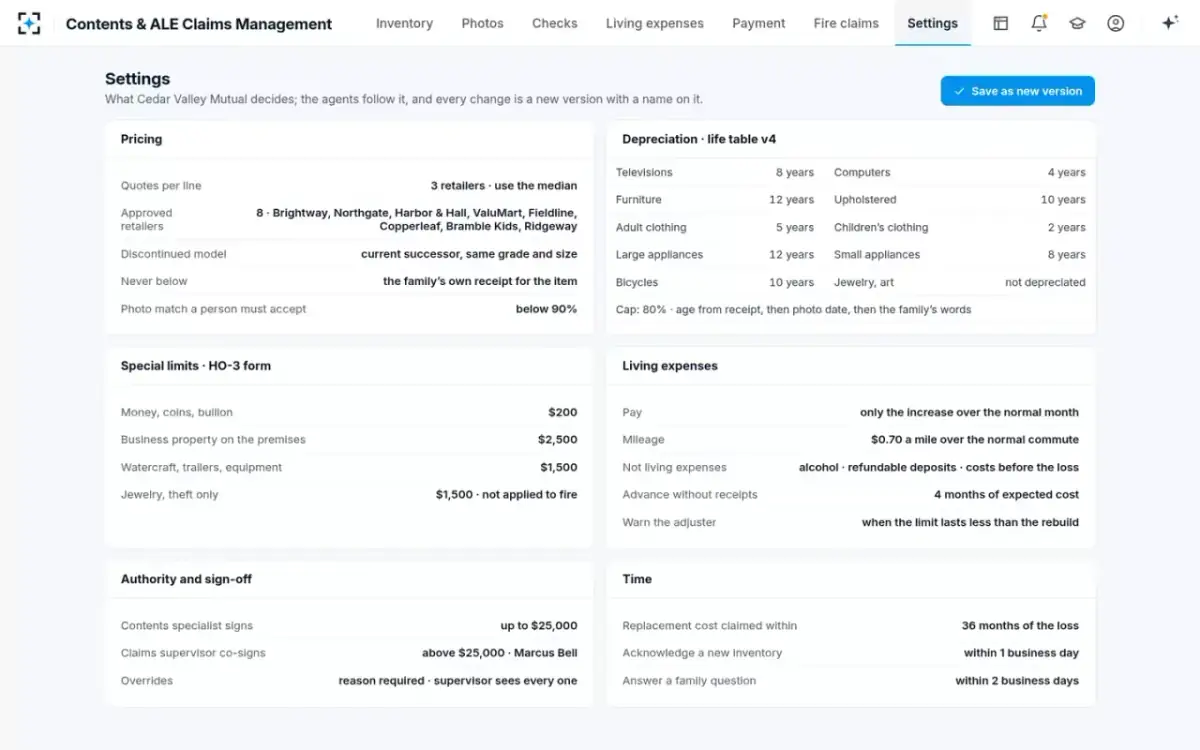
Your own rules, written down, and a set of your own closed claims. Every rule the agents follow is a carrier setting, and the go-live work is mostly agreeing what each setting should be. The solution's own answer to the question names four inputs: policy forms, the depreciation guide, living-expense guidelines and a sample of past contents files. The table below breaks those into the settings a carrier has to decide.
What a carrier brings, and the setting each becomes
| Bring | The setting it becomes | The sample carrier’s choice |
|---|---|---|
| Approved retailers | Quotes per line and the rule for choosing | 8 retailers; 3 quotes; the median |
| Successor policy | What to price when a model is discontinued | Current successor, same grade and size |
| Floor and grade rules | What a price may never go below | Never below the family’s own receipt; never a lower grade |
| Photo-match tolerance | The match score below which a person accepts | Below 90% |
| Depreciation guide | Life table by category, cap, and where age comes from | Life table v4; cap 80%; receipt, then photo date, then the family’s words |
| Policy forms | Special limits by form | HO-3: money $200, business property $2,500, watercraft $1,500 |
| Living-expense guidelines | What is owed, what is not, the advance and the alert | Only the increase over the normal month; $0.70 a mile; 4 months advanced; warn when the limit ends before the rebuild |
| Authority table | Who signs and who co-signs | Specialist to $25,000; supervisor co-signs above |
| Service standards | Response times the desk is held to | New inventory acknowledged in 1 business day; family questions in 2 |
| Closed contents files | The replay set for weeks 3 and 4 | A mix of total and partial losses, with the paid result |
Can we use our own depreciation tables?
Yes, and you should, because your table is what your specialists defend today and what examiners will compare against. The depreciation agent applies the carrier's life table by category and age, with the carrier's cap, and the same inputs always give the same answer. The sample's table gives televisions 8 years, computers 4, furniture 12, upholstered furniture 10, adult clothing 5, children's clothing 2, large appliances 12 and bicycles 10, caps any deduction at 80%, and does not depreciate jewelry or art.
The go-live check on a table is not whether it is generous but whether it is specific. California expects each deduction to reflect a measurable difference in value due to age and condition, itemized in dollars, and FEMA rejects one rate for everything in flood claims. A table with a single "electronics" row will produce defensible numbers for televisions and indefensible ones for laptops. Week 2 is where those rows get split. How the table produces a single line's deduction is shown in like kind and quality, line by line.
Which retailers can contents pricing use?
The ones your carrier approves, quoted by name and date, so that any price can be traced to its source. The sample carrier lists eight retailers, takes three quotes per line and uses the median, which discards both the cheapest and the dearest quote. A family whose television was priced at $1,849.99 can be shown the three retailers and their prices. Washington now gives claimants a right to ask for exactly that: when an insurer prices with a database or estimating software, it must say when the data was collected, where from and which businesses supplied it.
The retailer list is also where go-live surfaces gaps. A list built for electronics and furniture may have no source for hand tools, children's clothing or garden equipment, all of which appear on the sample family's list. The replay in weeks 3 and 4 will show which categories fall through to a person for want of a quote, and the list can be extended before go-live rather than during a catastrophe.
The carrier's rules, versioned: pricing, depreciation, limits, living expenses, authority, time
How long to implement contents claim software? A six-week plan
Six weeks is a realistic plan for one line of business in one state, if the rules exist as documents and a set of closed files can be exported; it is a plan, not a promise, and the first week usually decides whether it holds. Each week ends in a decision a named person signs.
Six weeks, week by week: the work and the decision that closes it
| Week | Work | Closes with |
|---|---|---|
| 1 | Collect forms, the life table, the retailer list, living-expense guidelines and the authority table; choose 20 closed contents files across total and partial losses | The contents lead agrees the file set and the rule documents are complete |
| 2 | Enter every rule as a setting; split vague rows of the life table; set the photo-match threshold | Compliance signs the rule set as version 1 |
| 3 | Replay the first ten closed files; compare each schedule with what was paid, line by line | A list of differences, each explained as an agent error, a rule gap or an error in the original file |
| 4 | Fix rule gaps; extend retailers for missing categories; replay the second ten | Pass marks met, or a named reason why not |
| 5 | Rehearse a declared-emergency total loss end to end, including the contents advance, the living-expense advance and the family’s statement | The catastrophe lead signs the rehearsal |
| 6 | First live claims, every payment reviewed by a second specialist | Go, or stay in review for another two weeks |
Set the pass marks before the replay, not after. Some should be absolute: every line cites its source and keeps the family's words, which is the solution's own design target of 100%; no line is removed by an agent; every capped line names its limit. Others are rates you choose from the replay itself: the share of like-kind items a specialist agrees with, the share of duplicates found that a specialist confirms, and the difference in payment from the original file once each difference is explained. A difference is not a failure. A replay often finds errors in the original file, and finding them is part of the value.
The rehearsal that decides go-live
The rehearsal is a closed total loss rerun as if it had happened in a declared emergency, start to finish, with every notice and every advance. It tests the parts a replay of ordinary claims does not: emergency flags, statutory advances, deadlines counted from the right date and the statement a frightened family reads. In California several of those parts are written into law, and the Department has already found insurers getting them wrong.
Bulletin 2026-5 is the warning. It found some insurers counting the 100-day proof-of-loss period from the emergency declaration instead of the date of loss, and told them plainly: "Compliance with SB 495 is required regardless of whether policy forms have been updated to reflect the statutory changes" (CDI Bulletin 2026-5). The Department's annual notice adds a duty on day one of every emergency claim: "every residential property insurance company is required to provide the claimant with a copy of this or the most recent notice no later than 15 calendar days from the date on which the insurer received notice of the claim" (CDI 2026 Annual Notice).
The disaster rehearsal: one closed total loss, rerun end to end
- Day 1: flag the claim to the event
Everything that follows depends on it: advances, notices, deadlines and the catastrophe lead’s view.
- By day 15: the state’s required notice sent
In California, the Department’s annual notice of significant laws, within 15 calendar days of notice of the claim.
- The living-expense advance
Sized by your rule (four months of expected cost in the sample), paid, and tracked against receipts from the first folio.
- The contents advance and the attestation
In California, at least 60% of the contents limit up to $350,000; check the attestation wording against the statute.
- The inventory, as the family would send it
Use the messiest real inventory in your files: several sources, groupings, duplicates and missing rooms.
- The payment, net of the advance
Check the advance is netted once, limits are named per line and holds are listed with what releases them.
- The statement to the family
Read it as the family would: what is paid today, what comes later, what is needed from them, and how long living expenses last.
- The deadlines
Proof-of-loss date counted from the date of loss; replacement-cost window counted from the first actual-cash-value payment.
Who owns what during go-live
Go-live has one owner, the head of the contents desk, and four people who each sign one thing. Compliance signs the rules, because those rules become the carrier's evaluations. The claims supervisor signs the authority table and reviews the first live payments. The catastrophe lead signs the rehearsal. IT owns two connections: advances already paid, coming from the claim system, and payments going back to it.
Why the rehearsal belongs before the season, not after
41,727
claims filed after the January 2025 Los Angeles fires, by the tracker’s July 2026 update
$25.2B
paid on those claims by the same update
15days
to send California’s notice of significant laws on each emergency claim
100days
the earliest a California insurer may require proof of loss after an emergency loss
Where Contents & ALE Claims Management fits, and what stays in your claim system
The solution sits between the family's documents and your claim system. It reads inventories and receipts, prices and checks each line under your rules, keeps the family's words and the source on every line, and drafts the payment recommendation and the family's statement for the specialist to edit and sign. Your claim system keeps the policy, the advances paid and the payments made; the solution reads the first and sends the signed recommendation back for payment.
What it does not do is as important for a buyer. It does not approve or pay. It does not decide coverage, remove lines or settle a disputed price. And it does not arrive with Botminds' rules: every threshold, table and limit is your setting, versioned with a name and a date, so the rules in force on any claim can be shown later. Connecting your own claim system and retailer sources is part of the go-live work, which is why the plan starts with documents and exports and only goes live in week 6.
What the specialist opens on a live claim: the whole inventory, priced, with what needs her
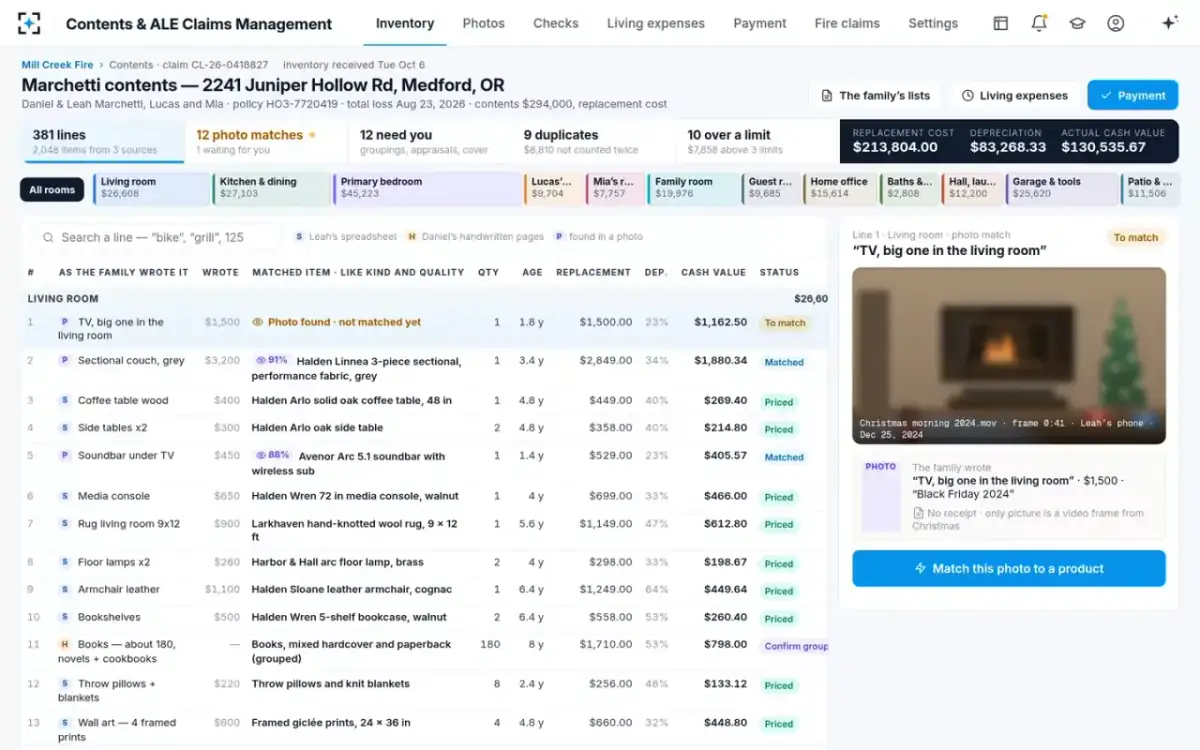
The specialist's day on that screen is described in the contents desk, seat by seat; what the agents do when they are unsure is in contents inventory software that asks instead of guessing.
Questions people ask
What is contents claims software?
Software that takes a policyholder's contents inventory, and often living-expense receipts, from arrival to a payment recommendation: every line matched to a product, priced at like kind and quality, depreciated, checked for duplicates and special limits. The insurer's contents specialist reviews it and signs; the software should never approve or pay.
What is contents pricing software?
The part of contents claims software that finds a like-kind replacement for each item and prices it from named sellers. Good pricing software uses the carrier's approved retailers and successor rule, dates its quotes, and lets the carrier show a claimant where any price came from.
Do we need to change our claim system to use contents claim software?
It should not need replacing. The software needs the advances already paid and the policy's limits from your claim system and sends the signed recommendation back for payment. Exports and read access are enough for the replay weeks; the payment connection comes before the first live claim.
How do we know contents automation is accurate?
Replay your own closed files and compare line by line with what was paid, after setting pass marks in advance. Some marks should be absolute, such as every line citing its source; others are agreement rates you set from the replay. Explain every difference before go-live.
Should we go live during a catastrophe?
Not if you can avoid it. A large event is when the desk has the least time to review new output and the most families waiting. Finish the rehearsal and the first live claims in a quiet period, so the first catastrophe is handled with rules already proven.