A contents adjuster is the claims professional who values a policyholder's personal property after a loss: they take the family's inventory, match each line to a product, price a like-kind replacement, apply depreciation and the policy's special limits, find duplicates and recommend the payment. Carriers often call the role a contents specialist, to separate it from the field adjuster who inspects the building. On a total loss the contents adjuster works almost entirely from paper and photos, because there is nothing left to inspect, and a single claim can run to several hundred lines, the work Contents & ALE Claims Management is built around.
No contents claim is carried by one person. It passes between a contents specialist, a field adjuster, a supervisor who signs above the specialist's authority and, after a disaster, a catastrophe lead who balances the work across a desk. Contents & ALE Claims Management is Botminds' software for that desk: agents read, match, price and check every line and every living-expense receipt, and the four people keep the decisions and the signatures. This guide uses the solution's fictional sample, a family whose home burned on 23 August 2026, to show each seat at work.
Four seats on one contents claim, before and after the agents take the typing
Today
“The list takes the family a month and me three weeks. The deciding takes an hour.”
With agents
Opens a priced schedule with the evidence beside every line; accepts matches, decides the flagged lines.
Still theirs: Every decision on a line, and her signature up to $25,000
Today
“Their living-expense limit won’t last the rebuild. Someone should tell them.”
With agents
His rebuild estimate feeds the projection of the living-expense limit, so a gap shows months ahead.
Still theirs: The rebuild estimate and the scope of the structure
Today
“Show me the duplicates and the limits before I sign.”
With agents
Co-signs from a waterfall that shows each deduction, and sees every override with its reason.
Still theirs: The co-signature above the specialist’s authority
Today
“Which families are still waiting for money?”
With agents
Sees every contents claim from the fire, its next step and the advances paid, and moves claims between specialists.
Still theirs: Who works which claim, and the event’s priorities
What does a contents adjuster do?
A contents adjuster lists, documents and values the personal property in a claim, then recommends what the policy owes for it. FEMA's flood manual, a detailed public handbook for this work, describes the expectation directly: "FEMA expects the adjuster to list, document, and value the entire contents loss and give the list to the policyholder for review. If the policyholder elects to complete the inventory, the adjuster is expected to start the inventory and ensure that the policyholder understands how to document the remaining contents" (NFIP Claims Manual, 2025).
The same manual lists what each line should carry: make, model, quantity, age, whether a special limit applies and the cost to replace at like kind and quality, each "priced individually" and depreciated individually. Behind that sentence is most of the job. A typical day for a contents specialist after a wildfire is less about inspecting damage than about interpreting a family's memory: "Books — about 180", "Mia toys — bins of them", "TV, big one". How that memory becomes a priced line is set out in like kind and quality, line by line.
What is a contents specialist, and how is the role different from a field adjuster?
A contents specialist is a desk role that owns the personal property part of a claim; a field adjuster owns the structure and the site. The field adjuster inspects, measures and writes the estimate to repair or rebuild. The contents specialist works from the inventory, receipts, statements and photos the family sends, prices them and checks them against the policy. On a partial loss the two meet at the house, where contents are sorted into what can be cleaned and what must be replaced.
The roles meet again on living expenses. A family's loss-of-use limit has to last until the house is rebuilt, and only the field adjuster knows when that will be. In the sample claim the field adjuster's estimate puts the rebuild in April 2028, while the family's living-expense limit, at their current spending, runs out around August 2027. A desk where the two seats never compare numbers finds that gap when the money stops. The arithmetic is in how loss of use is calculated.
Where a contents claim loses its days
Most of the calendar on a total-loss contents claim belongs to the family, not the desk, and most of the desk's share is handoffs. A family that has lost a house needs weeks to rebuild a list of its belongings; a specialist then needs days to type, match and price it, and the supervisor's signature waits on the specialist's. The sample claim shows the shape.
One contents claim on the calendar: the family's weeks and the desk's days
- Fire to living-expense advance5 d
- To the contents advance5 d
- Writing the inventory from memory34 d
- Priced overnight, opened the next Monday6 d
- Decided, signed and co-signed½ day
That shape is why the handoffs matter more than any single seat's speed. Each time a claim moves, from field to desk, from specialist to supervisor, from one specialist to another during a surge, the receiving person has to rebuild the context: which advance was paid, which lines are grouped, which items are waiting for an appraisal. The work that disappears with agents is mostly that rebuilding, plus the typing that came before it.
The handoffs on one contents claim, and what crosses each one
A person decides
Catastrophe lead assignsThe claim goes to a specialist with its advances and the field adjuster’s notes.
Agent
Agents read and priceSpreadsheet, handwritten pages and photos become one numbered schedule, each line citing its source.
Never: Never invent an item the family did not name
A person decides
Specialist decidesAccepts uncertain matches, confirms groupings and duplicates, holds items for appraisal.
Agent
Orchestrator draftsThe payment recommendation and the family’s statement, with every deduction shown.
Never: Never approves a payment
A person decides
Supervisor co-signsAbove the specialist’s authority, from the same waterfall and the overrides with their reasons.
Who approves contents payments?
A person at the insurer with the authority to do so, never the adjuster's software and, under federal flood policies, not even the independent adjuster. The Standard Flood Insurance Policy tells policyholders: "We have not authorized the adjuster to approve or disapprove claims or to tell you whether we will approve your claim" (SFIP Dwelling Form, VII.G.8). The adjuster recommends; the insurer's examiner or a staff person with authority decides.
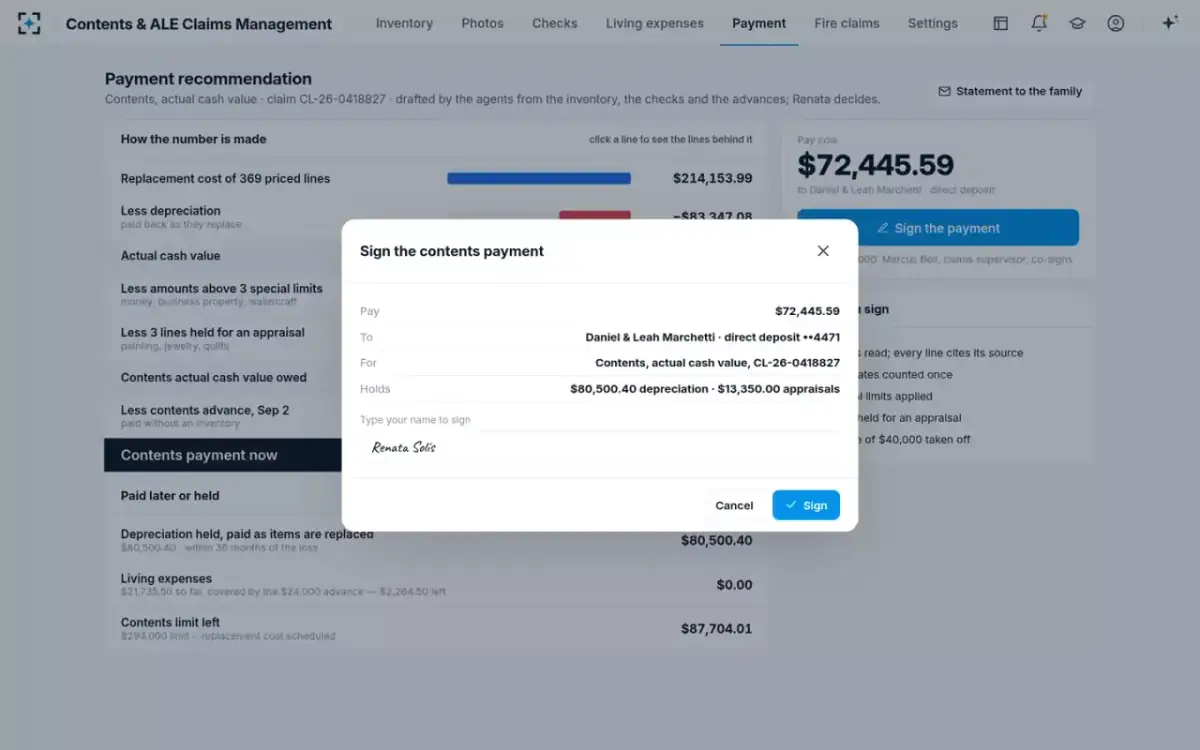
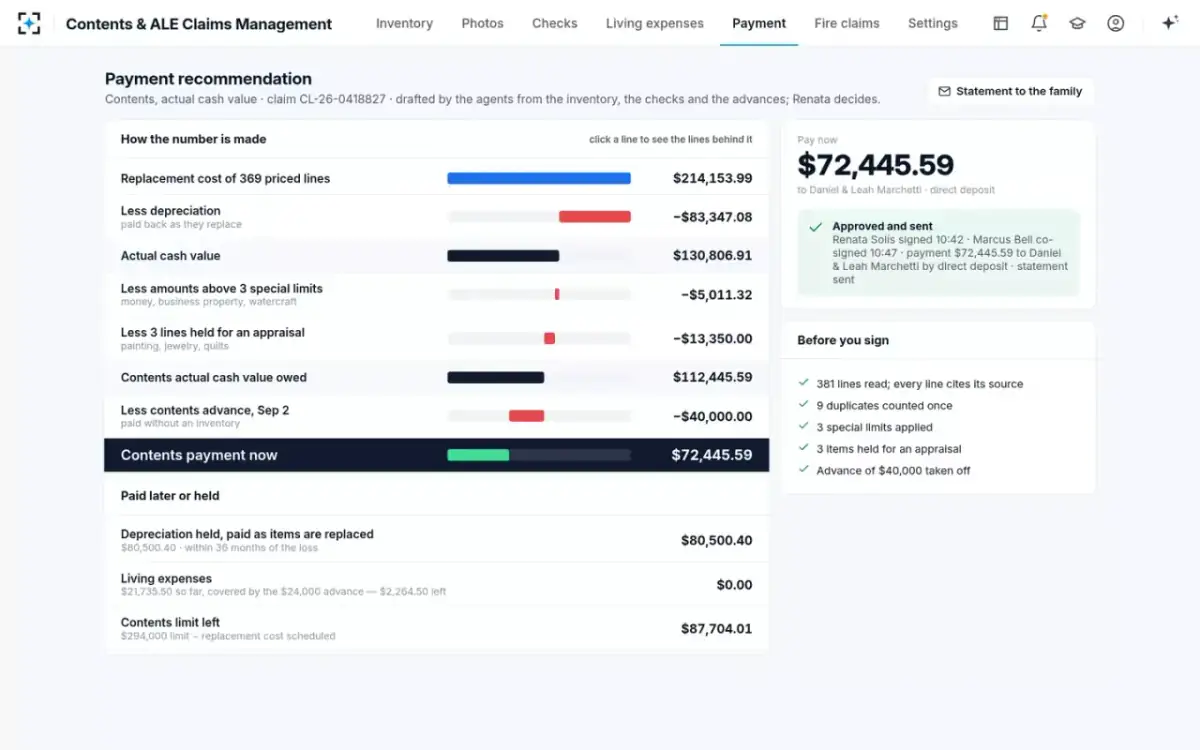
Inside a carrier, authority is a ladder of dollar limits. The sample carrier lets its contents specialist sign up to $25,000 and requires the claims supervisor to co-sign above it. The family's contents payment of $72,445.59 was above that line, so the specialist signed at 10:42 and the supervisor co-signed at 10:47; the payment and the statement then went to the family. What made five minutes enough was that the supervisor saw the same waterfall, the nine duplicates and the three special limits the specialist had decided, without asking for them.
Signing the contents payment: amount, payee, claim and holds confirmed
Contents pack out: where the inventory begins on a partial loss
A pack-out is the first contents job when a house is damaged but standing: belongings are sorted, moved out to be cleaned or stored, and listed as they go. The decision at the centre of it is salvage. FEMA's manual tells adjusters: "It is important for the adjuster and policyholder to identify damaged items that are salvageable and require cleaning, refinishing, or repair; and the damages that are non-salvageable and require replacement." It also asks them to raise "any salvage or buy-back opportunity" with the policyholder (NFIP Claims Manual).
The flood policy puts a matching duty on the policyholder: "As soon as reasonably possible, separate the damaged and undamaged property, putting it in the best possible order so that we may examine it" (SFIP, VII.G.2). On a total loss there is nothing to pack out, and the inventory starts from memory instead, which is a harder job of a different kind. Either way, the contents specialist ends up with a list to price; the difference is whether every line has an object behind it or only a recollection.
Contents claims adjuster jobs: what the work market shows
The Bureau of Labor Statistics does not count contents specialists separately; they sit inside a large occupation that is expected to shrink. In 2025 there were 389,700 jobs for claims adjusters, appraisers, examiners and investigators, with a median pay of $78,020, and the BLS projects a 6% decline from 2025 to 2035 (BLS Occupational Outlook Handbook). The same page adds: "The number of natural disasters, such as floods and fires, influences demand for claims adjusters in property and casualty insurance."
The occupation contents specialists belong to
389,700
jobs in 2025 for claims adjusters, appraisers, examiners and investigators
376,100
of them claims adjusters, examiners and investigators
$78,020
median annual pay, 2025
−6%
projected change in jobs, 2025–35
Those two facts pull in opposite directions for a contents desk. Fewer people overall, and more demand when a fire or flood comes. A contents team sized for an ordinary year cannot price several hundred-line inventories for every family in a burned neighbourhood at the same time, which is why the catastrophe lead's seat exists and why the reading and pricing are the parts carriers are now giving to software.
When a claim changes hands a third time
California treats repeated reassignment as a harm in itself after a disaster. Its Insurance Code provides: "If, within a six-month period, an insurer assigns a third or subsequent adjuster to be primarily responsible for a claim, the insurer shall provide the insured with a written status report." The report summarises decisions on structures and contents and every item in dispute, and for claims from a declared emergency the insurer must also name a primary point of contact with a direct means of reaching them (CDI 2026 Annual Notice, citing Ins. Code §2071 and §14047).
The rule describes exactly what a handoff costs: the new adjuster and the family both have to be told what has already been decided. A claim whose every line carries its source, its decision and the person who made it can be handed over without that loss, because the status report is the claim itself. A claim whose decisions live in one specialist's notes cannot.
What has to cross every handoff on a contents claim
- Advances already paid, with dates
Contents and living-expense advances, so no later payment forgets to net them.
- The family’s own words for each line
With the row, page and line or photo they came from.
- Decisions taken and by whom
Accepted matches, confirmed groupings, duplicates kept or merged, overrides with reasons.
- Lines held and what releases them
Appraisals requested, receipts awaited, items not covered.
- Limits applied
Which special limit each capped line falls under, and the amount above it.
- The living-expense position
Spent above the normal month, advance left, projected run-out date against the rebuild.
What each seat keeps with Contents & ALE Claims Management
No seat disappears. The contents specialist stops typing three sources into one spreadsheet and starts the day with a priced schedule, 381 lines in the sample, with the family's words on the left and the like-kind item, age, replacement cost, depreciation and cash value on the right. What remains is the deciding: in the sample, a photo still waiting to be matched, groupings to confirm, nine duplicate pairs and three items held for appraisal.
The field adjuster's estimate stops being a document in another system and becomes an input to the living-expense projection. The supervisor co-signs from the same evidence the specialist used. The catastrophe lead sees, for every family from the fire, how many lines are priced, what the next step is and what has been paid, and can move a claim between specialists without losing its history.
Approved and sent in Contents & ALE Claims Management: the specialist's signature and the supervisor's co-signature
The agents' own limits are what make this division of work safe. The inventory reader never adds an item the family did not name. The photo matcher sends anything below 90% to a person. The coverage checker flags duplicates and limits but never removes a line. The orchestrator never approves a payment. For how those agents decide when to ask rather than guess, see contents inventory software that asks instead of guessing.
Questions people ask
Is a contents adjuster the same as a public adjuster?
No. A contents adjuster or specialist works for the insurer, or for an adjusting firm the insurer hires, and recommends what the policy owes. A public adjuster is hired by the policyholder to prepare and negotiate the claim on their side. Both may work on the same inventory.
How long does a contents adjuster take to price an inventory?
No regulator publishes a figure, and it depends on the length and state of the list. FEMA's flood rules give adjusters 15 calendar days for a preliminary report and 45 days after that for the closing report, which is the closest public benchmark. In the solution's sample, a 381-line inventory from three sources was read and priced overnight, and the specialist's decisions took one morning.
Does a contents specialist visit the house?
On a partial loss, often, to decide what can be cleaned and what must be replaced. On a total loss there is little to see, and the work is done from the family's inventory, photos, receipts and statements, with the field adjuster's inspection covering the structure.
Can I ask for a new adjuster on my contents claim?
You can ask; the insurer decides who handles the claim. In California, if a claim from a declared emergency reaches a third adjuster within six months, the insurer must send a written status report and give you a primary point of contact.
Do contents adjusters use software to price items?
Increasingly. The BLS notes that software can already evaluate photographs of damaged property and estimate a claim amount. Regulators are drawing a line around it: Washington's claims rule, in force since 18 October 2026, says a reasonable investigation may not rely solely on a database or estimating software, so a person still has to own the result.