If your insurance adjuster is not responding, the most useful thing to find out is what the claim is waiting on, because a quiet claim is rarely idle: it is usually waiting on a document, an estimate, an inspection report, a decision or a payment, and often on someone other than the adjuster. Insurers are also bound by reply deadlines. Florida gives an insurer 7 calendar days to acknowledge a claim communication, Washington 10 business days to reply, and California 15 calendar days to give a complete response, so a question asked in writing has a clock attached. Botminds' Claim Status Self-Service is software that answers policyholders' claim questions from the live claim file and names the one item each claim is waiting on; questions that need the adjuster's judgment go to the adjuster with a reply-by time the policyholder can see.
This guide is written for both sides of the silence: the policyholder trying to get an answer, and the claims leader who wants fewer of these calls. Its examples come from a fictional sample: Halverton Mutual, an invented insurer, and its open property claims in a sample region, including Alicia Brennan's kitchen water claim in Folsom, California, as they run through the solution. Those figures are sample data, not a customer's result.
Who 2,192 open property claims were waiting on, one evening
Why is my insurance adjuster not responding?
Usually because the claim is waiting on something the adjuster does not have yet, or because the adjuster's queue is long and a status call ranks below the work that moves claims. In the sample region above, 43 percent of open claims were waiting on the adjuster, and 57 percent on someone else: the policyholder, a contractor, the payments team, a lender or a city permit office. A policyholder calling the adjuster about a claim that is waiting on their own contractor's estimate gets a slow answer and the wrong one.
The adjuster's queue is the other half. Adjusters carry many open claims at once; the sample desk adjuster carries 138. Federal labour statisticians expect the occupation to shrink: the Bureau of Labor Statistics counts 389,700 claims adjuster, appraiser, examiner and investigator jobs in 2025 and projects a 6 percent decline by 2035, noting that "Technology is expected to automate some of the tasks that these workers currently perform." Fewer people working more claims means status calls compete harder for the same hours.
Neither explains a claim that has gone silent for weeks with nobody saying why. That is a failure, and the rules treat it as one.
How long does an insurance adjuster have to respond?
Between 7 calendar days and 15 days in the states below, from the day the insurer receives a communication that calls for an answer. The clock usually belongs to the insurer, not the individual adjuster, so a message to an independent adjuster or a call centre counts. Florida says so expressly: "A communication made to or by a representative of an insurer with respect to a claim shall constitute communication to or by the insurer."
Deadlines for answering a policyholder’s claim communication
| Rulebook | Deadline | What it covers |
|---|---|---|
| Florida, Fla. Stat. §627.70131(1)(a) | 7 calendar days | Review and acknowledge any communication about a claim, unless payment is made in that time; residential property |
| Washington, WAC 284-30-360(3) as amended | 10 business days | An appropriate reply to pertinent communications that reasonably suggest a response is expected; individual policies (15 for group) |
| California, 10 CCR 2695.5(b) | 15 calendar days | A complete response, based on the facts then known, to any communication that reasonably suggests a response is expected |
| Ohio, Adm. Code 3901-1-54 | 15 days | A response to any claimant communication that suggests a response is appropriate |
| NAIC Model Regulation 902, §6 | 15 days | An appropriate reply on pertinent communications; a model many states adapt, not law in itself |
Washington's 2026 rule is the newest of these, and its wording is worth reading: for pertinent communications from a claimant that reasonably suggest a response is expected, "an appropriate reply must be provided" within 10 business days on an individual policy. The NAIC model, which many states adapted, uses the same idea with a 15-day clock. None of these rules requires the reply to settle the claim; they require the insurer to answer the question asked, with what it knows.
Two practical consequences follow. A question asked in writing, by email, portal message or letter, starts a clock that is easy to prove. And a voicemail asking for a call back is harder to prove, and less plainly a question that calls for an answer, than a written one, so the written question is the stronger move.
Who a quiet claim is really waiting on
Every open claim is waiting on someone, and naming that someone is the cheapest status message there is. The sample region's board sorts claims into five columns by who has the next move, and each claim shows the one item and the days it has waited. Of the 611 claims waiting on policyholders, 39 had waited 15 days or more; of the 941 waiting on adjusters, 24 had.
Around one quiet claim: who waits on whom
Today
Calls to ask where the claim stands, and is told it is in progress. Does not learn the claim is waiting on her own contractor.
With agents
Sees the one item the claim waits on, with an upload button and the date it was asked for.
Still theirs: Choosing her contractor and getting the estimate.
Today
Takes check-in calls between estimates; each call means opening the file to explain where it stands.
With agents
Gets only the questions that need a decision, each with the customer’s words, the file context and the time promised.
Still theirs: Every coverage call, every amount and every exception.
Today
Finds stuck claims by asking around or reading aging reports.
With agents
Sees every open claim by who has the next move and the days waiting, and owns the questions when an adjuster is out.
Still theirs: Reassigning work and calling the claims that have waited too long.
Today
Can read the status code but cannot say what it means or what is missing.
With agents
Sees the same tracker and the same sourced answers the customer sees.
Still theirs: Calls that need a person’s patience.
The item nobody named: seven days on one sample claim
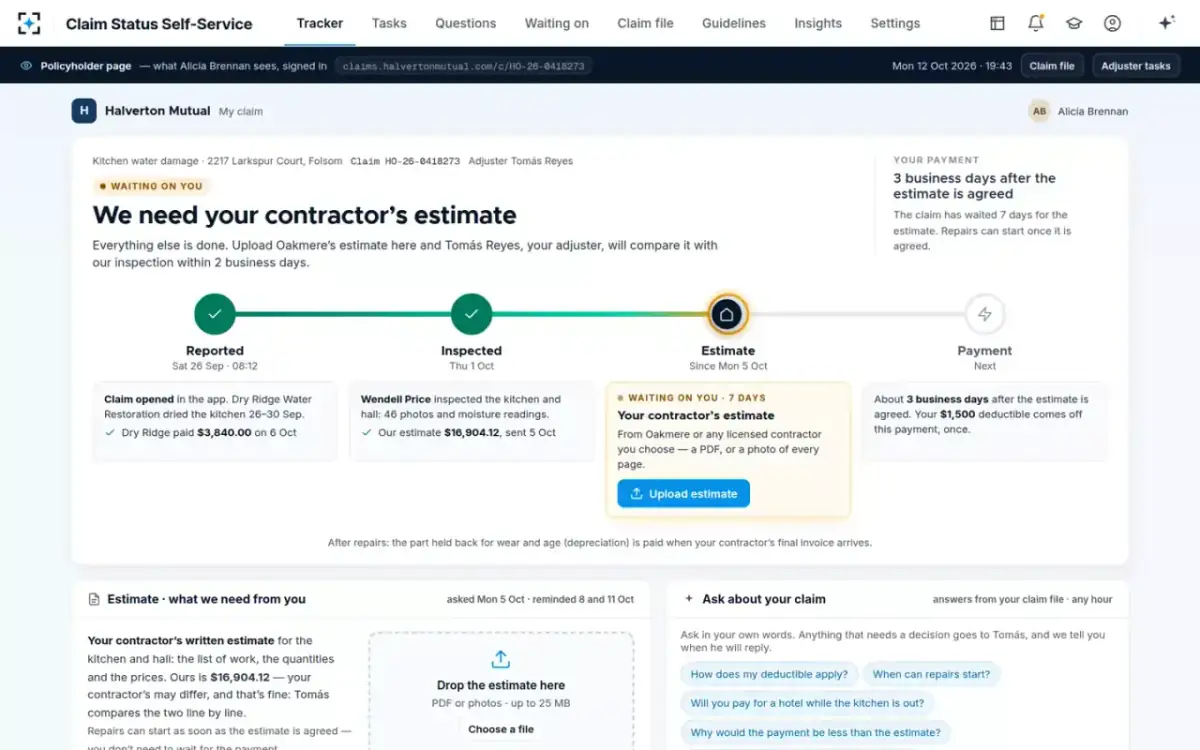
Alicia Brennan's kitchen flooded on Saturday 26 September. Her claim moved quickly at first: the drying contractor was paid in full, the inspection was done on 1 October, and the insurer's estimate went out on 5 October with a request for her contractor's estimate. Then the claim stopped, and for seven days it was waiting on her. Text reminders went out on days 3 and 7. She also called twice in that week, once speaking to her adjuster and once to the claims line, and neither call told her the estimate was what the claim was waiting for.
“Nobody told me the estimate was waiting on me. I thought you were writing it.”
Alicia Brennan, the sample claim's policyholder
From her side the adjuster was not responding; from the adjuster's side she had not sent the estimate. Both were right about their own half. The claim file knew the answer the whole time: a waiting item, "contractor's estimate", requested on 5 October. When she opened her claim page on the evening of 12 October, the page named it, she uploaded the estimate from her phone at 19:46, and 34 seconds later the claim had moved to the adjuster with a reply promised by Wednesday at 5 p.m.
The page names what the claim is waiting on, and who has it
Florida's law anticipates the other side of this. Its pay-or-deny clock is paused when a policyholder fails to provide requested material claims information within 10 days, and resumes when the insurer receives it, but only for requests sent at least 15 days before the payment deadline. A policyholder who does not know a request is outstanding can stop their own clock without knowing it.
What to do if your claim adjuster is not responding
Ask in writing what the claim is waiting on and who has it, and note the date. That one question turns a vague complaint into a communication with a deadline, and the answer usually tells you whether the next move is yours, a contractor's or the insurer's.
If the adjuster has gone quiet
- Ask in writing what the claim is waiting on
By email, portal message or letter, so the reply clock is easy to prove. Ask for the item, who has it and when it was requested.
- Check whether the item is yours
A contractor’s estimate, a signed proof of loss, receipts or bank details for a direct deposit are common waiting items owed by the policyholder.
- Ask for the adjuster’s name and licence number
Florida requires both on every communication about a residential claim, and a list of every adjuster who has dealt with you on request.
- Escalate to the supervisor
Ask the claims line for the adjuster’s supervisor, or the desk that covers when the adjuster is out.
- Count the days from your written question
7 calendar days in Florida, 10 business days in Washington, 15 in California, for the states in the table above.
- Contact the state insurance department
If the deadline passes without an answer, the department’s consumer services can ask the insurer to respond.
The licence point is a Florida rule with a practical use. After the first inspection, "Any subsequent communication with the policyholder regarding the claim must also include the name and license number of the adjuster communicating about the claim." A policyholder who has been passed between several adjusters can also ask for the list of all of them, which Florida insurers must keep and provide on request. The step-by-step guide to filing a department of insurance complaint covers what happens if it comes to that.
When the adjuster on your claim keeps changing
Frequent reassignment is a common cause of silence, because every new adjuster starts by reading the file. California treats it as a harm in itself: if an insurer assigns a third or later adjuster to be primarily responsible for a claim within six months, it must send the insured a written status report summarising the decisions made, the amounts of losses and coverage, the professionals consulted and every item in dispute, as the Department of Insurance's 2026 notice sets out.
That rule describes what a good status report contains, and it is a useful template whatever the state: what has been decided, what has not, what is in dispute and who decides next. A status page that holds those items for every claim makes a change of adjuster invisible to the policyholder, because the answer never depended on one person's memory.
What a claims desk can do about the silence
Most check-in calls disappear when three things are true: the policyholder can see the one item the claim waits on, the reminders for items the policyholder owes go out on a schedule, and every question that needs a person gets a named owner and a time. The sample carrier's settings show how that is configured: text reminders on day 3 and day 7 when a claim waits on the customer, an adjuster's call on day 10, no texts between 21:00 and 08:00 in the customer's time zone, and a two-business-day reply promise for questions handed to the adjuster.
The supervisor's view is the other half. A board that sorts open claims by who has the next move turns "which files are quiet?" into "which parties are we waiting on, and for how long?". In the sample region one claim had waited 16 days on a signed proof of loss, with three reminders sent and an adjuster's call due. That is a claim where the next move is the insurer's, even though the item is the policyholder's: someone needs to pick up the phone.
What Claim Status Self-Service does with an unanswered question
It answers what the file can answer and hands the rest to a named person with a deadline the customer sees. When Alicia asked whether the insurer would pay for a hotel while her kitchen was out, the question was about coverage, which the carrier's approved message guidelines reserve for the adjuster. So it was not answered by the system. It went to her adjuster in her own words, with the file context, and she was told he would reply by Wednesday 14 October at 5 p.m., by text and on the page. The 15-day response clock started on the claim at the same moment.
Handed questions arrive with the customer’s words and the promised time
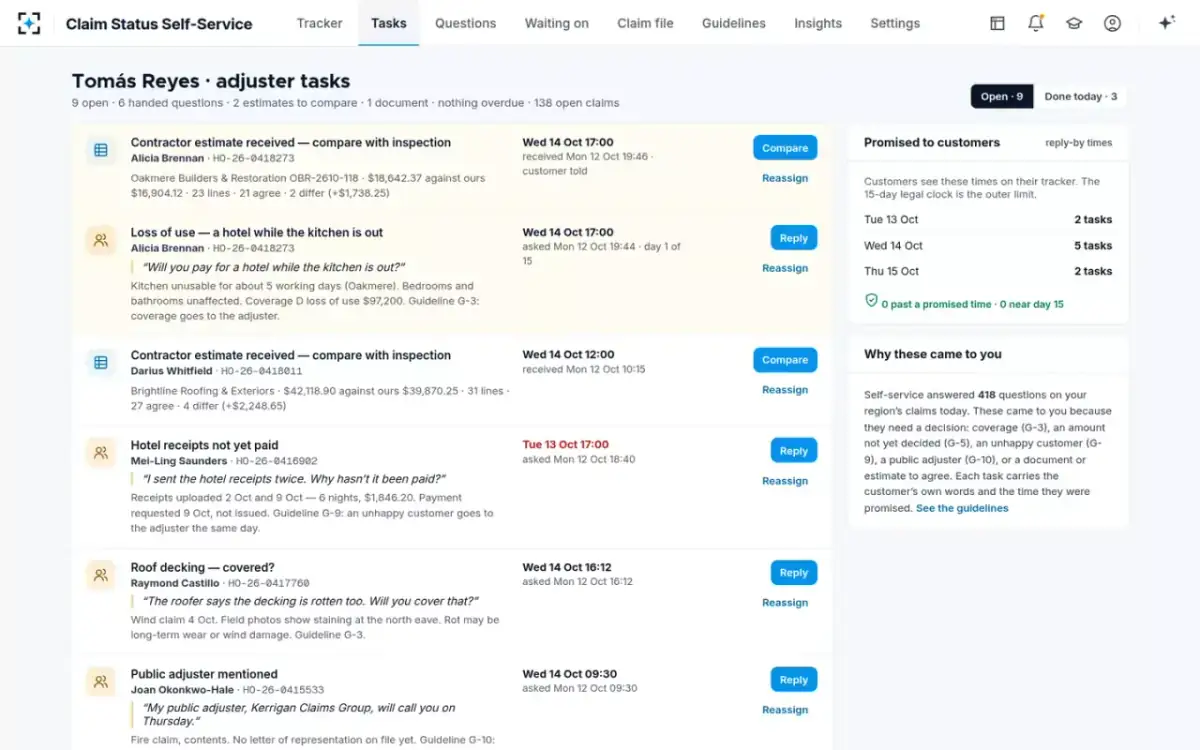
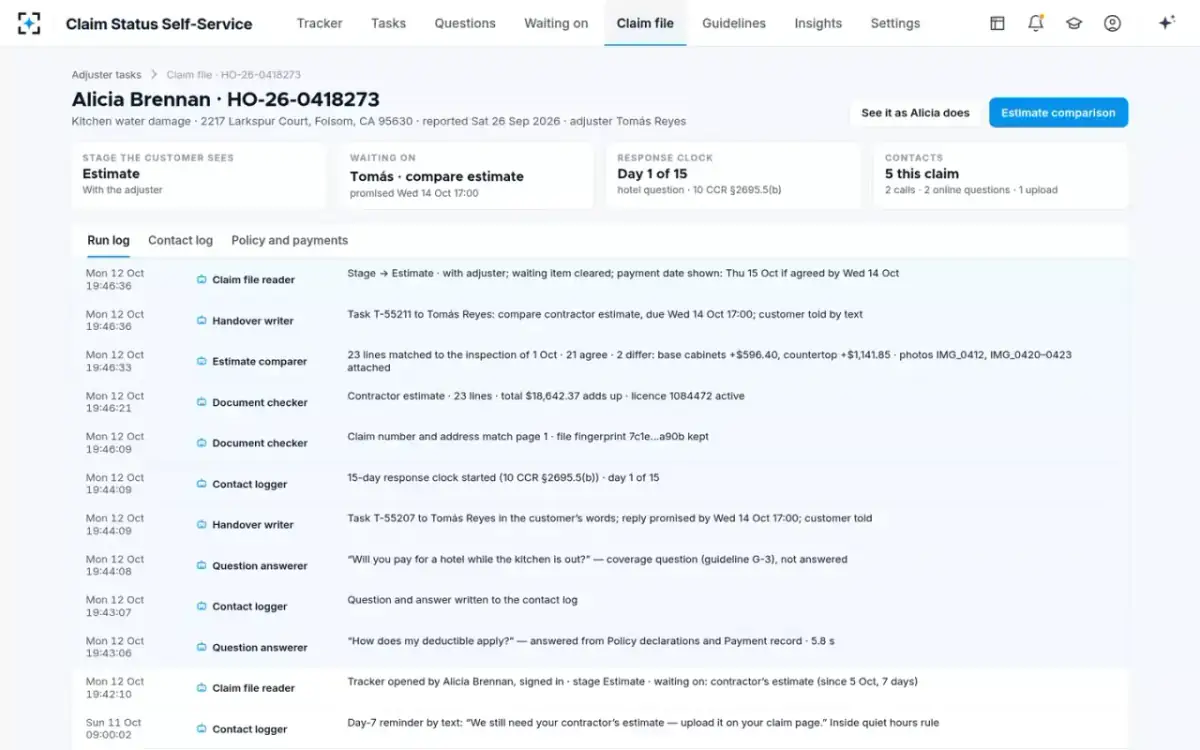
Every step lands on the claim's run log with its time, so a supervisor, an examiner or the policyholder's own later complaint can see exactly when the question was asked, what was answered, what was handed over and when the reply went out. In the sample week, 209 of 212 handed questions were answered by the promised time and the other three were still inside it.
Every question, reminder and handover, timed on the claim
What the solution does not do is answer for the adjuster. It will not promise coverage, quote an amount nobody has agreed, or give a date that is not on the file. The guide to what an "under review" status should say sets out the wording that makes a quiet claim explain itself, and to see the sample claim screen by screen, start from Claim Status Self-Service.
Questions people ask
How long does an insurance adjuster have to contact you after a claim?
It depends on the state and the kind of contact. Florida requires acknowledgment of a claim communication within 7 calendar days and, after proof of loss, an investigation begun within 7 days and any physical inspection within 30; California requires acknowledgment within 15 calendar days of notice of claim. The policy may promise faster contact.
How long do insurance adjusters take to finish a claim?
There is no single answer, because the clock that ends a claim is a pay-or-deny deadline, not an adjuster's. Florida requires residential property insurers to pay or deny within 60 days of notice, and California within 40 days of proof of claim; a claim waiting on the policyholder, a contractor or a lender can take longer.
Can I ask for a different adjuster?
You can ask the supervisor, and insurers often agree where communication has broken down, but there is generally no right to choose. If an adjuster is changed repeatedly, California requires a written status report once a third adjuster is assigned within six months.
Does a voicemail count as contacting my adjuster?
It may, but a written message is easier to prove and clearly asks for a response, which is what the deadlines in Washington, California and the NAIC model turn on. Put the question in writing and keep the date.
Who do I contact if the insurance company is not responding at all?
Your state's department of insurance. Florida's Homeowner Claims Bill of Rights, for example, gives policyholders a toll-free helpline at the Department of Financial Services for help with any claim.