A department of insurance complaint form is the form, usually online, that a state insurance regulator provides for policyholders and claimants to report a problem with an insurance company, agent or adjuster, such as a claim that is not being answered, paid or explained. The department sends the complaint to the insurer and the insurer must respond to the department within a deadline set by state rule: 14 days in Florida, 21 calendar days in California, 21 days in Ohio, 15 working days in Pennsylvania and, since 18 October 2026, 10 business days in Washington. For a claims team, a complaint is rarely the first sign of trouble. It is usually the last link in a chain that began with one wait nobody owned.
This guide covers both sides. For a policyholder, it sets out what the form does and what the rules say about an insurer that does not respond. For a claims or customer experience lead, it runs a pre-mortem: a fictional sample file followed forward, as it could have gone if nobody had acted, with the control that would have broken each link. Claims Cycle Time Monitoring is Botminds' solution that watches every open property and auto claim for the days it spends waiting and alerts people before a file reaches that point. The sample file and people are invented.
Pre-mortem: how a quiet file could become a complaint, and the control at each link
| Link | What happens | The control that breaks it | Who owns it |
|---|---|---|---|
| 1 · An unowned wait | A $2,316 supplement arrives on 30 Sep and joins a queue worked largest first; the shop will not order the panel until it is approved. | Name who the file is waiting on, following the chain past the shop to the insurer’s own desk. | Desk appraiser |
| 2 · Effort mistaken for progress | A routing note on 2 Oct and a voicemail to the shop on 5 Oct reset the diary. | Count only activity that moves the file; notes and one-way calls do not. | Supervisor, through the team’s rules |
| 3 · The wrong answer to the customer | The customer calls on 6 Oct and is told the file is waiting on the shop. | Give the true status: the shop is waiting on the insurer. | Adjuster |
| 4 · The second call | On 9 Oct he calls again and asks for a supervisor; his rental ends on 21 Oct. | Alert on a second unanswered call, with a drafted plan. | Supervisor and customer experience lead |
| 5 · The meter runs out | At the usual pace the repair ends about 2 Nov, twelve days after the rental cover. | Project the rental limit against the repair date and decide an extension early. | Supervisor, past the adjuster’s authority |
| 6 · The form | If nothing changes, a complaint to the department. The insurer must answer it within the state’s deadline, with the file. | A file documented well enough to reconstruct every step. | Compliance |
What is a department of insurance complaint form?
It is a state regulator's channel for consumers to report a problem with an insurer, and it sets an official clock running on the insurer's answer. Each state's insurance regulator takes complaints, though the office's name differs. In Florida, for example, complaints go to the Division of Consumer Services of the Department of Financial Services, whose duties begin with the words "Receive inquiries and complaints from consumers." Florida's insurance regulator, on its hurricane claims pages, adds that "OIR encourages consumers who are having issues with a claim to report it."
The forms ask for much the same things: who you are, the company, the policy and claim numbers, what happened and when, and what outcome you want. Copies of letters, emails, estimates and a dated list of calls make a complaint easier to act on, because the department will put the same questions to the insurer. Some states also oblige the insurer to tell a claimant about this right. The NAIC's model regulation provides that when a claimant objects to a rejection, the insurer shall notify the claimant in writing that the matter may be reviewed by the state's department of insurance, with its address and telephone number (Model 902 §7H).
What happens when you file a complaint with the department of insurance?
The department sends the complaint to the insurer, and the insurer must give the department a complete answer within a fixed time, usually with copies of the claim file. California's rule is typical in substance and specific in wording: a licensee must, within 21 calendar days, furnish the department "with a complete written response based on the facts as then known by the licensee", addressing every issue raised and including the documents and claim files requested. The department reviews the answer, may ask more, and keeps the record.
Days an insurer has to answer the regulator once a complaint is forwarded
A complaint also becomes part of the insurer's own records, which examiners read. Pennsylvania's Unfair Insurance Practices Act requires a complaint record that, in the words of a 2025 Pennsylvania examination report, "shall indicate the total number of complaints, their classification by line of insurance, the nature of each complaint, the disposition of these complaints and the time it took to process each complaint." In that examination of two affiliated insurers, 7 of 9 and 6 of 10 complaints received in the review period were claims-related, and examiners noted one claim denied twice and reversed only after a complaint to the department and the policyholder's hiring of an attorney.
File a complaint against a home or auto insurance company: the same form, different waits
Homeowners and auto complaints go through the same department and the same form, but they tend to grow from different waits. On a home claim, the file often waits on a restoration contractor's moisture logs, an independent adjuster's report or a mortgage servicer's endorsement of a check, while a family pays for a hotel. On an auto claim, it waits on a body shop's supplement, a parts date, a lienholder's payoff letter or the insurer's own approval, while a rental runs out. In the fictional sample team's book, six families in hotels were costing $1,025 a day and 29 rental cars $1,234.
For the policyholder, the useful preparation is the same either way: the claim number, the date of each call and who took it, what was promised and when, and copies of anything sent or received. For the insurer, the useful question is earlier: which of today's open files has a customer who has called twice without an answer.
Insurance company not responding to a claim: what the rules say
Every state compared here sets a deadline for answering a claimant's messages, separate from the deadline for deciding the claim. California requires a complete response, based on the facts then known, within 15 calendar days of any claimant communication that reasonably suggests a response is expected. Ohio and the NAIC model allow 15 days, Pennsylvania 10 working days and Washington, since 18 October 2026, 10 business days. A customer's second call asking when the car will be fixed starts that clock again.
Status letters run on their own clock while a decision is pending: every 30 calendar days in California and now Washington, at 30 days and every 45 days in Pennsylvania, at least every 45 days in Ohio. The full set of state clocks is compared in prompt payment laws by state. In Florida, a homeowner has a statutory right, on written request, to written confirmation within 30 days of a complete proof of loss that the claim is covered in full, partly covered or denied, or a written statement that it is being investigated (§627.7142).
What to do when an insurance company won't respond
The rules point to a sequence: put the request in writing, keep a dated record, ask for a supervisor, and file with the department if the deadline passes without an answer. A written message is easier to date than a call, and the response deadlines run from the insurer's receipt of a communication. A dated list of calls, with names, is what the department will ask for. Asking for a supervisor puts the file in front of the person who can approve what an adjuster cannot. The department's form is the step that brings in a regulator with its own deadline.
None of this is legal advice, and outcomes depend on the policy and the facts. What the rules make plain is that silence has a limit: an insurer that does not reply within the state's deadline is out of compliance whether or not the claim itself is in dispute.
The pre-mortem on a calendar: three weeks from supplement to the end of the rental
Laid on a calendar, the sample file shows how much time there was. The supplement arrived on 30 September; the customer's second call came on 9 October; the rental cover ends on 21 October. Every link in the chain had days of slack, and every day of it was spent waiting in a queue whose order ignored the rental.
Where the sample file’s time went, and how long was left
- To the routing note2 d
- To the voicemail3 d
- To the first call1 d
- To the second call3 d
- To the morning sweep3 d
- Days of cover left on 12 Oct9 d to 21 Oct
The controls that break the chain earlier
Each link has a control, and most need no new technology, only a different list. The checklist is the pre-mortem turned into practice for a claims or customer experience lead.
Seven controls that keep a quiet file away from the complaint form
- Name who every open file is waiting on, every day
Follow the chain: a shop waiting on a supplement is a file waiting on the insurer.
- Do not count effort as progress
A note, a routed task, a one-way voicemail or a pushed diary should not reset any clock a supervisor reads.
- Tell customers the true status
“Waiting on the shop” is wrong when the shop is waiting on the insurer, and the customer will find out.
- Alert on the second unanswered call
In the sample, it is one of two triggers that reach the customer experience lead.
- Project every daily limit against the repair date
Rental and hotel limits reached before the repair ends are predictable weeks ahead.
- Order queues by customer impact, not only by size
A small supplement holding a car in a rental should not wait behind large ones with none.
- Keep the file fit to answer a regulator in days
Every step dated, with who did it, so the response to the department can be complete.
Where Claims Cycle Time Monitoring fits
The solution reads every open file each morning and does the first, second and fifth controls on its own: it names the waiting party, marks which entries moved a file, and projects rental and hotel limits against the repair date. It drafts the third and sixth: the call script with the true status, and the reordering of the supplement queue for the desk appraiser to accept. The fourth is an alert setting: the customer experience lead is told at 30 quiet days or when a customer's second call goes unanswered.
Three days ahead: the files that will cross 14 quiet days
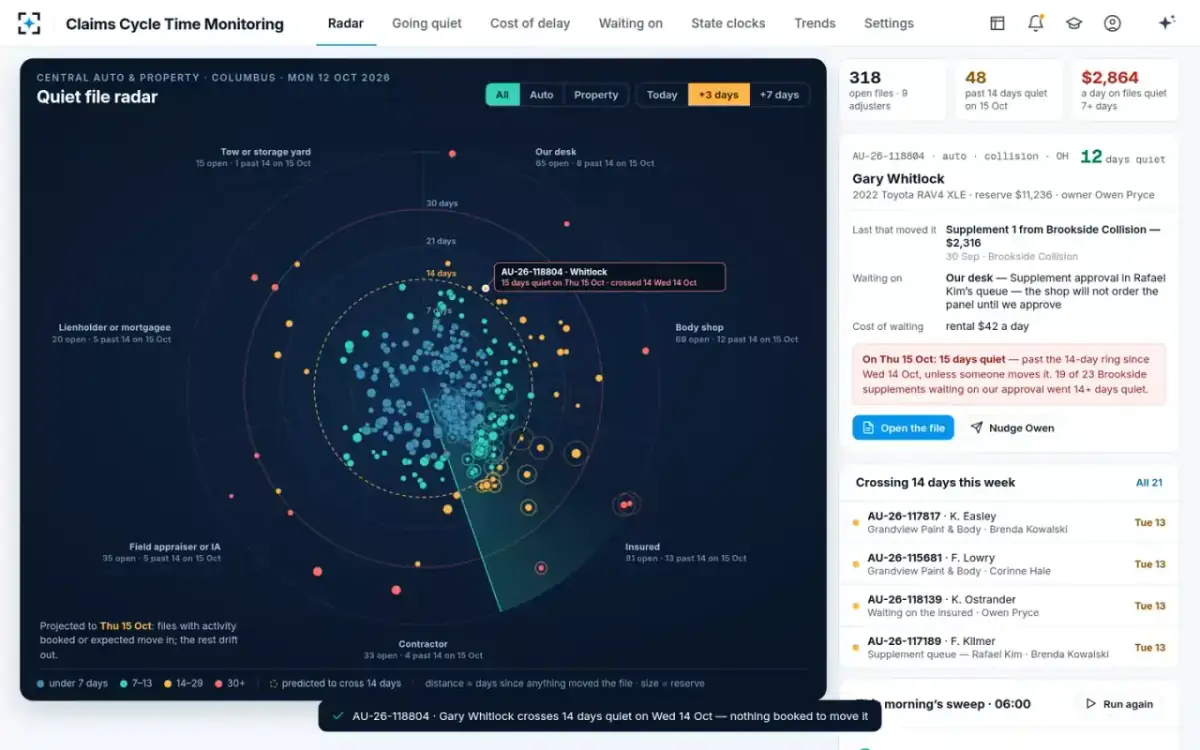
People stay in charge of everything that reaches the customer or the department. The adjuster sends every message, the desk appraiser approves supplements, the supervisor decides extensions past authority, and each step is written to the file's activity trail with who did it. In the sample, the plan for this file was approved at 09:12 on 12 October, the shop confirmed the panel and repair dates the same morning, and the rental was extended to the end of the repair.
"Every complaint I read started as a file that went quiet for two weeks."
Lena Hoffmann, customer experience lead on the fictional sample team
The supervisor's side of the same morning is described in a claims supervisor's hunt for quiet files, and the measures that predict which files will get here in what claim cycle time should count.
Questions people ask
Where do I file a complaint against my home insurance company?
With your state's insurance regulator, usually through a complaint form on its website. In Florida, consumer complaints about insurers go to the Division of Consumer Services of the Department of Financial Services.
How do I file a complaint against an auto insurance company?
The same way, with your state's insurance regulator, giving the policy and claim numbers, a dated account of what happened and copies of letters and estimates. The department forwards it to the insurer, which must answer within the state's deadline.
How long does an insurance company have to respond to a department of insurance complaint?
It varies by state: 10 business days in Washington since 18 October 2026, 14 days in Florida, 15 working days in Pennsylvania and 21 days in California and Ohio. Florida's division may fine an insurer up to $5,000 per violation for failing to respond in time.
Will a complaint to the department of insurance get my claim paid?
Not by itself: the department requires a complete answer and can examine the insurer's handling, and the outcome depends on the policy and the facts. In one 2025 Pennsylvania examination, examiners noted a claim paid only after a complaint to the department and the policyholder's hiring of an attorney, and said it should have been paid without that.
Do complaints affect an insurer?
Yes. Insurers must keep complaint records that regulators inspect, and regulators cite complaint trends when they change rules: Washington's commissioner pointed to an increase in consumer complaints and Insurance Fair Conduct Act notices when adopting the claims rule that took effect on 18 October 2026.