A claims supervisor is the manager of a team of claims adjusters: the person who assigns and reviews their files, approves payments, rentals and decisions beyond each adjuster's authority, coaches them, handles escalations from customers, and answers for the team's cycle time, accuracy and complaints. In property and auto claims a supervisor answers for every open file the team carries, through the adjusters who own them. The hard part of the job is not the decisions themselves but finding, among those files, the few that need one today. Without a daily list, those files surface in a periodic file review or in a customer's angry call, and both arrive late.
This guide describes the role as it is practised on a property and auto desk and follows one supervisor's morning on a fictional sample team. Claims Cycle Time Monitoring is Botminds' solution that reads every open file each morning, flags the files going quiet and drafts the next step, with the supervisor deciding anything past an adjuster's authority. The sample supervisor, her team and every claim on this page are invented.
Where a supervisor’s week on quiet files goes, before and with a morning list
Today · about 21 hours a week
- Finding quiet files · 28.6%
- Who each waits on · 23.8%
- Pricing overruns and status deadlines · 28.6%
- Deciding and chasing · 19%
With a morning list · about 5.5 hours
- Finding · 9.1%
- Who each waits on · 18.2%
- Pricing and deadlines · 18.2%
- Deciding and chasing · 54.5%
What does a claims supervisor do?
A claims supervisor makes sure every file on the team is moving, correctly and within the rules, and takes the decisions the adjusters cannot. The occupational database O*NET, which describes claims adjusters, examiners and investigators as one occupation, lists among its tasks "Supervise claims adjusters to ensure that adjusters have followed proper methods." and "Pay and process claims within designated authority level." The second phrase is the hinge of the role: authority is set in tiers, and whatever exceeds an adjuster's tier lands with the supervisor.
The Bureau of Labor Statistics counts about 376,100 claims adjusters, examiners and investigators in the United States in 2025 and projects the wider occupation to shrink by 6% between 2025 and 2035. The BLS expects technology to automate some of the work, giving the example of software that evaluates photographs of damaged property and calculates an estimated claim amount. It does not count supervisors separately. If fewer adjusters carry the same open files, the supervisor's job of finding the stuck ones gets harder, not easier.
Claims supervisor job description: the responsibilities that fill a week
Six responsibilities fill most supervisors' weeks, and each one rests on a record somebody can later inspect. The list below is drawn from the duties regulators and occupational data describe and from the sample team's authority table; a carrier's own job description will name its own limits.
A property and auto claims supervisor’s responsibilities, and the record behind each
| Responsibility | What it means day to day | The record it leaves |
|---|---|---|
| Authority | Approve what exceeds an adjuster’s limit: in the sample, rentals beyond 30 days and supplements over $2,500, with the desk appraiser. | Who approved, when and on what evidence, on the file’s activity trail. |
| File review | Read open files for quality and progress, traditionally on a fixed cycle such as every 30 days. | A review note on each file. |
| Deadlines | See that acknowledgements, decisions and status letters go out on time under each state’s rules. | Dated letters; examiners test them file by file. |
| Escalations | Take the customer who asks for a supervisor, and the complaint a regulator forwards. | Call notes, complaint log and response dates. |
| Assignment | Balance new files and reassign when an adjuster is overloaded or absent. | Owner changes on each file. |
| Reporting and coaching | Explain the team’s cycle time and quality, and coach the adjusters behind the numbers. | Weekly trend by adjuster. |
Authority is the responsibility that shapes the rest. In the sample team's settings, an adjuster may approve a rental up to the policy's 30 days and the supervisor beyond; supplements over $2,500 are approved by the desk appraiser and co-approved by the supervisor. Each limit is a place where a file can wait on the supervisor without anyone saying so, because the adjuster has done everything within reach. A supervisor's morning list should therefore include the files waiting on the supervisor, and the sample's drafted plans flag the step that needs one, such as an extension past the policy days, rather than leaving it to surface in a review.
Why the 30-day file review finds problems a month late
A review cycle checks each file once a period, so a file that goes quiet the day after its review can sit for most of the period before anyone looks. On a team of 318 open files, a 30-day cycle means reading about fifteen files every working day (318 files over roughly 21 working days, our arithmetic), and most of them land on files that are moving. The few that are stuck are found in the order the calendar reaches them, not the order of urgency.
The state clocks do not wait for the cycle. California requires written notice to a claimant every thirty calendar days until a decision is made, and Pennsylvania a written explanation of the delay at 30 days after notice and every 45 days after that. A monthly review is roughly as frequent as the letters it should be catching, so a file can miss its letter between two reviews. When Pennsylvania examined the hail claims of two affiliated insurers in 2025, every one of the five violations it cited in 150 homeowner files was a late status letter (Docket MC25-02-002).
The fix is to review by quietness rather than by calendar: each morning, list the files whose last meaningful activity is getting old, sorted by what the wait costs. That is what a claim aging report is often assumed to do and usually does not, a gap set out in why a busy diary is not a moving file.
A claims supervisor’s morning on a sample team
Take the fictional Central Auto & Property team in Columbus, Ohio, on Monday 12 October. Celia Navarro supervises nine adjusters carrying 318 open property and auto files across Ohio, Pennsylvania and Michigan. Before the team huddle she opens the solution's quiet file radar: each file placed by who it is waiting on and how many days since anything moved it. Thirty-nine files are past 14 days quiet, 21 will cross 14 days this week, and the files quiet seven days or more are costing $2,864 a day in rental, storage and hotel bills.
The quiet file radar a supervisor opens before the huddle
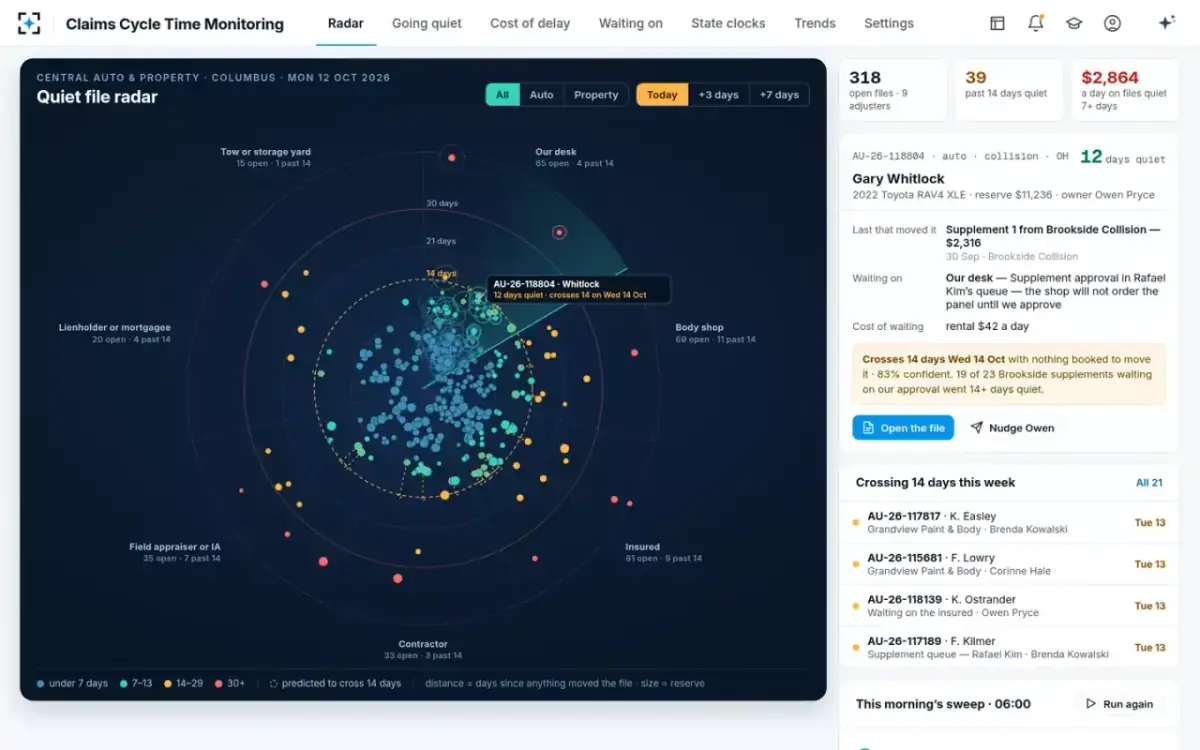
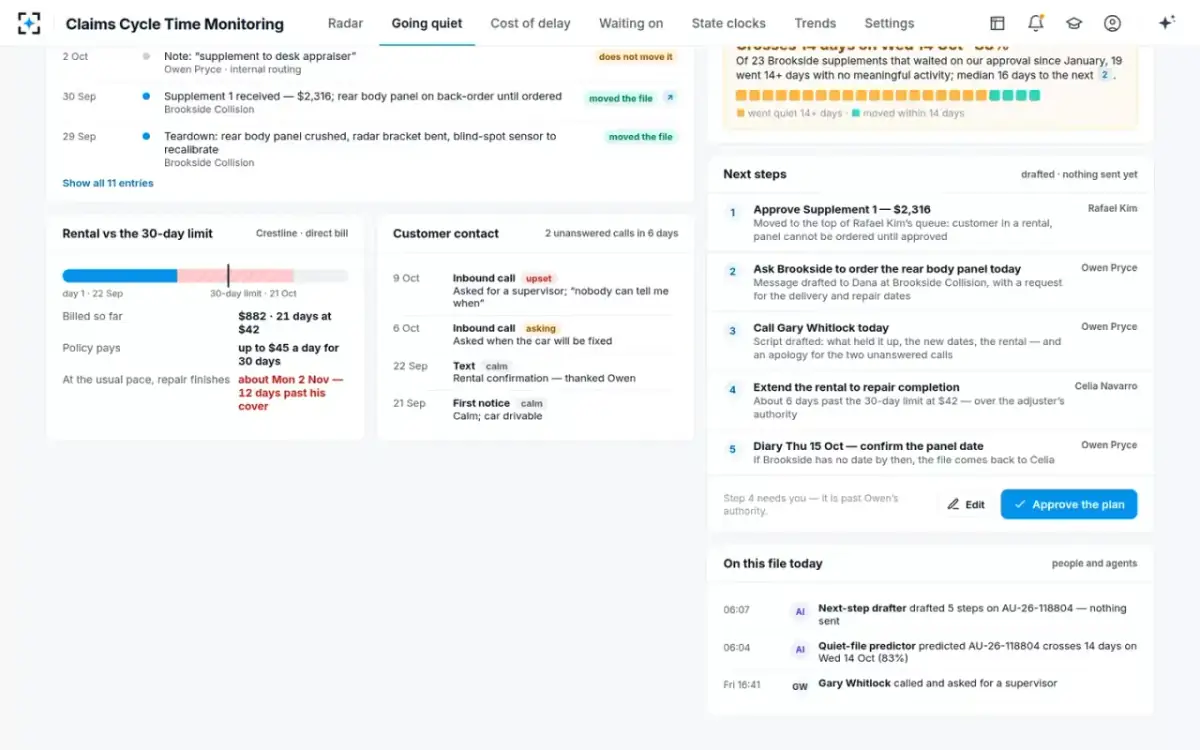
One file stands out. Gary Whitlock's 2022 Toyota RAV4, rear-ended near Hilliard, has been quiet for 12 days. The diary says it is waiting on the body shop; the solution has followed the chain and found the shop waiting on the carrier, because the shop's $2,316 supplement sits 17th of 41 in the desk appraiser's queue. Gary has called twice and asked for a supervisor. His rental is on day 21 of the 30 his policy pays for.
The drafted plan has five steps: the desk appraiser approves the supplement, the adjuster asks the shop to order the panel and calls Gary with a date and an apology, the supervisor extends the rental, and a diary date follows on Thursday. Step four is flagged because extending a rental past the policy days is beyond the adjuster's authority. Celia approves at 09:12; each step then lands on the file with the name of the person who did it.
A drafted plan, with the step that needs the supervisor flagged
How many files does a claims supervisor oversee?
There is no published standard, and the number depends on line, complexity and how many adjusters report to the supervisor. We found no government or regulator source that sets or surveys supervisory spans in property and auto claims. In the fictional sample, one supervisor oversees 318 open files through nine adjusters, about 35 each, with the senior auto adjuster carrying 46 and a desk appraiser handling supplements for three teams.
The more useful number is how many of those files need the supervisor this week. In the sample it is a few dozen: files past 14 quiet days, the steps that exceed an adjuster's authority, and the customers who have asked for a supervisor. A supervisor can judge 30 files a day; nobody can read 318 every morning to find them.
One sample morning, by what needs a supervisor
318
open files on the team
39
past 14 days with nothing moving them
21
will cross 14 quiet days this week
7
rentals already past their policy limits
The people a supervisor waits on, and who waits on the supervisor
A supervisor sits in the middle of the team's waiting: adjusters wait on the supervisor's approvals, and the supervisor waits on adjusters, the desk appraiser and outside parties to move the files that are stuck. In the sample, each of the five people around a quiet file sees the same morning differently.
Five people around one team’s open files, before and after the morning list
Today
Finds quiet files in the 30-day review or in a complaint.
With agents
Opens the radar before the huddle and approves rentals and supplements past authority from a drafted plan.
Still theirs: Every decision past an adjuster’s authority.
Today
Leaves the shop two voicemails, which in the system looks like work.
With agents
Gets one next step for each file three days before it crosses 14 quiet days, and sends it himself.
Still theirs: Every message to a customer, shop or lender.
Today
Works supplements largest first, blind to which ones have a customer in a rental.
With agents
Sees which supplements have a rental running, with the file behind each.
Still theirs: Approval of every supplement.
Today
Asks for the trend by team and proof it is real.
With agents
Reads files past 30 quiet days, days to close and rental days per claim weekly.
Still theirs: The rules: what counts as progress, the rings and the alerts.
Today
Reads complaints that each began as a file quiet for two weeks.
With agents
Is told when a file reaches 30 quiet days or a second call goes unanswered.
Still theirs: Escalations and regulator complaints.
Property claims supervisor or auto: different waits, the same clocks
A property claims supervisor waits on different parties from an auto supervisor, but answers to the same state rules. Auto files wait on body shops, supplements, lienholders and rental companies; property files on restoration contractors' moisture logs, independent adjusters' reports, mortgage servicers' endorsements and hotels. In the sample, six families in hotels cost $1,025 a day, close to the $1,234 a day of 29 rental cars, so a handful of property files can carry as much daily cost as a large share of the auto book.
Some states now put specific property deadlines on the desk. Washington's amended rule, in force since 18 October 2026, makes it an unfair practice to fail to approve a first-party claimant's scope of mitigation, or provide an approved scope, within five business days of receiving it (WAC 284-30-330(20), as amended). A property supervisor in Washington now has a five-day clock on a document that used to wait in a queue.
What regulators expect a supervisor to catch
Regulators judge a team by its files and its complaints, and both trace back to quiet files. Washington's commissioner gave an increase in consumer complaints and Insurance Fair Conduct Act notices as a reason for the 2026 rule: signals "which indicate a consumer's dissatisfaction with the claims handling process and the intent to sue their insurer." A supervisor who sees a second unanswered call is seeing the first step towards one.
"I don’t need to know which files are old. I need to know which ones nobody is pushing."
Celia Navarro, supervisor on the fictional sample team
That distinction is the supervisor's whole case for a different list. How a quiet file becomes a regulator complaint, link by link, is traced in how a quiet file reaches the department of insurance. For a total loss desk, where the roles differ again, see the total loss desk, seat by seat.
Questions people ask
What is a claims supervisor job description?
A claims supervisor leads a team of adjusters, reviews their files, approves payments and decisions above their authority, handles escalations and answers for the team's cycle time, quality and compliance. O*NET lists supervising adjusters "to ensure that adjusters have followed proper methods" among the tasks of the claims occupation.
What are a claims supervisor's responsibilities?
Authority approvals, file review, deadlines under state claims rules, customer and regulator escalations, assignment, and reporting and coaching. Each leaves a record an examiner or auditor can inspect, from approval entries to dated status letters.
What does a property claims supervisor do differently?
The same job, with different parties to wait on: restoration contractors, independent adjusters, mortgage servicers and hotels for families out of their homes. In Washington, since 18 October 2026, a property desk must approve a claimant's mitigation scope within five business days of receiving it.
How many files does a claims supervisor oversee?
No public standard exists. In the fictional sample in this guide, one supervisor oversees 318 open files through nine adjusters, of which 39 were past 14 days quiet on the morning described.
What is a 30-day file review?
A practice of reviewing every open file on a fixed 30-day cycle for quality and progress. It finds stuck files in calendar order rather than by urgency, and it runs at about the same frequency as the status letters it should catch, which is why a daily list of quiet files catches them sooner.